For adults aiming to gain practical speaking and workplace Mandarin, small group classes of roughly three to six learners usually deliver faster speaking practice and higher confidence than larger groups. Bigger classes still have a place, especially for exposure and peer learning, but only when the school actively builds in breakout work and structured speaking turns. If you’re choosing between formats, sit in on a trial class and ask directly how much talk time each student gets.
TL;DR:
- Small classes of three to six learners produce nearly three times more individual speaking time per session than larger classes, boosting feedback and confidence.
- Larger classes often lead to delayed feedback and uneven pacing, which can hinder progress unless instructors deliberately implement structured breakout work and speaking turns.
- Online breakout rooms and fixed sub-groups of four to five enhance participation more effectively than whole-class discussions, especially in bigger cohorts.
- Asking about typical talk time, breakouts, and personalized feedback during a trial class helps determine if the course format aligns with your speaking improvement goals.
- Progress in small classes tends to be steady and measurable through increased output, while larger classes often show uneven advances across participants.
Table of Contents
- How Group Class Size Effects Change Speaking Practice
- How Class Size Shapes Feedback, Pacing, and Progress Tracking
- Small Vs Large Classes: Online and In-Person Trade-Offs
- A Checklist for Choosing the Right Class Size
- An Instructor’s View on Realistic Progress Expectations
- Why Linda Mandarin’s Group and Zoom Formats Match This Checklist
- Sources
- FAQ
How Group Class Size Effects Change Speaking Practice
The clearest way class size effects show up isn’t in a syllabus. It’s in the stopwatch. Researchers who tracked actual classroom talk time found a stark gap: students in a small class averaged 15.37 minutes of individual talk time, compared to just 5.37 minutes in a large class studying communication and turns of talk. That’s nearly triple the speaking opportunity, in the same class period.
More talk time isn’t just a nice extra. It’s the mechanism behind everything adult learners actually want from a Mandarin course.
- More chances to get corrected mid-sentence, while the mistake is still fresh
- More repetitions of tones and sentence patterns under real conversational pressure
- More moments where a hesitant speaker gets pushed to finish a thought instead of shrinking back
A separate study of Iranian EFL learners backs this up from a different angle. It found class size had a statistically significant effect on willingness to communicate, with smaller classes producing both higher willingness-to-communicate scores and more turns of talk. That distinction matters for adults specifically, because workplace hesitation in Mandarin usually isn’t a vocabulary problem. It’s a confidence problem built over months of not speaking enough.
None of this means large classes are automatically weak. A skilled instructor running interactive, pair-based tasks in a class of twelve can still generate meaningful talk time. But the research is consistent: without deliberate structure, size alone tends to suppress participation, not enhance it.
How Class Size Shapes Feedback, Pacing, and Progress Tracking
Smaller classes don’t just create more talk time. They change how closely an instructor can track a learner’s actual progress. A study comparing reduced-size adult foreign language classes (five to six students) against standard classes (nine to ten) found the smaller groups showed measurable pronunciation and communicative gains by the course midpoint, and higher final proficiency across reading, listening, and speaking.
Large classes run into predictable friction points:
- Feedback arrives days later, if it arrives individually at all
- Pacing gets set to the middle of the group, leaving faster learners bored and slower ones lost
- The instructor’s attention gets split so thin that quiet students can go entire sessions unnoticed
Good instructors compensate for this instead of accepting it. Rotating attention deliberately across the room, using clear rubrics so learners can self-correct between sessions, and running short one-on-one check-ins even inside a group format all help close the gap. Peer review protocols, where learners critique each other’s tones and phrasing before the teacher weighs in, also stretch a single instructor’s bandwidth further without sacrificing quality.
Pro Tip: Ask a prospective school how often the instructor does one-on-one “mini-conferences” during group class time. If the answer is “never,” pacing will default to the group average, not your actual level.
Small Vs Large Classes: Online and In-Person Trade-Offs
Format matters almost as much as headcount. Research on synchronous online chatrooms found that groups capped around four students produced far more even participation than larger face-to-face groups, largely because there’s simply nowhere to hide in a four-person breakout.
That same evening-out effect shows up in online discussion research more broadly. Small-group formats generated roughly 21% more high-quality interaction, such as negotiating meaning or elaborating on a point, than whole-class discussion formats.
Three tactics consistently rescue larger cohorts, online or in person:
- Break the full class into fixed sub-groups of four to five for speaking drills, then rotate
- Assign speaking order explicitly, so turns don’t default to the most confident three people
- Use peer facilitators inside each sub-group to keep momentum when the instructor is elsewhere
Zoom classes actually make sub-grouping easier, since breakout rooms enforce the split automatically. In-person classes require more physical rearranging, but the payoff, more even airtime, is the same either way.
A Checklist for Choosing the Right Class Size
Before you enroll anywhere, get clear on what you’re optimizing for. Speed toward workplace fluency and comfortable small talk are different goals, and they point to different class sizes.
Start with your priorities:
- Is your main goal rapid speaking improvement, or broad language exposure on a budget?
- How much discomfort can you tolerate speaking in front of strangers early on?
- Do you need business vocabulary, negotiation phrasing, or roleplay practice specifically?
Then ask the school these questions directly, before paying:
- What’s the typical talk time per student in a session?
- What’s the maximum class size, and does it flex during the term?
- Are breakout groups or paired practice used regularly, or only occasionally?
- How often does the instructor give individual, corrective feedback rather than group feedback?
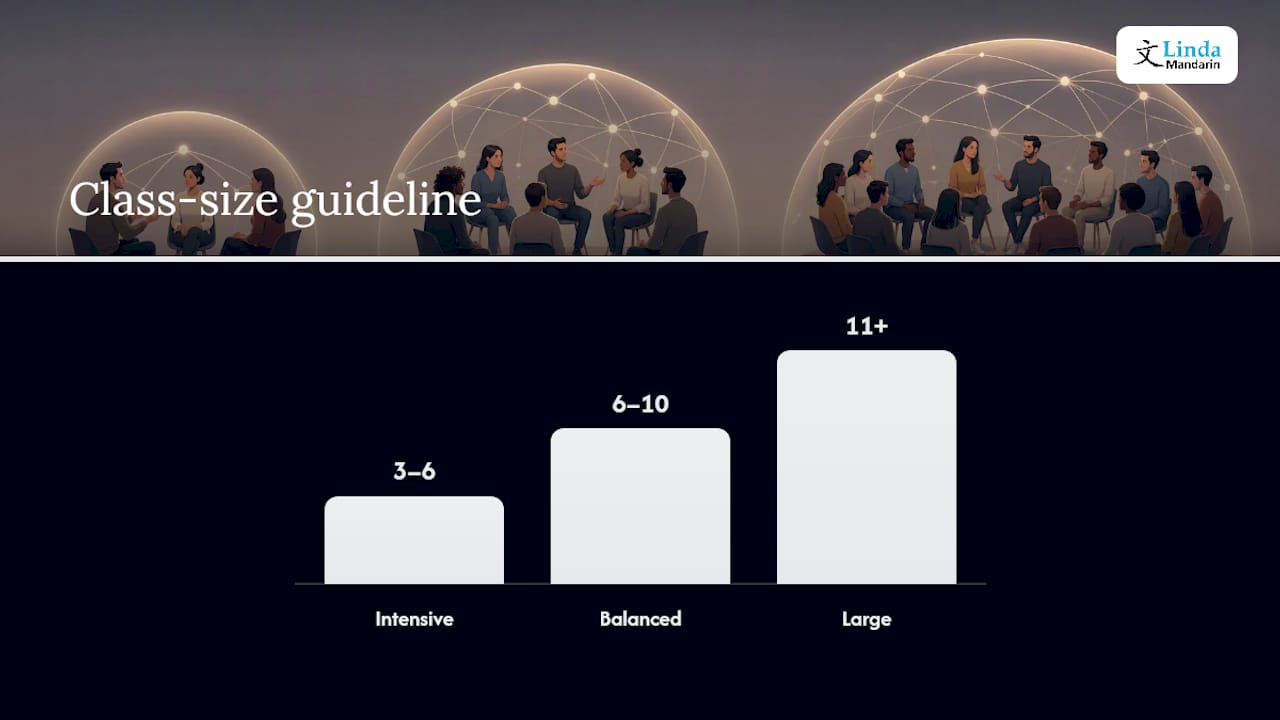
As a rule of thumb: three to six learners suits intensive speaking goals, six to ten works for balanced practice with reasonable cost, and eleven or more only makes sense if the school runs structured breakouts and assigns speaking turns deliberately, rather than leaving airtime to whoever speaks up first.
Pro Tip: If a school can’t tell you its typical breakout group size within a group class, that’s usually a sign breakouts aren’t a real part of the format, just a slide in the sales pitch.
An Instructor’s View on Realistic Progress Expectations
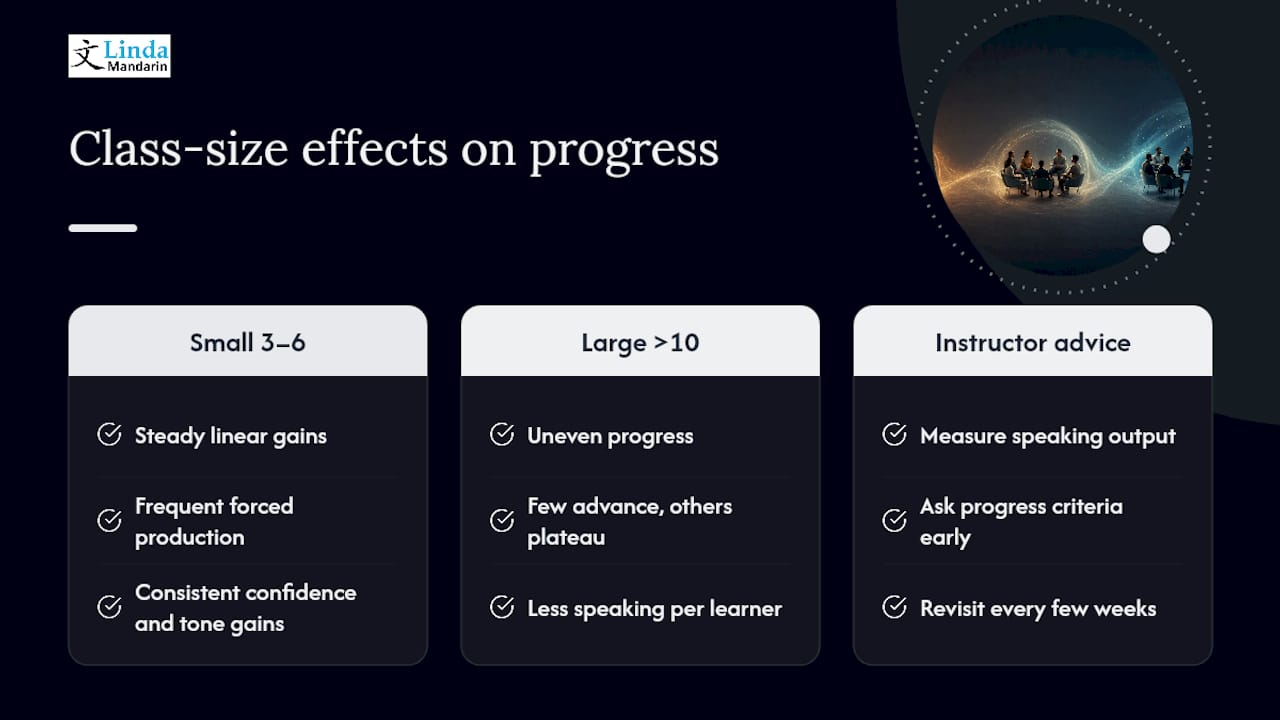
Progress in a three to six person class tends to look linear: steady gains in confidence and tone accuracy almost every session, because every student is forced to produce language repeatedly. In classes above ten, progress looks more uneven. A few learners advance quickly while others plateau, usually because they simply spoke less.
Adult learners should measure progress by speaking output, not just comprehension. If you can follow a lesson but rarely produce full sentences unprompted, the group is too large for your current goals, regardless of how good the syllabus looks on paper. Set the expectation early: ask what “progress” will actually be measured against, and revisit it every few weeks.
— Paul
Why Linda Mandarin’s Group and Zoom Formats Match This Checklist
Linda Mandarin has run adult-focused Mandarin training since 2003 from its center at 10 Anson Road, Level 22, International Plaza, Singapore, right above Tanjong Pagar MRT. Its programs run on a syllabus built for conversational and business communication, taught by native Mandarin instructors fluent in English.

If you’re an adult who tested well against the checklist above and wants rapid speaking gains, a small group format built around real talk time and instructor feedback fits best. If your schedule is tighter or you’re spread across time zones, the Zoom Mandarin classes use breakout structuring to keep participation even, rather than letting a screen full of muted faces replace actual speaking. Professionals building workplace vocabulary specifically should look at the Business Chinese course, which leans on roleplay and negotiation practice rather than generic vocabulary drills.
The most reliable way to test any of this is to sit in on one session. Book a Chinese trial class and ask, directly, how many minutes of speaking time you’ll get and how breakouts are structured. If the answers match what this article laid out, you’ve likely found the right fit.
Sources
- Study on class size and communication (talk-time and turns of talk)
- Willingness to Communicate in Iranian EFL Learners: The Effect of Class Size
- Study of class size reduction effects in adult foreign language classrooms (Arabic, Chinese, Korean)
FAQ
What is the ideal group size for adult Mandarin classes?
Three to six learners tends to produce the fastest speaking gains, based on talk-time research, while six to ten works well for learners balancing cost and practice.
Does class size really affect language learning outcomes?
Yes. Studies measuring actual classroom talk time found students in small classes spoke nearly three times longer per session than students in large classes, which translates directly into more feedback and practice.
Is private tutoring better than group Mandarin classes?
Private lessons maximize individual talk time, but small group classes of three to six still offer strong speaking practice plus peer interaction, often at a lower cost per session.
Can a large Mandarin class still work for beginners?
Large classes can work if the instructor consistently uses breakout groups and assigns speaking turns; without that structure, participation tends to concentrate among a few confident students.
How do I check class size fit before enrolling?
Ask directly about typical talk time per student, maximum class size, and how often breakouts are used, then confirm this during a trial class before committing.