TL;DR:
- Spaced repetition, contextual practice, and focusing on high-frequency words are essential for improving Chinese vocabulary. Adults need a system that combines tools like Anki, graded readers, and AI conversation practice for effective learning and retention. Active recall through sentence writing and linking new words to familiar roots strengthens long-term mastery.
Improving Chinese vocabulary is most efficiently achieved through spaced repetition, contextual sentence practice, and prioritizing high-frequency words from structured resources. Adults learning Mandarin for conversational fluency, academic goals, or professional advancement in fields like business or diplomacy need more than a word list. They need a system. Tools like Anki, graded readers, and AI conversation partners, combined with consistent daily practice, form the backbone of every effective vocabulary-building approach. This guide breaks down exactly how to improve Chinese vocabulary at every stage, from your first 100 words to advanced business Mandarin.
How to improve Chinese vocabulary: foundations and tools

The single most important decision a new Mandarin learner makes is what to learn first. High-frequency vocabulary, the words that appear most often in everyday speech and writing, delivers the fastest return on your study time. Rare or specialized words can wait.
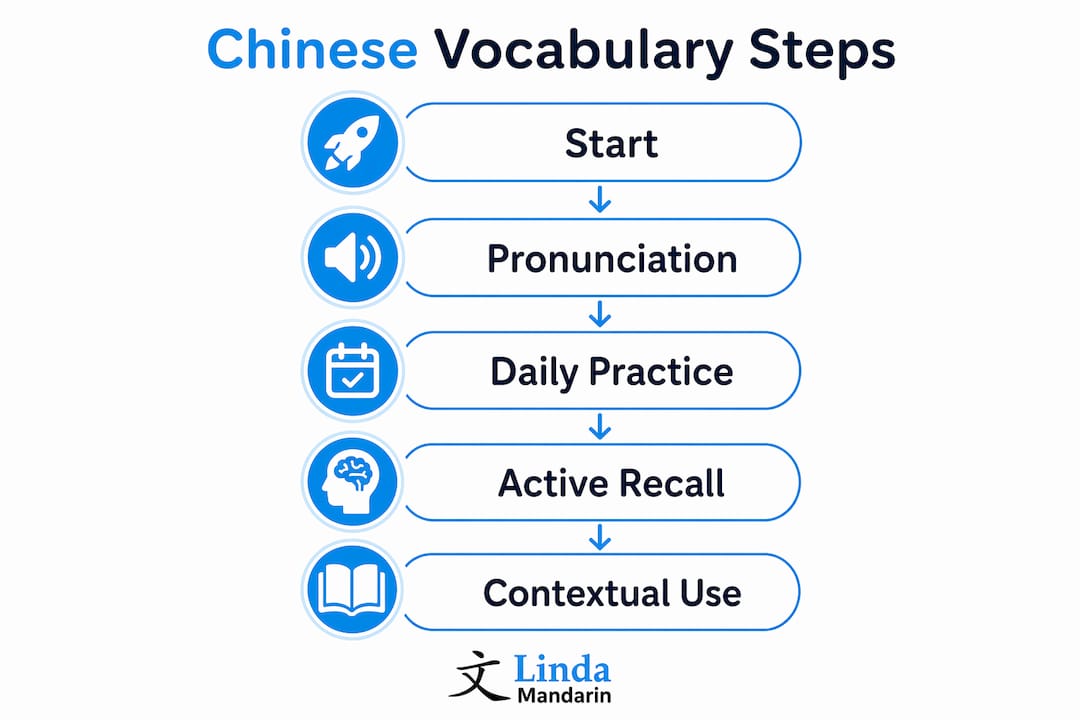
Before building your word bank, you need a pronunciation foundation. Pinyin, the romanized system for Mandarin sounds, must be learned alongside the four tones from day one. Skipping tone correction early creates pronunciation habits that are extremely difficult to fix later. Tutors and AI tools alike confirm that tone practice is non-negotiable from week one.
For pacing, beginners should target 10–15 new words daily, focusing on speaking and listening in the first four months before shifting to intensive character study. That pace is manageable and sustainable. Trying to memorize 50 words a day without review produces the illusion of progress, not actual retention.
The table below compares the core tools adult learners use to build their Chinese word bank.
| Tool | Primary purpose | Best for |
|---|---|---|
| Anki | Spaced repetition flashcard review | Daily vocabulary retention |
| Graded readers | Contextual reading at your level | Reinforcing known words naturally |
| AI conversation tools | Speaking and listening practice | Active output and tone feedback |
| High-frequency word lists | Vocabulary prioritization | Beginners and intermediate learners |
| Clozemaster | Fill-in-the-blank sentence practice | Contextual vocabulary drilling |
Anki uses a spaced repetition algorithm that shows you a word right before you are likely to forget it. That timing is what separates Anki from a paper flashcard deck. Graded readers, meanwhile, expose you to familiar words in natural sentence structures, which reinforces retention without the burnout that comes from reading native materials too early.
How can active recall and contextual learning maximize retention?
Passive review is the most common mistake adult Mandarin learners make. Reading a word, recognizing it, and moving on feels productive. It is not. Vocabulary learned in isolation has poor retention because the brain has no meaningful context to attach it to. Linguists call this “context starvation,” and it is a genuine barrier to long-term memory.
Active recall flips the process. Instead of asking “Do I recognize this word?”, you ask “Can I produce this word from memory?” The difference in retention is significant. Active output such as sentence writing and conversation practice enhances recall and builds true understanding of how a word functions in real speech.
The most effective technique for contextual learning is the sentence-paragraph-essay method:
- Sentence level: Write one original sentence using the new word. This forces you to think about grammar and meaning simultaneously.
- Paragraph level: Expand that sentence into a short paragraph of 3–5 sentences. You revisit the word in a slightly different context.
- Essay level: Use the word naturally in a longer piece of writing. At this stage, the word moves from short-term recognition to long-term mastery.
Research confirms that this progressive writing approach forces deeper cognitive processing and produces durable vocabulary retention. It works because your brain must retrieve, use, and contextualize the word rather than simply recognize it.
Pro Tip: Combine Anki flashcard review in the morning with a 10-minute AI conversation session in the evening. The flashcard session loads the words into short-term memory. The conversation session forces you to retrieve and use them under mild pressure, which is exactly the condition that builds long-term retention.
For daily improvement strategies, mixing written and spoken output every day produces faster results than either method alone.
What strategies help learners expand their Chinese vocabulary beyond beginner level?
Once you have a working vocabulary of 500–800 words, the most effective next step is semantic networking. This means linking new words to words you already know through shared character roots or related meanings. The character 电 (electricity) appears in 电话 (telephone), 电脑 (computer), 电视 (television), and 电影 (movie). Learning through character roots like this means one familiar character unlocks a cluster of related words at once.
Organizing your vocabulary by theme and frequency also accelerates growth. Instead of learning random words, group them by topic: workplace communication, food and dining, travel, or finance. This mirrors how native speakers store and retrieve language, and it makes your vocabulary immediately usable in real conversations.
Here is a ranked approach for expanding your Chinese word bank efficiently:
- Audit your current vocabulary. Identify gaps by topic or frequency tier. Most learners have strong vocabulary in one domain and weak vocabulary in others.
- Add graded readers to your weekly routine. Graded readers repeat high-frequency vocabulary in natural contexts, bridging the gap between textbook study and native materials without overwhelming you.
- Update your Anki decks monthly. Remove words you know cold and add words from your current reading or conversation practice. Stale decks waste review time.
- Practice with a speaking partner or tutor weekly. Vocabulary you can read but cannot speak is only half-learned. Oral production cements the word.
- Track vocabulary by part of speech. Many learners over-index on nouns and neglect verbs, adjectives, and connective phrases. A balanced word bank produces more natural speech.
Pro Tip: When you encounter an unfamiliar word in a graded reader, do not look it up immediately. Try to infer the meaning from context first. This inference process strengthens your reading comprehension and makes the word more memorable when you do confirm its meaning.
The table below shows the difference between two common vocabulary-building approaches at the intermediate level.
| Approach | Strength | Weakness |
|---|---|---|
| Random word memorization | Fast initial exposure | Low retention, no context |
| Semantic networking by character root | High retention, efficient expansion | Requires foundational character knowledge |
For a structured look at ways to expand your vocabulary in Mandarin, combining thematic grouping with character-root learning consistently outperforms random memorization.
How to overcome common obstacles in Chinese vocabulary learning
The most damaging habit in Mandarin vocabulary study is reviewing words passively every day without ever using them in speech or writing. Recognition and production are different cognitive skills. You can recognize 2,000 words and still struggle to hold a five-minute conversation. Switching to active models involving speaking and writing after studying new words is the fix.
Other common obstacles include:
- Ignoring tones during vocabulary review. A word reviewed without its correct tone is a word half-learned. Mandarin has four tones plus a neutral tone, and the wrong tone changes the meaning entirely. Always practice pronunciation alongside meaning.
- Studying characters before building spoken vocabulary. Characters are important, but adult learners who prioritize character writing before they can speak the word often plateau early. Spoken fluency and character recognition should develop in parallel, not in sequence.
- Skipping review of previously learned words. New words feel exciting. Old words feel boring. But vocabulary blitz phases of 20–30 new words daily require accompanying active recall to prevent passive recognition from replacing genuine mastery.
- Avoiding feedback. Many adult learners practice alone to avoid embarrassment. Tutor feedback and community correction are the fastest ways to catch pronunciation errors and vocabulary misuse before they become habits.
For a detailed breakdown of common Mandarin learning mistakes, addressing these issues early saves months of remedial work later.
Balancing vocabulary study with listening practice is also critical. Hearing words in natural speech trains your ear to recognize them at native speed, which is a completely different skill from reading them on a flashcard. Podcasts, short video content, and structured listening exercises all serve this purpose.
Key Takeaways
Consistent, contextual vocabulary practice with active recall is the most reliable method to build lasting Mandarin fluency for adult learners.
| Point | Details |
|---|---|
| Start with high-frequency words | Prioritize the words that appear most often in speech before studying rare or specialized vocabulary. |
| Use spaced repetition daily | Tools like Anki time your reviews to prevent forgetting and reduce wasted study time. |
| Practice active output | Write sentences and speak new words aloud. Recognition alone does not produce fluency. |
| Apply semantic networking | Link new words to familiar character roots to expand your word bank faster at intermediate level. |
| Fix tone errors early | Tone mistakes that go uncorrected become permanent habits. Get feedback from a tutor or AI tool from week one. |
What I have learned about building a Mandarin vocabulary that actually sticks
After years of working with adult Mandarin learners, the pattern I see most often is this: learners who study intensively for two weeks and then burn out make far less progress than learners who study 30–45 minutes every single day. Consistency beats intensity every time in language acquisition. Achieving conversational Mandarin takes 12–18 months of daily focused practice. That timeline is not discouraging. It is clarifying. It tells you exactly what commitment the goal requires.
The advice I give most often is to stop treating vocabulary study as a separate activity. The learners who grow fastest are the ones who use new words the same day they learn them. They write a text message, practice a sentence with a tutor, or describe something in their environment using the new word. That immediate application is what moves a word from your Anki deck into your actual speech.
Technology has made this easier than ever. AI conversation tools give you a low-stakes environment to practice speaking without the fear of embarrassing yourself in front of a native speaker. Use them. But do not let them replace human feedback entirely. A good tutor catches the errors that AI tools miss, particularly in tone and natural phrasing. The combination of structured technology practice and regular human correction is, in my experience, the fastest path to a vocabulary that works in real life.
— Paul
Structured Mandarin learning at Linda Mandarin
Adults who want to build their Chinese vocabulary with professional guidance have a clear option in Singapore. Linda Mandarin has been delivering Mandarin training for adults since 2003, with courses covering conversational Mandarin, business communication, and corporate training programs.

Classes are available in person at 10 Anson Road, level 22, International Plaza, right above Tanjong Pagar MRT, as well as through online Zoom sessions for learners who prefer flexible scheduling. Whether your goal is workplace communication or personal enrichment, Linda Mandarin’s adult Mandarin programs are structured to build vocabulary progressively and practically. For professionals, the corporate Mandarin training program delivers targeted vocabulary and communication skills directly relevant to business contexts.
FAQ
How many new Chinese words should I learn per day?
Beginners should target 10–15 new words daily, focusing on high-frequency vocabulary. Intermediate learners can scale up to 20–30 words during intensive study phases, provided they pair new words with active recall practice.
What is the best tool for memorizing Chinese words?
Anki is the most widely recommended tool for Chinese vocabulary retention because it uses spaced repetition to time reviews at the moment before you forget a word. Pair it with graded readers and AI conversation practice for full coverage.
Does learning Chinese characters help with vocabulary?
Yes, but spoken vocabulary should come first for adult learners. Once you can say and understand a word, learning its character deepens your understanding. Semantic networking through shared character roots also accelerates vocabulary expansion at the intermediate level.
How long does it take to reach conversational Mandarin?
Conversational fluency typically requires 12–18 months of daily practice at 45–60 minutes per session, with a focus on high-frequency vocabulary and consistent speaking practice from the start.
Why do I keep forgetting Chinese words I have already studied?
Forgetting happens when vocabulary is reviewed passively without active output. Writing sentences, speaking with a partner, and using new words the same day you learn them all significantly improve long-term retention.