HSK 2.0 tops out at about five thousand cumulative words across six levels. HSK 3.0, the new nine-level standard, specifies roughly eleven thousand words according to the official 2021 grading standard, though several public compilations put the practical total anywhere from 10,896 to 11,495 depending on how compound words and variants get counted. Both systems build cumulatively, meaning each level’s list includes everything from the levels below it.
For anyone registering for a 2026 test, the short answer is this: check which syllabus your test center uses before you build a study plan around either number.
- HSK 2.0: 6 levels, cumulative totals from 150 to about five thousand words
- HSK 3.0: 9 levels (levels 7–9 share a combined advanced band), roughly approximately eleven thousand words total
- Cumulative means each level’s count already includes every word from the level before it
- If your registration form still lists HSK 1–6, plan around HSK 2.0 counts; if it lists HSK 1–9 or references the 2021 standard, plan around HSK 3.0
Key Takeaways
HSK 3.0 expands total vocabulary to roughly approximately eleven thousand words across nine levels, more than double HSK 2.0’s about five thousand-word, six-level scope, with most of that growth concentrated in the combined advanced band.
| Point | Details |
|---|---|
| Two systems, different scale | HSK 2.0 tops out at about five thousand cumulative words across 6 levels; HSK 3.0 specifies roughly approximately eleven thousand across 9 levels. |
| Advanced band absorbs most growth | Levels 7 to 9 under HSK 3.0 add more than five thousand new words alone, more than half the entire standard. |
| Totals vary by compiler | Public sources report HSK 3.0 totals between 10,896 and 11,495 depending on how compounds and variants are counted. |
| Verify your syllabus version | A November 2025 revision adjusted per-level lists, so confirm which version your test center uses before studying. |
| Structured courses track level targets | Com’s adult courses align to progressive HSK-mapped levels across in-person and online Zoom formats. |
Table of Contents
- HSK Vocabulary Levels Compared: 2.0 vs 3.0 at a Glance
- HSK 2.0 Vocabulary by Level: Cumulative Totals
- HSK 3.0 Vocabulary by Level: New Standard for 2026
- What Changed Between HSK 2.0 and HSK 3.0, and Why It Matters
- How to Turn These Counts Into a Study Plan
- Where to Find Official HSK Vocabulary Lists and PDFs
- How HSK Word Lists Actually Count Vocabulary
- Is HSK 3.0 Actually Harder Than HSK 2.0?
- What the Vocabulary Changes Mean for CEFR Comparisons
- Vocabulary Strategies Suited to Each HSK Level Band
- Where to Find Supplementary Materials for the New Counts
- Sources
- FAQ
HSK Vocabulary Levels Compared: 2.0 vs 3.0 at a Glance
The two systems aren’t just different sizes. They’re structured on different logic entirely, and that changes how you should study.
| Dimension | HSK 2.0 | HSK 3.0 |
|---|---|---|
| Total vocabulary | about five thousand words | approximately eleven thousand words |
| Number of levels | 6 | 9 (7–9 combined into one advanced band) |
| Words per level | 150 to 2,500 new words | 500 to more than five thousand new words (advanced band) |
| Cumulative by top level | about five thousand | approximately eleven thousand |
| Characters specified | Not formally specified | Up to 3,000 characters |
| Exam format | Written and oral sections vary by level | Adds explicit grammar-point targets per level |
| Effective date | Long-standing legacy standard | GF0025-2021 standard, with revised syllabus lists published November 2025 for 2026 testing |
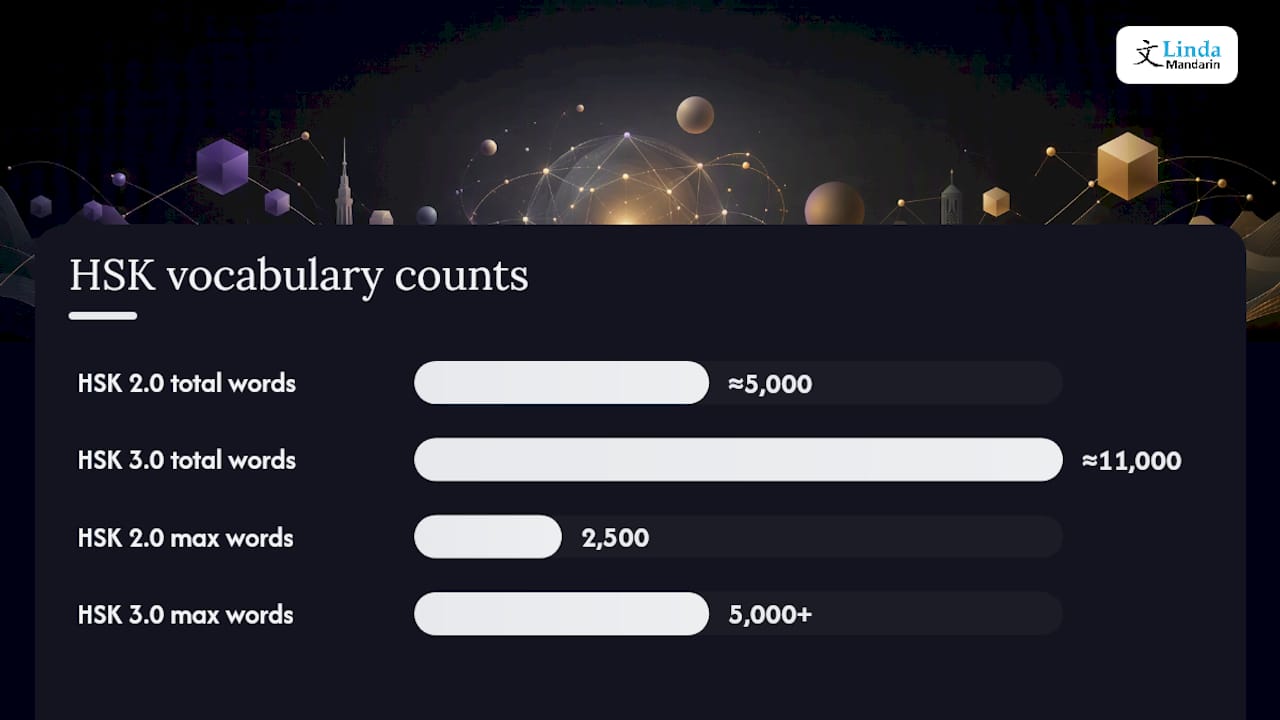
The core numbers to remember: HSK 2.0 caps at about five thousand words across six levels; HSK 3.0 nearly doubles that scope at roughly approximately eleven thousand words across nine levels, and it’s the first version to also specify character and grammar targets per level.
A word of caution on that HSK 3.0 figure: it moves depending on the source. HSKStory’s compilation lands closer to 10,896 words, while other tools push past 11,495. The gap comes down to counting method, not disagreement about content, and MandarinBean’s rounded figure of about 11,000 words sits comfortably in the middle.
HSK 2.0 Vocabulary by Level: Cumulative Totals
If your test still registers under the old six-level system, these are the numbers you’re working toward. HSK 2.0 is strictly cumulative, so passing HSK 3 means you’re also responsible for everything on the HSK 1 and 2 lists.
These figures still matter because plenty of institutions, older prep books, and some regional test centers reference them directly. If you’re unsure which version applies to your exam date, the registration portal listed for your test center will specify HSK 1–6 (old) or HSK 1–9 (new) explicitly, so check that before buying study materials built for the wrong system.
HSK 3.0 Vocabulary by Level: New Standard for 2026
The new standard doesn’t just add more words. It adds a second and third dimension, specifying characters and grammar points alongside vocabulary, so you can track three kinds of progress instead of one.
That last row does most of the heavy lifting: more than half of the total HSK 3.0 vocabulary sits in the combined levels 7 through 9 band alone. Levels 7, 8, and 9 aren’t tested separately the way HSK 1 through 6 are. They’re graded as one advanced tier, which means a learner aiming for “HSK 7” is really studying toward a shared pool of over 5,600 additional words and up to 3,000 characters.
Version matters here too. The base standard is GF0025-2021, but a revised syllabus published in November 2025 adjusted some per-level lists ahead of 2026 rollout. If you downloaded a word list before that revision, cross-check it against your test center’s current syllabus notice.
What Changed Between HSK 2.0 and HSK 3.0, and Why It Matters
The redistribution isn’t even. Beginner levels under HSK 3.0 actually ask for more words upfront (500 at level 1, versus 150 under HSK 2.0), while the real explosion happens at the top. HSK 2.0 was already back-loaded: roughly half of its total vocabulary concentrated in levels 5 and 6 alone, which is exactly why so many learners describe the jump from HSK 4 to HSK 6 as brutal. HSK 3.0 keeps that same pattern, just at a larger scale, with the 7–9 band absorbing more than five thousand new words in one combined tier.
Mapping the two systems isn’t exact, but as a planning guide:
- HSK 2.0 Level 3 roughly lines up with HSK 3.0 Level 3 in scope, though word selection differs
- HSK 2.0 Level 4 sits closer to HSK 3.0 Level 4–5 territory given the added vocabulary
- HSK 2.0 Level 6 (about five thousand words total) lands somewhere inside the HSK 3.0 Level 6 to early 7–9 band
- Treat any mapping as approximate. Neither system was designed as a direct translation of the other
Exam format shifted too. HSK 3.0 introduces explicit grammar-point counts and character targets per level, categories the old system never formally tracked, which changes what “ready for HSK 4” actually means in practice.
Pro Tip: Start by mastering the words that overlap between both systems, especially the HSK 1 through HSK 3 core vocabulary. That shared foundation carries forward no matter which version your exam ultimately follows, so you never waste early study hours.
How to Turn These Counts Into a Study Plan
Raw totals are useless without a timeline attached to them. Once you know your target level, divide the new-word count for that level by the weeks you have left, not the cumulative total, since you likely already know some of the earlier list.
A 24-week plan aimed at HSK 3.0 Level 4 (1,000 new words on top of what came before) breaks down like this:
- Weeks 1 to 4: audit what you already know from lower levels using a placement check
- Weeks 5 to 16: learn 60 to 70 new words per week from the official Level 4 list, paired with matching grammar points
- Weeks 17 to 20: shift to spaced repetition review, cutting new-word intake in half
- Weeks 21 to 24: full practice tests under timed conditions, focusing on weak recall areas
Prioritize high-frequency function words and connector phrases first. They appear across reading passages far more often than technical vocabulary and unlock comprehension faster per word learned. Flashcard tools with spaced repetition timing work well here because they surface words right before you’d naturally forget them.
Pro Tip: Track your active recall rate weekly, meaning the percentage of flashcards you get right on the first try without hesitation. Speed without retention just means relearning the same list twice.
A structured study guide tied to specific levels can help you sequence this instead of guessing at weekly targets.
Where to Find Official HSK Vocabulary Lists and PDFs
Always verify your source’s publication date before trusting a downloaded list, since revisions have already happened once for the 2026 cycle.
- Official Chinese proficiency testing authorities publish the current syllabus and level-by-level word lists tied to the GF0025-2021 standard
- Registration portals note whether a given test date runs on the six-level or nine-level system, check this before choosing materials
- Independent compilations like Chinese Language Hub’s vocabulary tool and MandarinBean’s PDF list are useful cross-references, but treat the official syllabus as the deciding document for exam content
How HSK Word Lists Actually Count Vocabulary
A “word” on an HSK list isn’t always one dictionary entry. The count includes single characters that function as standalone words (like 好 or 人), multi-character compounds (like 图书馆, “library”), and in some cases set phrases treated as a single vocabulary unit. This is exactly why total counts vary between compilers: one tool might count 高兴 as one word, while a stricter breakdown separates related forms or counts a compound’s component characters separately when tallying the character total.
Grammar particles and measure words get folded into the word count too, even though they behave differently from content words like nouns or verbs. That inflates lower-level totals slightly, since beginner lists need a handful of grammatical function words to make any sentence work at all.
Variant forms, simplified versus traditional characters, and regional spelling differences add another layer of inconsistency. Most official materials for HSK 3.0 use simplified characters as the default, but a word that has a common colloquial variant might appear once in some compilations and twice (as separate entries) in others.
This is the practical reason the same “HSK 3.0 total” shows up as 10,896 in one guide and 11,495 in another. Neither number is wrong. They’re counting slightly different things. When precision matters, like confirming exactly what your exam covers, the registration portal’s own published list is the only version that counts for grading purposes.
Is HSK 3.0 Actually Harder Than HSK 2.0?
Word count alone makes HSK 3.0 look far more demanding, and at the top end, it is. But difficulty isn’t purely about volume. HSK 2.0’s beginner levels were arguably gentler, 150 words at Level 1 versus 500 under HSK 3.0, which means new HSK 3.0 test-takers face a steeper initial climb even before touching intermediate material.
Where the systems diverge most is complexity per word. HSK 2.0 never formally specified grammar points or character targets, so two learners could pass the same level having studied fairly different underlying skills. HSK 3.0 closes that gap by pairing vocabulary with explicit grammar and character benchmarks, which arguably makes preparation more predictable even as the raw numbers grow.
The advanced band compounds this. HSK 2.0’s Level 6 tops out at about five thousand words total. HSK 3.0’s combined Level 7–9 band alone adds more than five thousand new words on top of everything below it, pushing the ceiling to roughly eleven thousand. That’s not a modest step up, it’s a different order of magnitude at the advanced tier specifically, while beginner and intermediate bands feel more comparable in relative effort.
One useful data point: comprehension tends to jump disproportionately once a learner crosses roughly 500 to 1,000 known characters, which lines up closely with the HSK 3 to HSK 4 transition in both systems. That threshold, more than the total word count, often determines when reading starts to feel less like decoding and more like actual reading.
What the Vocabulary Changes Mean for CEFR Comparisons
HSK’s relationship to the Common European Framework of Reference has always been approximate rather than official, since the two frameworks were built for different language families and testing philosophies. Even so, HSK 2.0’s six levels were commonly discussed alongside CEFR bands from A1 through roughly C1, with HSK 6 treated as a rough ceiling near advanced proficiency.
HSK 3.0’s expansion to nine levels changes that comparison. With over 11,000 words split across nine tiers instead of six, the framework now has more room to distinguish between “advanced” and “near-native,” territory CEFR’s C1 and C2 bands were always meant to cover but that HSK 2.0’s flat top level couldn’t fully represent. In practice, this means a learner who finished HSK 6 under the old system and assumed they’d reached a C1 equivalent may find that HSK 3.0’s Level 6, sitting mid-scale rather than at the top, tells a more accurate story about how much runway remains before true advanced fluency.
If you’re mapping your own progress against CEFR for professional or academic purposes, treat the correspondence as directional rather than exact. A CEFR-to-HSK equivalency reference is useful for translating a target level into a conversation with employers or universities, but no official conversion table exists that both testing bodies endorse jointly. The safest approach is to describe your level using both systems side by side when it matters, rather than assuming a one-to-one swap.
Vocabulary Strategies Suited to Each HSK Level Band
The right acquisition method changes as the lists get longer, and treating every level the same way wastes time. Beginner bands (HSK 1 to 3, roughly 150 to 2,245 cumulative words depending on which system you’re using) respond well to pure repetition. Flashcards, simple sentence drills, and daily conversation practice build these words into automatic recall fast because the vocabulary itself is concrete and high frequency.

Intermediate bands (HSK 4 to 5) need a different approach. The vocabulary shifts toward abstract concepts, multi-character compounds, and words with overlapping meanings that are easy to confuse. Contextual learning matters more here than raw memorization, reading short articles, and noting how a word behaves in different sentences, rather than drilling it in isolation.
Advanced bands (HSK 6, and especially the combined HSK 7–9 tier under the new standard) demand a near-total shift in method. With over 5,600 words packed into that top band alone, pure memorization becomes inefficient. Immersion through native content, extended reading, and topic-specific vocabulary clusters (business, academic, technical) work better than generic word lists at this stage, because so much of the advanced vocabulary only makes sense inside a specific domain or register.
Across every band, spaced repetition software remains the most consistent tool for retention, but the input material should change. Feed it simple example sentences at the beginner level and full paragraphs or dialogue excerpts once you’re past HSK 4, where context does more work than the word alone.
Where to Find Supplementary Materials for the New Counts
Official word lists tell you what to learn, not how to learn it, which is where supplementary material earns its place. Publishers have been slower than test authorities to update materials for HSK 3.0’s expanded scope, so availability skews toward the lower and middle levels for now, with advanced-band (7–9) resources still catching up as the 2026 rollout matures.
Look for three types of supplementary support specifically. Graded readers matched to a target level give you comprehensible input without constant dictionary lookups. Audio-based listening drills matter more under HSK 3.0 than they did before, since the standard’s added grammar-point specifications tend to show up in listening sections. And vocabulary apps that let you filter by official level list, rather than generic frequency lists, save real time by keeping your flashcard deck aligned with what your exam actually covers.
Cross-reference any third-party material against the syllabus version your test uses before committing hours to it. A comparison of intermediate-level competency benchmarks from other language programs can be a useful outside reference for how graded proficiency bands generally work, even outside Mandarin specifically, if you want a sense of how other frameworks structure the same climb from intermediate to advanced fluency.
A Practical Note From an HSK Instructor
Learners consistently underestimate how much the HSK 3.0 advanced band changes the endgame. Six years of watching students hit HSK 4 confidently, then stall at the 7–9 transition, taught me the fix isn’t more vocabulary drilling. It’s sequencing: master the shared core between both systems first, then commit fully to whichever official list your test center confirms, rather than splitting effort across both.
How Linda Mandarin Helps You Study Toward Your HSK Target
Turning a vocabulary count into real fluency is a different challenge than memorizing a list, and that’s where structured instruction earns its keep. Com’s adult courses, delivered in-person at our center above Tanjong Pagar MRT or live over Zoom, are built around progressive levels aligned to international HSK standards, so you’re always working toward a defined, level-appropriate vocabulary target instead of studying blind.

Whether you’re preparing for a specific HSK level, building conversational fluency for daily life, or need business Mandarin for workplace communication, Com’s course levels map directly to where you are now and where you need to be. Professionals juggling client meetings in Mandarin often start with our corporate Chinese training, which layers business vocabulary onto the same structured progression. Reach out for a personalized study plan, and we’ll help you figure out exactly which level and format, group, private, or online, fits your target timeline.
Sources
- Complete HSK 3.0 Vocabulary List: All 9 Levels (2025) | HSKStory
- HSK 3.0 Vocabulary List 2025 — All Levels with Pinyin | Chinese Language Hub
- Appendix:HSK list of Mandarin words – Wiktionary
- New HSK Vocabulary (2026 | PDF Available) – MandarinBean
FAQ
How many vocabulary words are in each HSK level?
Under HSK 2.0, cumulative totals run 150, 300, 600, 1,200, 2,500, and about five thousand words for levels 1 through 6. Under HSK 3.0, they run roughly 500, 1,272, 2,245, 3,245, 4,316, and 5,456 for levels 1 through 6, with the combined 7–9 band adding over 5,600 more.
How many vocabulary words are in HSK 6?
HSK 2.0’s Level 6 totals about five thousand cumulative words, the ceiling of that six-level system. HSK 3.0’s Level 6 sits at roughly 5,456 cumulative words, but it’s no longer the top tier since the combined 7–9 band extends the total to about approximately eleven thousand.
What HSK level is 1,000 words?
Under HSK 2.0, 1,000 words falls between Level 3 (600 cumulative) and Level 4 (1,200 cumulative). Under HSK 3.0, roughly 1,000 words lands close to the end of Level 3, which reaches about 2,245 cumulative words once you include HSK 3.0’s larger beginner lists.
How many words are required to pass HSK Level 1?
HSK 2.0’s Level 1 specifies 150 words. HSK 3.0’s Level 1 specifies 500 words, a substantially larger beginner list under the new standard.
Which HSK system should I study for right now?
Check your test registration confirmation. If it references levels 1 through 6, prepare with HSK 2.0 counts; if it references levels 1 through 9 or the GF0025-2021 standard, prepare with HSK 3.0 figures. A level-mapped course can help you confirm which target applies to your goals.