TL;DR:
- Intensive Mandarin courses in Singapore offer focused, daily immersion with small class sizes to accelerate learning.
- They differ from standard classes by providing more contact hours, faster progress, and aligned curricula like HSK and CEFR.
- Suitable for professionals, relocators, and culture enthusiasts seeking practical fluency within a short timeframe.
Most adults in Singapore assume that reaching real Mandarin fluency takes years of slow, painful study. That assumption is wrong. Intensive Mandarin courses have quietly transformed how adults learn Chinese, compressing what used to take years into months through focused immersion, structured curricula, and daily practice. Whether you are a professional chasing a promotion, someone preparing to relocate to China, or simply eager to connect more deeply with Singapore’s Chinese-speaking community, this guide breaks down exactly how intensive Mandarin programs work, what sets them apart, and how to find the right fit for your goals.
Table of Contents
- What defines an intensive Mandarin course?
- How do intensive courses compare to standard Mandarin classes?
- Who benefits most from intensive Mandarin learning?
- Choosing the right intensive course for your goals
- Our perspective: The real key to rapid Mandarin mastery in Singapore
- Explore intensive Mandarin learning solutions in Singapore
- Frequently asked questions
Key Takeaways
| Point | Details |
|---|---|
| Immersion speeds progress | Daily sessions and small groups foster rapid conversational skills and confidence. |
| Flexible delivery options | Adults can choose intensive courses onsite, online, or hybrid to fit their schedule. |
| Alignment with global standards | HSK/CEFR curriculum ensures recognized outcomes for personal and professional growth. |
| Critical for career advancement | Intensive Mandarin is especially valuable for Singapore professionals needing certification fast. |
What defines an intensive Mandarin course?
Not every Mandarin class labeled “intensive” is built the same way. True intensive programs share a specific set of mechanics that separate them from regular weekly classes. Understanding those mechanics helps you set realistic expectations before you commit.
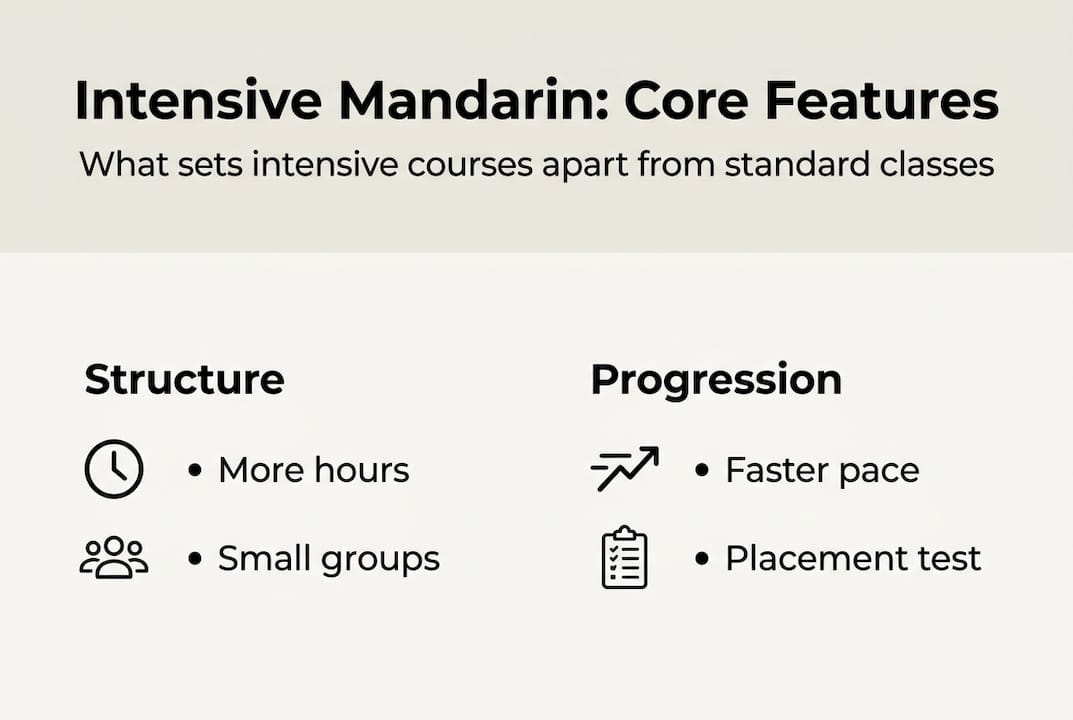
At its core, an intensive course means more contact hours, smaller groups, and faster progression. According to placement and level guidance, these programs typically feature small group classes of 2 to 6 students, daily sessions Monday through Friday running 4 to 6 hours per day, placement tests to match you to the right level, and HSK/CEFR-aligned curricula covering everything from beginner HSK1/A1 to advanced HSK6/C2. Delivery options span onsite, online, and hybrid formats.
The small group size is not just a selling point. It forces you to speak, respond, and think in Mandarin far more often than in a class of 20. You cannot hide in the back row.
Key features of intensive Mandarin courses:
- Placement tests that match you to the correct HSK or CEFR level before day one
- Daily immersive sessions rather than once or twice a week
- Curricula aligned to international standards (HSK1 to HSK6, A1 to C2)
- Certified native Mandarin instructors who are also fluent in English
- Flexible delivery: onsite, online Mandarin for professionals, or hybrid
Here is a quick snapshot of what the level structure looks like:
| HSK Level | CEFR Equivalent | Learner Profile |
|---|---|---|
| HSK 1-2 | A1 | Complete beginner |
| HSK 3 | A2 | Elementary conversational |
| HSK 4 | B1 | Intermediate, workplace use |
| HSK 5 | B2 | Upper intermediate, business |
| HSK 6 | C1-C2 | Advanced, near-native fluency |
One thing that surprises many new learners: you do not need to know your level before enrolling. A good placement test handles that for you. What matters is that you show up ready to commit to the daily schedule. The intensive Mandarin course details at Linda Mandarin outline exactly what that daily commitment looks like, so you can plan your schedule in advance.
Quick fact: Daily immersive sessions in small groups can accelerate Mandarin acquisition significantly compared to once-a-week classes at the same total hour count, because spaced repetition and active recall happen naturally within each session.
How do intensive courses compare to standard Mandarin classes?
Now that we have defined intensive courses, let’s see how they differ from conventional class structures. The difference is not just speed. It is about how learning is structured, what tradeoffs you accept, and what outcome you are optimizing for.
Standard Mandarin classes typically meet once or twice a week for 1.5 to 2 hours per session. That works well for people balancing demanding jobs and family life. Progress is steady but gradual. If you are learning Chinese with a busy schedule, a standard class keeps you moving without overwhelming your week.

Intensive courses flip that equation. Based on program comparisons, a standard group format at around 20 hours per week suits balanced schedules, while a super-intensive model at 30-plus hours per week with one-on-one sessions delivers the fastest gains but carries a higher burnout risk. Private lessons offer personalized attention at roughly S$55 to S$70 per hour, while group options cost less per session.
How to compare your options:
- Calculate your available weekly hours honestly before choosing a format
- Decide whether your goal is exam certification (HSK) or practical conversation
- Factor in your learning style: do you thrive in groups or prefer one-on-one attention?
- Check whether cultural context or pure business Mandarin matters more for your career
- Consider whether you need HSK exam preparation built into the curriculum
| Feature | Standard class | Intensive course |
|---|---|---|
| Weekly hours | 3-6 hrs | 20-30+ hrs |
| Group size | 10-20 students | 2-6 students |
| Progress speed | Gradual | Rapid |
| Burnout risk | Low | Moderate to high |
| Cost per hour | Lower | Moderate to higher |
| Best for | Busy professionals | Fast-track learners |
“The right format depends entirely on your timeline and tolerance for intensity. A course that works brilliantly for one person can feel overwhelming for another.”
The honest truth is that neither format is universally better. If you have a hard deadline, like a job relocation in three months, intensive wins every time. If you are building Mandarin as a long-term skill alongside a full-time career, a standard class may serve you better without the risk of burnout.
Who benefits most from intensive Mandarin learning?
With the differences clear, let’s look at who is most likely to benefit from intensive Mandarin study. Not everyone needs to learn Mandarin at maximum speed. But certain profiles gain outsized value from the intensive format.
Intensive courses prioritize speaking and conversation for real-world use in Singapore’s multilingual business environment, blending HSK standards with local professional needs. That design choice shapes who gets the most out of these programs.
Profiles that thrive in intensive Mandarin courses:
- Fast-trackers: Professionals who need conversational Mandarin within weeks for a new role or client relationship
- Career climbers: Employees targeting HSK certification as a formal credential for promotion or job applications
- Relocators: Adults moving to China, Taiwan, or other Mandarin-speaking regions who need functional fluency fast
- Culture seekers: Individuals who want deep engagement with Chinese heritage, literature, or community life in Singapore
- Corporate teams: Groups undergoing business Mandarin training as part of a company’s regional expansion strategy
One profile that often surprises people: retirees. Many older adults in Singapore who grew up speaking Cantonese or a Chinese dialect find that intensive Mandarin courses give them a structured way to finally close the gap with Mandarin-speaking family members or business contacts.
If you are worried that Mandarin is simply too difficult to learn as an adult, learning Chinese is more achievable than most people expect, especially when the curriculum is designed around practical communication rather than rote memorization.
Pro Tip: Before enrolling, write down one specific situation where you need to use Mandarin, whether it is a client meeting, a family dinner, or a job interview. That single use case will help you choose between a conversational focus and an exam-oriented track.
Choosing the right intensive course for your goals
Knowing who benefits, the next step is choosing a course that matches your needs. With several formats, levels, and delivery modes available, the decision can feel complicated. A simple framework makes it manageable.
Four steps to choosing the right intensive Mandarin course:
- Audit your schedule. Can you realistically commit to 4 to 6 hours of Mandarin daily? If not, a semi-intensive or standard format may prevent early dropout.
- Define your goal clearly. Business fluency, HSK certification, travel confidence, and cultural integration each call for different curriculum emphases.
- Pick your format. Placement tests and curriculum alignment ensure you start at the right level regardless of whether you choose onsite, online, or hybrid delivery.
- Evaluate the school. Look for certified native instructors, HSK/CEFR-aligned syllabi, small class sizes, and a track record of adult learners. Resources on selecting a Mandarin school can help you ask the right questions.
A common mistake adults make is choosing the most intensive option available simply because it sounds most effective. Intensity only works if you can sustain it. A learner who completes a semi-intensive course is far ahead of someone who drops out of a super-intensive program after two weeks.
There are also persistent myths worth addressing. Many adults believe that group classes cannot deliver real fluency or that online learning is somehow inferior. Common Mandarin class myths show that both assumptions are outdated, particularly as online platforms now replicate immersive classroom dynamics effectively.
Pro Tip: Ask any school you consider whether their curriculum is formally aligned to HSK and CEFR standards. If they cannot answer that question clearly, treat it as a red flag.
Stat to know: Learners in small group intensive classes (2 to 6 students) typically speak three to four times more per session than those in standard large-group classes, simply because there are fewer people to share the speaking time with.
Our perspective: The real key to rapid Mandarin mastery in Singapore
After more than two decades of teaching Mandarin to adults in Singapore, we have noticed a consistent pattern. The learners who progress fastest are not always the ones in the most intensive programs. They are the ones who use Mandarin outside of class every single day.
Singapore is genuinely one of the best places in the world to practice Mandarin outside a classroom. Your hawker center, your colleagues, your clients, and your neighborhood all offer real-world practice that no textbook can replicate. Intensive courses prioritize speaking for exactly this reason: the goal is always real-world use, not exam performance alone.
Burnout is a real risk that most course brochures underplay. We have seen motivated adults hit a wall around week three of a super-intensive program, not because the content was too hard, but because they had no social support system around their learning. Finding a study partner, joining a Mandarin conversation group, or even watching a Chinese drama series in the evenings can make a measurable difference in how long you stay motivated.
The uncomfortable truth is that the course is only about 40% of the equation. Your daily habits, your willingness to make mistakes in public, and your ability to build Mandarin into professional life account for the rest.
Explore intensive Mandarin learning solutions in Singapore
If you are ready to advance your Mandarin rapidly, there are structured solutions available right here in Singapore. Linda Mandarin has been delivering professional Mandarin training since 2003, with programs designed specifically for adult learners and working professionals.
You can explore the full Singapore intensive course options, review group class schedules to find a time that fits your week, or look into corporate Mandarin training if your organization needs team-wide language development. Located right above Tanjong Pagar MRT in Singapore’s central business district, Linda Mandarin also offers online and hybrid options for maximum flexibility. Reach out for a placement consultation and find the program that matches where you are and where you want to go.
Frequently asked questions
How long does it take to see results in an intensive Mandarin course?
Most learners notice speaking improvements within the first few weeks, thanks to daily immersion sessions in small groups that force active use of the language from day one.
Are intensive Mandarin courses suitable for beginners?
Absolutely. Placement tests match learners to the right starting level, so complete beginners at HSK1/A1 are placed appropriately and never thrown into content beyond their current ability.
Is online intensive Mandarin as effective as onsite learning?
Yes, when the program is well-designed. Onsite, online, and hybrid options now deliver comparable immersion and structure, with the added benefit of flexible scheduling that suits working adults.
What is the cost range for intensive Mandarin courses in Singapore?
Group courses average S$55 to S$70/hr, with private lessons priced higher to reflect the personalized attention and customized pacing they provide.