TL;DR:
- Setting clear goals and choosing a platform aligned with your purpose is crucial for sustained progress.
- A well-equipped study environment and combining multiple input methods enhance Mandarin learning efficiency.
- Consistent, active practice using scenario-based methods and regular feedback leads to effective language acquisition.
Learning Mandarin while managing a full-time career, family commitments, and the demands of expat life in Singapore is genuinely hard. Most people start with good intentions but quickly feel lost choosing between dozens of apps, platforms, and course formats. The good news: with the right structure, even a 20-minute daily session can move you from zero to conversational. This guide walks you through goal setting, platform selection, environment setup, a skill-building framework, and progress tracking, so you have a clear roadmap rather than a random mix of YouTube videos and half-finished apps.
Table of Contents
- Setting your learning objectives and choosing the right platform
- Preparing your environment and toolkit for effective online learning
- Step-by-step process: Building core Mandarin skills online
- Tracking progress, troubleshooting, and staying motivated
- Reframing online Mandarin learning: What actually works for adults and professionals
- Take your next step: Find the right Mandarin course for you
- Frequently asked questions
Key Takeaways
| Point | Details |
|---|---|
| Set clear objectives | Knowing your reason for learning Mandarin helps you choose the best online method and stay motivated. |
| Choose quality platforms | Well-reviewed courses that match your goals, like test prep or business Chinese, boost your chances of success. |
| Use evidence-based techniques | Strategies like explicit encoding, active recall, and project-based learning lead to faster Mandarin progress. |
| Track progress and troubleshoot | Regular quizzes and real-life practice ensure you improve and avoid common learning pitfalls. |
Setting your learning objectives and choosing the right platform
Before you sign up for anything, get specific about why you want to learn Mandarin. Are you preparing for business meetings with Chinese partners? Trying to integrate better into Singapore’s social fabric as an expat? Working toward an HSK certification for a visa or job application? Each purpose demands a different approach, and skipping this step is the single most common reason adults abandon language learning after three weeks.
Once your purpose is clear, evaluate platforms against that purpose. Popular online platforms for learning Mandarin include TouchChinese, Yoyo Chinese, ChineseClass101, and DigMandarin, offering structured courses from beginner to business Chinese with live one-on-one classes, test prep, and pronunciation focus. Each has distinct strengths, so matching them to your goals matters more than picking the most popular one.
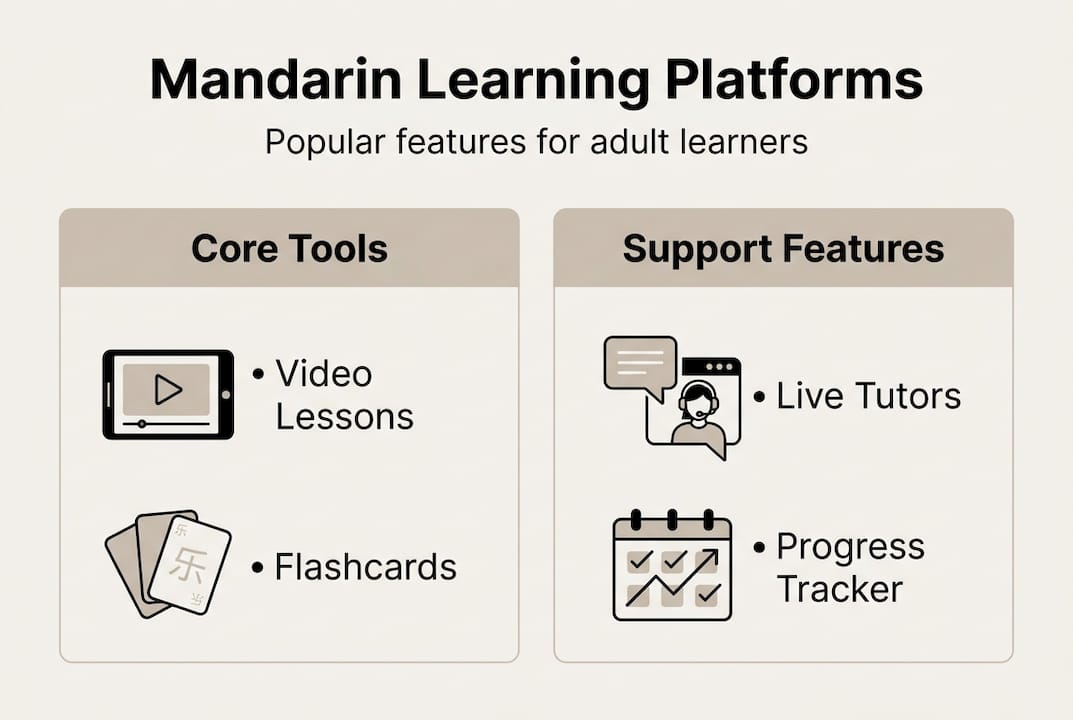
Platform comparison: Key features at a glance
| Platform | Best for | Live classes | HSK prep | Business focus |
|---|---|---|---|---|
| TouchChinese | Structured grammar | Yes | Yes | Moderate |
| Yoyo Chinese | Beginners, pronunciation | No | No | Low |
| ChineseClass101 | Self-paced variety | Yes | Partial | Low |
| DigMandarin | Course discovery | No | Yes | High |
Beyond the table above, use this checklist when evaluating any platform:
- Structured syllabus: Does the course follow a clear progression rather than random topic videos?
- Live interaction: Can you practice speaking with a real instructor or tutor?
- Business or scenario content: Does it offer role-play for professional settings?
- Progress tracking: Are there built-in tests or milestone markers?
- Flexibility: Can you study at your own pace or attend live sessions when your schedule allows?
You can also explore Mandarin learning resources that go beyond apps, including reading tools and vocabulary builders. For professionals with specific workplace communication needs, Mandarin for business communication is worth reviewing before committing to a platform.
Set realistic expectations from the start. Conversational fluency in Mandarin typically takes 1,200 or more hours for English speakers. Most working adults can dedicate 30 to 60 minutes per day, which means realistic milestones, not overnight breakthroughs.
Preparing your environment and toolkit for effective online learning
With your learning goals set and the right platform picked, your next step is to set yourself up for consistent success. Even the best Mandarin course will underdeliver if your study environment fights against you.

Start with your hardware. A laptop or tablet with a stable internet connection is the baseline. Add a decent pair of headphones with a microphone, because pronunciation feedback requires clear audio in both directions. A secondary monitor helps when you want a dictionary open alongside your lesson.
Essential tools and their roles
| Tool type | Recommended options | Purpose |
|---|---|---|
| Dictionary app | Pleco, MDBG | Instant character lookup, stroke order |
| Spaced repetition | Anki, Skritter | Vocabulary retention |
| Pronunciation guide | Forvo, HelloChinese | Tone and pinyin practice |
| Language exchange | iTalki, Tandem | Real conversation practice |
| Note-taking | Notion, Google Docs | Lesson summaries, review |
Research on how adults learn Chinese characters shows that multimodal vocabulary learning using explicit encoding combined with fast mapping is the most effective approach, and that phonetic radicals help with recognizing new characters more than relying solely on meaning. This finding directly supports using tools like Skritter, which combines visual, audio, and kinesthetic input in a single session.
Common obstacles include household distractions, inconsistent scheduling, and time zone mismatches for live classes. Reserve a physical study spot that signals “focus mode” to your brain. If you study at the kitchen table where you also eat and scroll social media, your concentration will suffer.
Pro Tip: Combine at least two input types in every study session. Watch a short video lesson, then immediately practice writing or speaking the same vocabulary. Switching between seeing, hearing, and producing Mandarin accelerates retention far more than passive watching alone. You can find additional effective Mandarin study techniques that align with how adult learners actually retain language.
Aim for daily sessions of 20 to 30 minutes rather than a two-hour marathon on weekends. Frequency beats duration when it comes to language acquisition.
Step-by-step process: Building core Mandarin skills online
Once your study space and resources are ready, you need a proven framework to maximize Mandarin progress online. Here is a sequenced approach designed specifically for working adults.
- Master pinyin and tones first. Before touching vocabulary or grammar, spend one to two weeks getting pinyin solid. Mandarin has four tones plus a neutral tone, and mispronouncing them changes meaning entirely.
- Learn high-frequency vocabulary with explicit encoding. Use Anki flashcards that include audio, pinyin, and a sample sentence. Avoid memorizing words in isolation.
- Build core grammar patterns. Focus on sentence structures you will actually use: introducing yourself, stating preferences, describing situations, and making requests.
- Practice speaking with guided feedback. Book live sessions through your platform or iTalki at least twice a week. Speaking with correction is irreplaceable.
- Develop listening with varied input. Start with slow, clear audio designed for learners. Gradually introduce authentic material like short Mandarin podcasts or news clips.
- Integrate reading and writing progressively. Begin with pinyin subtitles alongside characters. Move to reading simple texts without pinyin support as confidence grows.
For professionals, scenario-based Mandarin practice is a powerful accelerator. Role-playing a supplier negotiation or a client dinner in Mandarin builds the exact vocabulary and confidence you need. Online project-based learning boosts critical thinking and comprehension over traditional rote methods, making it especially well-suited for business learners who need practical scenarios over grammar drills.
Expats in Singapore have a natural advantage: a city-state where Mandarin is used daily in markets, government services, and workplaces. Use that environment. Practice ordering coffee in Mandarin, reading bilingual signage, or chatting with neighbors. The real world is your best supplementary classroom. Learning Mandarin as a Singapore expat carries unique advantages that platform-only learners simply miss.
Pro Tip: Practice active recall every three to four days by covering your notes and attempting to reproduce what you learned from memory. This retrieval effort is more effective than rereading or highlighting for long-term retention.
Tracking progress, troubleshooting, and staying motivated
With a step-by-step skills routine in place, maintaining momentum and measuring success becomes essential. Progress that isn’t tracked tends to feel invisible, and invisible progress kills motivation.
Here are concrete ways to measure where you stand:
- Take HSK mock exams every four to six weeks to benchmark vocabulary and grammar knowledge
- Record yourself speaking Mandarin monthly and compare recordings over time
- Ask your instructor or language partner for structured feedback on tones, sentence structure, and vocabulary range
- Track how much real-world Mandarin you attempt outside class: ordering food, reading signs, or writing a short WeChat message
Research confirms that active recall and quizzes outperform passive reading for busy professionals, and Singapore expats can leverage local subsidized programs for career-relevant Mandarin. Reviewing your Mandarin course levels helps clarify which benchmarks to target next.
Common mistakes to avoid:
- Passive exposure only: Watching Mandarin TV without active listening or note-taking builds very little usable skill
- Skipping speaking practice: Reading and listening without producing speech creates a comprehension gap that’s painful to close later
- Inconsistency: Three days of intense study followed by two weeks off is far less effective than 20 minutes every day
Consistency beats intensity every time. Even ten minutes of focused Mandarin practice daily compounds into thousands of meaningful repetitions over a year. Small, steady efforts are not a consolation prize. They are the actual strategy.
When you hit a plateau, that is often a sign to move up a level rather than repeat the same material. Explore HSK test preparation to formalize your progress, or read about the realities of Mandarin classes in Singapore to calibrate your expectations honestly.
Reframing online Mandarin learning: What actually works for adults and professionals
Here is something most Mandarin learning guides will not tell you: more screen time is not the answer. Many adults assume that signing up for more apps or longer video courses will fix their slow progress. It rarely does. The real bottleneck is almost never access to content. It is the gap between consuming Mandarin and actually using it.
Working professionals learn differently from students. You bring context, motivation, and a clear use case to every lesson. That is a massive advantage, but only if your learning method matches it. Rote memorization and passive video watching ignore that advantage entirely.
What works is combining explicit goal setting with scenario-based practice and regular performance feedback from someone qualified to give it. Watching how you responded in a simulated business meeting is more valuable than finishing a 40-lesson grammar course. This is why evidence-based Mandarin strategies that adapt to your cognitive style consistently outperform one-size-fits-all programs.
Do not be afraid to customize your approach. If vocabulary flashcards bore you, switch to reading short news summaries in Mandarin instead. If structured grammar exercises feel mechanical, find a conversation partner focused on your industry.
Take your next step: Find the right Mandarin course for you
Reading a guide like this builds a strong foundation, but real progress comes from structured feedback, a clear syllabus, and an instructor who can course-correct in real time. Self-study alone tends to plateau fast, especially for working adults with limited time to spend on trial and error.
Linda Mandarin has been helping adults and professionals in Singapore learn Mandarin since 2003. Whether you prefer the flexibility of an online Mandarin course via Zoom, the immersive pace of an intensive Mandarin course, or a structured corporate Mandarin training program for your team, there is a format designed around your schedule and goals. Book a trial lesson and find out which course level fits you best.
Frequently asked questions
What is the fastest way to learn Mandarin online as a working adult?
Structured online courses that use active recall methods combined with daily scenario-based practice produce the fastest results for busy adults. Consistency and speaking practice outperform any single platform or tool.
How do I assess my progress in online Mandarin learning?
Regular HSK mock exams, recorded speaking samples, and applying Mandarin in real conversations are the most reliable progress indicators. Research confirms that PBL-based comprehension testing outperforms traditional methods for measuring real-world language use.
Is it possible to become fluent in Mandarin solely through online courses?
Online courses can absolutely get you to strong conversational proficiency, but combined encoding methods and consistent speaking practice outside class are essential for reaching full fluency.
What platforms are best for professionals or expats to learn Mandarin online?
TouchChinese, Yoyo Chinese, ChineseClass101, and DigMandarin are among the top options, with structured business Chinese courses, test preparation, and live one-on-one classes suited to professional learners and expats.