Start with three things you can do right now. Learn eight validated phrases covering pain, breathing, and basic commands. Use them only to open a conversation, never to make a clinical decision alone. Call a qualified medical interpreter the moment any uncertainty appears about diagnosis, consent, or medication instructions. That is the safety floor for using Mandarin in U.S. clinical settings.
Immediate checklist before your next shift:
- Phrases to learn first: “Where does it hurt?” (Nǎr téng?), “Breathe in” (Xī qì), “Point to the pain” (Zhǐ chū téng de dìfang), “On a scale of 1 to 10” (Cóng yī dào shí), “Are you allergic to any medicine?” (Nǐ duì shénme yào guòmǐn ma?), “I need to examine you” (Wǒ xūyào jiǎnchá nǐ), “Do you understand?” (Nǐ míngbai ma?), “I will get an interpreter” (Wǒ qù zhǎo fānyì)
- Safety limit: Never use limited Mandarin for informed consent, mental status assessment, or delivering a serious diagnosis
- Confirm comprehension: Ask the patient to repeat back the key instruction in their own words, or use a teach-back gesture
- When to pause: Any hesitation, blank look, or unexpected response from the patient means stop and call a certified interpreter
These phrases are stopgaps. They reduce friction in low-stakes moments. They are not a substitute for a qualified medical interpreter, and no amount of self-study changes that clinical and legal reality.
Key Takeaways
Learning medical Mandarin safely means mastering a small, validated phrase set, confirming comprehension every time, and escalating to a certified interpreter the moment uncertainty appears.
| Point | Details |
|---|---|
| Start with 8 core phrases | Memorize triage, pain scale, and interpreter escalation phrases before your next shift. |
| 8–12 weeks to functional use | Structured practice of 30–45 minutes per week reaches usable clinical communication. |
| Interpreter triggers are non-negotiable | Consent, serious diagnosis, and mental status assessment always require a certified interpreter. |
| Cultural norms affect comprehension | Use formal address (nín), teach-back confirmation, and family-inclusive communication. |
| Linda Mandarin | Offers tailored online Zoom and corporate modules for clinical teams with flexible scheduling. |
Table of Contents
- Who this guide is for and what you can realistically achieve
- High-priority medical Mandarin phrases and clinical vocabulary
- Ready-to-use scripts for common clinical situations
- Cultural points that change how you communicate
- How to study medical Mandarin effectively
- How to assess your progress in clinical Mandarin
- When to use a qualified medical interpreter
- Where to find training and vetted materials
- How to keep your Mandarin sharp across shifts
- The gap between wanting to communicate and communicating safely
- Linda Mandarin’s training options for clinical teams
- Sources
- FAQ
Who this guide is for and what you can realistically achieve
This guide targets attending physicians, residents, nurses, allied health professionals, and medical students who encounter Mandarin-speaking patients in U.S. hospitals, urgent care centers, and outpatient clinics. You do not need prior Mandarin experience.
Realistic outcomes depend on how much time you invest:
- A few hours of focused study: Survival phrases for triage, vitals, and basic commands
- 8–12 weeks of structured practice (30–45 minutes per week): Functional clinical communication covering symptom history, pain assessment, and simple discharge instructions
- 3–6 months of consistent work: Basic conversational competency sufficient for routine patient interactions
This guide does not lead to certification or replace interpreter services. It gives you a safety-first roadmap: what to learn, how to practice it, and exactly when to hand off to a professional.
High-priority medical Mandarin phrases and clinical vocabulary
The Northwestern Feinberg bilingual medical vocabulary organizes terms by specialty, body part, and symptom, making it one of the most practical starting points for building a pocket reference. Research on nursing vocabulary confirms that diagnosis-related terms appear most frequently in clinical encounters, which supports learning symptom and diagnosis vocabulary first before moving to procedures or departments.
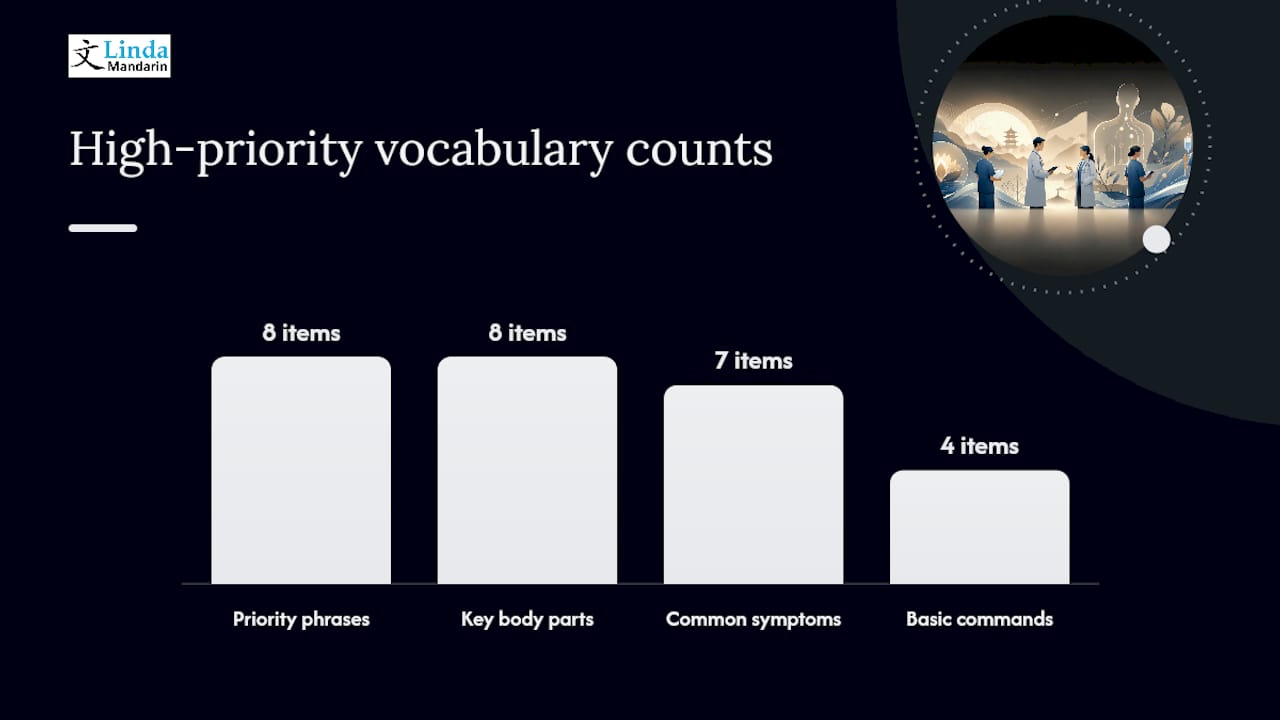
| English Phrase | Pinyin | Clinical Use |
|---|---|---|
| Where does it hurt? | Nǎr téng? | Triage, pain location |
| How long have you had this? | Nǐ yǒu duō jiǔ le? | History-taking |
| Do you have a fever? | Nǐ fāshāo ma? | Symptom screening |
| Are you short of breath? | Nǐ hūxī kùnnan ma? | Respiratory triage |
| I need to take your blood pressure | Wǒ yào liáng nǐ de xuèyā | Vitals |
| Do not eat or drink anything | Bùyào chī hē rènhé dōngxi | Pre-procedure instruction |
| Sign here, please | Qǐng zài zhèlǐ qiānmíng | Consent forms |
| Call the nurse if you need help | Rúguǒ xūyào bāngzhù, qǐng jiào hùshi | Discharge safety |
Key body parts: tóu (head), xiōng (chest), fùbù (abdomen), bèi (back), tuǐ (leg), shǒu (hand), xīn (heart), fèi (lungs)
Common symptoms: téng (pain), tóutòng (headache), ěxīn (nausea), tùtǔ (vomiting), tóuyūn (dizziness), fāshāo (fever), késou (cough)
Basic commands: Zhāng kāi zuǐ (open your mouth), Shēn shé tou (stick out your tongue), Shēn shǒu (extend your arm), Fàngsōng (relax)

Tones matter more than most clinicians expect. Grouping terms by anatomy, symptoms, and procedures while drilling tone accuracy prevents the kind of misunderstanding where a mispronounced syllable changes the meaning entirely. Pinyin is your primary clinical tool; written Chinese (simplified in mainland China, traditional in Taiwan and Hong Kong) is secondary for most U.S. clinical encounters.
Pro Tip: Never ask “Do you understand?” and accept a nod as confirmation. Chinese-speaking patients often nod out of politeness. Instead, ask them to point to the area you described or repeat the instruction back to you.
Ready-to-use scripts for common clinical situations
Short, rehearsed scripts reduce cognitive load under pressure. Practice each one until it feels automatic.
Triage script
“Nǐ hǎo. Nǐ nǎr téng? Nǐ téng le duō jiǔ? Nǐ yǒu fāshāo ma?” (Hello. Where does it hurt? How long have you had the pain? Do you have a fever?) Pair with a body diagram the patient can point to. Estimated time: 60 seconds.
Pain assessment
“Cóng yī dào shí, nǐ de téng shì jǐ fēn? Yī shì bù téng, shí shì zuì téng.” (On a scale of 1 to 10, how is your pain? One is no pain, ten is the worst.) Hold up fingers to reinforce the scale visually.
Focused history
“Nǐ yǒu shénme guòmǐn ma? Nǐ xiànzài chī shénme yào? Nǐ yǒu táng niào bìng huò gāo xuèyā ma?” (Do you have any allergies? What medications are you taking? Do you have diabetes or high blood pressure?)
Informed consent for a minor procedure
“Wǒ xūyào zuò yīgè xiǎo shǒushù. Wǒ huì jiěshì. Nǐ míngbai ma? Qǐng zài zhèlǐ qiānmíng.” (I need to perform a minor procedure. I will explain. Do you understand? Please sign here.) For anything beyond a routine procedure, stop and use a certified interpreter.
Discharge instructions
“Nǐ kěyǐ huí jiā le. Qǐng měitiān chī zhège yào. Rúguǒ nǐ gǎnjué gèng bù hǎo, qǐng huí yīyuàn.” (You can go home. Please take this medicine every day. If you feel worse, please return to the hospital.)
Role-play each script with a colleague for 2–4 minutes before using it at the bedside. The ICON Project’s Chinese-English medical term sheets are free to download and work well as pocket reference cards for these scripts.
Safety reminder: If a script does not resolve the patient’s concern clearly, or if the patient’s response does not match what you expected, stop the conversation and call a certified interpreter before proceeding.
Cultural points that change how you communicate
Chinese-speaking patients often communicate differently than U.S.-trained clinicians expect, and missing those cues leads to incomplete histories and missed consent.
- Use formal address: Say nín (您) instead of nǐ (你) with older patients. It signals respect and immediately improves rapport
- Family decision-making: Many Chinese families expect major medical decisions to involve the family unit, not just the patient alone. Ask early: “Would you like a family member present for this discussion?”
- Indirectness about bad news: Patients may not ask follow-up questions even when they do not understand. Silence is not agreement
- Face-saving: Patients may say “yes” to avoid embarrassment. Teach-back confirmation is non-negotiable
- Titles matter: Address older patients as lǎo xiānsheng (older gentleman) or lǎo nǚshì (older lady) when you do not know their name
Red flags that require an interpreter or cultural liaison: a family member insisting on answering all questions for the patient, a patient who appears distressed but says everything is fine, any situation involving end-of-life discussions or psychiatric assessment.
Pro Tip: For sensitive questions, frame them indirectly first. Instead of “Are you depressed?” try “Some patients with your condition feel sad or worried. Is that true for you?” This approach reduces the face-threat and produces more honest answers.
Linda Mandarin’s Chinese culture training covers exactly these communication norms for adult professionals, which translates directly to clinical settings.
How to study medical Mandarin effectively
Course formats that fit clinical schedules:
- Micro-workshops (2–4 hours): Best for a fast phrase foundation. The MedEdPORTAL module “Essential Medical Mandarin for Health Care Providers” follows this format, combining learning objectives with a compact curriculum clinicians can complete in a single session
- Weekly 1:1 Zoom coaching: Flexible enough for shift workers; allows instructor feedback on tone and pronunciation
- Small-group role-play: Peer feedback accelerates phrase retention faster than solo study
- Asynchronous phrase libraries with audio: Good for maintenance between sessions, not for initial learning
Penn’s Advanced Medical Chinese (CHIN0878) demonstrates what a full academic curriculum looks like: diagnosis vocabulary, focused communication tasks, and ethics/consent role-play. That arc, compressed into eight weeks, is a practical model for busy clinicians.
8-week sample plan (30–45 minutes per week):
- Week 1: Tones and pinyin basics; memorize 8 survival phrases
- Week 2: Body parts and symptom vocabulary (20 terms)
- Week 3: Triage script drill with a partner
- Week 4: Pain assessment and vitals language
- Week 5: History-taking script; add allergy and medication questions
- Week 6: Consent and procedure language; role-play with a supervisor
- Week 7: Discharge instruction script; teach-back practice
- Week 8: Full scenario role-play (triage → history → discharge); self-assessment
When choosing a course, look for: a sample curriculum with clinical scenarios, instructors with professional or clinical teaching experience, flexible scheduling, and explicit guidance on when to use an interpreter. Pronunciation training focused on medical communication is worth adding alongside any phrase-based course, since tone errors in Mandarin can change a word’s meaning entirely.
How to assess your progress in clinical Mandarin
Observable skills that indicate safe practice:
- Accurately eliciting a symptom location and duration using Mandarin alone
- Delivering a basic pain scale question and interpreting the response correctly
- Phrasing a simple consent statement and confirming patient understanding via teach-back
- Recognizing when a patient’s response indicates confusion or non-comprehension
- Knowing and stating the interpreter escalation trigger without hesitation
Assessment tasks: observed role-play with a bilingual colleague, a recorded patient-teacher interaction reviewed for tone accuracy and comprehension checks, and a supervised bedside demonstration with a clinical supervisor present.
Document language limitations in the medical record when relevant. A note such as “patient communication conducted primarily in Mandarin with limited phrase use; certified interpreter used for consent discussion” protects both the patient and the clinician. Re-assess every 4–6 weeks during active practice, and at least once per quarter during maintenance phases.
When to use a qualified medical interpreter
High-risk situations that require a certified interpreter every time:
- Informed consent for any procedure, surgery, or anesthesia
- Delivering a new serious diagnosis or prognosis
- Medication reconciliation or complex discharge instructions
- Mental status assessment or psychiatric evaluation
- Any situation where the patient’s response is unclear or unexpected
Workflow for a two-person team:
- Attempt a validated phrase from your pocket reference
- Confirm comprehension using teach-back or a pointing task
- If any uncertainty remains, stop and call the interpreter before proceeding
U.S. hospitals receiving federal funding are required under Title VI of the Civil Rights Act to provide meaningful access to language services for patients with limited English proficiency. Your institution’s interpreter policy is the governing document; this guide supplements it, it does not override it.
Practical tips for telephone and video interpreters: state the clinical context in the first 10 seconds (“I have a 68-year-old Mandarin-speaking patient, I need to explain a chest X-ray result”), speak in short sentences and pause after each one, and confirm the interpreter’s read-back before moving to the next point.
Where to find training and vetted materials
- MedEdPORTAL: Essential Medical Mandarin for Health Care Providers: Free, peer-reviewed module with learning objectives and a compact curriculum; ideal starting point
- Penn Advanced Medical Chinese (CHIN0878): Academic course model showing how vocabulary, role-play, and consent ethics combine in a full curriculum
- ICON Project Chinese-English medical term sheets: Free downloadable phrase lists organized by clinical category; print and laminate for pocket use
- Northwestern Feinberg bilingual vocabulary PDF: Structured specialty and body-part glossaries; strong foundation for building a personal phrase bank
- Medical Mandarin phrasebook (medicalmandarin.wordpress.com): Online phrase library with audio; useful for self-study between sessions
U.S. clinicians can access the MedEdPORTAL module, ICON Project sheets, and Northwestern PDF at no cost. Instructor-led options like Linda Mandarin’s Zoom courses add supervised role-play and tone correction that self-study alone cannot replicate.
How to keep your Mandarin sharp across shifts
Micro-practice techniques that fit a clinical day:
- Run a 2–3 minute phrase drill before a shift using your pocket reference card
- After any Mandarin patient encounter, debrief with a bilingual colleague on what worked and what didn’t
- Rotate a set of 10 flashcards weekly, focusing on the terms you use least
- Practice the triage script with a resident or student during downtime
Pro Tip: Keep a laminated pocket card with your 8 core phrases and the interpreter escalation trigger. Review it during handoff. The 30 seconds it takes to glance at it before entering a room is the single highest-return habit for maintaining clinical Mandarin.
Low-risk practice opportunities include screening questions during routine vitals checks and opening greetings. Reserve supervised bedside practice for situations where a bilingual colleague or supervisor is present. Log your practice minutes weekly; even 20 minutes per week maintains phrase recall between formal sessions. Short pronunciation drills before patient consultations are an efficient way to warm up tone accuracy without adding time to your schedule.
The gap between wanting to communicate and communicating safely
There is real urgency behind learning Mandarin for clinical work. A patient who cannot describe their symptoms clearly, a family who cannot understand discharge instructions, a clinician who cannot confirm comprehension — these are not just communication failures. They are patient safety events.
But the urgency cuts both ways. Clinicians who learn a few phrases and then overestimate their ability create a different kind of risk: the patient who nods along, the consent that was never truly informed, the symptom that got lost in translation. The goal of learning medical Mandarin is not fluency. It is knowing exactly where your competence ends and the interpreter’s begins.
The most effective path is a narrow one: learn a small set of validated phrases, practice them until they are automatic, and treat every unexpected patient response as a trigger to escalate. Linda Mandarin’s adult professional programs, including online Zoom and corporate training options, are built around exactly this kind of structured, practical progression for working professionals.
Linda Mandarin’s training options for clinical teams
Clinical teams need Mandarin training that fits around shift patterns, not semester schedules. Linda Mandarin’s corporate Mandarin training can be tailored into a medical-Mandarin module for hospital departments, urgent care teams, or individual clinicians. Online Zoom lessons with certified native instructors mean you practice pronunciation and role-play scenarios from anywhere, with feedback that self-study tools cannot provide.

The structured syllabus covers real-life communication progressively, from survival phrases through to functional clinical conversation, with flexible scheduling suitable for shift workers. Request a tailored module for your clinical team or view course levels and scheduling options to find the format that fits your workflow.
Sources
- Essential Medical Mandarin for Health Care Providers
- CHIN0878 – Advanced Medical Chinese
- Common Medical Terms / Bilingual medical and cancer vocabulary (Feinberg labs)
- Chinese-English regularly used medical terms (ICON Project)
- Practical Values of Thesaurus of Modern Chinese in Nursing Scope Vocabulary
Use these resources for self-study and phrase building. For high-risk clinical communication, always rely on a certified medical interpreter.
FAQ
What Mandarin phrases should a nurse learn first?
Start with eight high-yield phrases covering pain location, breathing commands, the 1–10 pain scale, allergy screening, and the interpreter escalation statement. These cover the most frequent low-stakes clinical moments where a validated phrase reduces friction without creating safety risk.
How long does it take to reach usable clinical Mandarin?
With 30–45 minutes of structured practice per week, most clinicians reach functional clinical communication in 8–12 weeks. Survival phrases are achievable in a few hours of focused study.
When must a U.S. clinician use a certified medical interpreter?
Any time consent, a serious diagnosis, medication reconciliation, or mental status assessment is involved. Under Title VI of the Civil Rights Act, federally funded hospitals must provide meaningful language access to patients with limited English proficiency.
Is the MedEdPORTAL medical Mandarin module free?
Yes. The Essential Medical Mandarin for Health Care Providers module is freely available on MedEdPORTAL with peer-reviewed learning objectives and a compact curriculum suitable for a single self-study session.
Can Linda Mandarin create a custom module for a clinical team?
Yes. Linda Mandarin offers corporate training programs that can be tailored to clinical workflows, with online Zoom delivery and experienced native instructors who adapt content to professional communication needs.