This guide gives you the exact Mandarin phrases hospitality staff need to welcome, check in, and assist Chinese-speaking guests, plus pinyin with tone marks, short on-shift scripts, five timed drills, and a printable cheat sheet. Start here: memorize the five greetings in Section 2, print the vocabulary table in Section 5, and keep the cheat sheet from Section 9 at your desk. Polite forms like 先生 (xiānsheng) and 女士 (nǚshì) matter from the first word, and the emergency phrases in Section 5 are the ones to know cold before anything else.
Chinese-speaking guests consistently rate the absence of Mandarin-speaking staff as one of the most noticeable service gaps in hotels. You don’t need fluency to close that gap. A dozen well-practiced phrases, delivered with confidence and a genuine smile, change the entire guest experience.
Key Takeaways
Hospitality staff who memorize five core greetings, run daily five-minute scenario drills, and keep a laminated cheat sheet at the desk can handle most Chinese-speaking guest interactions with confidence from the first week.
| Point | Details |
|---|---|
| Memorize five greetings first | 您好, 欢迎光临, and the reservation question cover most first-contact moments. |
| Use 您, not 你 | The formal “you” signals respect and is noticed immediately by Chinese-speaking guests. |
| Run five-minute pre-shift drills | Scenario-based practice builds phrase recall faster than vocabulary study alone. |
| Keep a laminated cheat sheet at the desk | Include greetings, check-in steps, top 10 facility words, numbers, and emergency phrases. |
| Linda Mandarin for structured follow-up | Corporate and Zoom courses offer role-play practice and customizable scripts for hospitality teams. |
Table of Contents
- How to greet Chinese-speaking guests at the front desk
- Check-in and check-out: a short front-desk script
- Handling guest requests and solving problems on shift
- Hotel and room vocabulary: quick reference table
- How to address guests politely and avoid cultural missteps
- Pronunciation and quick tone tips for clear speech
- Five role-based drills your team can run before every shift
- What to put on your printable one-page cheat sheet
- Structured Mandarin training for hospitality teams
- Sources
- FAQ
How to greet Chinese-speaking guests at the front desk
First impressions happen in seconds. These phrases cover the moment a guest walks through the door or approaches the desk. Memorize the top three; keep the rest on a laminated card.
-
Welcome / Hello
你好 | Nǐ hǎo | “Hello” (casual, one guest)
您好 | Nín hǎo | “Hello” (formal, preferred at front desk) -
Welcome to our hotel
欢迎光临 | Huānyíng guānglín | “Welcome” (standard hospitality greeting) -
How can I help you?
请问有什么可以帮您?| Qǐngwèn yǒu shénme kěyǐ bāng nín? | “May I help you?” -
Do you have a reservation?
您有预订吗?| Nín yǒu yùdìng ma? | “Do you have a reservation?” -
Please wait a moment.
请稍等。| Qǐng shāo děng. | “Please wait a moment.”
Usage note: Use 您 (nín) instead of 你 (nǐ) with every guest. The difference is respect. 您 is the formal “you,” and Chinese-speaking guests notice when staff use it. Save 你 for colleagues. The follow-up question “Do you have a reservation?” (您有预订吗?) is the single most useful phrase after the greeting, so pair them in practice from day one.
Pro Tip: Memorize 您好 and 欢迎光临 as one unit. Say them together every time a guest approaches, the way you’d say “Good morning, welcome” in English. The rhythm makes it stick.
Check-in and check-out: a short front-desk script
A scripted flow removes the guesswork when nerves kick in. Run through this numbered sequence during pre-shift practice until it feels automatic.
-
Confirm the reservation name
请问您贵姓?| Qǐngwèn nín guì xìng? | “May I have your name, please?” -
Ask for ID
请出示您的护照或身份证。| Qǐng chūshì nín de hùzhào huò shēnfèn zhèng. | “Please show your passport or ID.” -
Confirm room type
您预订的是单人间还是双人间?| Nín yùdìng de shì dānrén jiān háishì shuāngrén jiān? | “Single or double room?” -
Payment
请问您用现金还是信用卡付款?| Qǐngwèn nín yòng xiànjīn háishì xìnyòngkǎ fùkuǎn? | “Cash or credit card?” -
Hand over the key card
这是您的房卡,您的房间是__号。| Zhè shì nín de fáng kǎ, nín de fángjiān shì __ hào. | “Here is your key card. Your room is number __.” -
Check-out phrase
您今天退房吗?| Nín jīntiān tuì fáng ma? | “Are you checking out today?” -
Receipt / bill
这是您的账单。| Zhè shì nín de zhàngdān. | “Here is your bill.”
Pro Tip: When confirming a guest’s name or room number, slow down and repeat the number twice. Say it once, pause, then say it again. Guests who are not fully comfortable in English appreciate the repetition, and it prevents key-card errors without making anyone feel talked down to.
Handling guest requests and solving problems on shift
Quick, calm responses to requests and complaints are where Mandarin for hospitality staff earns its keep. These phrases cover the most common scenarios.
Common requests:
-
Extra towels
我需要多几条毛巾。| Wǒ xūyào duō jǐ tiáo máojīn. | “I need more towels.”
Reply: 好的,马上送到。| Hǎo de, mǎshàng sòng dào. | “Of course, we’ll send them right away.” -
Wake-up call
请帮我设定叫醒服务,明天早上__点。| Qǐng bāng wǒ shèdìng jiàoxǐng fúwù, míngtiān zǎoshang __ diǎn. | “Please set a wake-up call for __ AM tomorrow.” -
Late checkout
我可以延迟退房吗?| Wǒ kěyǐ yánchí tuì fáng ma? | “Can I have a late checkout?” -
Maintenance issue
我的房间有问题。| Wǒ de fángjiān yǒu wèntí. | “There’s a problem in my room.”
Reply: 非常抱歉,我们马上派人来。| Fēicháng bàoqiàn, wǒmen mǎshàng pài rén lái. | “We’re very sorry. Someone will come right away.”
Apologizing and escalating:
- 非常抱歉给您带来不便。| Fēicháng bàoqiàn gěi nín dài lái bù biàn. | “We sincerely apologize for the inconvenience.”
- 我马上帮您联系经理。| Wǒ mǎshàng bāng nín liánxì jīnglǐ. | “I’ll contact the manager for you right away.”
Pro Tip: When logging a maintenance or complaint call, repeat the guest’s room number back in Mandarin: “您的房间是__号,对吗?” (Nín de fángjiān shì __ hào, duì ma? — “Your room is number __, correct?”). It signals attention to detail and gives the guest confidence the issue is being tracked.
Hotel and room vocabulary: quick reference table
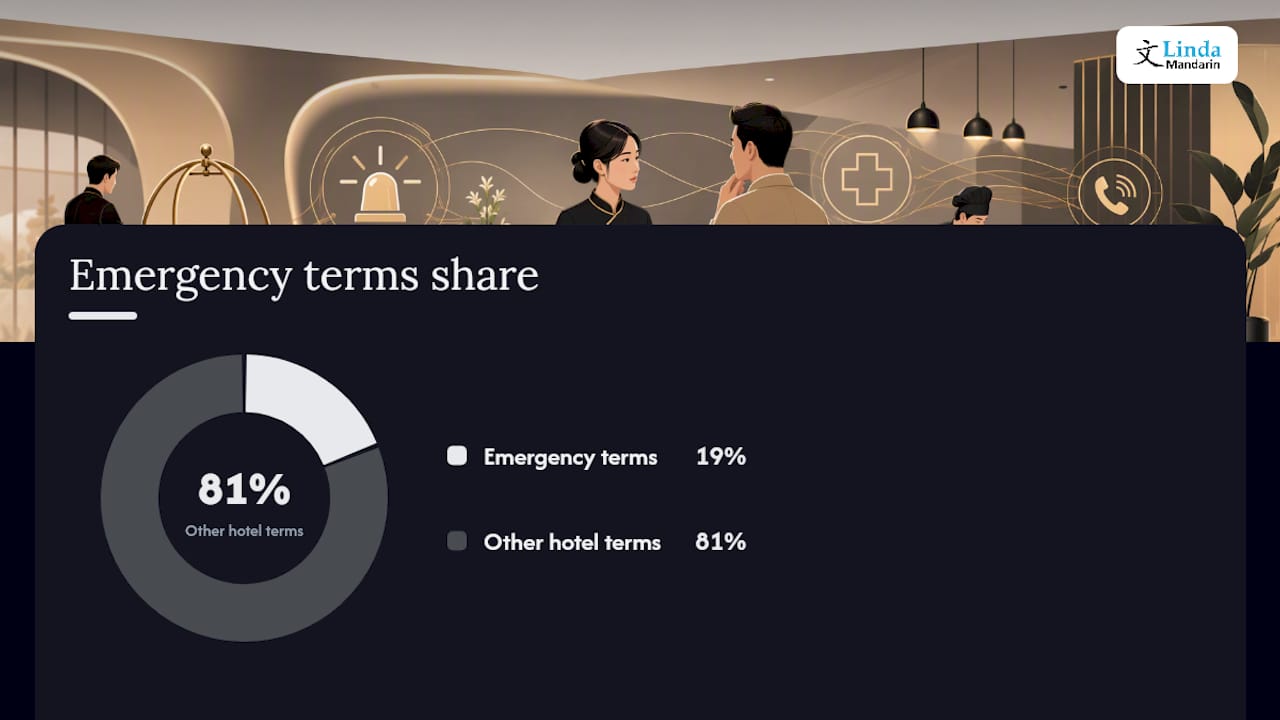
The terms below come from a structured hotel vocabulary list used by hospitality language programs. Mark the emergency terms with a highlighter on your printed copy.
| Chinese | Pinyin | English |
|---|---|---|
| 酒店 | jiǔdiàn | hotel |
| 房间 | fángjiān | room |
| 前台 / 接待处 | qiántái / jiēdài chù | front desk / reception |
| 电梯 | diàntī | elevator |
| 洗手间 | xǐshǒujiān | restroom |
| 早餐 | zǎocān | breakfast |
| 空调 | kōngtiáo | air conditioning |
| 钥匙卡 | yàoshi kǎ | key card |
| 行李 | xínglǐ | luggage |
| 游泳池 | yóuyǒng chí | swimming pool |
| 健身房 | jiànshēn fáng | gym |
| 餐厅 | cāntīng | restaurant |
| 停车场 | tíngchē chǎng | parking lot |
| 火警 🔴 | huǒ jǐng | fire alarm |
| 紧急出口 🔴 | jǐnjí chūkǒu | emergency exit |
| 紧急情况 🔴 | jǐnjí qíngkuàng | emergency |
Numbers 0–10 for room numbers and prices:
| Number | Chinese | Pinyin |
|---|---|---|
| 0 | 零 | líng |
| 1 | 一 | yī |
| 2 | 二 | èr |
| 3 | 三 | sān |
| 4 | 四 | sì |
| 5 | 五 | wǔ |
| 6 | 六 | liù |
| 7 | 七 | qī |
| 8 | 八 | bā |
| 9 | 九 | jiǔ |
| 10 | 十 | shí |
Room 308 = 三零八号 (sān líng bā hào). Price $250 = 两百五十美元 (liǎng bǎi wǔshí měiyuán).
How to address guests politely and avoid cultural missteps
Getting the title right costs nothing and earns real goodwill. The hospitality-focused textbook China Ready! endorses cultural-awareness training alongside language practice for exactly this reason.
Titles to use:
- 先生 (xiānsheng) — “Mr.” or “Sir,” used for male guests
- 女士 (nǚshì) — “Ms.” or “Ma’am,” used for female guests
- Example: “王先生,您好!” (Wáng xiānsheng, nín hǎo!) — “Hello, Mr. Wang!”
Polite phrases:
- Thank you: 谢谢您 | Xièxiè nín
- You’re welcome: 不客气 | Bú kèqì
- Sorry / Excuse me: 对不起 | Duìbuqǐ
- Please: 请 | Qǐng
- No problem: 没问题 | Méi wèntí
Cultural dos and don’ts:
- Use the guest’s surname with the title, not their given name. Chinese names are typically surname-first (e.g., Wang Wei = surname Wang).
- Avoid pointing with a single finger; use an open hand to gesture toward directions or items.
- Silence is not rudeness. A guest who nods and doesn’t respond verbally may simply be processing.
- Offering both hands when presenting a key card, bill, or gift is a sign of respect widely recognized across Chinese-speaking cultures.
- Avoid excessive physical contact, including back-patting or shoulder touches, even in a friendly context.
A note on body language: indirect phrasing is common in Mandarin-speaking contexts. A guest saying “maybe” or “it’s fine” may actually be signaling discomfort. Watch for hesitation and follow up with a gentle “Is there anything else I can help you with?” (还有什么我可以帮您的吗? Hái yǒu shénme wǒ kěyǐ bāng nín de ma?).
Pronunciation and quick tone tips for clear speech
Mandarin has four tones plus a neutral tone, and the same syllable pronounced with a different tone means a completely different word. Three examples that matter on shift:
- mā (妈, first tone, flat and high) = mother. mǎ (马, third tone, dip then rise) = horse. Getting these mixed up in a sentence about a guest’s family is memorable for the wrong reasons.
- wèn (问, fourth tone, sharp fall) = to ask. wén (文, second tone, rising) = culture/text. When asking a guest a question, the fourth tone is what you want.
- fáng (房, second tone, rising) = room. fàng (放, fourth tone, falling) = to put/place. Front-desk staff say 房间 (fángjiān) dozens of times per shift, so the rising tone on 房 is worth drilling.
Practical hacks for on-shift clarity:
- Slow down by 20%. Native Mandarin speakers understand slower, clear speech far better than fast, muddled attempts.
- When a guest looks confused, repeat the key noun, not the whole sentence. Say “电梯 (diàntī) — elevator” and point.
- Use numbers and names clearly. Numbers are universal; saying “三零八” while showing the number on paper removes all ambiguity.
- Check comprehension with a yes/no question: “对吗?” (Duì ma? — “Is that right?”)
Pro Tip: When tones cause a misunderstanding, don’t repeat the same word louder. Write the number or show the Chinese character on your phone. Context plus a visual beats a repeated mispronunciation every time.
Five role-based drills your team can run before every shift
Scenario-based practice is the method training professionals recommend for shift workers because it builds phrase recall in the exact context where you’ll use it. Short drills of 5–15 minutes fit naturally into pre-shift briefings.
-
Greeting drill (5 minutes)
One person plays the arriving guest; the other runs the full greeting sequence: 您好 → 欢迎光临 → 请问有什么可以帮您? → 您有预订吗? Rotate partners. Success: smooth delivery without looking at notes. -
Reservation check script (7 minutes)
Run the full check-in script from Section 3, using a different room number each round. The “guest” gives a Chinese surname; the “staff” repeats it back correctly. Success: no hesitation on the ID request or key-card handover line. -
Requests and problem-handling (10 minutes)
One person calls out a request (extra towels, maintenance, late checkout); the other responds with the correct phrase and a follow-up confirmation. Rotate after three rounds. Success: the reply includes an apology or confirmation of timing. -
Facilities explanation (7 minutes)
Staff member points to a hotel map and explains where the elevator, restaurant, and gym are using only Mandarin vocabulary from the table in Section 5. Guest asks one follow-up question. Success: the location is communicated without switching to English. -
Emergency phrase drill (5 minutes)
All staff say the three emergency phrases aloud together: 火警 (huǒ jǐng), 紧急出口 (jǐnjí chūkǒu), 请立刻离开 (Qǐng lìkè líkāi — “Please evacuate immediately”). Repeat three times. Success: every person can say all three without the cheat sheet.
Two-week progression schedule: Week 1, run drills 1 and 2 daily. Week 2, add drills 3 and 4. Run drill 5 every day of both weeks. By day 14, most staff can handle a standard check-in and a common request without hesitation.
Pro Tip: Rotate who plays the guest. The person in the guest role hears the phrases from the outside and catches pronunciation errors the speaker misses. A quick 30-second feedback round after each rotation is worth more than five extra minutes of solo study.
What to put on your printable one-page cheat sheet
A printed cheat sheet used consistently is more reliable than memory under pressure. Keep it simple enough to scan in three seconds.
| Section | What to include |
|---|---|
| Greetings (top of page) | 您好, 欢迎光临, 请问有什么可以帮您? with pinyin |
| Check-in script (left column) | Steps 1–5 from Section 3, one line each |
| Top 10 room/facility words | Elevator, restroom, breakfast, AC, key card, restaurant, gym, parking, room, front desk |
| Numbers 0–10 | Chinese character + pinyin, in a single row |
| Emergency phrases (bottom, bold/red) | 火警, 紧急出口, 请立刻离开 |
Printing and placement tips:
- Use a minimum 11pt font so it’s readable at arm’s length.
- Laminate it. A laminated card survives a full shift at the front desk; a paper printout lasts two days.
- Place one copy at each front-desk station and one inside the housekeeping cart.
- For F&B staff, add a second mini-sheet with food and dietary restriction phrases (see Section below on food and beverage).
Digital backup: Save the same phrases as a note on your work phone or as quick-text shortcuts on your POS system. Type “grt” and it expands to “您好,欢迎光临” — a two-second setup that pays off on every busy shift.
What actually changes when you practice the script
The first time I ran a five-minute check-in drill with a front-desk team, the result was not perfect Mandarin. It was something more useful: staff stopped freezing when a Chinese-speaking guest approached. One team member told me afterward that having the script meant she knew what came next, so she could actually focus on the guest’s face instead of panicking about the words. That shift in attention, from internal anxiety to external presence, is what guests feel. The phrases are the vehicle. The confidence is what they remember. That’s why the drills in Section 8 matter more than any vocabulary list, and why a short structured course takes that confidence further than self-study alone.
Structured Mandarin training for hospitality teams
Self-study with a cheat sheet gets your team started. A short structured program is what converts phrase knowledge into confident, consistent guest-facing communication — and that gap is wider than most managers expect.
Linda Mandarin has delivered corporate Mandarin training for working professionals since 2003, with formats built specifically for teams that can’t pull staff off the floor for weeks at a time. Options include on-site corporate sessions, small-group classes, and live online Zoom training, all with customizable scripts and role-play practice drawn from real hospitality scenarios. Class sizes and session lengths flex around shift schedules. The difference from self-study is measured progression: instructors track which phrases staff are mispronouncing, which cultural missteps keep recurring, and which scripts need more drilling. Managers can request a team proposal or an exploratory call directly through the corporate training page. If you’re deciding between in-person and Zoom formats, the Mandarin class selection guide for working adults walks through the tradeoffs clearly.
Sources
- Mandarin Speaking for Hospitality & Tourism Industry Training – Raffles University Centre of Professional Development
- HSK Hotel-related Vocabulary List – AllSet Learning Vocabulary Wiki
- China Ready!: Chinese for Hospitality and Tourism – 1st Edition – Routledge
- Learn Chinese Mandarin Online (Hospitality) – Level 1 Online Learning at Cudoo
FAQ
How do you say “thank you for your hospitality” in Mandarin?
The most natural phrase is 谢谢您的款待 (Xièxiè nín de kuǎndài), which translates directly to “Thank you for your hospitality.” For a shorter, everyday thank-you on shift, 谢谢您 (Xièxiè nín) is the polite standard.
What is the Mandarin word for “staff” in a hotel context?
The general word for staff is 员工 (yuángōng). In a hotel context, you’ll also hear 服务员 (fúwùyuán), which refers specifically to service staff or attendants.
What is the Mandarin word for “supervisor”?
Supervisor is 主管 (zhǔguǎn). Manager is 经理 (jīnglǐ). Both are useful when escalating a guest complaint: “我马上帮您联系经理” (I’ll contact the manager for you right away).
How do you greet a Chinese-speaking employer or senior guest?
Use 您好 (Nín hǎo) followed by their title and surname, for example 王经理,您好 (Wáng jīnglǐ, nín hǎo — “Hello, Manager Wang”). The formal 您 and the surname-first convention both signal respect.
How long does it take hospitality staff to learn basic Mandarin phrases?
Most staff can memorize the core greeting and check-in phrases within one to two weeks of daily five-minute drills. A short structured course, such as those offered by Linda Mandarin, typically builds confident guest-facing communication within four to eight weeks of regular practice.