TL;DR:
- Mandarin grammar relies on fixed word order and function particles rather than verb conjugation, making it more accessible for learners. Sentence structure follows Subject + Time + Place + Verb + Object, with particles like 了 and 吗 signaling tense, aspect, and questions accurately. Mastery of measure words and topic-comment patterns is essential for natural, correct expression, with early focus on particle usage key to fluent communication.
Mandarin grammar is defined by fixed word order and functional particles rather than verb conjugation or inflection, making it structurally distinct from European languages but far more learnable than most adults expect. This guide to Mandarin grammar breaks down the core rules that govern sentence construction, from the Subject + Time + Place + Verb + Object sequence to the particles that signal tense, mood, and aspect. You will also learn how measure words and topic-comment structures shape meaning in ways that direct translation from English cannot capture. Whether you are learning Mandarin for professional advancement, personal growth, or business communication, mastering these patterns gives you a reliable foundation to build on.
What is Mandarin grammar and how does it work?
Mandarin grammar is the system of rules that governs how words combine to form meaningful sentences in Standard Chinese (Putonghua). Unlike Spanish, French, or German, Mandarin has no verb conjugation. The verb 吃 (chī, “to eat”) is identical whether the subject is 我 (I), 他 (he), or 我们 (we). This means you never need to memorize verb tables, which removes one of the biggest obstacles adult learners face in other languages.

What Mandarin uses instead of conjugation is word order and particles. The placement of a word in a sentence determines its grammatical role. Particles like 了 (le), 过 (guo), and 吗 (ma) attach to verbs or sentence endings to signal completion, past experience, or a question. These small words carry enormous grammatical weight, and understanding them early accelerates your progress faster than any other single study habit.
The practical implication is significant. You can produce grammatically correct Mandarin sentences at a beginner level with a relatively small set of rules, provided you apply them consistently. The challenge is not complexity. It is learning to think in Chinese structural logic rather than translating word-for-word from English.
What is the basic Mandarin sentence structure?
Mandarin sentence structure follows Subject + Time + Place + Verb + Object. The Subject-Verb-Object (SVO) core matches English, but time and place expressions move to positions before the verb rather than after it. The sentence 我八点吃早饭 (Wǒ bā diǎn chī zǎofàn) translates literally as “I eight o’clock eat breakfast.” In English, you would say “I eat breakfast at eight o’clock.” The time marker shifts forward in Mandarin.
This distinction trips up English speakers more than almost any other rule. Consider these contrasting patterns:
- English: I went to the office yesterday.
- Mandarin: 我昨天去办公室 (Wǒ zuótiān qù bàngōngshì) — “I yesterday go office.”
- English: She studies at the library every evening.
- Mandarin: 她每天晚上在图书馆学习 (Tā měitiān wǎnshang zài túshūguǎn xuéxí) — “She every evening at library study.”
The full general formula is: Subject + Time + Place + Verb + Object. When both time and place appear in the same sentence, time comes first, then place, then the verb. Reversing this order produces sentences that native speakers find unnatural, even if the meaning is technically guessable.
Common learner errors include placing time expressions after the verb (“我吃早饭八点”) or putting place phrases at the end of the sentence in English style. Both patterns feel instinctive to English speakers and both are wrong in Mandarin.
Pro Tip: Write five new sentences every day using the full Subject + Time + Place + Verb + Object formula, even when time or place is absent. The habit of mentally running through the sequence prevents positional errors from becoming ingrained.
How do Mandarin particles work?
Particles are the grammatical engine of Mandarin. They do not change the meaning of individual words, but they alter the tense, aspect, or mood of an entire clause. Mastering the four most common particles gives you control over a large portion of everyday Mandarin grammar.
Here are the four particles every learner must prioritize:
- 了 (le) for completion and change of state. Placed immediately after a verb, 了 signals that an action is completed: 我吃了 (Wǒ chī le, “I have eaten”). Placed at the end of a sentence, it signals a change of state: 天黑了 (Tiān hēi le, “It has gotten dark”). 了 carries dual roles and confusing the two positions leads to systematic errors that persist for years if not corrected early.
- 过 (guo) for past experience. The aspectual particle 过 placed after a verb indicates that an experience occurred at some point in the past but is no longer ongoing: 我去过北京 (Wǒ qùguo Běijīng, “I have been to Beijing before”). The implication is that the experience is complete and disconnected from the present moment.
- 吗 (ma) for yes/no questions. Adding 吗 at the end of any statement converts it into a yes/no question without changing word order. 你吃了 (You have eaten) becomes 你吃了吗? (Have you eaten?). This is one of the most learner-friendly features of Mandarin grammar.
- 不 (bù) and 没 (méi) for negation. 不 negates present habits, future actions, and adjectives: 我不吃肉 (I don’t eat meat). 没 negates completed actions and is the correct negation for 了: 我没吃 (I haven’t eaten / I didn’t eat). Using 不 where 没 is required is one of the most common Mandarin grammar mistakes among beginners.
| Particle | Function | Example |
|---|---|---|
| 了 (le) | Completion / change of state | 我吃了 (I have eaten) |
| 过 (guo) | Past experience | 我去过日本 (I’ve been to Japan) |
| 吗 (ma) | Yes/no question marker | 你好吗?(Are you well?) |
| 不 (bù) | Negation of habits/future | 我不喝酒 (I don’t drink alcohol) |
| 没 (méi) | Negation of completed actions | 我没去 (I didn’t go) |
Pro Tip: When you are unsure whether to use 不 or 没, ask yourself whether the action was completed. If it was (or was supposed to be), use 没. If you are describing a general habit or preference, use 不.
What role do measure words play in Mandarin grammar?
Measure words, or classifiers, are required between a number or demonstrative and a noun in Mandarin. English has a limited version of this with “a sheet of paper” or “a head of cattle,” but Mandarin applies the rule universally. You cannot say “three book” or “this dog” without inserting the correct classifier between the number or demonstrative and the noun.
The most common general classifier is 个 (gè), which works with people and many everyday objects: 三个人 (sān gè rén, “three people”), 两个苹果 (liǎng gè píngguǒ, “two apples”). Specific classifiers include:
- 本 (běn) for bound objects like books: 一本书 (yī běn shū, “one book”)
- 张 (zhāng) for flat objects: 一张纸 (yī zhāng zhǐ, “one sheet of paper”), 一张桌子 (yī zhāng zhuōzi, “one table”)
- 条 (tiáo) for long, flexible objects: 一条鱼 (yī tiáo yú, “one fish”), 一条裤子 (yī tiáo kùzi, “one pair of pants”)
- 只 (zhī) for small animals: 一只猫 (yī zhī māo, “one cat”)
| Classifier | Category | Example |
|---|---|---|
| 个 (gè) | General / people | 一个朋友 (one friend) |
| 本 (běn) | Books / volumes | 两本书 (two books) |
| 张 (zhāng) | Flat objects | 三张票 (three tickets) |
| 条 (tiáo) | Long, flexible objects | 一条鱼 (one fish) |
| 只 (zhī) | Small animals | 两只狗 (two dogs) |
The most practical approach to learning classifiers is to memorize them alongside the noun itself rather than as a separate vocabulary item. Learn “一本书” as a unit, not “书” and “本” separately. This mirrors how native speakers acquire them in childhood and reduces the cognitive load of retrieval during conversation.
Pro Tip: When you learn a new noun, write it in a full noun phrase with its classifier and a number. Flashcard apps like Anki let you drill these as complete units, which builds the correct retrieval pattern from the start.
How does topic-comment structure shape Mandarin sentences?
Mandarin is classified by linguists as a topic-prominent language, meaning sentences are often organized around a topic rather than a grammatical subject. The topic-comment structure introduces what the sentence is about first, then makes a comment about it. This differs fundamentally from English, which organizes sentences around a grammatical subject performing an action.
The sentence 这本书我已经看完了 (Zhè běn shū wǒ yǐjīng kàn wán le) translates as “This book, I’ve already finished reading it.” In English, you would restructure this as “I’ve already finished reading this book,” placing the subject first. In Mandarin, the book is the topic and comes first, even though it is the grammatical object of the verb.
Understanding topic-comment sentences explains several patterns that confuse learners:
- Topics can be objects, locations, or time frames, not just subjects.
- The comment that follows the topic often contains a pronoun referring back to the topic.
- Literal English translations of topic-comment sentences sound awkward or ungrammatical.
- Native Mandarin speakers use this structure constantly in conversation to shift emphasis.
- Mastering it allows you to sound natural rather than textbook-correct.
Avoiding literal translation is the single most important habit shift for intermediate learners. Once you stop mapping Mandarin onto English sentence logic and start recognizing topic-comment patterns, your reading comprehension and listening speed both improve significantly.
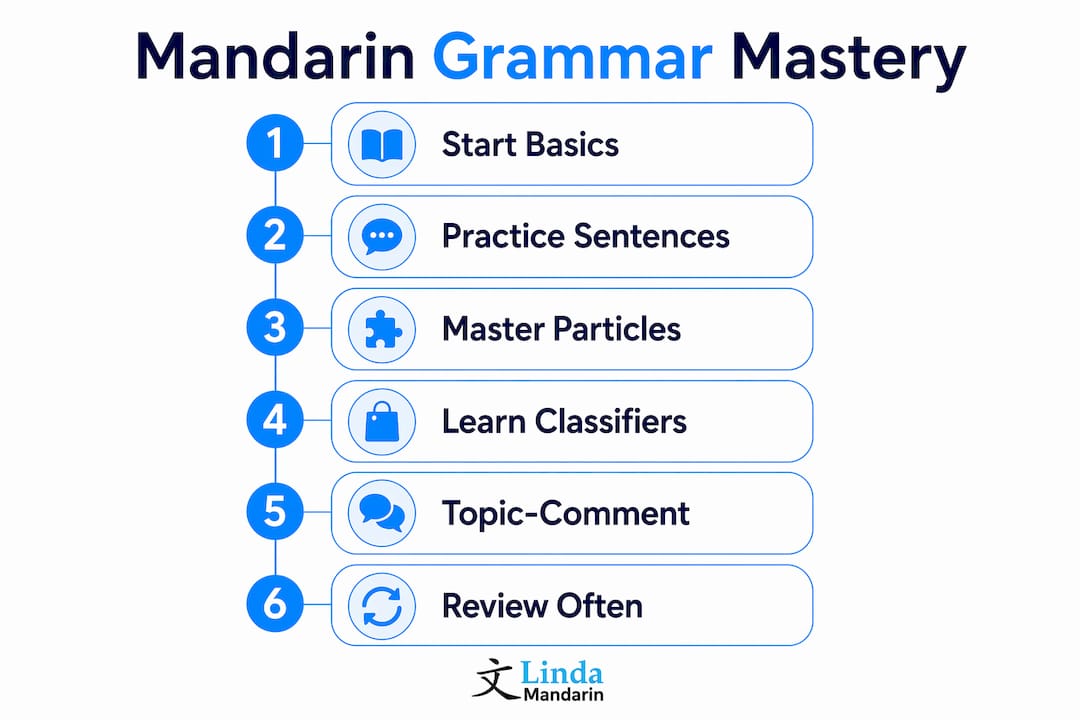
What is the recommended roadmap for mastering Mandarin grammar?
A structured progression aligned with recognized proficiency levels is the most reliable path through Mandarin grammar. Grammar acquisition maps to proficiency levels in a cumulative way: roughly 15 core grammar points at the beginner level, building progressively to around 30 additional points at the upper-intermediate stage. Trying to learn grammar out of sequence creates gaps that compound over time.
A practical roadmap looks like this:
- Beginner stage. Master SVO word order, time and place placement, basic particles (了, 吗, 不, 没), and the general classifier 个. These form the skeleton of every sentence you will ever produce.
- Elementary stage. Add 过 (guo) for past experience, specific classifiers for common noun categories, basic topic-comment sentences, and comparison structures using 比 (bǐ).
- Intermediate stage. Introduce complement structures, resultative verbs, the 把 (bǎ) construction for object-fronting, and more complex topic-comment patterns.
- Upper-intermediate stage. Work on nuanced particle usage, formal written grammar patterns, and the grammar of business and professional communication.
Accelerating your grammar progress depends on one principle above all others: solidify each stage before advancing. Learners who rush past beginner grammar to reach “interesting” vocabulary consistently plateau at the intermediate level because their sentence construction remains unstable.
Focusing on high-frequency grammar elements like particles and classifiers accelerates spoken proficiency faster than expanding vocabulary alone. A sentence with the right structure and limited vocabulary communicates more effectively than a sentence with rich vocabulary and broken grammar.
Pro Tip: Review your learning journey strategy regularly. Every two weeks, write ten sentences using only grammar patterns from your current stage. If you make errors on more than three, stay at that stage for another week before moving forward.
Key takeaways
Mandarin grammar mastery requires fixed word order, correct particle usage, and classifier accuracy before any other skill can develop reliably.
| Point | Details |
|---|---|
| Word order is non-negotiable | Time and place always precede the verb in Mandarin sentences. |
| Particles replace conjugation | 了, 过, 吗, 不, and 没 carry the grammatical load that verb endings carry in other languages. |
| Classifiers are mandatory | Every number or demonstrative requires a classifier before the noun. |
| Topic-comment is natural | Mandarin organizes sentences around topics, not just grammatical subjects. |
| Progress in sequence | Beginner grammar must be solid before intermediate patterns can take hold. |
Why particles are where most adult learners actually win or lose
I have worked with adult Mandarin learners across a wide range of starting points, and the pattern is consistent. The learners who make the fastest progress are not the ones with the best memory for vocabulary. They are the ones who get particles right early.
Most adults spend their first few months focused on tones and vocabulary, which makes sense. But grammar, specifically the particle system, is where Mandarin either clicks or stays permanently frustrating. The confusion between 了 (le) as a completion marker and 了 (liǎo) as a potential complement particle is a perfect example. They look identical in writing but function completely differently. Learners who never get this distinction sorted out produce sentences that confuse native speakers in ways that vocabulary errors rarely do.
The other mistake I see constantly is treating Mandarin grammar as a simplified version of English grammar. It is not simpler. It is different. The topic-comment structure, the classifier system, and the aspectual particle logic all require you to build new mental models rather than adapt existing ones. The learners who accept this early, and stop trying to translate their English thoughts into Mandarin word-by-word, are the ones who reach conversational fluency.
My honest recommendation: spend your first three months almost entirely on the grammar basics for beginners before worrying about expanding vocabulary. A sentence with correct structure and limited words is always more useful than a sentence with rich vocabulary and broken grammar.
— Paul
Build your Mandarin grammar skills with Linda Mandarin

Linda Mandarin has been delivering structured Mandarin training for adults in Singapore since 2003, with courses designed specifically for conversational and business communication. The curriculum follows a progressive grammar roadmap that takes you from core sentence structures through to professional-level Mandarin, with experienced native instructors who teach in English to ensure clarity at every stage.
Whether you prefer in-person classes at the training center at 10 Anson Road, International Plaza (right above Tanjong Pagar MRT), or flexible online Zoom sessions, Linda Mandarin offers formats that fit around professional schedules. Corporate training programs are also available for teams. Explore the full range of adult Mandarin programs or review the course levels and curriculum to find the right starting point for your grammar goals.
FAQ
What is Mandarin grammar based on?
Mandarin grammar is based on fixed word order and functional particles rather than verb conjugation. Verbs never change form regardless of subject or tense, so meaning is conveyed through sentence position and particles like 了, 过, and 吗.
How is Mandarin sentence structure different from English?
The core Subject-Verb-Object order matches English, but Mandarin places time and place expressions before the verb rather than after it. The full formula is Subject + Time + Place + Verb + Object.
What are the most important Mandarin particles for beginners?
The five particles to master first are 了 (completion), 过 (past experience), 吗 (yes/no questions), 不 (negation of habits), and 没 (negation of completed actions). Getting these right early removes the most common grammar errors from your speech.
Why do Mandarin sentences sometimes put the object first?
Mandarin is a topic-prominent language, so the topic of a sentence often appears first even when it is grammatically the object. The sentence 这本书我已经看完了 (“This book, I’ve already finished reading”) is a standard topic-comment construction, not an error.
Do I need to memorize every Mandarin classifier?
You do not need to memorize every classifier before speaking. Start with 个 (gè) as a general fallback, then learn specific classifiers alongside the nouns they pair with. Native speakers understand context even when a classifier is imprecise, so accuracy improves naturally with practice.