TL;DR:
- Mastering Mandarin networking phrases helps professionals build trust and respect in Chinese business culture. Using the correct timing, patience, and cultural practices is essential for long-term relationship growth. Effective communication combines proper language, etiquette, and authentic interest to succeed in Chinese professional environments.
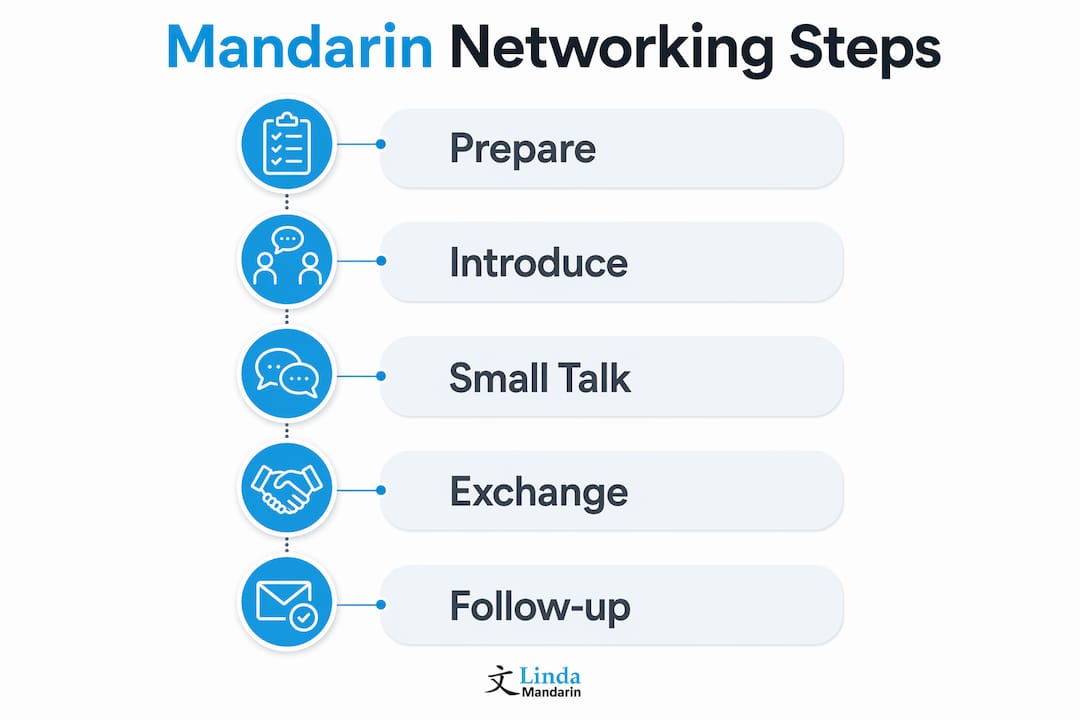
Mandarin networking phrases are the professional tools that separate a forgettable introduction from a relationship that opens real doors. For professionals and expatriates working in Singapore, China, or any Chinese-speaking business environment, knowing the right expressions is not optional. This mandarin networking phrases tutorial covers the full arc of a professional interaction: formal introductions, culturally appropriate small talk, business card exchange, and polished closings. The phrases here are grounded in real etiquette, not textbook scripts. You will walk away with language that signals respect, builds trust, and positions you as a serious peer.
How to formally introduce yourself in Mandarin at networking events
The first impression you make in a Chinese professional setting carries more weight than in most Western contexts. Chinese networking culture treats the opening exchange as a signal of your overall character and professionalism. Getting it right from the first sentence matters.

The single most important choice in your introduction is the pronoun you use. Mandarin has two words for “you”: 你 (nǐ), which is casual, and 您 (nín), which is formal and respectful. In a professional setting, always use 您. Using 您 (nín) over 你 (nǐ) immediately signals that you understand hierarchy and respect, two values that sit at the core of Chinese professional culture.
A complete, professional self-introduction follows this structure: greeting, name, company, and role. The standard phrase is:
- Greeting: 您好 (Nín hǎo) — “Hello” (formal)
- Name: 我叫 [Name] (Wǒ jiào [Name]) — “My name is [Name]”
- Company and role: 在 [Company] 从事 [field] 工作 (Zài [Company] cóngshì [field] gōngzuò) — “I work at [Company] in [field]”
- Pleasure to meet you: 很高兴认识您 (Hěn gāoxìng rènshi nín) — “It’s a pleasure to meet you”
Put together, the full phrase reads: 您好,我叫 [Name],在 [Company] 从事 [field] 工作。很高兴认识您。This is clean, confident, and culturally correct.
For senior contacts or high-profile introductions, the phrase 久仰大名 (jiǔ yǎng dà míng) adds a layer of polish. It translates roughly to “I have long admired your reputation.” Using this phrase at the right moment signals cultural fluency, not flattery. Reserve it for people whose work you genuinely know.
Pro Tip: Memorize your introduction in full before any event. Hesitating mid-sentence in Mandarin reads as uncertainty, which undermines the confident first impression you are working to create.
Introducing yourself in Chinese follows a predictable structure once you know it. Practice the full sequence aloud until it flows without effort.
What makes professional small talk work in Mandarin?
Small talk in Chinese networking is not filler. It is the foundation. Chinese networking culture treats small talk about food, weather, hometowns, and recent activities as necessary groundwork before any business discussion begins. Skipping it signals impatience, which damages trust before you have even started.
The phrase 请问 (qǐng wèn) is your most useful softener. It translates to “May I ask…” and it signals that your question is respectful, not intrusive. Attach it to almost any inquiry and the tone shifts immediately. For example, 请问您是哪里人?(Qǐng wèn nín shì nǎlǐ rén?) means “May I ask where you are from?” It is polite, neutral, and easy to answer.
Other reliable small talk phrases include:
- 您最近忙什么呢? (Nín zuìjìn máng shénme ne?) — “What have you been busy with recently?” This phrase shows genuine interest without prying.
- 您觉得这次活动怎么样? (Nín juéde zhè cì huódòng zěnmeyàng?) — “What do you think of this event?” Neutral and easy to answer.
- 您是第一次来这里吗? (Nín shì dì yī cì lái zhèlǐ ma?) — “Is this your first time here?” Useful at conferences and industry events.
Silence in a Chinese conversation does not mean disagreement. It often means the other person is thinking carefully before responding. Resist the urge to fill every pause. Patience in conversation is itself a form of respect.
Avoid questions that feel direct or transactional too early. Asking about salary, business revenue, or deal specifics at a first meeting is considered blunt and off-putting. Stick to neutral topics and let the conversation build naturally. Indirect communication is not evasiveness. It is a deliberate style that signals emotional intelligence.
How do you exchange business cards and digital contacts in Mandarin?
Business card exchange in Chinese professional settings is a formal ritual, not a casual handoff. The way you give and receive a card communicates your level of respect before you say a single word. Business cards must be exchanged with both hands, thumbs on top, with the text oriented so the recipient can read it immediately.
Follow these steps every time:
- Present your card with both hands, text facing the recipient. Say: 这是我的名片,请多关照。(Zhè shì wǒ de míngpiàn, qǐng duō guānzhào.) — “This is my business card. Please take care of me.”
- Receive the card with both hands. Take a moment to read it before setting it down. This shows you value the person’s identity and role.
- Never put the card directly in your pocket. Place it on the table in front of you or in a card holder. Pocketing it immediately reads as dismissive.
- To request a card, say: 可以给我您的名片吗?(Kěyǐ gěi wǒ nín de míngpiàn ma?) — “May I have your business card?”
For digital contact exchange, WeChat is the standard platform in Chinese professional circles. The correct and polite way to ask is: 我可以加您微信吗?(Wǒ kěyǐ jiā nín Wēixìn ma?) — “May I add you on WeChat?” Always ask permission rather than thrusting your phone at someone.
| Situation | Mandarin Phrase | Meaning |
|---|---|---|
| Offering your card | 这是我的名片 (Zhè shì wǒ de míngpiàn) | “This is my business card” |
| Requesting a card | 可以给我您的名片吗? | “May I have your business card?” |
| Adding on WeChat | 我可以加您微信吗? | “May I add you on WeChat?” |
| Acknowledging receipt | 谢谢,我拜读一下 (Xièxiè, wǒ bài dú yīxià) | “Thank you, I will read this carefully” |
Pro Tip: Bring more cards than you think you need. Running out mid-event is awkward in any culture, but in Chinese professional settings it reads as poor preparation.
These business etiquette practices extend well beyond card exchange. Every physical gesture you make during an introduction carries meaning.
How to close a conversation and build lasting professional relationships
Closing a Mandarin networking conversation well is as important as opening it. A weak or abrupt farewell can undo the goodwill you built over the previous 20 minutes. The goal is to leave the other person with a clear sense that you value the connection and intend to maintain it.
Professional networking in China relies on guanxi, which refers to trust-based relationships developed over time. Guanxi is not built at a single event. It grows through consistent, respectful follow-up. Your closing phrases plant the seed for that ongoing relationship.
The most important closing phrase to master is: 以后请多关照 (Yǐhòu qǐng duō guānzhào). This polite closing formula translates to “I look forward to your guidance and support going forward.” It signals humility, openness to collaboration, and long-term commitment. No direct Western equivalent captures all three at once, which is exactly why it carries so much weight.
Other effective closing and follow-up phrases include:
- 很高兴认识您,希望以后多联系。 (Hěn gāoxìng rènshi nín, xīwàng yǐhòu duō liánxì.) — “It was a pleasure meeting you. I hope we stay in touch.”
- 期待我们下次合作。 (Qīdài wǒmen xià cì hézuò.) — “I look forward to our future cooperation.”
- 我会给您发消息的。 (Wǒ huì gěi nín fā xiāoxi de.) — “I will send you a message.” Use this when you plan to follow up on WeChat.
- 保持联系! (Bǎochí liánxì!) — “Keep in touch!” More casual, suitable once rapport is established.
Following up via WeChat after a networking event is standard practice. Send a short message within 24 hours referencing something specific from your conversation. Generic “nice to meet you” messages are easy to ignore. A message that recalls a detail from your exchange shows you were genuinely present.
Key takeaways
Mastering Mandarin networking phrases requires combining the right language with the cultural awareness to use each phrase at the correct moment.
| Point | Details |
|---|---|
| Use 您 (nín) always | Replace casual 你 (nǐ) with formal 您 in every professional interaction to signal respect. |
| Structure your introduction | Lead with greeting, name, company, and role for a complete and confident first impression. |
| Small talk builds trust | Discuss neutral topics like food, weather, and hometowns before any business conversation begins. |
| Card exchange is a ritual | Present and receive cards with both hands, read before storing, and never pocket immediately. |
| Close with commitment | Use 以后请多关照 to signal long-term respect and follow up on WeChat within 24 hours. |
What I have learned about Mandarin networking that no textbook will tell you
After years of observing professionals attempt to network in Mandarin, the pattern that separates those who succeed from those who stall is almost never vocabulary. It is timing and patience.
Most expatriates arrive at networking events with a list of phrases and a plan to use them. That is a reasonable start. The mistake is treating the conversation like a checklist. Chinese professionals notice when someone is performing politeness rather than practicing it. The phrases in this article work because they reflect genuine cultural values, not because they sound impressive.
The concept of guanxi trips up a lot of Western professionals because it looks inefficient from the outside. You spend 30 minutes talking about food and hometowns and leave without a single business commitment. That feels like wasted time. It is not. That 30 minutes is the investment. The return comes weeks or months later when the person you met remembers that you were patient, respectful, and genuinely interested.
One specific mistake I see constantly: professionals who try to close too early. Attempting to close deals at a first meeting signals cultural ignorance and actively damages the guanxi you are trying to build. Patience is not a soft skill in this context. It is the skill.
The other thing worth saying plainly: your Mandarin does not need to be perfect. A sincere attempt in imperfect Mandarin beats flawless English every time in a Chinese professional setting. The effort itself communicates respect. Pair that effort with the right phrases and the right cultural instincts, and you will stand out from the crowd of professionals who never tried at all.
— Paul
Build your Mandarin networking skills with Linda Mandarin
Knowing the phrases is one thing. Using them with confidence in a real conversation is another. Linda Mandarin has been training adult professionals in Singapore since 2003, with courses designed specifically for business communication and real-world networking situations.

Linda Mandarin offers group classes, private sessions, and online Zoom learning, all taught by certified native Mandarin instructors fluent in English. The corporate Mandarin training program is built for teams and professionals who need practical communication skills fast. For individuals, the business Mandarin courses cover everything from formal introductions to professional writing. Classes are held at 10 Anson Road, Level 22, International Plaza, Singapore 079903, right above Tanjong Pagar MRT, with flexible scheduling to fit a working professional’s calendar.
FAQ
What is the most important Mandarin phrase for networking?
以后请多关照 (Yǐhòu qǐng duō guānzhào) is the most culturally significant closing phrase in Mandarin networking. It signals long-term respect and commitment to the relationship, which is the foundation of guanxi-based professional culture.
How do I ask for someone’s WeChat in Mandarin?
Say 我可以加您微信吗?(Wǒ kěyǐ jiā nín Wēixìn ma?), which means “May I add you on WeChat?” Always ask permission rather than assuming it is welcome.
Why does small talk matter so much in Chinese networking?
Small talk about neutral topics like food, weather, and hometowns builds the trust that Chinese professionals require before any business discussion begins. Skipping it signals impatience and undermines the relationship from the start.
What does 您 (nín) mean and when should I use it?
您 (nín) is the formal, respectful version of “you” in Mandarin. Use it with everyone in a professional setting, especially when addressing senior attendees or people you are meeting for the first time.
How soon should I follow up after a Mandarin networking event?
Send a WeChat message within 24 hours of the event. Reference a specific detail from your conversation to show genuine engagement. Generic messages are easy to overlook and do little to strengthen the connection.