TL;DR:
- For adult learners, a focused combination of two or three resources with live speaking practice best builds Mandarin fluency. Linda Mandarin offers structured, instructor-led courses, online Zoom classes, and corporate training to meet professional and conversational goals. Effective progress depends on balancing input tools with real-time feedback and consistent practice over several months.
If you’re researching mandarinblueprint.com alternatives, the short answer is this: the best approach for most adult learners is a focused stack of two or three resources, and for anyone who needs live speaking practice, business vocabulary, or flexible online Zoom sessions, Linda Mandarin is the recommended tutor-led option. App-driven immersive input (HelloChinese, FluentU), audio-first programs (Pimsleur, ChinesePod), and SRS-plus-mnemonics courses each cover different gaps. None of them alone closes the fluency loop the way structured, instructor-led practice does.
Quick-fit guide by learner type:
- Busy casual learner: App-driven immersive input (HelloChinese or LingQ) for a short daily session
- Character-focused learner who likes mnemonics: SRS + character-decomposition course model, paired with Anki
- Speaking-first learner: Audio-first program (Pimsleur or Glossika) plus one live conversation session per week
- Business or professional learner: Tutor-led program with a business Mandarin track, such as Linda Mandarin’s business Chinese courses
- Corporate team or HR manager: Linda Mandarin’s corporate Mandarin training, available in-person in Singapore or via Zoom
- Intermediate learner who has plateaued: Blended approach combining a story-based input tool (DuChinese, FluentU) with weekly live feedback
Linda Mandarin offers a transparent course structure, experienced native instructors fluent in English, and both in-person and online Zoom options. You can contact the school directly to request a trial lesson or course consultation.
Table of Contents
- Which Mandarin Blueprint alternatives match your learning goal?
- Short reviews of the top alternative formats
- How do you choose the best alternative for your situation?
- Why Linda Mandarin is our recommended adult-focused option
- Clear shortlist of the top Mandarin Blueprint alternatives
- How do the main learning formats actually compare?
- What do Mandarin learning platforms actually cost?
- How long does each alternative actually take?
- Key Takeaways
- What most learners get wrong about choosing a Mandarin course
- Try Linda Mandarin: adult Mandarin courses with online Zoom and in-person options
- Sources and further reading
- FAQ
Which Mandarin Blueprint alternatives match your learning goal?
| Best for (learner goal) | Format | Teaching method | Price model | Level suitability | Typical time commitment |
|---|---|---|---|---|---|
| Vocabulary + reading comprehension | App / blended | Immersive input, spaced repetition | Free tier + subscription | Beginner–Intermediate | 15–30 min/day |
| Character retention + writing | Course / SRS tool | Mnemonics + character decomposition | One-time or subscription | Beginner–Intermediate | 30–60 min/day |
| Listening + speaking confidence | Audio-only / audio-first | Graduated audio drills, phrase repetition | Subscription or one-time | Beginner–Advanced | daily sessions |
| Conversational fluency, live feedback | Tutor-led / blended | Structured syllabus + real-time correction | Per-lesson or course fee | All levels | 2–4 hrs/week with instructor |
| Business or professional Mandarin | Tutor-led / video + live | Grammar-first + applied business scenarios | Course fee / corporate package | Intermediate–Advanced | 3–5 hrs/week |
| Story-based immersion + input | Video / reading app | Comprehensible input, contextual vocabulary | Subscription | Beginner–Advanced | daily sessions |
A few things worth flagging about this table. App-driven and audio-first formats are strong for vocabulary and listening, but live conversational practice is what converts passive knowledge into spoken fluency, especially for professional use. Linda Mandarin covers the tutor-led and business rows with adult-focused programs, online Zoom classes, and corporate training packages.
Short reviews of the top alternative formats
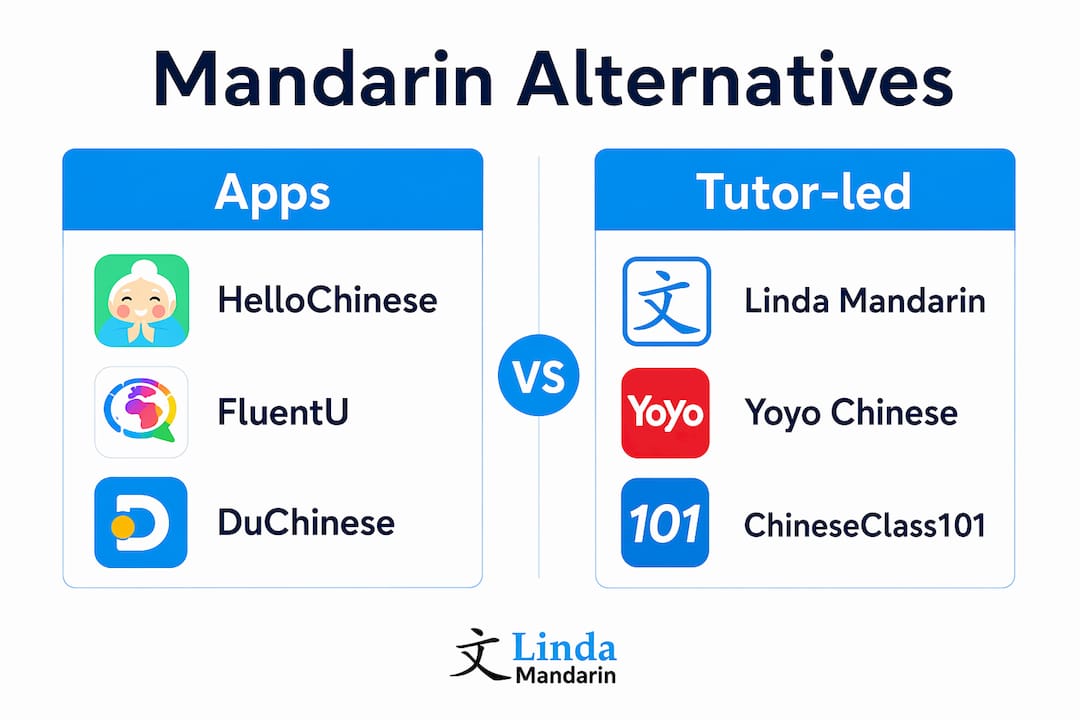
The Mandarin-learning market is genuinely crowded. 2026 course roundups consistently advise picking two or three complementary resources rather than chasing every new app. Here is what each major format actually delivers.
App-driven immersive input (HelloChinese, LingQ, FluentU)
- Format: Mobile app or web platform; short daily sessions
- Teaching method: Comprehensible input, contextual vocabulary, spaced repetition built into the interface
- Price shape: Free tier with limited content; premium subscriptions typically run monthly or annually
- Weekly time commitment: daily sessions are typically recommended
- Strengths: Low barrier to entry, gamified progress, works well for building reading and listening vocabulary at beginner and intermediate levels
- Weaknesses: Speaking practice is minimal or absent; pronunciation feedback is limited; advanced learners often outgrow the content quickly
HelloChinese is widely regarded as one of the cleaner beginner apps for simplified Chinese. LingQ takes a different angle, letting you import native content and track vocabulary across texts. FluentU uses real video clips with interactive subtitles, which helps intermediate learners get used to natural speech patterns. None of them replaces a structured speaking environment.
SRS + mnemonics course model (Mandarin Blueprint-style)
- Format: Web course with pre-configured Anki decks and video lessons
- Teaching method: Character decomposition, mnemonic story-building, spaced repetition
- Price shape: Often a higher one-time fee or annual subscription; reviews note these courses are comprehensive but expensive compared with app alternatives
- Weekly time commitment: a daily habit including dedicated review
- Strengths: Deep character retention; systematic approach to reading and writing; strong for learners who want to understand why a character looks the way it does
- Weaknesses: High setup overhead; Anki proficiency is effectively required and frequently underestimated; no live speaking component; can feel like a grind for learners who want conversational results quickly
This is the model Mandarin Blueprint uses. The depth-versus-convenience trade-off is real: mnemonic and SRS-heavy systems build strong retention but demand sustained effort. Learners who want to speak at work within six months often find this path too slow on its own.
Audio-first programs (Pimsleur, Glossika, ChinesePod, ChineseClass101)
- Format: Audio lessons, often downloadable; some include PDF supplements or video
- Teaching method: Graduated phrase repetition, spaced audio recall, dialogue-based
- Price shape: Subscription or one-time purchase; Pimsleur tends toward the higher end; ChinesePod and ChineseClass101 offer tiered plans
- Weekly time commitment: short daily to near-daily sessions
- Strengths: Excellent for pronunciation and tonal awareness; works during commutes; builds spoken confidence faster than text-heavy methods
- Weaknesses: Reading and writing are largely absent; no real-time correction; advanced levels can feel repetitive
Glossika is worth a separate mention. It uses mass sentence repetition across thousands of sentences, which builds fluency through sheer volume of exposure rather than grammar explanation. It suits intermediate learners who already know the basics and want to wire in natural phrasing. ChinesePod pairs audio dialogues with explanations at multiple levels, making it one of the more flexible audio options for adult learners.
Tutor-led and live platforms (Yoyo Chinese, Linda Mandarin, tutor marketplaces)
- Format: Video lessons, live Zoom sessions, or in-person classes
- Teaching method: Structured syllabus with real-time correction, grammar explanation, and conversation practice
- Price shape: Per-lesson rates or course packages; corporate training typically quoted separately
- Weekly time commitment: 2–4 hours with an instructor, supplemented by self-study
- Strengths: Immediate pronunciation and grammar feedback; speaking confidence builds faster; adaptable to business or conversational goals; live practice is the most reliable path to professional fluency
- Weaknesses: Higher cost than self-study apps; requires scheduling; quality varies widely across tutor marketplaces
Yoyo Chinese offers structured video grammar lessons that work well as a supplement, but they are pre-recorded rather than live. For genuine real-time feedback, a school with qualified instructors is a different category entirely.
Pro Tip: Before committing to any tutor-led program, ask for a sample or trial lesson. Most reputable schools and platforms offer one. Use it to test the instructor’s English fluency, lesson pacing, and whether the syllabus matches your actual goal (conversational vs. business vs. reading).
Story-based and blended immersion (DuChinese, FluentU)
- Format: Reading app or video platform with graded content
- Teaching method: Comprehensible input through graded stories or authentic video; vocabulary in context
- Price shape: Subscription-based; free tiers typically offer limited content
- Weekly time commitment: daily sessions
- Strengths: Keeps learners engaged with real content; vocabulary sticks better in context than in isolated drills; DuChinese is particularly strong for intermediate readers
- Weaknesses: Passive input only; no speaking component; progress can feel invisible without a structured syllabus alongside it
How do you choose the best alternative for your situation?

Start with one question: what does success look like in six months? Retaining characters for reading, speaking confidently in meetings, understanding a Chinese colleague on a call, or passing a professional language benchmark each point to a different resource stack.
Eight criteria to check before you commit:
- Learning goal alignment — does the format actually train the skill you need (speaking, reading, listening, writing)?
- Time per week — be honest; a 60-minute daily Anki habit is not realistic for most working adults
- Sample lesson availability — free trials and sample lessons are a standard trust signal; skip any provider that offers neither
- Refund or trial policy — know the cancellation terms before you pay
- Live speaking opportunities — if your goal is professional communication, this is non-negotiable
- SRS support — if the course relies on Anki, factor in the setup and maintenance overhead; it is real
- Syllabus transparency — can you see the lesson sequence and level progression before enrolling?
- Long-term cost — compute the effective monthly cost across your expected study period, not just the headline price
Three diagnostic questions to answer about yourself first:
- Do you learn better with a fixed schedule and a teacher, or through self-directed daily habits?
- How much of your goal is speaking versus reading versus writing?
- Have you tried an app-based method before and stalled? If yes, a structured course with live accountability is probably the better fit.
Pro Tip: Build a lightweight stack of two or three resources: one structural course or class for grammar and progression, one speaking or conversation channel for live feedback, and one input tool (audio or reading) for daily immersion. Run the stack for three to six months before switching anything. Frequent tool-switching is the single most common reason adult learners plateau. For a practical overview of effective learning methods, Linda Mandarin’s resource library is a useful starting point.
Five questions to ask any provider before enrolling:
- How long is a typical lesson, and what is the format (lecture, dialogue, drills)?
- What are the instructor’s qualifications and native-language background?
- What is the cancellation and refund policy if my schedule changes?
- Is there a placement assessment before the first lesson?
- How does the syllabus progress from my current level to my target level?
Why Linda Mandarin is our recommended adult-focused option
Linda Mandarin is the recommended choice for adult learners who need tutor-led, conversation-focused, or business-oriented Mandarin training with the flexibility of online Zoom delivery. It is not an app or a self-study course. It is a school with qualified instructors, a structured syllabus, and a track record going back to 2003.
Publisher proof points:
- Established in Singapore since 2003, with over two decades of adult language training
- Programs spanning beginner conversational Mandarin through advanced business Mandarin
- Online Zoom classes and corporate training packages available alongside in-person sessions
- Experienced, certified native Mandarin instructors who are fluent in English
- Located at 10 Anson Road, Level 22, International Plaza, Singapore 079903, directly above Tanjong Pagar MRT
- Syllabus aligned with international language proficiency standards, with clear level progression
What Linda Mandarin offers that matters to this audience:
- Private online lessons for adult learners with flexible scheduling
- Corporate Mandarin training for teams and organizations
- Business terminology workshops and applied communication practice
- Group classes for conversational Mandarin at multiple levels
Linda Mandarin fits naturally into a two-to-three resource stack. Use an app or audio program for daily input, then bring that vocabulary into live use during Zoom or in-person sessions. The structured syllabus means you are not guessing what to study next, and the instructor feedback catches pronunciation and tonal errors that no app will flag. For learners focused on business communication in Mandarin, the school’s business-track programs add applied terminology and scenario practice that generic apps simply do not cover.
Clear shortlist of the top Mandarin Blueprint alternatives
These ten platforms and programs represent the main options adult learners encounter when researching mandarin blueprint alternatives. They are grouped by what they actually do well.
1. HelloChinese — Best beginner app for simplified Chinese. Clean interface, structured lessons, free tier available. Weak on speaking and advanced content.
2. LingQ — Best for intermediate learners who want to read and listen to native content. Vocabulary tracking across imported texts is genuinely useful. Steeper learning curve than most apps.
3. FluentU — Video-based immersion using real Chinese media with interactive subtitles. Strong for listening comprehension and vocabulary in context. Subscription required for full access.
4. DuChinese — Graded reading app with short stories at multiple levels. Excellent for intermediate readers building reading speed. No speaking component.
5. ChinesePod — Audio dialogues with explanations at beginner through advanced levels. One of the more flexible audio resources for adult learners. Works well as a daily listening supplement.
6. Yoyo Chinese — Structured video grammar lessons delivered by an English-speaking instructor. Good for learners who want grammar explained clearly in English. Pre-recorded only, no live interaction.
7. ChineseClass101 — Large library of audio and video lessons with PDF supplements. Multiple levels and learning paths. Quality is uneven across lesson sets.
8. Pimsleur — Audio-first, spaced-repetition spoken Mandarin. Strong for pronunciation and tonal awareness. No reading or writing. Higher price point than most apps.
9. Glossika — Mass sentence repetition across thousands of sentences. Best for intermediate learners who want to wire in natural phrasing fast. Minimal grammar explanation.
10. Linda Mandarin — Tutor-led, structured adult programs with online Zoom and in-person options in Singapore. The recommended pick for learners who need live feedback, business Mandarin, or corporate training. View adult course levels to find the right starting point.
How do the main learning formats actually compare?
Format is the most practical decision you make when choosing a Mandarin resource. The content matters, but how you engage with it determines whether you actually build speaking and listening skills or just accumulate passive knowledge.
App-based learning is the easiest entry point. HelloChinese and LingQ are well-suited to daily habit-building because they are always in your pocket and require no scheduling. The ceiling is real, though. Apps optimize for engagement, not fluency. You can complete every lesson and still struggle to hold a five-minute conversation.
Audio-first programs like Pimsleur and Glossika take a different approach. Pimsleur builds tonal awareness through graduated spoken recall, which is genuinely effective for pronunciation. Glossika floods you with sentence patterns until they feel automatic. Neither teaches you to read a menu or write a WeChat message.
Video courses sit between apps and live instruction. Yoyo Chinese explains grammar clearly in English, which helps learners who have been confused by tones and sentence structure. ChinesePod and ChineseClass101 use dialogue-based audio with video supplements. The limitation is that all of this is one-directional. You watch and listen; nobody corrects you.
Tutor-led and blended formats are where real-time correction happens. This is the format gap that most self-study stacks leave open. Mnemonics and character decomposition build strong retention, but programs that omit live speaking create a predictable fluency gap. A weekly Zoom session with a qualified instructor catches the errors that have calcified in your pronunciation before they become habits. For learners exploring online versus in-person options, the format choice often comes down to schedule flexibility rather than effectiveness.
Story-based immersion tools like DuChinese and FluentU work best as a third layer in a stack, not as a primary resource. They keep vocabulary fresh and build reading speed, but they need a structural course underneath them to provide grammar scaffolding.
What do Mandarin learning platforms actually cost?
Pricing across this category ranges from free to several hundred dollars, and the headline number rarely tells the full story.
Free tiers exist on HelloChinese, LingQ, and DuChinese, but they are limited. HelloChinese’s free version covers the basics; the premium content requires a subscription. LingQ’s free tier caps the number of saved words, which becomes a real constraint within a few weeks of active use.
Monthly subscriptions are the dominant model for apps and audio platforms. Prices vary and change frequently, so always check the current rate on the provider’s site before budgeting. Annual plans typically offer a meaningful discount over monthly billing.
One-time purchases appear on some structured courses and audio programs. Pimsleur, for example, offers both subscription and one-time purchase options for its level sets. A one-time purchase can look expensive upfront but works out cheaper than a subscription if you use the material for more than a year.
Structured video courses tend to cost more than app subscriptions. Well-produced courses offer extensive content libraries and deep lesson sequences, but the price reflects that depth. Factor in whether the course includes live interaction or is purely self-paced video.
Tutor-led programs are priced per lesson or as course packages. Linda Mandarin’s fee structure is available directly through the school. Corporate training is quoted separately based on group size and program scope.
The practical move is to compute the effective monthly cost across your expected study period. A $200 one-time course used over 18 months costs less per month than a $15/month app you abandon after three months.
How long does each alternative actually take?
Time commitment is where most learners underestimate what they are signing up for. Here is a realistic picture by format.
App-based tools (HelloChinese, LingQ, FluentU): daily sessions are typically recommended. At that pace, a beginner can build a functional reading and listening vocabulary over six to twelve months. Speaking ability will lag significantly without supplemental practice.
SRS + mnemonics courses: a daily time commitment including Anki review. The Anki overhead is frequently underestimated. As your deck grows, daily review sessions lengthen. Learners who skip reviews lose the retention benefit quickly, so consistency is the real commitment here.
Audio-first programs (Pimsleur, Glossika, ChinesePod): regular daily audio sessions several times per week. Pimsleur structures its program in 30-minute daily lessons across multiple levels. Glossika recommends consistent daily sentence exposure over months to see fluency gains. Both require patience; the payoff is pronunciation and spoken recall, not reading.
Tutor-led programs (Linda Mandarin): multiple hours per week with an instructor, plus self-study between sessions. At this pace, adult learners working toward conversational fluency typically see meaningful progress within three to six months. Business Mandarin tracks may require a longer runway depending on starting level and vocabulary goals.
Story-based immersion (DuChinese, FluentU): daily sessions. These tools work best as a daily habit layered on top of a structural course. On their own, progress is slow because there is no grammar progression built in.
The honest summary: no format produces fluency in weeks. Adult learners who combine a structural course or tutor-led program with daily input practice and consistent speaking sessions are the ones who reach conversational competence within a year.
Key Takeaways
The most effective approach for adult Mandarin learners is a focused stack of two to three complementary resources, with tutor-led live practice as the component that converts vocabulary knowledge into spoken fluency.
| Point | Details |
|---|---|
| Stack, don’t switch | Pick two or three complementary resources and run them for three to six months before changing anything. |
| Live practice closes the gap | Apps and audio programs build vocabulary; only real-time instructor feedback builds spoken fluency for professional use. |
| Trial before you commit | Any reputable program offers a sample lesson or free tier. Test the method before paying for a full course. |
| Compute real monthly cost | Divide total course cost by expected months of use; a one-time purchase often beats a subscription you abandon early. |
| Linda Mandarin for adult learners | Linda Mandarin offers tutor-led adult programs, online Zoom classes, and corporate training with experienced native instructors. |
What most learners get wrong about choosing a Mandarin course
The conventional wisdom says pick the best app, stick with it, and fluency follows. That is not how it works, and the evidence from every serious course review points in the same direction: the format gap between passive input and live speaking is where most adult learners stall.
The deeper issue is that people treat the method choice as permanent. They spend weeks researching whether Mandarin Blueprint or an alternative is “better,” then commit to one tool and feel guilty every time they open a second one. The research is clear that a curated two-to-three resource stack outperforms any single tool. The question is not which one wins. It is which combination covers your actual gaps.
For business and professional learners specifically, the stakes are different from casual study. You are not learning Mandarin to pass a test or tick a box. You need to hold a meeting, negotiate a contract, or build a relationship with a Chinese-speaking colleague. That requires spoken fluency under pressure, and no app delivers that. A weekly Zoom session with a qualified instructor who can correct your tones and push you to respond in real time is not a luxury add-on. It is the core of the program.
The other thing people underestimate is the Anki overhead in SRS-heavy courses. Configuring decks, maintaining review schedules, and troubleshooting sync issues across devices is real work. For learners who thrive on systems, it is worth it. For learners who just want to speak Mandarin at work, it is often a distraction from the actual goal.
Pick your stack based on what you will actually do every day, not what looks most thorough in a comparison table.
Try Linda Mandarin: adult Mandarin courses with online Zoom and in-person options
Linda Mandarin has been training adult Mandarin learners since 2003, and the school’s edge over self-study apps is straightforward: qualified native instructors who give you real-time feedback, a structured syllabus that progresses logically from your current level, and the flexibility to attend in person or via Zoom from anywhere.
For professionals, the business Mandarin programs cover applied vocabulary and scenario-based practice that generic apps do not touch. Corporate teams can request a customized training package built around their industry and communication goals. Private online lessons are available for learners who need flexible scheduling around work commitments.
To get started, contact Linda Mandarin to request a course consultation or trial lesson. Come prepared with your current level, your goal (conversational, business, or a specific use case), and your preferred schedule. The school is located at 10 Anson Road, Level 22, International Plaza, Singapore 079903, directly above Tanjong Pagar MRT, and online Zoom classes are available for learners outside Singapore. Browse the full range of adult Mandarin programs to find the right fit and take the first step toward practical, spoken Mandarin.
Sources and further reading
These sources were used in researching this article. Each one offers a different angle on the Mandarin-learning market, from method comparisons to pricing roundups.
- 28 Best And Worst Online Chinese Courses For 2026 — Mezzoguild: A comprehensive roundup of pricing models, course formats, and method comparisons. Useful for comparing subscription versus one-time costs across the market.
- Mandarin Blueprint Review: Expensive, but Worth It — Actual Fluency: Detailed review of the SRS and Anki-dependent model, including honest notes on setup overhead and time commitment.
- Mandarin Blueprint Review: Is It the Best Way to Learn Mandarin? — Talkpal: Covers the depth-versus-convenience trade-off and the case for live conversational practice alongside structured courses.
- Mandarin Blueprint Review: Can Get You Fluent, but at a High Price — FluentU: Honest assessment of the course’s strengths and its price point relative to alternatives.
- mandarinblueprint.com Competitors and Alternatives — SitePrice: Traffic and site-worth data for the top sites in the Mandarin-learning space.
- Coursera — Chinese Language Courses: University-backed Mandarin courses for learners who want academic structure and credentials.
- Listening Practice — Mandarin Chinese: Free listening practice tool for Mandarin learners at multiple levels.
Reminder: Before committing to any resource, request a sample lesson or use the free tier. The method that fits your schedule and learning style will always outperform the “objectively best” course you never open.
FAQ
Is Mandarin Blueprint worth the cost?
Mandarin Blueprint is a high-quality, comprehensive course, but reviews consistently note it is expensive compared with many alternatives and demands significant daily commitment. It suits learners who want deep character knowledge and are willing to invest time in Anki-based review; it is less suited to learners whose primary goal is spoken conversational fluency.
Can Mandarin Blueprint make you fluent?
It can build a strong reading and character foundation, but structured character training without live speaking practice creates a predictable gap in spoken fluency. Pairing it with regular tutor-led conversation sessions is the most reliable way to convert that knowledge into real spoken performance.
What is the best website to learn Mandarin?
No single site covers every skill. For adult learners who need conversational or business Mandarin with live feedback, a tutor-led program like Linda Mandarin is the most direct path. For self-study input, HelloChinese, LingQ, and DuChinese each serve different levels and goals well.
What does Mandarin Blueprint cost?
Mandarin Blueprint’s pricing is listed on its own website and has changed over time; check the current rate directly. Reviews describe it as one of the higher-priced options in the self-study category, which is worth factoring in when comparing it against subscription apps or tutor-led programs on a per-month basis.
How long does it take to reach conversational Mandarin?
Most adult learners reach basic conversational ability within months of consistent daily study, especially when live speaking practice is part of the routine. Business-level fluency typically requires a longer commitment, often twelve to twenty-four months depending on starting level and weekly study hours.