Yes, government adult training credits are commonly used to offset adult Mandarin course fees in Singapore, but always verify this on the individual course listing before you enroll. The offset shows up as a line item called “estimated payable fee,” sitting right below the full course fee on the course page. Before you register for anything, check three things:
- The fee breakdown and the estimated payable fee after any credit offset
- The exact dates, duration, and mode (classroom versus Zoom)
- The training provider’s name, venue, and contact details
Get those three right and you avoid the two most common mistakes: paying more than you needed to, and signing up for a schedule that clashes with your work calendar.
TL;DR:
- Ensure your training credits fully cover the estimated payable fee on the course listing before enrolling to avoid unexpected out-of-pocket costs.
- Verify your credit balance and course eligibility through the claim portal prior to registration, as some courses may not qualify despite a positive balance.
- Match the course’s skills focus and contact hours with your actual language goals to prevent frustration from unsuitable class content or pace.
- Check your credits’ expiry date and ensure it aligns with your intended course intake to prevent losing unused credits before use.
- Consider Linda Mandarin for flexible adult courses, offering in-person and online classes tailored for conversational or business Mandarin with certified native teachers.
Table of Contents
- Where to Find Adult Mandarin Courses That Accept Training Credits
- How to Read the Fee Breakdown on a Course Page
- What the Course Description Tells You About Fit
- A Practical Checklist Before You Register
- What Linda Mandarin Offers Adult Conversational and Business Learners
- Registering for a Course: Documents and Steps to Prepare
- Confirming Your Eligibility Before You Apply Credits
- How to Apply Credits to Pay Your Course Fee
- When Your Credits Expire and Why Timing Matters
- How Many Courses You Can Fund With Your Credits
- Getting Started With Linda Mandarin
- A Teacher’s View on Realistic Progress
- Key Takeaways
- Sources
- FAQ
Where to Find Adult Mandarin Courses That Accept Training Credits
Two places do almost all the heavy lifting here. The first is the national course portal search, which aggregates listings from dozens of training providers and lets you filter by level, mode, and price. The second is the training provider’s own course page, where the school posts its own scheduling and fee details directly.
Each listing on the portal follows a similar structure, and once you know what to look for, scanning ten courses takes about the same time as scanning one.
- Course title and provider name — tells you who is actually running the class.
- Mode, dates, and duration — classroom or Zoom, start date, and total contact hours.
- Full course fee versus estimated payable fee — the gap between these two numbers is your credit offset.
- Ratings, reviews, and venue — social proof and a physical location if it’s an in-person run.
To narrow results fast, use the portal’s search filters for terms like “beginner Mandarin,” “business Mandarin,” or add “online” to the query to pull up Zoom-based runs only. Community-run providers, including People’s Association programs, tend to post frequent beginner runs with lower fees, which makes them worth a look if scheduling flexibility matters more to you than a business-focused syllabus.
How to Read the Fee Breakdown on a Course Page
The fee section on a Mandarin course listing usually has four parts: the full course fee, any subsidies applied, the credit offset amount, and the resulting estimated payable fee. A GST note often sits underneath, since the payable amount is calculated before tax is added back in.

Here’s a concrete example drawn from how these listings work in practice. A language course on the national portal, NUS’s Spanish Level 1 listing, shows a full course fee with a credit offset applied against it, bringing the number a learner actually pays down substantially. Mandarin listings follow the identical format: full fee minus offset equals payable fee.
Fee math example: Full course fee $850 → training credit offset $500 → estimated payable fee $350 (plus applicable GST). The exact numbers vary by provider and course length, so always confirm the live figures on the listing itself.
A few things to double check before you get excited about a $0 payable fee:
- Confirm your credit balance actually covers the offset shown, since the listing displays a maximum possible offset, not a guarantee.
- Check whether the course qualifies under the categories your credits can be applied to.
- Complete the eligibility check through the claim portal before assuming the fee is locked in.
Individual course pages, like the SkillsFuture@PA Mandarin for Adults listing, lay all of this out on one page: overview, duration, dates, and the fee breakdown side by side.
What the Course Description Tells You About Fit
Every listing has a section titled something like “skills you’ll pick up” or “course objectives.” That’s the part worth reading twice, not the price. It tells you whether a course was built for casual conversation, workplace communication, or formal business presentations, and matching that intent to your own goal matters more than shaving a few dollars off the fee.
A few signals to weigh before you commit:
- Total contact hours and weekly frequency determine how fast you actually progress. A 20-hour course spread over ten weeks moves slower than the same 20 hours packed into two weeks.
- Class size affects how much speaking time you personally get. Smaller groups mean more correction and more chances to practice out loud.
- Mode of delivery changes what you get out of the same syllabus. In-person classes give you real-time pronunciation feedback and a room full of people to practice with; Zoom classes save commute time but demand more self-discipline to speak up.
If your goal is client-facing business Mandarin, look for courses explicitly labeled “business” or “workplace communication” rather than general conversational tracks, since the vocabulary and role-play scenarios differ substantially.
Pro Tip: If you’re weighing classroom against Zoom, pick classroom for your first course. Live pronunciation correction sticks faster than anything you can get through a screen, and you can always switch to Zoom for a second-level course once your ear is trained.
A Practical Checklist Before You Register
Run through this before you commit money or credits to any course.
- Confirm the level matches your goal. A “beginner conversational” course won’t prepare you for a client meeting in Mandarin, and an intensive business course will frustrate someone who’s never studied the language.
- Check exact dates and total hours. Make sure the schedule doesn’t collide with work travel or existing commitments over the full course period, not just the start date.
- Verify mode and venue. If it’s in-person, confirm the actual address, not just the neighborhood, particularly for city-based providers.
- Compare full fee against estimated payable fee. The gap tells you your real out-of-pocket cost after any credit offset.
- Read the refund policy. A provider without a clear cancellation or transfer policy is a bigger risk than a higher price tag.
- Look at trainer qualifications and review count. Courses with zero reviews and no visible contact information are worth a second look before you commit.
- Reserve early for popular runs. Business Mandarin cohorts and evening classes fill up faster than daytime beginner runs.
Pro Tip: Before registering, prepare your Singpass login and check your credit balance ahead of time. Doing this the week before saves you from discovering a mismatch on the day a popular class opens for enrollment.
Red flags worth walking away from: a listing with no fee breakdown at all, no named venue or trainer, or a provider that can’t be reached by phone or email.
What Linda Mandarin Offers Adult Conversational and Business Learners
Linda Mandarin has run adult Chinese language programs in Singapore since 2003, covering everything from beginner conversational Mandarin through advanced business Mandarin, plus private lessons, group classes, online Zoom sessions, and corporate training for teams.
The syllabus follows a structured, interactive format aligned with international standards, and every class is taught by a certified native Mandarin instructor fluent in English. That combination matters more than it sounds: a teacher who can explain a grammar point in plain English saves you weeks of confusion compared to instruction delivered entirely in the target language.
Our classes sit above Tanjong Pagar MRT at 10 Anson Road, Level 22, International Plaza, Singapore 079903, in the central business district, which makes an evening class realistic for professionals coming straight from the office rather than a trek across the island.
…
Registering for a Course: Documents and Steps to Prepare
Registration for most adult Mandarin courses in Singapore follows a similar sequence regardless of provider. Start by identifying the specific course run you want, since fees, dates, and available seats vary between intakes even within the same provider.
You’ll typically need a few things ready before you start the enrollment form: your NRIC or FIN for identity verification, a Singpass login if you’re checking or applying credits toward the fee, and payment details for whatever portion of the fee remains after any offset. Some providers also ask for your employment status or company details if you’re enrolling through a corporate arrangement rather than as an individual.
Once you’ve picked a course, the registration itself usually happens in one of two ways: directly through the provider’s own enrollment form, or through the national portal if the course is listed there. Either path asks you to confirm your personal details, select the specific class date and time slot, and review the fee breakdown one more time before payment.
Before you submit anything, reread the course’s eligibility notes. Some business Mandarin courses assume a baseline conversational level and ask you to confirm you meet it, either through a short placement question or a self-assessment. Skipping this step is how people end up in a class two levels above where they should be, spending the first three sessions lost rather than learning.
After registration, most providers send a confirmation email with the venue details, a materials list if any, and instructions for what to bring on day one. Keep that email. It’s usually your only record of the exact class time if the provider’s calendar changes.
Confirming Your Eligibility Before You Apply Credits
Not every course qualifies for a training-credit offset, and not every learner qualifies to use their credits on every course, so this step deserves a few extra minutes before you assume the fee shown will actually apply to you.

Eligibility generally comes down to two things: whether you, as an individual, have an active credit balance and haven’t exhausted whatever category caps apply, and whether the specific course has been listed as one that accepts credit offsets. A course can be excellent and still not be eligible, so don’t assume every Mandarin class on a provider’s website automatically qualifies just because a similar one does.
The most reliable way to confirm both sides of that equation is through the claim portal, which shows your current balance and lets you check whether a specific course code is eligible before you pay a cent. Do this before registering, not after, because reversing a payment once it’s processed is a slower and more frustrating process than a five-minute check upfront.
If you’re enrolling through a corporate arrangement, where your employer is sponsoring the course, the process shifts slightly. Your company’s HR or L&D team usually handles the credit application on the corporate side, and you’ll be asked to confirm your attendance and completion rather than manage the fee offset yourself. Ask your HR contact which category your company falls under before assuming individual rules apply.
One more thing worth confirming: some providers require you to complete the course and hit an attendance threshold before the credit claim is finalized. Read that clause before you enroll, especially if travel or shift work might affect your attendance.
How to Apply Credits to Pay Your Course Fee
Once you’ve confirmed eligibility, applying your credits to an actual course fee is a straightforward sequence, though the exact screens vary slightly depending on whether you’re going through the national portal or a provider’s own enrollment page.
Start by logging into your account with your Singpass, which verifies your identity and pulls up your current credit balance automatically. From there, locate the specific course you intend to enroll in, either by searching directly or by clicking through from the provider’s own course page if it links back to the portal listing.
On the course’s registration screen, you’ll see the full fee alongside a field to apply your available credits. Enter the amount you want to apply, up to your balance or the course fee, whichever is lower. The system recalculates the estimated payable fee in real time as you adjust that number, so you can see exactly what you’ll owe out of pocket before confirming anything.
After applying credits, you’ll typically be asked to pay the remaining balance through a standard payment method, card or bank transfer depending on the provider. Once payment clears, you should receive a confirmation showing both the credit amount applied and the final amount paid. Save that confirmation. It’s your proof of payment and your proof of credit usage if any dispute comes up later.
A practical note: apply your credits before the course intake closes, not on the day of the first class. Providers sometimes lock enrollment a few days before the start date, and a delayed credit application can mean losing your seat even if your balance is sufficient.
When Your Credits Expire and Why Timing Matters
Training credits aren’t indefinite, and the validity window is one of the most overlooked details among adult learners planning a Mandarin course months in advance.
Credits are typically tied to a validity period from the date they’re issued or topped up, after which unused amounts lapse. This matters most for anyone planning a course “eventually” rather than booking a specific intake. If your credits are set to expire in three months and the Mandarin course you want doesn’t run again until next quarter, you risk losing that balance before you get the chance to use it.
Check your expiry date through your account on the claim portal rather than guessing based on when you think your credits were issued. The portal shows your current balance and the date it expires, which is the only reliable source for that information since expiry rules can shift between credit cycles.
If you’re eyeing a business Mandarin course that only runs quarterly, work backward from your expiry date rather than forward from today. Registering three weeks before your credits lapse, only to find the next intake starts a month after that, is an entirely avoidable problem if you check the calendar first.
One more timing detail worth flagging: some providers require credits to be applied and processed before the course start date, not just before the credit expiry date. That means the practical deadline for using your credits toward a specific course is often earlier than the expiry date itself, since the provider needs processing time on their end.
How Many Courses You Can Fund With Your Credits
There’s no rule limiting you to a single Mandarin course. What actually limits your usage is your available credit balance and any category caps that apply to how those credits can be spent across courses.
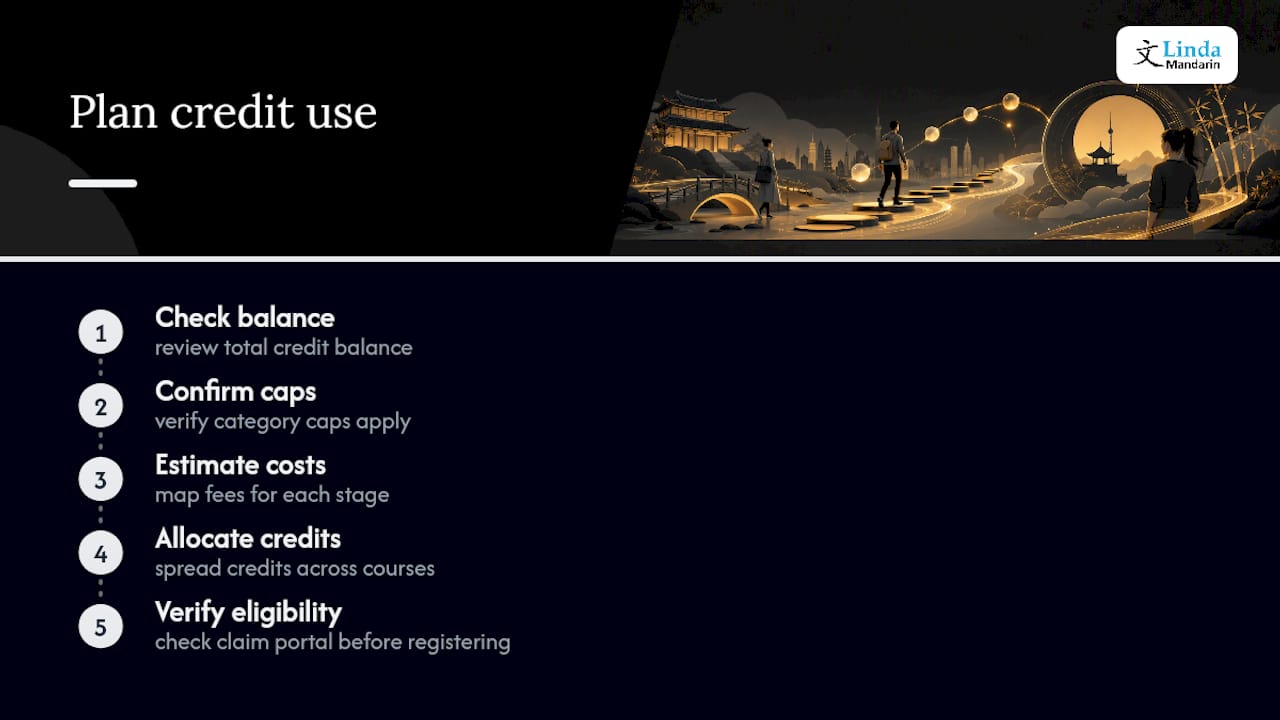
In practice, this means you can spread credits across multiple courses, a beginner conversational Mandarin class this quarter and a business Mandarin follow-up next quarter, provided your balance covers each course’s offset and each course qualifies individually. There’s no requirement to use your entire balance on one course, and doing so isn’t necessarily the smartest move if it means you can’t afford a follow-up course that builds directly on what you just learned.
The practical constraint most learners run into isn’t a hard cap on course count. It’s running out of balance partway through a learning pathway. If you’re planning to progress from beginner to intermediate to business Mandarin over a year, map out the approximate fees for each stage first and check whether your credit balance and its replenishment cycle will cover the full sequence, or whether you’ll need to pay a larger share out of pocket for later courses.
If you’re unsure how a specific course counts against any caps that might apply to you individually, the fastest way to confirm is through the claim portal before registering, rather than assuming the same rules that applied to your last course apply identically to your next one.
Getting Started With Linda Mandarin
If you’ve read this far, you already know how to check a fee breakdown and confirm your credit eligibility. The next step is finding a course that actually fits your schedule and your goal, whether that’s holding a conversation with your in-laws or negotiating a contract in Mandarin.

Linda Mandarin runs adult conversational and business Mandarin classes from its center above Tanjong Pagar MRT at 10 Anson Road, Level 22, International Plaza, Singapore 079903, with both in-person and online Zoom formats available depending on how your week looks. You can browse course levels to find the right starting point, or check class schedules and fees directly to see upcoming dates and current pricing before you commit.
Busy professionals juggling irregular hours often benefit from a quick placement conversation rather than guessing which level fits, so if you’re not sure whether you belong in a conversational track or a business-focused one, use the enquiry form on the adult programs page to ask directly. Teams looking to build Mandarin skills across a department can also reach out through the corporate training page for a tailored quote rather than fitting into a standard public class schedule.
A Teacher’s View on Realistic Progress
Most working adults overestimate what a single term will do and underestimate what a year of consistent practice does. Ten weeks of weekly classes gets you functional survival Mandarin: ordering food, small talk, basic directions. It won’t get you through a client negotiation.
What actually moves the needle is short daily practice, even ten minutes of speaking aloud, paired with one class a week and 30 to 60 minutes of self-study reviewing vocabulary. Private lessons suit people with unpredictable schedules; small-group classes suit people who learn better with a bit of social pressure to keep up.
If you’re not sure which pace or level fits your current ability, ask for a placement assessment before you book. It saves you from the two most common outcomes: boredom in a class too easy, or panic in one too hard.
— Paul
Key Takeaways
Government training credits can offset adult Mandarin course fees in Singapore, but confirming eligibility and reading the fee breakdown correctly are what actually determine your final out-of-pocket cost.
| Point | Details |
|---|---|
| Verify the fee breakdown | Check the full course fee against the estimated payable fee shown on the listing before registering. |
| Confirm eligibility early | Use the claim portal to check your credit balance and course eligibility before, not after, paying. |
| Match level to goal | Read the “skills you’ll pick up” section to confirm the course fits conversational or business needs. |
| Watch expiry timing | Confirm your credit validity window covers the course intake date, not just today’s balance. |
| Consider Linda Mandarin | Offers adult conversational, business, private, group, Zoom, and corporate Mandarin courses above Tanjong Pagar MRT. |
Sources
FAQ
What Is the Quickest Way to Learn Mandarin?
Consistent short daily speaking practice combined with a weekly class produces faster real-world results than cramming hours into one sitting. Small-group or private lessons that force you to speak out loud each session tend to build conversational confidence faster than self-study alone.
What Courses Can Use a $4,000 Training Credit Amount?
Eligible adult Mandarin courses, including beginner conversational and business-focused runs, can typically apply this toward the fee, but the exact offset and eligibility depend on the specific course listing and your available balance. Always check the course’s fee breakdown and confirm eligibility through the claim portal before assuming a course qualifies.
Can Lee Kuan Yew Speak Mandarin?
Yes, Singapore’s founding prime minister famously learned Mandarin as an adult later in life and spoke publicly about how demanding that process was, a fact often cited to encourage adult learners that fluency is achievable at any age.
What Is the Best Online Mandarin Course?
The right online course depends on your goal: conversational Zoom classes suit casual learners, while structured business Mandarin programs suit professionals needing workplace vocabulary. Linda Mandarin offers both formats through its online and adult program listings, with native certified instructors teaching each session live.