TL;DR:
- Practical Mandarin emphasizes real-life communication through high-frequency phrases and situational practice. It speeds up fluency for adults by focusing on daily and workplace scenarios instead of exhaustive grammar. Structured lessons and routine reviews help learners develop confidence and effective conversational skills quickly.
Practical Mandarin is defined as the application-focused form of Mandarin Chinese that prioritizes real-life communication over academic completeness. It targets the phrases, sentence patterns, and listening skills you actually use in daily transactions, workplace coordination, and social settings. Rather than memorizing thousands of characters before speaking a word, you build confidence by mastering a smaller, high-frequency set of language tools tied to recurring situations. This approach is the fastest path to functional fluency for working adults, and it is the foundation behind how Linda Mandarin structures its adult programs in Singapore.

What is practical mandarin and how is it different?
Practical Mandarin, sometimes called functional or spoken Mandarin, is the subset of the language built around communication tasks rather than grammatical completeness. The goal is not to pass a literature exam. The goal is to greet a colleague, negotiate a delivery timeline, or order a meal without hesitation.
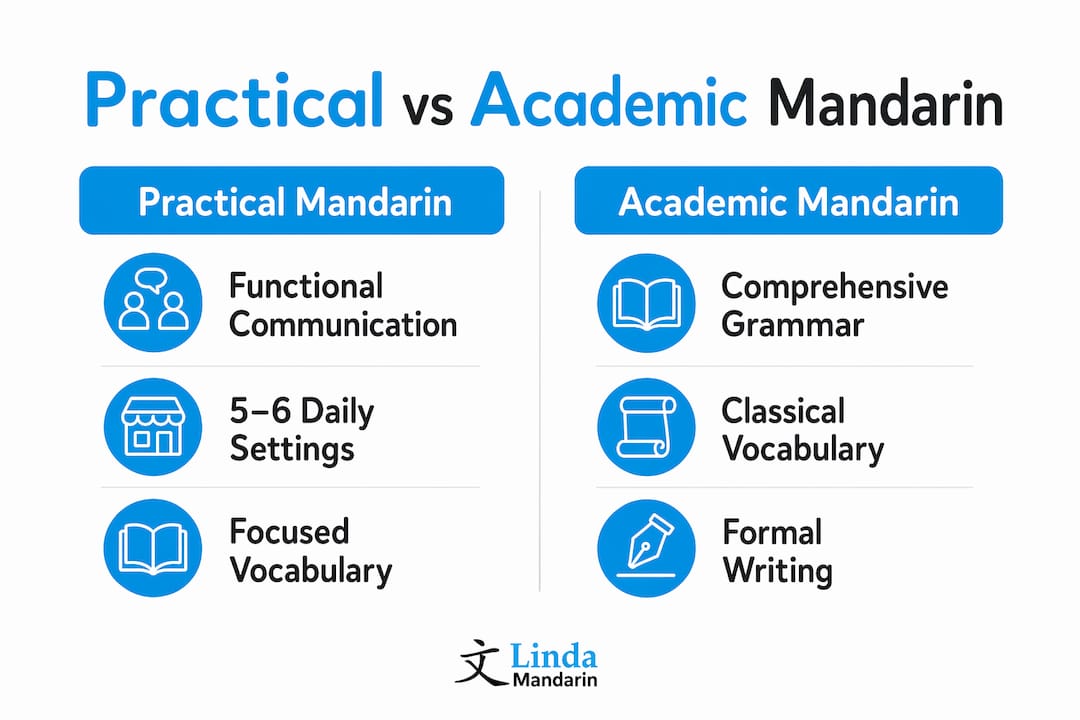
Standard Mandarin study, as taught in most academic settings, covers the full grammar system, classical vocabulary, and formal writing conventions. That depth is valuable for scholars. For a professional in Singapore who needs to communicate with Mandarin-speaking clients or partners, it is often the wrong starting point.
Practical Mandarin focuses on function over volume, dividing learning into 5–6 recurring daily life and work settings to speed recall through short, frequent review sessions. That structure matters because your brain retains language faster when it connects words to actions you repeat every day. Commuting, dining, shopping, and coordinating at work are not random scenarios. They are the exact contexts where your Mandarin will get tested.
The practical approach also changes the study pace. One weekly lesson of 60–90 minutes with 10–15 minute reviews optimizes professional Mandarin progress without overwhelming learners. That is a realistic schedule for a working adult, and it produces measurable results within weeks.
Practical mandarin vs. academic mandarin: a direct comparison
| Feature | Practical Mandarin | Academic Mandarin |
|---|---|---|
| Primary goal | Functional communication | Grammatical mastery |
| Vocabulary focus | High-frequency phrases in real settings | Broad vocabulary across all registers |
| Learning pace | Weekly lessons plus short daily reviews | Intensive classroom hours |
| Skill emphasis | Speaking and listening first | Reading, writing, grammar equally weighted |
| Ideal for | Working adults, professionals, travelers | Students, researchers, formal certification |
Pro Tip: If your goal is to hold a business conversation within three months, start with practical Mandarin. Save the grammar deep-dives for after you can already communicate.
What are the core phrases in practical mandarin usage?
Practical Mandarin usage is built on a short list of sentence patterns that cover the majority of real-world situations. You do not need 5,000 words to be useful. You need the right 300 words in the right order.
The most common daily phrases cover greetings, numbers, directions, and transactions. Knowing how to say “How much does this cost?”, “Where is the nearest station?”, and “I would like to order…” gets you through most of Singapore’s daily life. These are not trivial phrases. They are the building blocks of every longer conversation.
For workplace settings, the priority shifts. Business Mandarin focuses on diplomatic communication skills such as polite disagreement and managing project updates, not just technical terms. Phrases like “Let me confirm that with my team” or “Could you clarify the deadline?” carry more professional weight than knowing the Mandarin word for a specific industry term.
Relationship-building and coordination phrases such as buying time, making polite requests, and asking for clarification maintain credibility in cross-border communication. These soft-skill phrases are what separate a competent Mandarin speaker from a truly effective one in a business context.
Here are the core phrase categories every practical Mandarin learner should prioritize:
- Greetings and introductions: Standard and formal versions for different social contexts
- Numbers, dates, and times: Critical for meetings, pricing, and scheduling
- Directions and locations: Navigating offices, neighborhoods, and transit
- Transaction language: Ordering, paying, confirming, and negotiating
- Workplace coordination: Requesting, clarifying, updating, and politely declining
- Social phrases: Small talk, compliments, and relationship-building expressions
Pro Tip: Pronunciation affects clarity especially for numbers, dates, and technical terms in professional Mandarin. Practice tones on numbers first. A mispronounced price or date in a business meeting creates real problems.
How to learn practical mandarin effectively as an adult
Adults learn practical Mandarin faster by associating phrases with routine settings and repeated practical use rather than memorizing large vocabularies. The key is building a learning routine around the situations you already live through every day.
The most effective method is scenario-based spaced repetition. You assign specific Mandarin phrases to specific life contexts, then review them in short sessions tied to those contexts. Reviewing dining phrases before lunch or workplace phrases before a Monday meeting is not a gimmick. It is how memory consolidation works.
Teaching strategies based on needs analysis improve language application in authentic scenarios and learner effectiveness. Before you start any course, identify your top three communication goals. Are you preparing for client meetings? Traveling to mainland China? Building relationships with Mandarin-speaking colleagues in Singapore? Your answer should shape every lesson.
Here is a practical weekly learning structure that works for busy adults:
- Set your scenario list. Choose 5–6 recurring situations from your actual life: morning commute, lunch orders, team meetings, client calls, social dinners, and weekend errands.
- Assign phrases to each scenario. Learn 8–12 phrases per scenario before moving to the next. Depth before breadth.
- Schedule one focused lesson per week. A 60–90 minute session with a qualified instructor covers new material and corrects pronunciation errors before they become habits.
- Add three short review sessions. Ten to fifteen minutes each, tied to the scenarios you are actively using that week.
- Use shadowing for listening skills. Listen to a native speaker say a phrase, then repeat it immediately. This trains both pronunciation and listening comprehension at the same time.
- Track your wins. Note every time you successfully use Mandarin in a real situation. Progress feels slow until you start counting the moments it actually works.
You can explore effective Mandarin learning methods that adult learners in Singapore have used to build real communication skills without burning out.
Pro Tip: Avoid the common trap of collecting vocabulary lists without context. A word you cannot place in a sentence is a word you will forget within a week.
What do practical mandarin courses look like for adults?
Intermediate practical Mandarin courses typically feature 30-hour modules aiming for over 1,200 vocabulary words for workplace and social proficiency. That vocabulary threshold is meaningful. At 1,200 words, you can hold a real conversation, follow a business meeting, and read basic written communications.
Well-designed adult courses balance four skills: speaking, listening, reading, and writing. Speaking and listening take priority in practical programs because they deliver the fastest return on your time investment. Reading and writing are built in progressively as your spoken foundation grows stronger.
Course flexibility matters for professionals. The best programs offer group classes, private sessions, and online Zoom formats so you can learn around your work schedule. Blended learning approaches that combine in-person instruction with online review sessions are particularly effective for adults who travel or work irregular hours.
Customization is the other critical factor. Communicative needs must guide course content to increase confidence and real-world language application. A course designed for a finance professional looks different from one designed for someone building social connections in a Mandarin-speaking community.
| Course Level | Module Length | Vocabulary Target | Core Competency |
|---|---|---|---|
| Beginner conversational | 30 hours | 300–500 words | Greetings, daily transactions, basic directions |
| Intermediate practical | 30 hours | 1,200+ words | Workplace coordination, social interaction |
| Business Mandarin | 30–40 hours | 1,500+ words | Negotiation, presentations, formal correspondence |
| Corporate customized | Flexible | Role-specific | Industry terminology, team communication |
Key takeaways
Practical Mandarin is the fastest route to real communication because it builds on high-frequency phrases in recurring situations rather than exhaustive grammar study.
| Point | Details |
|---|---|
| Function over volume | Focus on 5–6 recurring settings to build recall faster than broad vocabulary study. |
| Consistent low-intensity practice | One weekly lesson plus three short reviews outperforms irregular intensive cramming. |
| Pronunciation is non-negotiable | Mispronounced numbers and dates cause real errors in professional Mandarin contexts. |
| Needs analysis shapes results | Identifying your top communication goals before starting a course accelerates progress. |
| 1,200 words unlocks workplace use | Intermediate practical courses targeting this threshold enable real business and social interaction. |
Why i think most adults approach mandarin learning backwards
The most common mistake I see adult learners make is treating Mandarin like a subject to study rather than a skill to practice. They spend months building vocabulary lists and reviewing grammar rules before they ever attempt a real conversation. By the time they try to speak, the fear of making mistakes has grown larger than their confidence.
The biggest challenge in business Mandarin is bridging daily conversational skills with formal negotiation and diplomacy. That gap does not close through more studying. It closes through deliberate, repeated use in real situations, even imperfect ones.
What actually works is starting with the conversation you need to have next week, not the one you might need in two years. If you have a client dinner in three weeks, learn the phrases for that dinner. If you are joining a Mandarin-speaking team, learn the coordination phrases for your first meeting. Task-based learning builds confidence faster than any textbook sequence.
Cultural nuance matters too, and it is often underestimated. Tone, formality level, and relationship-building language carry enormous weight in Mandarin-speaking business cultures. Knowing the right phrase is only half the skill. Knowing when and how to use it is the other half. That is why working with experienced native instructors, not just language apps, makes a measurable difference for professionals.
The learners I have seen make the fastest progress share one habit: they measure success by communication moments, not study hours. Every time you successfully use Mandarin in a real interaction, that is a data point worth tracking. Motivation follows evidence of progress.
— Paul
Start speaking mandarin faster with linda mandarin
Linda Mandarin has been training adult professionals in Singapore since 2003, with courses designed specifically for conversational and business Mandarin communication. Located above Tanjong Pagar MRT at 10 Anson Road, Level 22, International Plaza, the school offers group classes, private sessions, and online Zoom learning to fit your schedule.

Whether you need corporate Mandarin training for your team or a structured adult program to build your own professional communication skills, Linda Mandarin’s certified native instructors tailor every course to your real-world goals. Explore the full range of adult Mandarin course levels and find the program that matches where you are and where you need to be.
FAQ
What is the practical mandarin definition?
Practical Mandarin is the communication-focused form of Mandarin Chinese that prioritizes high-frequency phrases and real-life scenarios over full grammatical mastery. It is designed for adults who need to speak and understand Mandarin in daily life and professional settings.
How is practical mandarin different from standard mandarin?
Standard Mandarin study covers the full grammar system, formal writing, and broad vocabulary across all registers. Practical Mandarin focuses on the 300–1,200 most useful words and phrases tied to recurring daily and workplace situations, making it faster to apply in real conversations.
How long does it take to learn practical mandarin?
With one 60–90 minute lesson per week plus three short review sessions, most adult learners reach basic conversational ability within three to four months. Intermediate workplace proficiency typically requires completing a 30-hour module targeting 1,200 or more vocabulary words.
What are the best practical mandarin courses for adults in singapore?
The best practical Mandarin courses for adults combine scenario-based instruction, native-speaker teachers, and flexible scheduling. Linda Mandarin offers group, private, and online Zoom formats at its Singapore center, with programs ranging from beginner conversational to advanced business communication in Mandarin.
Do i need to learn to read and write for practical mandarin?
Reading and writing are not required to reach functional spoken Mandarin. Most practical programs prioritize speaking and listening first, then introduce reading and writing progressively. For business use, basic reading of messages and emails is a useful addition once your spoken foundation is solid.