TL;DR:
- Professional Chinese writing uses a formal register with specific vocabulary, structure, and cultural tone tailored for business and official contexts. Mastering these conventions builds trust and ensures effective cross-cultural communication in Chinese professional settings.
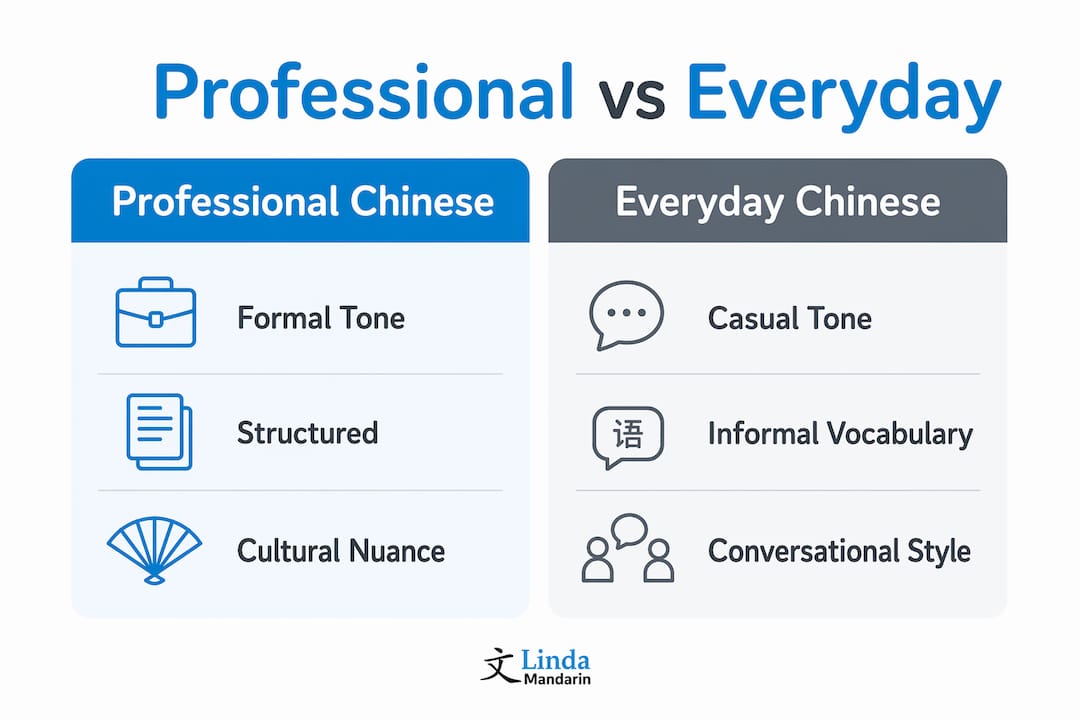
Professional Chinese writing is a distinct form of communication characterized by formal structure, cultural sensitivity, and specific linguistic conventions tailored for business and official contexts. Unlike everyday Mandarin conversation or casual text messages, this formal register follows strict rules around vocabulary, tone, layout, and respect. Whether you are drafting a business email to a Shanghai partner, preparing an official letter for a government body, or writing a formal proposal, understanding what is professional Chinese writing gives you a real competitive edge. Linda Mandarin has trained adult professionals in Singapore since 2003, and the gap between learners who grasp these conventions and those who do not is immediately visible on the page.
What is professional Chinese writing and how does it differ from everyday Chinese?
Professional Chinese writing is the formal register of written Mandarin used in business, official correspondence, and structured personal communication. The industry term for this register is “书面语” (written language), which sits in direct contrast to “口语” (spoken, colloquial language). Most learners spend years mastering spoken Mandarin before realizing that written professional Chinese operates by an entirely different set of rules.
The most obvious difference is vocabulary. Colloquial Chinese uses short, conversational words. Professional Chinese writing favors four-character idioms, formal compound words, and precise terminology that signals education and respect. A casual speaker might write “我想问一下” (I just want to ask), while a professional writer would open with “谨致函询” (I respectfully write to inquire). The gap is not subtle.
Tone is the second major dividing line. Everyday Chinese is direct and personal. Professional Chinese writing builds in layers of politeness, hierarchy awareness, and indirectness. Misapplying these conventions can damage business relationships and even create legal vulnerabilities in contract negotiations. That consequence alone makes this worth studying seriously.
Format is the third distinguishing factor. Professional Chinese writing follows predictable structural templates for letters, emails, and reports. These templates are not optional. Deviating from them signals unfamiliarity with Chinese business culture, which undermines trust before the reader even processes your content.
- Formal vocabulary replaces colloquial equivalents in every sentence.
- Honorifics and titles appear at the start of correspondence, not mid-letter.
- Indirect phrasing softens requests and disagreements.
- Four-character idioms signal fluency and cultural literacy.
- Closing phrases vary by recipient status and relationship.
Pro Tip: Read published Chinese business letters from reputable Chinese companies before writing your own. Absorbing the rhythm and vocabulary of authentic professional writing is faster than memorizing grammar rules in isolation.
Common styles and conventions in formal Chinese writing

Regular Script, known in Chinese as “楷书” (K’ai-shu), is the dominant handwriting style for professional and formal written Chinese. Regular Script was standardized during the Tang Dynasty and introduced simplified, practical character forms that prioritized readability over artistic expression. That legacy shapes professional Chinese writing today. Even in digital formats, the clean, structured aesthetic of Regular Script influences how documents are laid out and how characters are formed in handwritten correspondence.
Traditional Chinese calligraphy carries cultural weight that extends beyond handwriting. In formal business contexts, a handwritten note or signed document in a clean, controlled script communicates respect and effort. Digital fonts used in professional documents typically mirror Regular Script proportions, which is why choosing the right font in a Chinese Word document is not a trivial decision.
Standard formatting elements in formal letters and emails
A formal Chinese letter follows a strict sequence that signals professionalism from the first line. The standard format places the sender’s information at the top right, the date below it, and the recipient’s details on the left. The salutation comes next, followed by the body, and then a polite closing phrase.
| Element | Formal Chinese convention |
|---|---|
| Salutation | 尊敬的 (Respected) plus full title and surname |
| Opening line | State purpose directly after greeting |
| Body paragraphs | Short, structured, one idea per paragraph |
| Closing phrase | 此致敬礼 (With best regards) or 谨上 for senior recipients |
| Signature | Full name, title, organization, and date |
Cultural expectations also shape the writing style itself. Chinese professional communication values harmony, hierarchy, and indirectness. A direct refusal is rarely written plainly. Instead, writers use softening phrases that acknowledge the other party’s position before delivering unwelcome news. This is not evasiveness. It is a deliberate cultural practice that preserves the relationship while still communicating the message.
- Use 尊敬的 plus the recipient’s title for formal salutations.
- Place the date in year/month/day order, which is the Chinese standard.
- Keep body paragraphs to three to five sentences each.
- Match your closing phrase to the recipient’s seniority level.
- Sign with your full professional title, not just your name.
How to write in Chinese professionally: tips and pitfalls to avoid
The single biggest mistake adult learners make is “translation-ese.” Translation-ese is the primary marker of amateur Chinese writing, characterized by literal English-to-Chinese phrases that feel unnatural to native readers. A sentence like “It is worth noting that our company has extensive experience” translated word-for-word into Chinese reads as clumsy and foreign. A professional writer replaces that construction with a direct, idiomatic Chinese equivalent that carries the same meaning without the English skeleton underneath it.
Concise phrasing is the antidote. Professional Chinese writing values economy of language. Every sentence should carry weight. Filler phrases that pad English writing have no place in formal Chinese correspondence. If a word does not add meaning, remove it.
Using analytical verbs and abstract summary sentences at the end of paragraphs signals advanced skill. Instead of ending a paragraph with a factual statement, a professional writer closes with a sentence that synthesizes the paragraph’s meaning at a higher level. This technique shows the reader that you are not just reporting facts. You are interpreting them.
Rhythm matters more than most learners expect. Top Chinese writers use a spiral structure that opens with a relatable scene or observation, builds emotional engagement, and then transitions to the business or theoretical point. This structure works in longer documents and formal reports. It keeps readers engaged and makes the core message land harder.
- Replace “It is worth noting that” with a direct statement of the fact.
- Avoid starting sentences with “I think” in formal writing. State the position as fact.
- End each paragraph with a sentence that summarizes the abstract point, not just the last detail.
- Use four-character idioms sparingly and only when you know their exact meaning.
- Address the recipient by full title on first mention, then by title alone in subsequent references.
Pro Tip: Write your first draft in Chinese from scratch rather than drafting in English and translating. Even a rough Chinese draft avoids the structural patterns that produce translation-ese. You can refine the Chinese directly without fighting an English skeleton.
You can also explore professional Mandarin writing techniques to build on these fundamentals with updated examples and structured exercises.
How are professional Chinese writing skills applied in business emails and letters?
Chinese business emails prioritize relationship building before discussing business, which surprises many Western professionals. The opening of a business email is not wasted space. It is where you establish goodwill, acknowledge the relationship, and signal respect. Skipping this step to get to the point faster reads as rude, not efficient.
A well-structured Chinese business email follows this sequence:
- Formal greeting: Use 尊敬的 plus the recipient’s title and surname. Never use first names in a first email to a Chinese business contact.
- Opening acknowledgment: Reference the relationship, a previous meeting, or a shared context. One or two sentences is enough.
- Clear subject statement: State the purpose of the email in one direct sentence after the acknowledgment.
- Body: Present your content in short paragraphs. One idea per paragraph. Use formal vocabulary throughout.
- Request or next step: State what you need or propose clearly, but frame it as a respectful request rather than a demand.
- Closing phrase: Use 此致敬礼 for standard business correspondence or 谨上 when writing to someone significantly senior.
- Signature block: Include your full name, title, company, and contact details.
Effective professional Chinese writing builds trust and credibility in Sino-foreign commercial negotiations. That trust compounds over time. A partner who receives consistently well-written, culturally appropriate correspondence from you will extend more goodwill in negotiations than one who receives grammatically correct but culturally tone-deaf emails.
Tone adaptation is equally critical. Writing to a peer differs from writing to a senior executive or a government official. Using 尊敬的 plus the recipient’s official title conveys respect and acknowledges social hierarchy. Dropping the title or using an informal salutation in a formal context signals either ignorance or disrespect, neither of which serves your goals.
For practical examples and templates, Linda Mandarin’s guide on writing Chinese emails professionally walks through real scenarios with annotated samples. You can also explore AI-assisted drafting tools like Chinese AI content generators to practice generating formal Chinese text, though human review from a qualified instructor remains the standard for high-stakes correspondence.
Key Takeaways
Professional Chinese writing requires mastering formal register, cultural hierarchy, and specific structural conventions to communicate effectively in business and official contexts.
| Point | Details |
|---|---|
| Formal register is non-negotiable | Professional Chinese uses distinct vocabulary, honorifics, and structure that differ sharply from spoken Mandarin. |
| Translation-ese destroys credibility | Literal English-to-Chinese phrasing signals amateur writing. Draft in Chinese from the start. |
| Structure follows strict templates | Formal letters and emails follow a fixed sequence: salutation, opening, body, closing phrase, and signature. |
| Closing phrases signal respect | Match your closing phrase, such as 此致敬礼 or 谨上, to the recipient’s seniority level. |
| Cultural nuance drives trust | Relationship-building language and indirectness are not optional. They are the foundation of effective Chinese business correspondence. |
Why cultural authenticity matters more than grammar accuracy
I have reviewed hundreds of formal Chinese letters written by adult learners, and the pattern is consistent. Grammar is rarely the problem. Cultural authenticity is. A letter can be grammatically flawless and still read as foreign because the writer followed English rhetorical logic inside Chinese sentence structures.
The learners who progress fastest are the ones who stop thinking about Chinese writing as a translation task. They start treating it as a separate communication system with its own logic. That shift takes time, but it is the only path to writing that a native Chinese reader would describe as natural.
Emotional engagement is underrated in professional writing. The spiral structure, opening with a relatable observation before moving to business, works because it mirrors how Chinese readers expect to be brought into a topic. Ignoring that expectation does not make your writing more professional. It makes it feel abrupt.
The importance of Chinese language in business success extends well beyond vocabulary. The writers who build the strongest cross-cultural business relationships are those who write with cultural awareness, not just linguistic accuracy.
— Paul
Linda Mandarin’s courses for professional Chinese writing
Linda Mandarin has been training adult professionals and corporate teams in Singapore since 2003, with courses that go well beyond conversational Mandarin. The school’s business Chinese writing workshop covers formal letter structure, email conventions, honorifics, and the cultural context that makes professional writing land correctly with Chinese-speaking recipients.

For professionals working with Chinese partners or clients, Linda Mandarin also offers corporate Chinese Mandarin training tailored to your industry and communication goals. Classes run in-person at 10 Anson Road, Level 22, International Plaza, Singapore 079903, right above Tanjong Pagar MRT, and online via Zoom for flexible scheduling. Both group and private formats are available.
FAQ
What is professional Chinese writing?
Professional Chinese writing is the formal written register of Mandarin used in business correspondence, official documents, and structured communication. It follows strict conventions around vocabulary, structure, honorifics, and cultural tone that differ significantly from everyday spoken or written Chinese.
How do I avoid translation-ese in Chinese business writing?
Draft your correspondence directly in Chinese rather than translating from English. Replace filler phrases with direct Chinese equivalents, and end paragraphs with abstract summary sentences rather than restating the last detail.
What closing phrase should I use in a formal Chinese letter?
Use 此致敬礼 for standard business correspondence and 谨上 when writing to a significantly senior recipient. The choice of closing phrase signals your awareness of social hierarchy, which matters in Chinese professional culture.
Why does Chinese business writing start with relationship building?
Chinese professional communication prioritizes trust and relationship before business content. Opening an email with an acknowledgment of the relationship or shared context signals respect and sets a cooperative tone for the rest of the message.
How does professional Chinese calligraphy relate to modern business writing?
Regular Script, standardized during the Tang Dynasty, established the clear, structured character forms that underpin modern professional Chinese writing. In formal handwritten correspondence, a clean and controlled script still communicates respect and cultural literacy to Chinese recipients.