TL;DR:
- Mandarin’s main challenges are tonal pronunciation, cultural norms, and business etiquette, not character memorization.
- Effective learning combines structured feedback, daily practice, and real workplace use for faster progress.
- Most learners plateau due to lack of speaking practice and neglecting active output and correction.
Many professionals in Singapore assume that learning Mandarin is primarily a character memorization challenge. It is not. The real barriers are tonal pronunciation, cultural communication norms, and business etiquette, all of which matter far more in a professional setting than knowing how to write characters. Whether you are an executive building relationships with Chinese-speaking clients or an expatriate navigating Singapore’s multicultural workplace, this guide walks you through what actually makes Mandarin hard, how to learn it efficiently, the mistakes that stall most learners, and how to put it all to work in your career.
Table of Contents
- What makes Mandarin unique and challenging?
- Core strategies for learning Mandarin efficiently
- Common pitfalls and how to overcome them
- Applying Mandarin for professional and daily success
- Why most Mandarin learners in Singapore plateau (and how to break through)
- Take your Mandarin to the next level with Linda Mandarin
- Frequently asked questions
Key Takeaways
| Point | Details |
|---|---|
| Tone mastery is key | Getting the tones right is essential to avoid misunderstandings in Mandarin. |
| Blend methods for success | Combining technology, practice, and real conversation drives the fastest, most reliable progress. |
| Watch common pitfalls | Mistakes with tones, structure, and business etiquette can hold back even advanced learners. |
| Prioritize real output | Active speaking and regular feedback are crucial for long-term advancement. |
What makes Mandarin unique and challenging?
Mandarin is not just a different language. It is a fundamentally different system of communication. For English speakers, the biggest structural shock is the tonal system. Mandarin has four main tones plus a neutral tone, and each tone changes the meaning of a syllable entirely. The syllable ma, for example, means mother (mā), hemp (má), horse (mǎ), or scold (mà) depending on which tone you use. Miss the tone, and you have said something completely different.
Beyond tones, Mandarin’s syllable structure is built around pinyin romanization, which maps sounds to letters in ways that do not always match English phonics. The letter x sounds like “sh,” and zh sounds closer to “j.” Tone sandhi, where tones shift in connected speech, adds another layer that even intermediate learners often overlook. These are not minor details. They are the foundation of being understood.
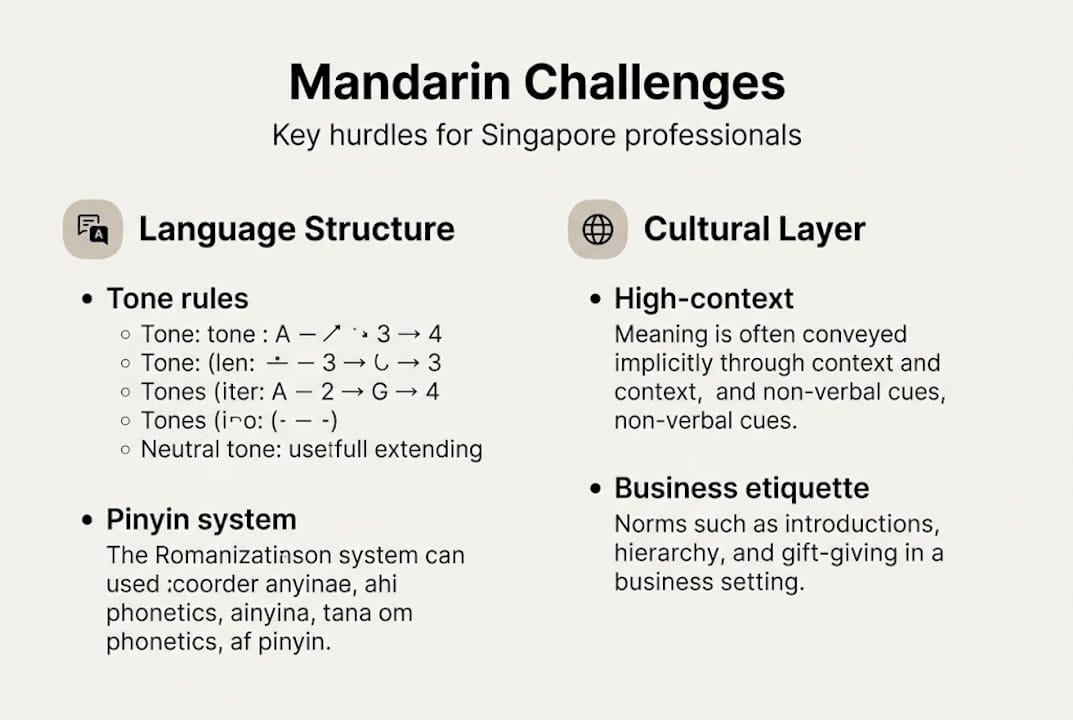
Then there is the cultural layer. Mandarin communication in Singapore’s business world is high-context, meaning much of what is communicated depends on relationship status, hierarchy, and shared understanding rather than explicit words. The concept of guanxi (relationships and social networks) shapes how conversations are structured, how requests are made, and how trust is built. Knowing the right words is only half the job. Knowing when and how to use them is the other half.
Here is a quick look at how Mandarin’s core features compare to what English speakers are used to:
| Feature | English | Mandarin |
|---|---|---|
| Tones | None | 4 tones + neutral |
| Writing system | Alphabet (26 letters) | Characters + pinyin |
| Sentence structure | Subject-verb-object | Subject-verb-object (similar, but context-heavy) |
| Formality signals | Word choice | Titles, tone, and register |
| Cultural weight | Low-context | High-context |
Common misconceptions worth clearing up:
- Characters are the hardest part. Not for spoken business Mandarin. Tones and pronunciation are more immediately critical.
- Fluency requires years of full immersion. Structured, goal-oriented learning accelerates results significantly.
- Singapore Mandarin is the same as Mainland Mandarin. Vocabulary, slang, and formality norms differ in meaningful ways.
As one widely cited principle in linguistics puts it: “Language is not just words. It is the culture, the hierarchy, and the relationship behind every sentence.” For Mandarin in Singapore, this could not be more accurate. Understanding Mandarin tone challenges and knowing what is hardest about Mandarin are the first honest steps toward real progress.
Core strategies for learning Mandarin efficiently
Knowing what makes Mandarin hard is useful. Knowing how to learn it efficiently is what actually moves the needle. For busy Singapore professionals, the approach matters as much as the effort.
Multi-modal and blended learning consistently outperforms single-method study for advanced learners. That means combining structured classroom instruction with AI-assisted apps, live conversation practice, and real workplace exposure. No single tool does it all.
Here is how common learning formats stack up for working professionals:
| Format | Speed of progress | Retention | Best for |
|---|---|---|---|
| Face-to-face group class | Moderate | High | Structured foundation |
| Private tutoring | Fast | High | Targeted gaps |
| Online Zoom class | Moderate | Moderate-High | Flexible schedules |
| AI/app-only | Slow | Low-Moderate | Supplemental practice |
| Corporate training | Fast | Very High | Business-specific goals |
| Casual immersion only | Slow | Low | Not recommended alone |
The most effective Mandarin learning methods share one thing: structured feedback. Casual conversation without correction reinforces errors. A teacher or program that identifies and corrects tonal mistakes in real time builds accuracy far faster than self-directed listening.
Here is a practical learning routine that works for professionals:
- Start every session with tone drills. Even five minutes of focused tone practice daily builds muscle memory faster than an hour of passive listening.
- Use micro-practice windows. Fifteen minutes during a commute or lunch break, done consistently, outperforms two-hour weekend sessions.
- Engage Mandarin at work. Label items, greet colleagues, or read a short Chinese news headline daily to reinforce vocabulary in context.
- Record yourself speaking. Playback reveals tonal errors your ear misses in real time.
- Join a structured class with corrective feedback. Daily micro-practice and tone drills build retention, but only when errors are caught and corrected.
Pro Tip: Set a weekly speaking goal, not a study-time goal. Committing to three short Mandarin conversations per week, even simple ones, builds output confidence faster than any vocabulary list.
Common pitfalls and how to overcome them
Even motivated learners make the same mistakes. Knowing them in advance saves months of frustration.
The most damaging error is tonal neglect. Missing a tone shifts meaning entirely, and even advanced learners slip under pressure. In a business meeting, a mispronounced title or word can create confusion or unintended offense. This is not a beginner problem. It follows learners all the way to intermediate and advanced levels if not addressed early.

The second major pitfall is applying English sentence logic to Mandarin. Mandarin does not use articles (“a,” “the”), and verb tenses work differently. When professionals mentally translate from English before speaking, they produce awkward, unnatural Mandarin that signals low fluency even when vocabulary is strong.
Business etiquette errors are equally costly. Addressing a senior colleague without their proper title, or using casual speech in a formal setting, signals a lack of cultural awareness. In Singapore’s Chinese business culture, these moments are noticed.
Here is a breakdown of the most common pitfalls and how to fix them:
- Tonal errors: Practice minimal pairs (words that differ only by tone) daily. Use a tutor who corrects in real time.
- English sentence structure: Learn Mandarin sentence patterns as whole units, not word-by-word translations.
- Ignoring formality registers: Study formal versus casual vocabulary separately. Know which context calls for which.
- Skipping feedback: Passive listening without correction builds bad habits. Structured review is non-negotiable.
- Avoiding speaking: Most learners over-prepare and under-practice. Output is where fluency is built.
For a deeper look at where learners go wrong, the guides on common Mandarin errors and beginner challenges in Singapore are worth your time. And if tones are your weak spot, focused tone mastery tips can help you address them systematically.
Pro Tip: Record a short Mandarin self-introduction and play it back weekly. Compare it to a native speaker recording of the same content. The gaps you hear are your fastest path to improvement.
Applying Mandarin for professional and daily success
Learning Mandarin is only valuable if it works in real situations. For Singapore professionals, that means business meetings, networking events, client calls, and everyday workplace interactions.
Proper use of hierarchy, titles, and formal vocabulary is essential in Chinese business culture. Addressing someone as Lǐ Zǒng (Director Li) rather than just their first name signals respect and cultural awareness. These small choices build trust faster than any formal presentation.
Here is how to apply Mandarin across key professional scenarios:
- Business meetings: Open with a formal greeting and use the correct title for each person. Avoid interrupting. Silence often signals respect or consideration, not discomfort.
- Networking events: Use Mandarin to introduce yourself and ask about the other person’s work. Even basic fluency in this context creates a strong impression.
- Client calls: Prepare key phrases in advance. Knowing how to express agreement, ask for clarification, and close a conversation politely in Mandarin sets you apart.
- Daily workplace interactions: Small gestures, greetings, and casual check-ins in Mandarin build guanxi over time. Relationships in Chinese business culture are built incrementally.
- Social settings: Participating in team lunches or informal gatherings in Mandarin deepens trust in ways that formal meetings cannot.
“In Chinese business culture, language is relationship. Speaking Mandarin, even imperfectly, signals that you value the connection enough to try.”
For expatriates especially, understanding Chinese business etiquette and applying Mandarin success tips in real contexts accelerates both language growth and professional credibility. For organizations, corporate Mandarin training tailored to specific industries and goals delivers the fastest, most relevant results.
Why most Mandarin learners in Singapore plateau (and how to break through)
Here is something most language guides will not tell you: the majority of adult learners in Singapore do not plateau because they lack motivation or time. They plateau because they treat Mandarin as a knowledge subject rather than a performance skill.
Passive methods, watching shows, reading vocabulary lists, using apps without speaking, feel productive. They are not, at least not beyond a certain point. Real advancement requires output. Speaking, writing, and being corrected in real time. The learners who break through the intermediate ceiling are the ones who schedule regular speaking sessions, seek structured feedback, and adapt their communication style based on social and professional context.
The uncomfortable truth is that comfort is the enemy of fluency. If every Mandarin interaction feels easy, you are not growing. Pushing into formal business conversations, unfamiliar topics, and corrective feedback is where lasting gains happen. Sustaining Mandarin skills long-term requires treating the language as a living, social practice, not a subject you study in isolation.
Take your Mandarin to the next level with Linda Mandarin
If you are ready to move from theory to real progress, Linda Mandarin offers structured programs built specifically for Singapore-based professionals and expatriates. Since 2003, the school has helped executives, business teams, and adult learners build practical Mandarin skills that work in real workplaces.
Whether you need corporate training for your team, an intensive course to accelerate your personal progress, or want to explore the full range of adult Mandarin programs available in group, private, and online formats, Linda Mandarin has a path designed around your goals. Located above Tanjong Pagar MRT in Singapore’s central business district, the school makes professional Mandarin training genuinely accessible. Your next conversation in Mandarin starts here.
Frequently asked questions
How long does it take to become fluent in Mandarin for business purposes?
With structured feedback and consistent workplace practice, working fluency in 1-2 years is achievable for most dedicated adult learners. Intensive programs accelerate this timeline significantly.
What is the most important aspect to focus on when starting Mandarin?
Tone mastery comes first. Tones change word meaning entirely, so building accurate pronunciation habits early prevents errors that are much harder to fix later.
Are self-study apps effective for Mandarin learners?
Blended AI platforms boost retention compared to passive study, but apps alone are not enough for professional fluency. Real conversation and corrective feedback are essential complements.
Why do many adults plateau after initial gains in Mandarin?
Plateaus happen when learners rely on passive input without prioritizing spoken output. Structured feedback and output-first strategies consistently outperform casual immersion for sustained advancement.