You can start making native-like tonal contrasts within weeks by following three focused practices: ear training, tone-pair production, and feedback loops. That’s the core of how to master Chinese tones, and everything else in this guide builds on it.
Your three daily actions:
- Ear training practiced daily. Listen to minimal pairs and try to identify each tone before checking the answer. Start slow, then push the speed.
- Tone-pair production practiced daily with recording. Say each pair aloud, record it, and play it back against native audio.
- Time spent reviewing feedback and comparison daily. Use an app, a native audio sample, or a tutor note to spot what’s off.
Your 30-second action right now: Open any tone-pair audio (mā / má / mǎ / mà), shadow the sequence three times, then record yourself once and play it back. That’s it. You’ve started.
One-week quick routine to build the habit:
- Days 1–2: Ear drills only. Listen to tone-pair audio and identify each tone without looking at pinyin.
- Days 3–4: Isolated production. Say each tone clearly, record, compare to native audio.
- Days 5–6: Tone-pair drills plus sandhi practice (more on sandhi below).
- Day 7: Review your recordings and do real-speech shadowing with a short dialogue.
Table of Contents
- What the four Mandarin tones actually sound like
- Why getting tones right makes or breaks your Mandarin
- Evidence-backed core methods that actually improve tones
- How to run tone-pair drills: timing, word lists, and the right tool
- Tools and feedback pathways that actually tell you what’s wrong
- Tone sandhi and the neutral tone: why your tones sound robotic in sentences
- A realistic 4-week practice plan with daily goals and progress checks
- What teachers and linguists say — and the mistakes that hold learners back
- Key Takeaways
- The honest truth about how long this actually takes
- Guided tone training with live feedback at Linda Mandarin
- Useful resources to continue your practice
- FAQ
What the four Mandarin tones actually sound like
Mandarin has four tones plus a neutral tone, and each one changes the meaning of a syllable completely. Think of them as pitch shapes, not volume levels.
- Tone 1 (mā): High and flat. Hold your voice steady at the top of your range. Contour: —
- Tone 2 (má): Rising. Like the end of an English question: “Really?” Contour: /
- Tone 3 (mǎ): Dipping and low. Your voice dips down then comes back up, though in fast speech it mostly just stays low. Contour: ∨
- Tone 4 (mà): Falling sharply. Like a firm command. Contour:
- Neutral tone: Short and unstressed. It has no fixed pitch; it attaches to the tone before it.
The classic minimal set — mā (mother), má (hemp), mǎ (horse), mà (scold) — shows exactly why tones matter. Four identical sounds, four completely different words.
One critical point from Dr. Farrah Neumann: focus on relative pitch movement rather than hitting an exact pitch height. Your Tone 1 doesn’t need to match a native speaker’s absolute frequency. What matters is that your Tone 1 stays high and flat while your Tone 4 drops sharply from it. The contrast is the signal.
Why getting tones right makes or breaks your Mandarin
Wrong tones don’t just sound foreign. They produce a different word. Ask for mǎi (to buy) and say mài (to sell) instead, and the sentence means the opposite of what you intended. This isn’t a minor accent issue; it’s a comprehension failure.
The good news: you don’t need perfect native pitch to be understood. What you need is reliable contrast. If your Tone 1 and Tone 4 are consistently distinguishable from each other, native speakers will follow you even if your overall pitch range is different from theirs.
What correct tones give you:
- Listeners spend less effort decoding what you said and more effort engaging with what you mean.
- You stop relying on context to rescue misheard words.
- Your confidence in conversation goes up because you’re not second-guessing every syllable.
Set your goal as reliable contrast and natural rhythm, not perfect pitch mimicry. That’s a reachable target within weeks of deliberate practice, not years.
Evidence-backed core methods that actually improve tones
Most learners spend too long drilling isolated syllables. It feels productive, but isolated-syllable practice doesn’t transfer well to real speech. The methods below are sequenced to move you from perception to production to connected speech as fast as possible.
Ear training first
Focused listening before production speeds up pronunciation gains because your brain needs to perceive a contrast before it can reliably produce it. Start with minimal-pair identification drills: hear two syllables, decide which tone each is. Use an interactive pinyin chart (Yabla’s or MandarinCorner’s free versions work well) and work through each tone pair systematically. Once you can identify tones at normal speed, your production sessions become far more efficient.
Minimal-pair practice
Minimal-pair drills force you to rely on pitch contrast because everything else about the syllable is identical. A pair like mā / mà strips away all other cues. Structure your reps: hear the pair, identify each tone, produce the pair, record, compare. Ten reps per pair per session is enough if you’re genuinely focused.
Tone-pair drills
A tone pair is two consecutive syllables, each carrying a tone. Since real Mandarin speech is a stream of tone pairs, drilling them transfers directly to conversation in a way that isolated syllables never will. There are 20 possible tone-pair combinations (Tone 1+1, 1+2, 1+3 … 4+4, plus neutral-tone combinations). Cycle through all 20 in each session, spend extra time on the pairs you consistently miss, then practice them in real words.

Shadowing
Olle Linge of HackingChinese puts it plainly: theory helps you notice tones, but the brain learns them by listening, producing, and comparing repeatedly. Shadowing is that loop in action. The protocol: play a short audio chunk (3–5 seconds), pause, repeat it with the same rhythm and pitch shape, then play it again and compare. Don’t shadow at full speed until you can match the contour at 70% speed first.
Recording and comparing
Recording yourself daily and comparing to native audio closes the gap between what you think you produce and what you actually produce. Self-assessment without a recording is unreliable; your brain fills in what it expects to hear. Record on your phone, play back immediately, and listen for one specific thing per session: “Did my Tone 3 dip low enough?” or “Did my Tone 2 actually rise?”

Pro tips for faster gains:
Pro Tip: Exaggerate your tones early. A Tone 4 that feels overdramatic to you often sounds natural to a native speaker. You can dial it back later; you can’t fix a tone you never fully produced.
Pro Tip: Use hand gestures to map pitch contours while you drill. Moving your hand flat for Tone 1 and sharply down for Tone 4 adds a kinesthetic anchor that speeds up muscle memory.
How to run tone-pair drills: timing, word lists, and the right tool
Tone pairs are the most transferable unit of practice for connected speech. A single syllable in isolation gives you no information about how tones interact. Two syllables together show you the transitions that make Mandarin sound natural, or robotic.
A 10–15 minute tone-pair session:
- Warm-up (2 min): Listen to all four tones on a single syllable (mā / má / mǎ / mà) without producing. Just tune your ear.
- Cycle all 20 pairs (6–8 min): Say each pair aloud twice, record the tricky ones.
- Extra reps on problem pairs (2–3 min): Spend double time on any pair you consistently flatten or confuse.
- Contextual word practice (2 min): Use real two-syllable words that contain your problem pair.
Sample word lists by common pair:
| Tone pair | Example words | Meaning |
|---|---|---|
| Tone 1 + Tone 1 | 今天 (jīntiān), 飞机 (fēijī), 书包 (shūbāo) | today, airplane, backpack |
| Tone 2 + Tone 4 | 学习 (xuéxí), 明白 (míngbái), 来自 (láizì) | study, understand, come from |
| Tone 3 + Tone 3 | 你好 (nǐ hǎo → ní hǎo), 可以 (kěyǐ), 所以 (suǒyǐ) | hello, can/may, therefore |
| Tone 4 + Tone 1 | 大家 (dàjiā), 上班 (shàngbān), 现在 (xiànzài) | everyone, go to work, now |
| Tone 4 + Tone 2 | 汉语 (Hànyǔ), 问题 (wèntí), 自然 (zìrán) | Chinese language, question, natural |
Tool callout: YoyoChinese’s Tone Pairs tool is built specifically for this drill. It presents all 20 tone-pair combinations with native audio, lets you cycle through them systematically, and flags which pairs you struggle with. Use it as your primary tone-pair resource: run the full cycle once per session, then replay your three weakest pairs twice more.
Tools and feedback pathways that actually tell you what’s wrong
Getting feedback outside of class is where most learners stall. Here’s a prioritized set of tools and exactly how to use each one for tones.
Speechling
An ASR (automatic speech recognition) service that records your pronunciation and returns feedback from a human coach. For tones specifically: record a set of tone-pair words, submit them, and ask your coach to flag any tone that sounds ambiguous. The combination of machine scoring and human review catches errors that either alone would miss.
Forvo
A native pronunciation database with recordings from real speakers across multiple regional accents. Use it to hear how a word sounds in Beijing Mandarin versus Taiwanese Mandarin. For tone practice: look up your problem words, listen to three different native recordings, and shadow each one. Hearing the same tone from multiple voices trains your ear to recognize the category, not just one speaker’s version.
Pleco
The standard Chinese dictionary app for serious learners. Every entry includes native audio. Use Pleco’s audio during vocabulary review: look up a word, listen to the pronunciation, say it back, and record yourself on a separate app for comparison. Pleco’s stroke-order animations and character breakdowns also help you connect the written form to the tonal form, which reinforces memory.
Pimsleur Mandarin
An audio course built around spaced repetition and prosody. Pimsleur’s strength for tone learners is its sentence-level audio: you hear tones in context, not isolation, and the program prompts you to produce full phrases from the start. Use it for your daily commute or any time you can’t sit at a desk.
Anki with audio cards
Build a deck where the front of each card is a word in characters, and the back is the pinyin plus a native audio clip. When you review, say the word before flipping the card, then compare your production to the audio. This turns vocabulary review into a daily tone-production drill.
Recording checklist:
- Record in a quiet room; background noise masks pitch contours when you play back.
- Hold your phone 6–8 inches from your mouth (too close distorts; too far loses detail).
- Listen back with headphones, not speakers, for clearer pitch perception.
- Ask yourself one specific question per playback: “Did that tone rise / fall / stay flat as intended?”
- Compare your recording to a native clip of the same word within 30 seconds of recording.
Tone sandhi and the neutral tone: why your tones sound robotic in sentences
Drilling isolated tones perfectly and then sounding unnatural in sentences is one of the most common plateaus. The reason is almost always tone sandhi, the systematic way tones change when they appear next to each other.
The third-tone sandhi rule (highest priority):
When two Tone 3 syllables appear in a row, the first one changes to Tone 2. So nǐ hǎo is actually pronounced ní hǎo. This isn’t optional or casual; it’s the standard pronunciation. Drill it until it’s automatic.
Other sandhi patterns you need early:
- 不 (bù) before Tone 4: 不 changes from Tone 4 to Tone 2. So bù duì (not correct) becomes bú duì.
- 一 (yī) rules: Before Tone 4, 一 becomes Tone 2 (yí gè). Before Tones 1, 2, or 3, it becomes Tone 4 (yì tiān, yì nián, yì diǎn).
- Neutral tone in compounds and particles: Words like 吗 (ma), 呢 (ne), and the second syllable of many common words (妈妈 māma, 爸爸 bàba) lose their original tone and become short and unstressed. Don’t give them full tone weight.
Sentence drills to internalize sandhi:
- Say nǐ hǎo ten times, consciously producing ní hǎo each time. Then say it in a full sentence: nǐ hǎo, wǒ shì Měiguórén.
- Drill bù in context: bú duì, bù hǎo, bú shì, bù lái. Notice the Tone 4 → Tone 2 shift before Tone 4 words.
- Shadow a short scripted dialogue that contains at least three instances of third-tone sandhi. Pause after each sandhi pair and confirm you produced the changed tone.
Ignoring sandhi leads to correct-sounding isolated syllables but incorrect connected speech. Practice it early, with targeted sentence drills, and it becomes automatic within a few weeks.
A realistic 4-week practice plan with daily goals and progress checks
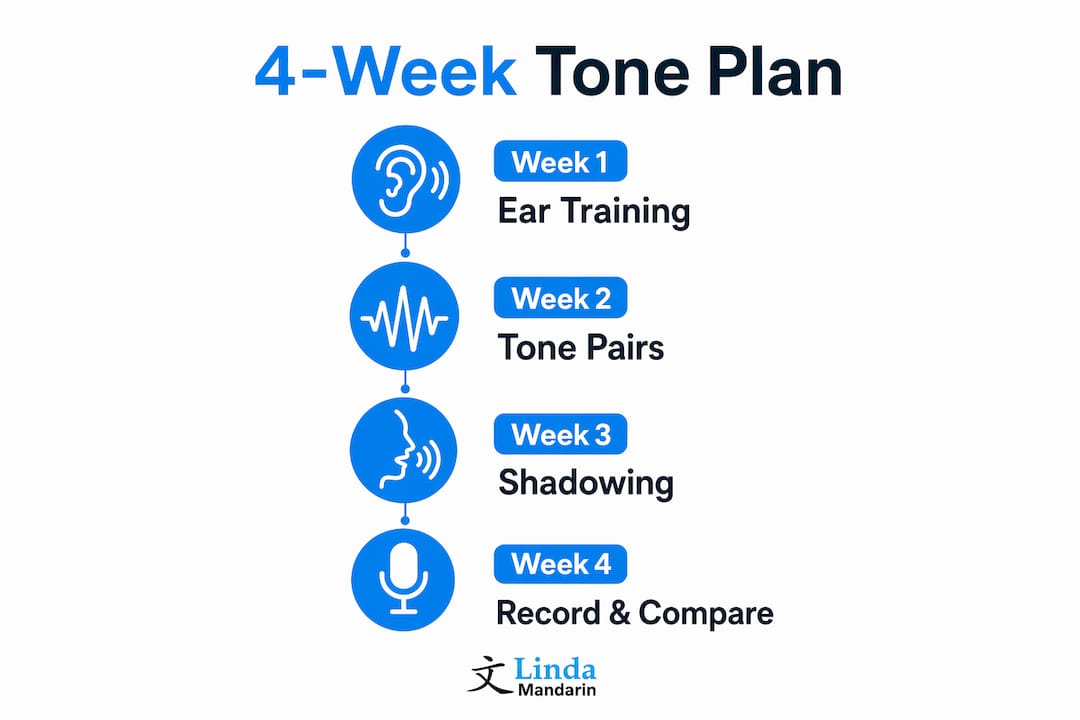
Short, structured daily practice over consecutive weeks produces measurable tonal improvements. A rough guideline: awareness in 1–2 months, consistency in 6–12 months. The plan below compresses the early gains into four focused weeks.
| Week | Daily focus | Daily time | Weekly milestone |
|---|---|---|---|
| Week 1: Ear awareness | Minimal-pair identification drills + interactive pinyin chart listening | About twenty minutes daily | Identify all four tones correctly at normal speed, high accuracy |
| Week 2: Isolated production | Record each tone on 10 syllables, compare to native audio, note errors | about half an hour daily | Produce each tone distinctly in isolation; tutor or app confirms contrast |
| Week 3: Tone-pair drills | Cycle all 20 tone-pair combinations; add sandhi sentence drills | about half an hour daily | Reflexive tone-pair production on 15 common pairs without hesitation |
| Week 4: Sentences and conversation | Shadow short dialogues; record full sentences; get tutor feedback | 30 min | Maintain correct tones in short sentence exchanges; sandhi rules like on nǐ hǎo and bù become automatic |
Daily session breakdown (Week 3 example):
- 5 min: Ear warm-up (listen to tone pairs, no production)
- 10 min: Tone-pair production cycle (all 20 pairs, two reps each)
- 8 min: Sandhi sentence drills (third-tone and 不/一 rules)
- 7 min: Record a short paragraph, compare to native audio, note one specific error
Progress checks:
- Recorded samples: Keep a weekly “tone diary” — one 30-second recording per week of the same short text. Compare Week 1 to Week 4.
- App scoring: Use Speechling’s scoring to track whether your tone accuracy improves week over week.
- Tutor verification: At the end of Week 2 and Week 4, ask a native speaker or instructor to listen to your recordings and confirm whether your tone contrasts are reliable.
A 30-day progression that emphasizes tone pairs, daily recordings, and feedback produces measurable accuracy gains when practiced deliberately. The 4-week structure above maps directly to that principle.
What teachers and linguists say — and the mistakes that hold learners back
What experienced teachers emphasize:
Tones are a skill, not a natural talent. Consistent, deliberate practice is what separates comprehensible speakers from those who remain misunderstood, regardless of how long they’ve been studying. The learners who plateau are almost always the ones who stopped getting feedback.
Olle Linge’s core point is worth repeating: theory helps you notice tones but the brain learns them by doing, not reading about them. Knowing that Tone 3 dips low is not the same as producing a Tone 3 that dips low. The gap between those two things closes only through repeated listen-produce-compare cycles.
Common mistakes and quick fixes:
- Overfocusing on perfection before moving to sentences. Fix: Move to tone-pair and sentence drills by Week 2, even if isolated tones aren’t perfect yet. Connected speech practice accelerates isolated accuracy, not the other way around.
- Not recording yourself. Fix: Record every production session, no exceptions. Self-assessment without audio is systematically unreliable; you hear what you intended, not what you produced.
- Ignoring tone sandhi. Fix: Add sandhi sentence drills from Day 5 onward. Sandhi isn’t advanced grammar; it’s the basic rule that makes nǐ hǎo sound natural.
- Treating tones as optional once you’re understood. Fix: Being understood in a forgiving context doesn’t mean your tones are correct. Keep tracking accuracy even when communication succeeds.
- Drilling only one speaker’s voice. Fix: Use Forvo to hear multiple native speakers on the same word. Tone categories are more robust than any single speaker’s pitch range.
For a deeper look at the specific tone problems adult learners run into, Linda Mandarin’s guide on common tone errors covers three recurring patterns and how to fix each one.
Key Takeaways
Mastering Mandarin tones requires daily ear training, tone-pair production, and recorded feedback loops practiced consistently over four structured weeks.
| Point | Details |
|---|---|
| Tone pairs over isolated syllables | Drill all 20 tone-pair combinations daily; they transfer to real speech far better than isolated syllable practice. |
| Record every session | Compare your recordings to native audio within 30 seconds; self-assessment without audio is unreliable. |
| Sandhi from Day 5 | Practice third-tone sandhi (nǐ hǎo → ní hǎo) and 不/一 rules early to avoid robotic connected speech. |
| Realistic timeline | Expect tone awareness in 1–2 months and consistent accuracy in 6–12 months with daily practice of suitable duration. |
| Linda Mandarin for live feedback | Linda Mandarin’s adult programs offer real-time tone correction and customized drills that accelerate progress beyond self-study. |
The honest truth about how long this actually takes
Most learners want a shortcut around tones. There isn’t one, but there is a faster path, and it’s not what most people do.
The conventional advice is to drill tones in isolation until they’re perfect, then move to words, then sentences. That sequence feels logical, but it produces learners who can recite mā / má / mǎ / mà flawlessly and still get blank stares in conversation. The reason: isolated syllable accuracy doesn’t automatically transfer to connected speech. The transitions between tones, the sandhi rules, the rhythm of a real sentence — none of that gets practiced in isolation drills.
What actually works faster is moving to tone pairs and sentence-level shadowing much earlier than feels comfortable. Your isolated tones will be imperfect. That’s fine. The sentence-level practice will sharpen them in context, which is where they need to work anyway.
The other thing most guides understate: feedback quality matters more than practice volume. Twenty minutes of deliberate practice with a recording and a comparison to native audio beats two hours of casual repetition with no feedback. If you can add a live instructor who can hear your tones and correct them in real time, your progress in the first month will look different from anything self-study alone produces.
Tones are genuinely hard for English speakers. They’re also genuinely learnable. The learners who get there aren’t the ones with the best ear; they’re the ones who kept recording themselves and kept asking for corrections.
Guided tone training with live feedback at Linda Mandarin
Self-study tools get you started, but real-time correction from a native instructor is what closes the gap between “almost right” and “actually understood.” Linda Mandarin has been training adult Mandarin learners since 2003, and tone accuracy is built into every level of the curriculum, not treated as a separate module.

In a first lesson, you get a tone assessment that identifies your specific problem pairs, direct corrective feedback on your production, and a two-week practice plan tailored to your current level. Instructors model the shadowing technique live, which is far more effective than following written instructions alone. Classes run in-person at 10 Anson Road, Level 22, International Plaza (right above Tanjong Pagar MRT) and via online Zoom, so you can get the same quality of feedback whether you’re in Singapore or anywhere else.
If you’re a professional who needs Mandarin for business communication, the corporate Mandarin training program includes pronunciation coaching specific to workplace contexts. For adult learners at any level, the adult course programs page shows current options, schedules, and how to book a first session.
Useful resources to continue your practice
| Resource | Best for | Suggested next action |
|---|---|---|
| YoyoChinese Tone Pairs | Structured tone-pair drills with native audio | Run the full 20-pair cycle once per session |
| Speechling | ASR scoring plus human coach feedback on pronunciation | Record 10 tone-pair words and submit for coach review |
| Forvo | Hearing tones from multiple native speakers | Look up your 5 problem words; shadow 3 different speakers each |
| Pleco | Audio dictionary for vocabulary + tone review | Listen to each new word’s audio before adding it to your deck |
| Pimsleur Mandarin | Sentence-level prosody and tone-in-context audio | Use one 30-minute lesson daily during commute or exercise |
| HackingChinese Tones Guide | Expert methodology and practice frameworks | Read the tone-pair section; apply the listen-produce-compare loop |
| Duolingo Chinese Tones Guide | Beginner-friendly explanation of tone mechanics | Use for the minimal-pair identification exercises |
| Mynago 30-Day Plan | Structured daily progression with milestones | Follow the Week 1–2 ear and production schedule |
| Linda Mandarin Adult Programs | Live instruction and real-time tone correction | Book a first lesson for a personalized tone assessment |
FAQ
How long does it take to master Mandarin tones?
Most learners develop reliable tone awareness within 1–2 months of daily practice (20–30 minutes per session) and reach consistent accuracy in connected speech within 6–12 months. Progress depends heavily on whether you use recorded feedback and get corrections from a native speaker or instructor.
What is the most effective method for improving Chinese tones?
Tone-pair drills combined with a daily record-and-compare loop produce the fastest gains. Drilling isolated syllables for too long without moving to tone pairs and sentence-level shadowing slows progress significantly.
What is the third-tone sandhi rule in Mandarin?
When two Tone 3 syllables appear consecutively, the first changes to Tone 2. The most common example is nǐ hǎo, which is pronounced ní hǎo in natural speech. Practicing this rule early prevents the robotic sound that comes from applying textbook tones to connected speech.
Do I need to match a native speaker’s exact pitch to be understood?
No. What matters is reliable contrast between your tones relative to each other, not matching a native speaker’s absolute pitch height. As Dr. Farrah Neumann notes, focusing on how your tones move relative to each other is more productive than chasing an exact pitch target.
How do regional accents affect Mandarin tone perception?
Regional accents shift the pitch range and sometimes the contour of tones slightly, which is why hearing the same word from multiple speakers on Forvo is useful. Standard Mandarin (Pǔtōnghuà) is the reference for learning, but training your ear on multiple voices makes your tone recognition more flexible in real conversations.