TL;DR:
- Practicing Pinyin and tones daily for the first two weeks builds a strong pronunciation foundation.
- Structured drills, feedback, and consistency accelerate progress, with full mastery taking several months.
Start with Pinyin and the four tones for the first one to two weeks, practicing 45–60 minutes daily. That single decision builds the phonetic foundation that makes every word you learn after it stick faster and sound cleaner.
Here are the three actions to take today:
- Learn the Pinyin chart. Open an interactive chart (TonePerfect is a solid starting point) and listen to each syllable with all four tones before you try to say anything.
- Train the four tones with native audio. Don’t just read tone descriptions. Listen to mā, má, mǎ, mà back to back until you can hear the pitch difference without thinking.
- Start tone-pair practice. Pick two adjacent tones and repeat short phrases like nǐ hǎo slowly, then at natural speed.
Your first 20-minute session:
- 5 minutes: Listen to a native recording of a simple phrase (try nǐ hǎo or xièxiè) and mimic the pitch, not just the consonants.
- 8 minutes: Work through one row of the Pinyin chart, clicking each syllable and repeating aloud.
- 7 minutes: Drill one tone pair (e.g., Tone 1 + Tone 3) using three short words.
Audio tip: Before reading a single Pinyin rule, listen to a native speaker say māo (cat) in all four tones. Your ear needs the reference point before your mouth can follow.
Table of Contents
- Why Pinyin is the right place to start your Chinese pronunciation journey
- How initials and finals form syllables you can actually read
- The four tones explained: how to hear them, produce them, and practice transitions
- Your step-by-step practice plan for the first 12 weeks
- Common beginner mistakes and how to fix them fast
- Drills and resources to practice Chinese pronunciation right now
- Why this step-by-step plan actually works
- Key Takeaways
- What most learners get wrong about Chinese pronunciation
- Structured courses can shorten your pronunciation timeline significantly
- Useful sources and next-step resources
- FAQ
Why Pinyin is the right place to start your Chinese pronunciation journey
Pinyin (拼音, pīnyīn) is the official romanization system for Mandarin Chinese. It uses the Latin alphabet to represent Mandarin sounds, but the letters do not always match their English values. The letter x, for example, sounds nothing like the English x in “fox.” That mismatch trips up nearly every English speaker who skips the Pinyin basics and tries to guess pronunciation from spelling.
The anatomy of every Mandarin syllable follows a clean three-part structure: Initial + Final + Tone. The initial is the opening consonant (like m, b, or zh). The final is the vowel or vowel cluster that follows (like a, iao, or ong). The tone sits on top of the whole syllable. According to TonePerfect’s interactive chart, Mandarin has 21 initials and 35–38 finals, producing roughly 441 valid syllable combinations. That is a finite, learnable set.
Spending one to two weeks on Pinyin before touching vocabulary pays off in two concrete ways. First, you can look up any new word and know exactly how to pronounce it. Second, you can type in Chinese using a Pinyin input method, which accelerates reading and writing practice later.
How to use a Pinyin chart:
| Syllable | Pinyin | Tone Mark | Meaning |
|---|---|---|---|
| First tone (flat, high) | mā | ā | mother |
| Second tone (rising) | má | á | hemp / numb |
| Third tone (dip-rise) | mǎ | ǎ | horse |
| Fourth tone (falling) | mà | à | to scold |
Notice that the same letters m + a produce four completely different words depending on tone. That is why tone is not optional decoration. It is part of the word itself.
For audio, the Linda Mandarin pronunciation guide walks through Pinyin initials and finals with clear explanations built for adult learners. Pair it with TonePerfect’s click-to-play chart so you hear every syllable from a native speaker.
Pro Tip: Zero-initial syllables (like ā, ē, ō) start directly on the vowel with no consonant. On a Pinyin chart, these appear in the leftmost column. Beginners often skip them — don’t. They include common words like 啊 (ā, a particle) and 饿 (è, hungry).
How initials and finals form syllables you can actually read
The 21 initials fall into natural groups that share articulation points. Knowing the groups helps you practice efficiently instead of drilling 21 unrelated sounds.
Key initial groupings:
- Labials: b, p, m, f (lips)
- Alveolars: d, t, n, l (tongue tip near front teeth)
- Velars: g, k, h (back of throat)
- Palatals: j, q, x (tongue body near palate — these only combine with i- and ü-finals)
- Retroflex: zh, ch, sh, r (tongue curled back — unique to Mandarin)
- Dental sibilants: z, c, s (tongue tip at teeth — similar position to English ts)
The finals group by their medial vowel: i-medials (ia, ie, iao, iou), u-medials (ua, uo, uai, uei), and ü-medials (üe, üan, ün). Nasal endings split into -n finals (an, en, in, un) and -ng finals (ang, eng, ing, ong). Keeping these groups in mind turns the pronunciation table from a wall of syllables into a navigable map.
Minimal pairs every beginner should drill:
- zhī vs. zī (retroflex vs. dental sibilant)
- chī vs. cī (same distinction, aspirated)
- shī vs. sī (same distinction, fricative)
- jī vs. zhī (palatal vs. retroflex)
- xī vs. shī (palatal fricative vs. retroflex fricative)
- bō vs. pō (unaspirated vs. aspirated pair)
The aspirated vs. unaspirated distinction (b/p, d/t, g/k) is one of the most common stumbling blocks for English speakers. In English, b and p differ in voicing. In Mandarin, both are unvoiced — the difference is a puff of air. Hold a piece of paper in front of your mouth: pā should move it, bā should not.
Mandarin articulation sits further back in the mouth than most English sounds. For retroflex sounds (zh, ch, sh, r), curl the tip of your tongue up and back toward the roof of your mouth without touching it. For dental sibilants (z, c, s), keep the tongue flat and forward near the teeth. The two positions feel noticeably different once you isolate them.

Pro Tip: For the x vs. sh confusion: x is produced with the tongue body raised toward the hard palate (like a softer “sh” but further forward). sh is retroflex — tongue tip curled back. Say “she” in English, then try to pull the tongue tip back without moving your lips. That back position is sh. The forward position is x.
The four tones explained: how to hear them, produce them, and practice transitions
Mandarin has four lexical tones plus a neutral (fifth) tone. Every syllable carries one of these, and changing the tone changes the word entirely.
The five tones at a glance:
- Tone 1 (ā): High and flat. Hold a steady, high pitch like a musical note. Example: māo (cat). Think of a flat line at the top of your pitch range.
- Tone 2 (á): Rising. Start mid-pitch and rise sharply, like asking “What?” in English. Example: máo (fur/hair).
- Tone 3 (ǎ): Dip-rise. Start mid, dip low, then rise slightly. In isolation it sounds like a drawn-out “hmm.” Example: mǎo (a unit of currency, 10 cents).
- Tone 4 (à): Falling. Start high and drop sharply, like a firm “No!” Example: mào (hat/to emit).
- Neutral tone: Short, light, and unstressed. No tone mark. Example: the particle ma (吗) at the end of a yes/no question.
How to check your own tones: Record yourself saying a word, then play it back against a native recording. The pitch contour should match. If Tone 2 sounds flat instead of rising, you are likely starting too high. If Tone 3 sounds like Tone 4, you are dropping without the final rise.
Tone-pair drill sequence (5–6 pairs to internalize):
- Tone 1 + Tone 1: jīntiān (today)
- Tone 1 + Tone 4: māmà (mom)
- Tone 2 + Tone 3: méiyǒu (don’t have)
- Tone 3 + Tone 2: nǐ lái (you come)
- Tone 4 + Tone 1: shàngbān (go to work)
- Tone 3 + Tone 3 → Tone 2 + Tone 3: nǐ hǎo → níhǎo
That last pair introduces the most important sandhi rule for beginners: when two third tones appear in a row, the first one changes to a second tone. So nǐ hǎo (你好, hello) is pronounced níhǎo in natural speech, not nǐhǎo. The written tone marks stay as third tones, but your mouth produces a second tone on the first syllable. This is not an exception — it is a systematic rule that applies whenever two third-tone syllables are adjacent.
Tone-pair practice is more effective than drilling isolated tones because it trains the pitch transition, which is where most errors actually occur. Practice each pair slowly (3 reps), then at natural speed (3 reps), then in a short sentence (2 reps). Ten minutes of this daily produces faster gains than 30 minutes of isolated tone repetition.

For deeper tone work, Linda Mandarin’s guide to mastering Chinese tones covers contour diagrams and common transition errors in detail.
Your step-by-step practice plan for the first 12 weeks
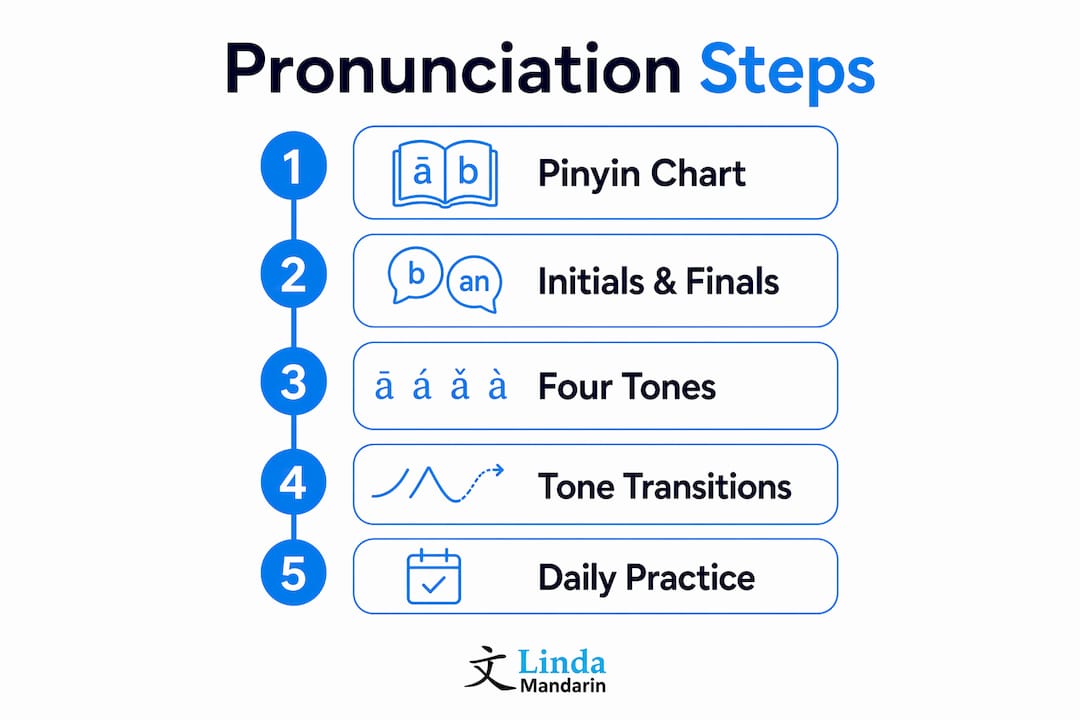
A structured timeline removes the guesswork. Here is a phase-by-phase plan built around 45–60 minutes of daily practice.
Phase overview:
| Phase | Weeks | Daily Minutes | Core Focus | Milestone |
|---|---|---|---|---|
| Foundation | 1–2 | 45–60 | Pinyin chart + four tones | Read any Pinyin syllable aloud with correct tone |
| Expansion | 3–6 | 45–60 | Initials/finals drills, tone pairs, basic vocabulary | Produce syllables cleanly; say 20 short phrases |
| Conversation | 7–12 | 45–60 | Short dialogues, tone correction, sentence building | Hold a 2-minute exchange on a familiar topic |
Week-by-week breakdown:
-
Weeks 1–2 (Foundation): Spend the first session mapping the full Pinyin chart. In sessions 2–5, drill each initial group with audio. By day 7, you should be able to read any Pinyin syllable aloud without guessing. Add tone-pair drills starting day 4. Target: read any Pinyin combination with the correct tone by the end of week 2.
-
Weeks 3–6 (Expansion): Shift to combining initials and finals in minimal-pair drills (zh/z, x/sh, b/p). Introduce 10–15 new vocabulary words per week, always with tone marks. Practice tone pairs in short phrases rather than isolated syllables. Add one 10-minute recording session per week: say a phrase, play it back, compare to a native recording.
-
Weeks 7–12 (Conversation): Move to short scripted dialogues (greetings, ordering food, asking directions). Continue tone-pair drills as a warm-up. Add a human tutor or AI feedback tool at least once per week for real-time correction. Real-time tone correction during this phase prevents errors from becoming habits.
Daily session checklist:
- Warm-up (5 min): Listen to a native recording of today’s target phrase. Mimic pitch, not just sounds.
- Tone drill (10 min): Two tone-pair sets, slow then natural speed.
- Minimal-pair practice (10 min): One confusable pair from your current weak spots.
- Vocabulary + short sentences (15–20 min): New words in context, always with tones.
- Recording review (5–10 min): Record one sentence, compare to native audio, note the gap.
Add a human tutor or AI pronunciation tool by week 3 at the latest. Self-study alone cannot replicate the feedback loop of hearing your own errors named and corrected in real time.
Common beginner mistakes and how to fix them fast
Most pronunciation errors in the first month come from a short list of predictable habits. Knowing them in advance cuts weeks off your correction time.
-
Rushing to native speed too early. Clarity before speed is the rule. When you imitate native speed before your tones are stable, you lock in the wrong pitch patterns. Fix: slow every new word to half speed for the first five repetitions. Only increase speed after three consecutive correct reps.
-
Reading Pinyin letters as English letters. The letter c in Pinyin sounds like “ts” (as in “cats”). The letter e sounds like the vowel in “uh.” The letter q sounds like “ch” but forward in the mouth. Fix: treat Pinyin as a new alphabet. Spend 10 minutes on day one mapping every Pinyin letter to its actual sound, not its English equivalent.
-
Ignoring tones on familiar words. Once you know a word, it is tempting to drop the tone and rely on context. That habit compounds. Fix: every time you write a new word in your notes, write the tone mark. Every time you say it, say the tone. No exceptions for the first three months.
-
Confusing retroflex and dental sibilants. Zh/ch/sh vs. z/c/s is the most common source of a “foreign accent” in Mandarin. Fix: use the tongue-position drill. Say zī (dental, tongue forward), then zhī (retroflex, tongue curled back). Alternate 10 times slowly. The physical sensation is the cue, not the sound alone. For more on tongue placement fixes, Linda Mandarin’s tone problem guide covers the mechanics in detail.
-
Treating the third tone as always dipping. In connected speech, the third tone before any non-third tone is often a low tone, not a full dip-rise. The full dip-rise only appears in isolation or before a pause. Fix: practice third-tone words in phrases, not just alone.
-
Skipping the neutral tone. The neutral tone is short and unstressed, but dropping it entirely changes the rhythm of a sentence. Fix: practice common particles (ma, ne, ba) in full sentences so the neutral tone becomes automatic.
Record yourself once per week, compare to a native recording, and write down one specific gap to fix the following week. That feedback loop, even without a tutor, accelerates improvement faster than passive listening.
Drills and resources to practice Chinese pronunciation right now
The right tools make daily practice faster and more accurate. Here is a curated set of drills and resources that cover every stage of the step-by-step Mandarin learning process.
Six drill recipes:
- Tone-pair drill: Pick one tone combination (e.g., Tone 2 + Tone 4). Say five different words with that pattern, slow then fast. 5 minutes.
- Minimal-pair drill: Choose one confusable pair (e.g., xī vs. shī). Alternate between them 10 times, focusing on tongue position. 5 minutes.
- Syllable ladder: Start with a single syllable (bā), add a second (bāba), then a short phrase (wǒ bāba). Build up and back down. 5 minutes.
- Recording playback drill: Say a sentence, record it, play it back against a native audio clip. Identify one specific difference. 10 minutes.
- Sentence chunking: Take a 6-word sentence and break it into two-word chunks. Drill each chunk for tones, then reassemble. 8 minutes.
- Shadowing: Play a native audio clip at 75% speed and speak simultaneously, matching pitch and rhythm. 10 minutes.
Recommended resources:
- TonePerfect interactive chart: Covers all 441+ valid syllables with native audio for each tone slot. Use it to hear any syllable you are unsure about and to run targeted minimal-pair comparisons.
- DigMandarin pronunciation guide: A detailed written guide covering initials, finals, and common mistakes. The DigMandarin guide is particularly useful for understanding why certain sounds are hard for English speakers.
- New Concept Mandarin (YouTube): Structured pronunciation playlists that walk through tones and initials/finals with clear visual and audio explanations. Good for visual learners who want a teacher-led format.
- Grace Mandarin (YouTube): Short, focused videos on specific pronunciation challenges. Useful for targeting one sound at a time rather than working through a full course.
- HelloChinese (app): A free app with a built-in tone recognition feature that scores your pronunciation and flags which tones need work. Strong for beginners in weeks 1–6 because it sequences Pinyin before vocabulary.
- Pleco (dictionary app): The standard Mandarin dictionary for learners. Every entry includes audio from a native speaker. Use it to check the pronunciation of any new word before you say it yourself. The flashcard system supports spaced repetition for tone practice.
- Linda Mandarin’s complete tone guide: An in-depth resource covering tone contours, common transition errors, and practice recommendations for adult learners.
For speaking-focused curriculum design, the approach used in practical speaking courses for other languages offers a useful model: prioritize spoken output with immediate feedback over passive reading, a principle that applies directly to Mandarin tone training.
Free vs. paid: Free tools (HelloChinese, Pleco, TonePerfect, YouTube) cover the full foundation. Paid tools add personalized feedback, structured progression, and human correction. The gap matters most in weeks 3–12, when self-study alone tends to plateau without corrective input.
Why this step-by-step plan actually works
The sequencing in this plan is not arbitrary. It reflects how phonetic learning works under deliberate practice conditions.
Pinyin first gives you a decoding system before you accumulate vocabulary. Every word you learn after week two comes with a pronunciation key you already know how to read. Without Pinyin, learners guess at sounds from characters and build errors in from day one.
Tones prioritized early prevents the most common long-term problem: treating tones as optional. Once a learner has spoken a word incorrectly for three months, the wrong version is deeply encoded. Early corrective feedback, from a tutor or an AI tool that scores tone accuracy, stops that from happening. AI-driven pronunciation apps can grade tone accuracy and generate personalized drill sets for the specific syllables a learner struggles with most, which makes practice time more efficient than working through a fixed curriculum.
Deliberate practice principles underpin the daily session structure. Short, focused blocks (45–60 minutes) with immediate feedback outperform longer passive sessions. Spaced repetition, built into tools like Pleco’s flashcard system, consolidates tone-word pairings across days rather than cramming them in one session.
On timeline: Conversational fluency typically takes 12–18 months at 45–60 minutes of daily practice. Professional proficiency aligns with FSI Category IV estimates of approximately 2,200 hours. The 12-week plan in this article targets the first milestone: a stable phonetic foundation from which vocabulary and grammar can grow without constant backtracking to fix sounds.
Timeline callout: 12–18 months of daily 45–60 minute practice for conversational fluency; ~2,200 hours for professional proficiency (FSI Category IV). The first 12 weeks build the phonetic base that determines how fast the rest goes.
Scheduling your practice at the same time each day, even for 45 minutes, produces more consistent gains than longer irregular sessions.
Key Takeaways
Mastering Chinese pronunciation requires Pinyin first, tones second, and daily corrective feedback from week one to prevent errors from becoming permanent habits.
| Point | Details |
|---|---|
| Start with Pinyin and tones | Spend weeks 1–2 on the Pinyin chart and four tones before adding vocabulary. |
| Practice 45–60 minutes daily | Conversational fluency typically takes 12–18 months at this daily pace; professional proficiency aligns with FSI Category IV estimates of approximately 2,200 hours. |
| Use tone-pair drills, not isolated tones | Drilling adjacent tone combinations trains the pitch transitions where most errors occur. |
| Get corrective feedback early | Add a tutor or AI pronunciation tool by week 3 to prevent entrenched mispronunciations. |
| Linda Mandarin adult courses | Structured group, private, and online Zoom classes provide the live correction self-study cannot replicate. |
What most learners get wrong about Chinese pronunciation
Most beginners treat Chinese pronunciation as a memorization task. Learn the chart, memorize the tones, move on. That framing is what causes the plateau that hits around week six, when a learner can read Pinyin but still sounds noticeably foreign in every sentence.
The real issue is that tones are not labels attached to words. They are physical habits. Your mouth, tongue, and vocal cords need to produce the right pitch contour automatically, without conscious thought, before you can hold a real conversation. That kind of automaticity only comes from repetition with feedback, not from reading descriptions of what a tone should sound like.
The learners who make the fastest progress share one habit: they record themselves from day one. Not to post online, but to hear the gap between what they think they are saying and what actually comes out. That gap is almost always larger than expected in the first two weeks, and almost always smaller by week six. The recording is the feedback loop that makes the difference when a tutor is not available.
The other underrated factor is patience with the third tone. Most learners learn the dip-rise shape and apply it everywhere. But in natural speech, the third tone before a non-third tone is mostly just low. Drilling the full dip-rise in connected speech makes you sound labored and unnatural. The fix is simple: practice third-tone words in phrases from the start, not in isolation.
For learners who want a structured path through these challenges, Linda Mandarin’s guide on the hardest parts of learning Mandarin is worth reading before you start week one.
Structured courses can shorten your pronunciation timeline significantly
Self-study gets you started. A structured course gets you there faster and with fewer bad habits to unlearn later.
Linda Mandarin has been training adult Mandarin learners in Singapore since 2003. The school’s courses for adults and professionals cover everything from beginner conversational Mandarin to business-level speaking, with native-speaking instructors who correct tone errors in real time, not after the fact. That live correction in the first few weeks is exactly what the research supports as the fastest route to a stable phonetic foundation.

For learners who want flexibility, online Zoom classes offer the same structured instruction and live feedback without requiring you to be in Singapore. Corporate training programs are available for teams that need Mandarin for professional communication. Whether you are starting from zero or fixing pronunciation habits that have been building for months, the adult Mandarin courses at Linda Mandarin are designed to move you through the Pinyin-to-conversation sequence efficiently.
If you are specifically focused on Pinyin foundations, the dedicated Pinyin course covers the full chart, tone drills, and initial/final combinations in a structured format with instructor feedback. Browse the full range of adult programs to find the format that fits your schedule and goals, then book a session to get started.
Useful sources and next-step resources
A short list of the core resources referenced in this guide, organized so you can open audio examples immediately.
-
TonePerfect Interactive Pinyin Chart: Click any cell to hear a native speaker pronounce that syllable in all four tones. Use it in weeks 1–2 for chart familiarization and throughout the 12 weeks for minimal-pair checks. Free.
-
DigMandarin Chinese Pronunciation Guide: A written guide covering initials, finals, common English-speaker errors, and tone descriptions. Read it alongside the Pinyin chart in week one. Free.
-
StoryLearning Chinese Pronunciation Guide: Covers mouth and tongue position for retroflex vs. dental sounds and aspirated vs. unaspirated pairs. Particularly useful for weeks 2–4 when you are drilling initials. Free.
-
HelloChinese (app, iOS and Android): Built-in tone recognition scores your pronunciation and adapts drills to your weak spots. Use it as your primary daily practice app in weeks 1–6. Free tier covers the full Pinyin foundation.
-
Pleco (app, iOS and Android): The standard Mandarin dictionary. Every entry includes native-speaker audio. Use it to check pronunciation before saying any new word, and use the flashcard system for spaced repetition of tone-word pairs. Free core app; paid add-ons available.
-
New Concept Mandarin (YouTube): Structured pronunciation playlists with teacher-led explanations of tones and syllable structure. Good for visual learners who want a classroom-style format for free.
-
Grace Mandarin (YouTube): Short videos targeting specific pronunciation challenges. Use for targeted drilling when one sound is giving you trouble.
-
Linda Mandarin Pronunciation Guide for Adult Learners: A practical resource built for adult learners covering Pinyin, tones, and recommended practice routines aligned with conversational and business goals.
FAQ
How do you learn Chinese pronunciation step by step?
Start with the Pinyin chart and four tones for the first one to two weeks, practicing 45–60 minutes daily. Then move to initials and finals drills, tone-pair practice, and short sentences, adding live or AI feedback by week three to catch errors before they become habits.
What is the 3-3-3 rule in Mandarin?
The 3-3-3 rule is not a single standardized framework in Mandarin instruction; definitions vary across teachers and courses. A common version used in tone drilling is: say a new word three times slowly, three times at natural speed, and three times in a short sentence. This repetition pattern helps encode both the sound and the tone contour together.
How do you say 1 through 10 in Mandarin?
The numbers one through ten in Mandarin include: yī (1), èr (2), sān (3), sì (4), wǔ (5), liù (6), qī (7), bā (8), and shí (10). Note the tones: yī is Tone 1, èr and sì are Tone 4, sān and shí are Tone 1, wǔ is Tone 3, liù and bā are Tone 4, and qī is Tone 1.
How do you practice Chinese pronunciation effectively?
Record yourself daily, compare your output to native audio, and identify one specific gap to fix each week. Tone-pair drills, minimal-pair practice, and shadowing native recordings at 75% speed are the three most efficient daily habits for building accurate pronunciation.
How long does it take to get a stable pronunciation foundation?
Most learners reach a stable phonetic foundation, meaning they can produce all four tones and most initials/finals consistently, within 8–12 weeks of focused daily practice. Conversational fluency typically follows at 12–18 months with 45–60 minutes of daily practice.