TL;DR:
- Structured beginner Mandarin classes help adults start speaking quickly with practical scenarios.
- Courses often follow HSK or CEFR standards, focusing on pinyin, tones, and real-life vocabulary.
- In-person, online, and blended formats suit different schedules, with consistent practice key to success.
Most adults in Singapore assume Mandarin is too complex to learn after a certain age, or that a packed schedule makes it impossible. Neither is true. Structured Chinese classes for beginners are specifically designed to break the language into manageable, practical pieces so you start speaking real sentences within weeks, not years. Whether you’re a professional looking to connect better with clients, an expatriate wanting to feel more at home, or simply someone curious about Chinese culture, this guide walks you through everything you need to know to start confidently.
Table of Contents
- Understanding Chinese classes for beginners in Singapore
- Popular methodologies and curriculum frameworks
- Choosing the right class format: In-person, online, or blended
- Practical tips for success in beginner Mandarin learning
- The truth about learning Mandarin as an adult in Singapore
- Take the next step: Find your beginner Mandarin class
- Frequently asked questions
Key Takeaways
| Point | Details |
|---|---|
| Beginner classes are accessible | No prior Chinese experience is required and courses fit busy adult schedules in Singapore. |
| Framework matters | HSK and CEFR guide effective entry-level learning with clear communication goals. |
| Choose the right format | In-person, online, and blended classes each offer unique benefits for adult learners. |
| Consistency drives results | Daily small steps and cultural immersion accelerate your progress in Mandarin. |
Understanding Chinese classes for beginners in Singapore
A genuine beginner Mandarin course assumes you know nothing. Zero. No prior exposure to Chinese characters, tones, or grammar is expected. The focus is entirely on getting you to communicate in everyday situations as quickly as possible.
In Singapore, these courses are open to a wide range of learners. Expatriates, working professionals, and permanent residents all enroll, and many programs qualify for SkillsFuture funding, which means Singapore Citizens and PRs can offset course fees using their credit. For example, the ITE Everyday Mandarin Beginner course covers 18 classroom hours with no entry requirements and is SkillsFuture eligible, focusing on daily conversations, self-introductions, directions, and workplace or social settings.
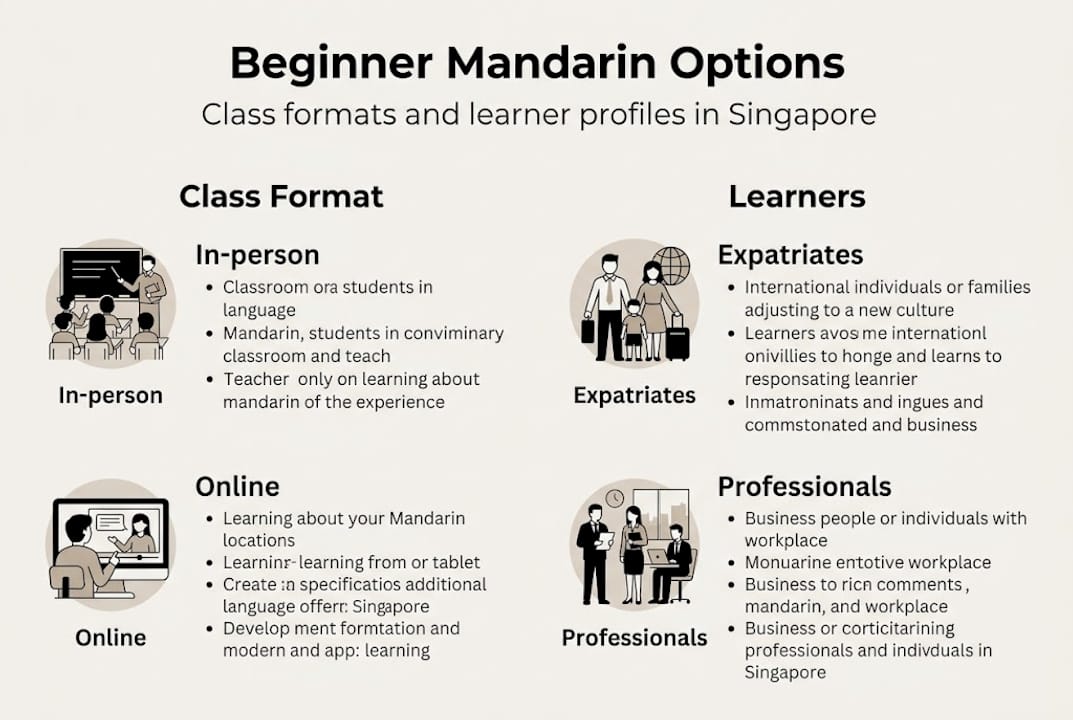
Unlike children Mandarin classes, which rely heavily on repetition and play-based learning, adult beginner courses are structured around real-life adult scenarios. Think ordering food, introducing yourself at a business meeting, or navigating a neighborhood.
Here’s what a typical beginner curriculum covers:
- Basic greetings and self-introductions
- Numbers, dates, and time expressions
- Asking for and giving directions
- Workplace communication essentials
- Social phrases for dining, shopping, and events
- Introduction to pinyin (the phonetic system for Mandarin pronunciation)
| Course feature | Typical range |
|---|---|
| Total classroom hours | 18 to 36 hours |
| Class size | 6 to 15 students |
| Duration | 2 to 4 months part-time |
| Delivery format | In-person, online, or blended |
| SkillsFuture eligible | Often yes, varies by provider |
“The best beginner course is one that gets you speaking on day one. Grammar explanations matter, but real confidence comes from actual conversation practice.”
Exploring the full range of Mandarin programs for adults available in Singapore will help you compare formats and find the right fit before committing.
Popular methodologies and curriculum frameworks
Not all beginner courses are built the same. The framework a school uses shapes how fast you progress and how well the skills transfer to real life.
Two standards dominate the beginner Mandarin landscape. The HSK (Hanyu Shuiping Kaoshi) framework, developed by Hanban, organizes language skills into practical listening, speaking, reading, and writing competencies. CEFR A1, the Common European Framework of Reference for Languages, is a widely recognized international benchmark that makes it easier to compare your Mandarin level against other languages you may have studied. According to course methodology guidance, both HSK and CEFR A1 alignment are common standards used in beginner courses, alongside pinyin instruction, small group interaction, cultural integration, and placement testing.
Here’s how the most effective beginner programs are typically structured:
- Pinyin first. Before you read a single character, you learn pinyin. This phonetic system lets you pronounce any Mandarin word correctly and builds a strong pronunciation foundation.
- Tones introduced early. Mandarin has four tones plus a neutral tone. Getting these right from the start prevents bad habits that are hard to break later.
- Vocabulary in context. New words are taught inside real sentences and scenarios, not isolated lists.
- Cultural integration. Understanding why certain phrases are used, or how Chinese social customs work, makes the language stick faster.
- Progressive skill building. Each lesson builds on the last, so nothing feels random or disconnected.
| Framework | Focus | Best for |
|---|---|---|
| HSK/Hanban | Practical communication skills | Learners targeting formal certification |
| CEFR A1 | Internationally comparable benchmarks | Professionals with multilingual backgrounds |
| School-designed syllabus | Flexible, real-life scenarios | Casual learners and expatriates |
Pro Tip: If you’re unsure which level to enter, use a Mandarin placement test guide to identify your starting point accurately. Joining the wrong level wastes time and kills motivation.
Understanding Mandarin course design fundamentals can also help you evaluate whether a school’s approach matches your learning goals before you sign up.
Choosing the right class format: In-person, online, or blended
With an understanding of teaching methods, it’s important to consider which class format aligns best with your learning style and schedule.
Each format has real advantages, and the right choice depends on your lifestyle, not just your preference.
In-person classes are ideal if you thrive on face-to-face interaction. You get immediate feedback from your instructor, real-time correction of your tones, and the social energy of a classroom. That said, small group interaction is widely recommended for beginner learners because it balances personal attention with peer practice, which builds confidence faster than solo study.
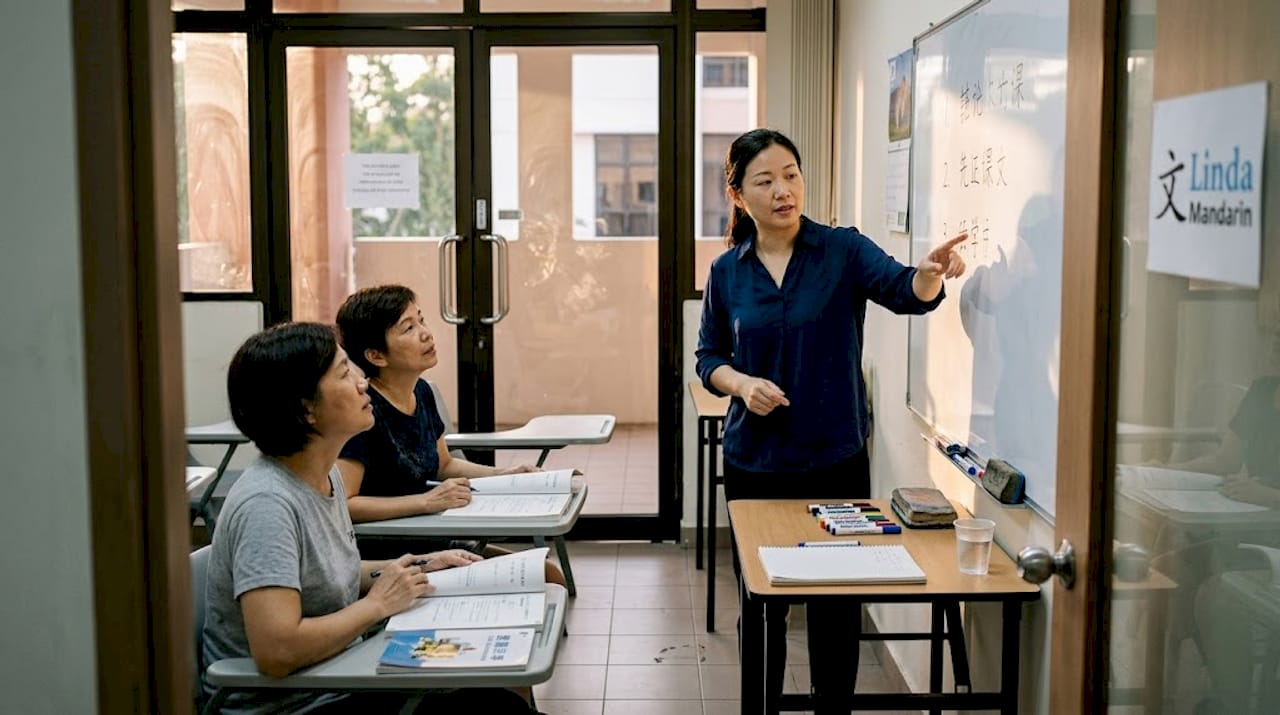
Online classes suit busy professionals who can’t commit to a fixed location. Zoom-based lessons with a live instructor are not the same as watching pre-recorded videos. You still get real-time feedback and conversation practice, just from your home or office.
Blended models combine the best of both. You attend live sessions for speaking and listening practice, and use digital tools for vocabulary review and reading between classes.
Here’s a quick breakdown to help you decide:
- In-person: Best for social learners, beginners who need strong pronunciation correction, and those who prefer structured routines
- Online: Best for professionals with irregular schedules, frequent travelers, or those outside the central Singapore area
- Blended: Best for learners who want flexibility without sacrificing live interaction
- Private classes: Best for learners with very specific goals, such as business Mandarin or exam preparation
Pro Tip: Before committing to a full course, book a Mandarin trial class to experience the teaching style firsthand. One session tells you more than any course description.
Also consider the instructor’s background. A certified native Mandarin speaker who is also fluent in English can explain concepts in ways that make sense to an adult learner, rather than just repeating the phrase louder.
Practical tips for success in beginner Mandarin learning
Once you’ve chosen your ideal format, the next step is making steady progress. Here’s how to maximize your beginner journey.
The single biggest predictor of success is not talent. It’s consistency. Fifteen minutes of daily practice beats a three-hour session once a week, every time. Your brain needs repeated, spaced exposure to new sounds and vocabulary to actually retain them.
- Practice daily, even briefly. Use your commute to review flashcards or listen to a short Mandarin podcast. Small habits compound fast.
- Use spaced repetition apps. Tools like Anki or Pleco help you review vocabulary at the exact moment your brain is about to forget it, which is far more efficient than rereading your notes.
- Speak in class, even imperfectly. Making mistakes in a safe classroom environment is how you identify gaps. Staying silent is the real mistake.
- Find a language partner. A fellow learner or native speaker willing to chat for 20 minutes a week gives you unscripted practice that no textbook can replicate.
- Immerse yourself in Singapore’s Chinese culture. Attend a temple fair, explore a hawker center and read the signs, or watch a Mandarin drama with subtitles. Singapore offers more cultural immersion opportunities than most cities in the world.
The HSK and CEFR-aligned syllabus used in structured courses emphasizes practical communication from the very first lesson, which means every class session is directly applicable to real life. You’re not memorizing abstract grammar rules. You’re learning to say something useful.
Pro Tip: Explore Chinese culture training programs alongside your language course. Understanding the cultural context behind phrases makes them easier to remember and more natural to use.
The truth about learning Mandarin as an adult in Singapore
Here’s something most language schools won’t say out loud: adults are often better language learners than children in a structured classroom setting. Children have time and immersion on their side. Adults have something more powerful: motivation, discipline, and the ability to understand patterns quickly.
Basic conversational Mandarin is achievable in months, not years, when you commit to a structured program. Full fluency is a longer road, but that’s not the goal at the beginner stage. The goal is to hold a real conversation, read a menu, or greet a colleague in Mandarin. Those milestones come faster than most people expect.
Singapore is also one of the most supportive environments in the world for learning Mandarin. The language is everywhere: on signs, in conversations, in media. Your classroom learning gets reinforced every time you step outside. Exploring the full range of programs for adults at a reputable school gives you a structured foundation that turns that daily exposure into actual progress. The biggest barrier is not your age or your schedule. It’s starting.
Take the next step: Find your beginner Mandarin class
If you’re ready to build real Mandarin skills, the path forward is clearer than you think.
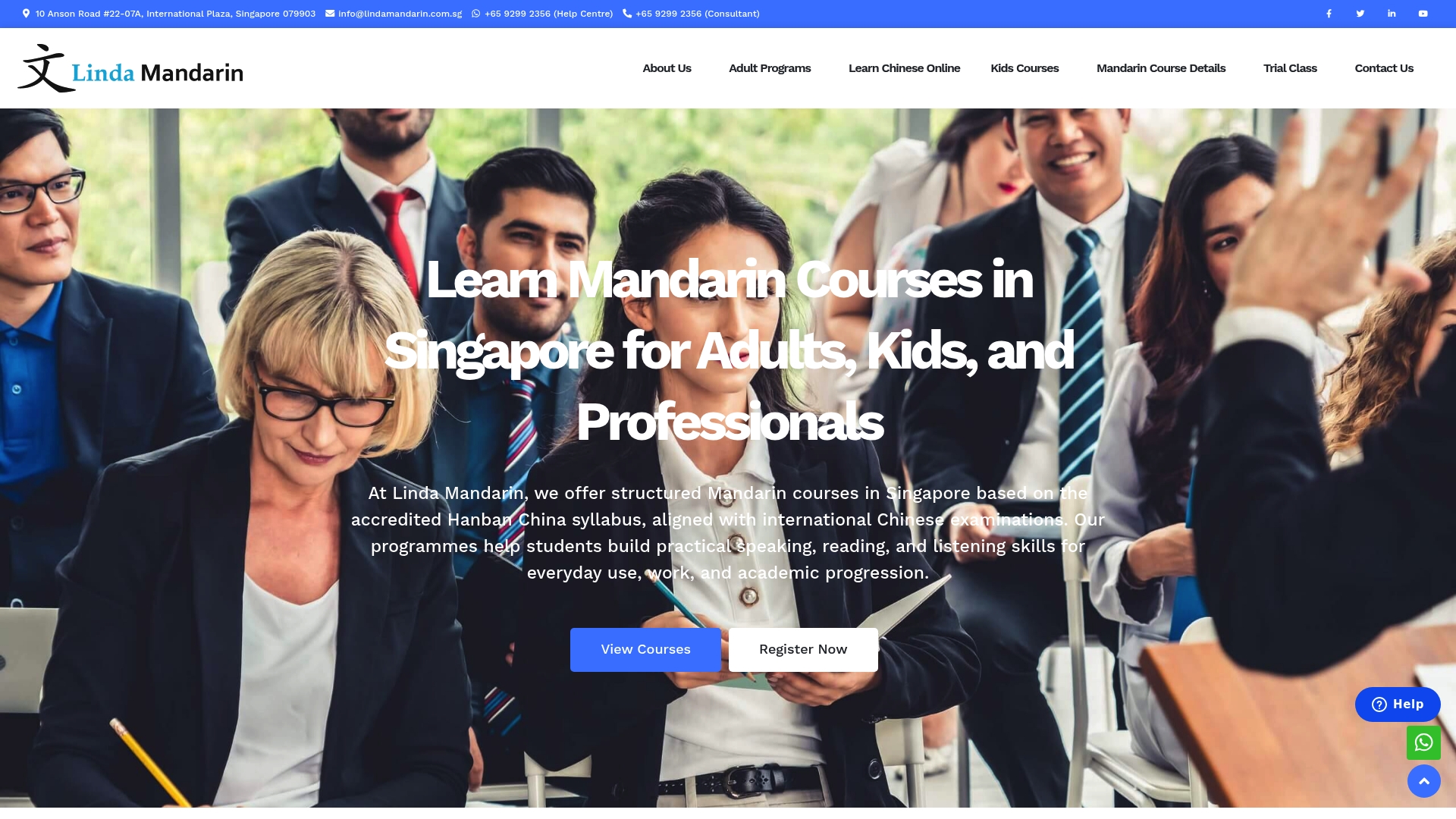
At Linda Mandarin, beginner learners can choose from a range of Mandarin course levels designed specifically for adults, whether you prefer a relaxed group setting or a faster-paced intensive Mandarin course. All adult Mandarin programs are taught by certified native instructors fluent in English, located right above Tanjong Pagar MRT for easy access. Review your options, check available schedules, and book a trial lesson to experience the teaching approach before committing. Your first real Mandarin conversation is closer than you think.
Frequently asked questions
How long does it take to complete a beginner Mandarin course in Singapore?
Most beginner courses run between 18 and 30 classroom hours, which typically translates to 2 to 3 months of part-time study depending on the schedule you choose.
Are Mandarin classes for beginners suitable for total newcomers with no Chinese background?
Yes. Most beginner courses require no entry requirements and start from absolute zero, covering pinyin, basic tones, and everyday phrases from the first lesson.
What curriculum standard is best for adult beginners: HSK or CEFR?
Both HSK and CEFR A1 are widely used for adult beginners. HSK focuses on practical Mandarin skills, while CEFR A1 makes it easier to compare your level across multiple languages you may already know.
Is SkillsFuture credit applicable for beginner Chinese courses?
Yes. Courses such as ITE’s Everyday Mandarin are SkillsFuture eligible for Singapore Citizens and Permanent Residents, allowing you to offset course fees with your existing credit balance.