TL;DR:
- Adults can achieve Mandarin fluency with structured study, consistent practice, and realistic goals.
- Balanced development of listening, speaking, reading, and writing skills accelerates language mastery.
- Engagement in daily real-world Mandarin use is key to progressing beyond test-based learning.
Many adults in Singapore quietly believe that learning Mandarin fluently is only possible for children, or for those who grew up speaking it at home. That belief is wrong, and the data backs it up. HSK-aligned courses show measurable progress for adult learners across every proficiency level, from complete beginners to near-native speakers. With the right structure, a realistic timeline, and a plan that covers all four language skills, fluency is absolutely within reach. This article walks you through the key frameworks, practical habits, and mindset shifts that will help you move from confusion to genuine confidence in Mandarin.
Table of Contents
- Understand HSK levels and what they mean for you
- Build a balanced study plan: Listening, speaking, reading, writing
- Tackling advanced Mandarin: Overcoming common challenges
- Real-world practice: Maximizing your Mandarin outside of class
- Why true Mandarin mastery means going beyond the test
- Take your Mandarin learning further with tailored courses
- Frequently asked questions
Key Takeaways
| Point | Details |
|---|---|
| Structure matters | Using HSK levels helps adults track real progress in Mandarin. |
| Balance your skills | Focusing on listening, speaking, reading, and writing together boosts results. |
| Go beyond the test | Practicing Mandarin in real life leads to deeper and more lasting fluency. |
| Tackle advanced challenges | Overcoming higher levels needs practical learning, not just memorization. |
Understand HSK levels and what they mean for you
The first step is understanding the system behind structured Mandarin learning. The HSK, which stands for Hanyu Shuiping Kaoshi (the official Chinese Proficiency Test), gives you a clear roadmap with six levels of increasing difficulty. Each level maps to a CEFR equivalent, which is the Common European Framework of Reference used to standardize language learning across the world. Knowing where you sit on this scale helps you set goals that are ambitious but realistic.
Here is how the levels break down in practical terms:
| HSK Level | Vocabulary Size | CEFR Equivalent | Real-Life Capability |
|---|---|---|---|
| HSK 1 | 150 words | A1 | Basic greetings, numbers, simple phrases |
| HSK 2 | 300 words | A2 | Simple daily conversations |
| HSK 3 | 600 words | B1 | Navigate most everyday situations |
| HSK 4 | 1,200 words | B2 | Discuss a wide range of topics fluently |
| HSK 5 | 2,500 words | C1 | Read newspapers, watch films, formal discussions |
| HSK 6 | 5,000+ words | C2 | Near-native fluency |
Mandarin course levels at structured schools typically divide into Beginner (HSK 1 to 3), Intermediate (HSK 4), and Advanced (HSK 5 to 6). This mirrors international standards and helps you measure progress with real benchmarks rather than vague feelings of improvement.
Here is what this means practically for adults:
- HSK 1 to 2: Perfect starting point if you have zero or very limited Mandarin exposure.
- HSK 3: A strong conversational base. Many professionals in Singapore find this level genuinely useful in daily interactions.
- HSK 4: The point where you can discuss ideas, not just logistics. This is often the target for business professionals.
- HSK 5 to 6: Advanced territory. Only about 60% of test-takers pass the HSK 5, which tells you everything about how demanding this stage is.
That last statistic matters. The ~60% pass rate at HSK 5 is not there to discourage you. It is there to tell you that advanced Mandarin requires a smarter approach, not just more hours. Use Mandarin learning resources that go beyond flashcards and textbooks to get there.
Build a balanced study plan: Listening, speaking, reading, writing
Once you know your starting point, map a plan across all four skills. Each one serves a different purpose, and neglecting any of them will create gaps that become harder to fix at higher levels.
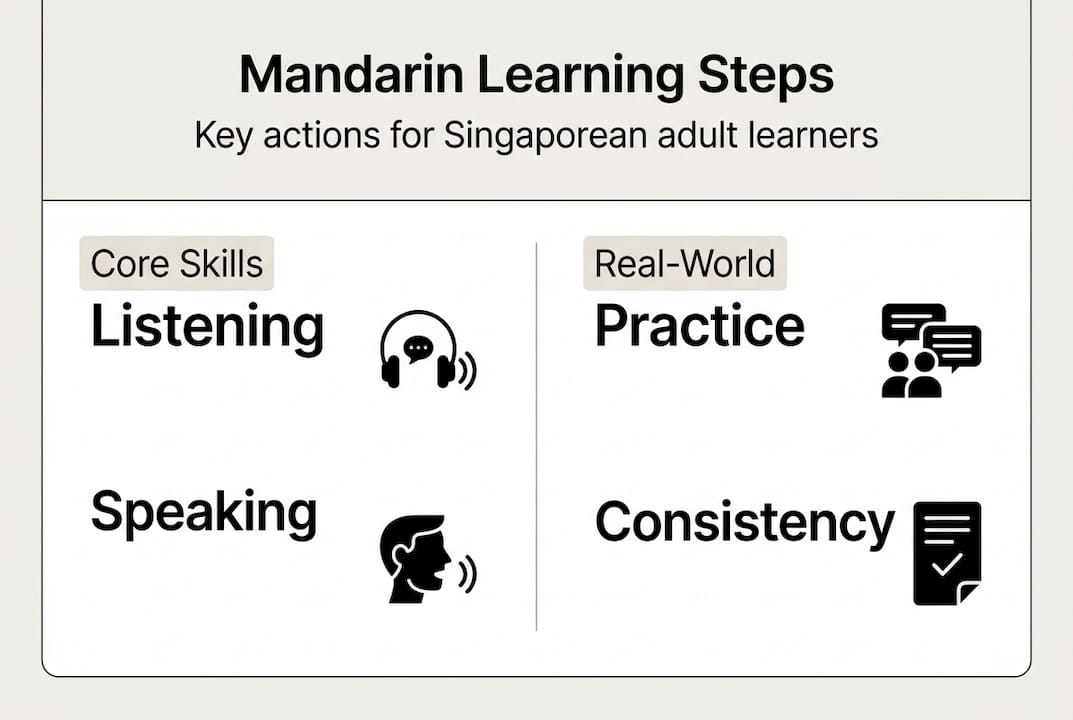
Listening is the foundation. Before you can speak naturally, your ear needs to recognize tones, rhythm, and connected speech. Watch Mandarin dramas, listen to podcasts, or follow Chinese news with subtitles. Start slow, then push yourself with native-speed content.

Speaking is where most adults stall. They wait until they feel ready. The problem is that feeling never arrives on its own. Effective Mandarin learning strategies consistently point to early speaking practice as one of the biggest accelerators. Say things out loud from day one, even if you feel awkward.
Reading builds vocabulary in context. Graded readers, local news in Chinese, and WeChat articles all work well. The goal is to stop translating in your head and start reading for meaning.
Writing reinforces memory and forces you to recall characters actively rather than just recognizing them passively. Even short daily journaling in Mandarin moves the needle.
Pro Tip: Do not wait until you have memorized 500 words before speaking to a native speaker. Find a language exchange partner in Singapore or join a local Mandarin conversation group within your first month. Discomfort is the fastest teacher.
Research published in Frontiers in Psychology confirms what experienced teachers already know: higher HSK listening and reading scores strongly predict better academic and professional language outcomes. Balanced skill development is not just good practice, it is the most effective path to real results.
“Students who invested equally across listening, reading, speaking, and writing showed significantly stronger outcomes than those who focused on a single skill.”
Here are specific habits to build into your week:
- 20 minutes of Mandarin audio daily (podcast, drama, or language app)
- One structured grammar or vocabulary lesson every other day
- Weekly conversation practice with a native speaker or tutor
- Vocabulary retention tips using spaced repetition apps like Anki
- Read one short Chinese article per week, even at HSK 2 level
Consistency across all four skills beats intensity in just one area, every single time.
Tackling advanced Mandarin: Overcoming common challenges
After establishing basic fluency, you will encounter new obstacles. Advanced Mandarin is a different animal. Grammar becomes more nuanced, context-specific language appears, and business or professional settings demand precision that casual conversation does not require.
Here is a quick look at how advanced skills connect to real business scenarios:
| Advanced Skill | Business Application |
|---|---|
| Formal sentence structures | Written proposals and emails |
| Idiomatic expressions (chengyu) | Building rapport in meetings |
| Polite vs. direct registers | Negotiating without offense |
| Industry-specific vocabulary | Technical presentations |
| Listening at native speed | Following boardroom discussions |
Knowing business Mandarin skills requires more than grammar drills. You need contextual fluency, which means using the right tone, the right level of formality, and the right vocabulary for each specific situation.
Here are the top three roadblocks adults face at advanced levels, and how to address them:
- Over-reliance on memorization. At HSK 5 and above, rote learning stops working. You need exposure to Mandarin in varied, unpredictable contexts. Read opinion pieces, watch debates, and discuss current events in Chinese.
- Fear of making mistakes in professional settings. This fear causes adults to revert to English when Mandarin gets difficult. The solution is to practice in low-stakes environments first, then gradually introduce Mandarin into real work conversations.
- Ignoring tones at speed. Tones that feel natural in slow practice often collapse under pressure. Record yourself speaking naturally, then compare with native speakers. The gap will surprise you.
The low HSK 5 pass rate is largely explained by adults relying on rote strategies that worked at lower levels but simply do not scale. Practical, context-driven practice is what separates those who stall from those who push through.
Pro Tip: Do not just prep for the HSK 5 exam. Find a Mandarin-speaking colleague or mentor and practice actual negotiation scenarios, pitch structures, or client conversations monthly. This mirrors real-world pressure and builds confidence that test prep alone cannot.
Real-world practice: Maximizing your Mandarin outside of class
Conquering tests is only half the journey. True fluency means applying skills daily, and Singapore gives you an extraordinary environment to do exactly that.
Singapore is one of the few places in the world where you can switch between Mandarin, English, and dialects within a single lunch conversation. That is not a distraction. That is an advantage. The multilingual texture of daily life here means Mandarin practice opportunities are everywhere, if you know how to find them.
Research on HSK curriculum and real-world use shows that test-focused learning creates washback effects, where learners optimize for exam formats instead of flexible communication. Pairing structured study with genuine daily use is what prevents this from happening to you.
“HSK preparation builds strong foundational skills, but learners who don’t extend practice beyond test formats often plateau at exactly the level they passed.”
Here are practical ways to build real-world Mandarin into your routine:
- Order food or ask for directions in Mandarin at hawker centers and markets
- Join language exchange meetups through platforms like Meetup.com (Singapore has active Mandarin groups)
- Switch your phone or laptop interface to Chinese
- Follow Singapore-based Mandarin influencers or YouTube channels
- Watch Taiwanese or mainland Chinese drama series without English subtitles once a week
- Use Mandarin in one work email or meeting per week, even a short sentence or greeting
Intensive Mandarin courses can also accelerate immersion by compressing structured learning into shorter, focused bursts. This is especially useful for professionals with limited time who want to make fast, measurable progress.
The key insight is simple. The more you treat Mandarin as a living language rather than a subject to study, the faster it sticks.
Why true Mandarin mastery means going beyond the test
Here is something most guides will not tell you plainly: the biggest obstacle to Mandarin fluency for adults is not vocabulary size or grammar rules. It is the belief that learning happens primarily in a classroom or exam setting.
We have worked with adult learners in Singapore for over two decades. The ones who progress fastest are not the ones who studied hardest before the HSK. They are the ones who made Mandarin part of their actual life. They chatted with their office’s Mandarin-speaking clients. They watched dramas without subtitles. They made embarrassing mistakes at the kopitiam and laughed about it.
Most Mandarin courses, even good ones, are designed to teach to a standard. That is necessary and valuable. But holistic Mandarin strategies remind us that language confidence grows fastest through spontaneous, unscripted use. The moments where you do not have time to think in English first. Those moments are where fluency actually lives.
Singapore’s unique setting makes this possible every single day. Stop treating it as background noise and start treating it as your best classroom.
Take your Mandarin learning further with tailored courses
If you are ready to structure your learning and keep growing, expert-guided classes are one of the most reliable ways to accelerate progress and avoid the plateau that so many self-taught learners hit.
At Linda Mandarin, we offer structured Mandarin classes for adults at every level, from total beginners building their first 150 words to professionals refining advanced business communication training skills. For those targeting formal certification, our HSK preparation options are designed to build both exam competence and real-world communication ability. Classes are available in group, private, and online formats, so your schedule does not have to hold your learning back. Come find us right above Tanjong Pagar MRT.
Frequently asked questions
What is the best age for adults to start learning Mandarin?
Adults can successfully learn Mandarin at any age by following a structured, skill-balanced approach. HSK-aligned progress is measurable and consistent for adult learners at every starting point.
How long does it take to reach conversational fluency in Mandarin?
Most adults achieve daily conversational skills within 6 to 18 months of consistent study and real-world practice. Basic conversational ability is typically covered by HSK 1 to 3, which represents a solid foundation for everyday use in Singapore.
Is HSK enough for business Mandarin proficiency?
HSK provides a strong foundation, but real business fluency requires targeted practice in negotiation, industry vocabulary, and contextual communication. Business professionals consistently need skills beyond what test preparation alone delivers.
Why do so many adults struggle at higher HSK levels?
Advanced stages demand critical thinking and contextual fluency that rote memorization cannot build. The low HSK 5 pass rate reflects how much harder the jump from intermediate to advanced really is for most learners.