TL;DR:
- For rapid progress in Mandarin, focus on pinyin, tones, and daily speaking practice combined with structured courses and live feedback. Consistent active speaking with AI tools and native tutors produces better results than passive app use alone, especially within the first three months. A balanced program of self-study, guided instruction, and real-world practice accelerates mastery faster than relying on apps or casual learning.
The fastest path to usable Mandarin is this: spend your first week on pinyin and the four tones, commit to 15–30 minutes of daily practice, and get your mouth moving with real sentences from day one. Adult learners who combine a structured curriculum with early speaking practice consistently outpace those who spend months on apps alone. Short, focused beginner courses show that A1-level survival communication is achievable with as little as 5–15 minutes of daily practice when those sessions pair pinyin with sentence-based audio. The key is pairing that daily habit with live feedback on your tones before bad habits set in.
Three things to do today:
- Set up pinyin study. Start with Linda Mandarin’s Han Yu Pin Yin course or a free pinyin chart with audio. Learn the four tones as sounds, not rules.
- Install a pronunciation tool or book a 30-minute tutor trial. AI speaking tools like Lucy OS1 simulate real conversation with low-latency responses and tone handling in dialogue.
- Pick one beginner course or app and commit to 15–30 minutes daily. Consistency matters more than session length. One focused session beats three scattered ones.
Table of Contents
- How do you learn Mandarin in your first 30 days?
- Which learning methods actually work for adult beginners?
- What does a realistic 12-week Mandarin study plan look like?
- How do you get tones and pronunciation right from the start?
- What resources should adult beginners actually use?
- How do you learn Mandarin by yourself and actually make progress?
- What does research say about the fastest route to usable Mandarin?
- How do you measure progress and what comes next after 3 months?
- FAQ
- Key Takeaways
- What actually works for adult Mandarin learners
- Start learning Mandarin with Linda Mandarin
- Useful sources
- FAQ
How do you learn Mandarin in your first 30 days?
A clear plan removes the decision fatigue that kills most self-study attempts. Here is a week-by-week structure that works.
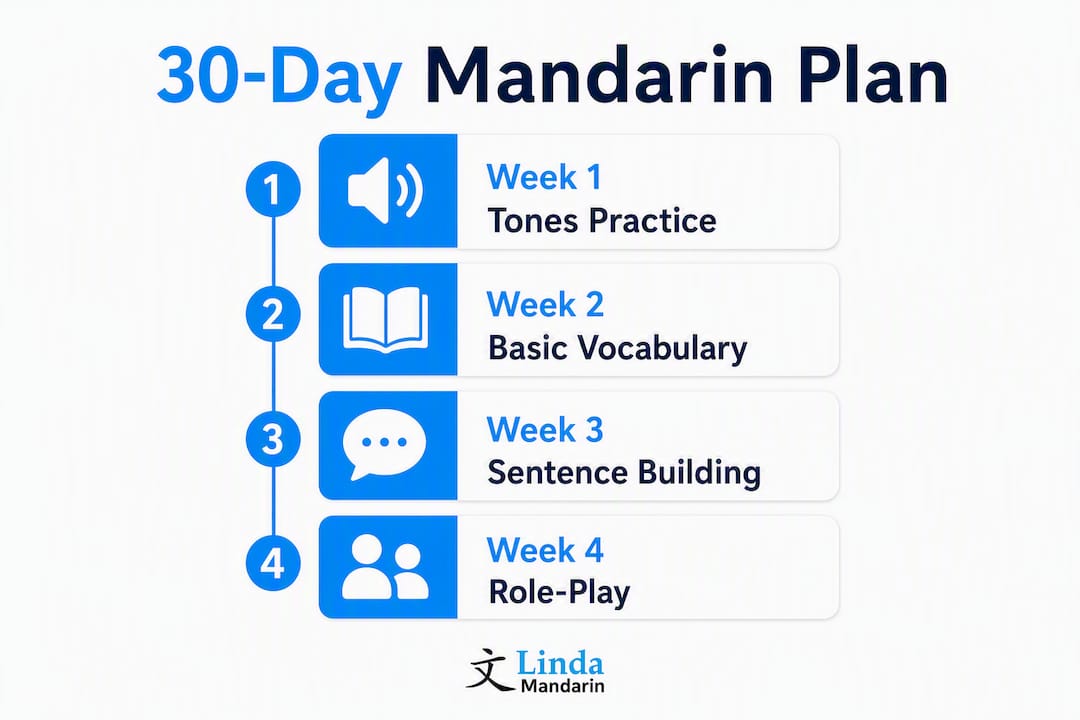
Week 1: pinyin, tones, and daily drills
- Learn the pinyin alphabet and the four tones using audio examples, not just charts.
- Practice tone pairs daily: first-second, first-third, second-fourth, and so on.
- Install one beginner app or enroll in a free trial course.
- Book your first 30-minute tutor session for the end of the week.
- Aim for 20 minutes of focused practice each day, no exceptions.
Week 2: high-frequency phrases and your first 100 words
- Learn 10–15 survival phrases: greetings, numbers, directions, ordering food.
- Use spaced repetition (Anki or a built-in app deck) to lock in your first 100 words.
- Do three short speaking sessions with a tutor or language partner.
- Record yourself saying phrases and compare to native audio.
- Focus on being understood, not sounding perfect.
Weeks 3–4: sentences, role-play, and real output
- Move from isolated words to short, complete sentences.
- Practice two or three role-play scenarios per week (ordering coffee, introducing yourself, asking for directions).
- Increase speaking time to 20–30 minutes per session.
- Do a weekly self-check: can you handle five basic social interactions without freezing?
- Adjust your app or course if it is not pushing you to produce sentences.
Pro Tip: Intelligibility beats perfection at this stage. A native speaker who understands you is more valuable feedback than a flawless tone score on an app. Book that first tutor session before you feel “ready.”
Which learning methods actually work for adult beginners?
No single format does everything. The learners who progress fastest combine two or three complementary methods rather than betting everything on one app.
| Format | Best for | Tradeoff |
|---|---|---|
| Microlearning apps | Daily vocabulary and pinyin drills | Low feedback quality; easy to stay passive |
| Structured online courses | Curriculum, grammar context, milestones | Requires self-discipline without a teacher |
| Live 1:1 tutors | Tone correction, real conversation, accountability | Higher cost; scheduling required |
| AI speaking tools | Scalable speaking practice, scenario simulation | No emotional nuance; limited correction depth |
| Language exchange partners | Low-cost conversation practice with native speakers | Inconsistent availability and feedback quality |
Apps like Duolingo or HelloChinese are fine for daily habit-building, but they rarely push you to produce full sentences under pressure. That is where live tutors earn their keep. Language exchange platforms like Tandem connect you with native speakers for flexible, low-cost conversation practice, which is particularly valuable for building tonal confidence.

The most effective combination for adult beginners: one structured course for curriculum and grammar context, one AI speaking tool for daily sentence production, and one weekly live tutor session for tone correction and real feedback. AI speaking partners like Lucy OS1 simulate realistic conversation scenarios with sub-second response times, which means you can practice ordering food or navigating a meeting without waiting for a human partner to be available.
Prioritize live tutors when your tones are still inconsistent or when you are preparing for a specific real-world situation (a business trip, a job interview). Self-study tools fill the gaps between those sessions.
What does a realistic 12-week Mandarin study plan look like?
Academic-style beginner specializations on Coursera typically run around a quarter of a year at a moderate weekly study load, with outcomes that include a substantial vocabulary, multiple language points, and the ability to handle numerous real-life situations. That is a useful benchmark. For most adult self-directed learners, a 12-week plan at 5–7 hours per week is more realistic and still produces usable conversational ability.
| Weeks | Focus | Sample activities | Milestone |
|---|---|---|---|
| 1–4 | Pinyin, four tones, survival phrases | Tone drills, 100-word SRS deck, 2 tutor sessions | Handle 5 basic social interactions |
| 5–8 | Vocabulary expansion, sentence patterns | Role-play scenarios, grammar in context, AI speaking | Produce 20+ sentences from memory |
| 9–12 | Structured speaking tasks, real-world practice | Business greetings, ordering, directions, weekly tutor | Handle 10+ real-life situations confidently |
- Weeks 1–4: Lock in pinyin and tones before adding vocabulary volume. A shaky tonal foundation makes everything harder later.
- Weeks 5–8: Expand to 300–500 words using spaced repetition. Start connecting words into sentence patterns rather than memorizing isolated vocabulary.
- Weeks 9–12: Shift the majority of practice time to speaking output. Use scenario-based AI practice tools like Lang Life to simulate real contexts (ordering, directions, business meetings) and reinforce measure words in context.
If you can commit 10 hours per week, you will hit the Coursera benchmark outcomes closer to the 12-week mark. At 5 hours per week, expect the same milestones to take 6–9 months. Neither pace is wrong; the one you can sustain is the right one.
How do you get tones and pronunciation right from the start?

Tones are not optional in Mandarin. The same syllable spoken in four different tones means four completely different things. “Mā” (mother), “má” (hemp), “mǎ” (horse), and “mà” (to scold) are not variations; they are separate words. Getting tones wrong does not just sound foreign — it causes genuine miscommunication.
The goal in the first month is intelligibility, not native-like perfection. Here is what actually moves the needle:
- Tone pair drills. Practice two-syllable combinations (first-second, third-fourth, etc.) rather than isolated tones. Real speech uses tone pairs, not single tones in a vacuum.
- Shadowing. Listen to a native speaker phrase, pause, repeat it immediately. Do this for 5–10 minutes daily using podcast audio or tutor recordings.
- Minimal pair practice. Drill words that differ only by tone (mā/má/mǎ/mà) until your ear distinguishes them automatically.
- Record and compare. Record your own voice, then compare it to the native audio. Your ear catches errors in playback that you miss while speaking.
- Context-based reinforcement. Practice tones inside real phrases, not in isolation. “Wǒ yào yī bēi kāfēi” (I want a cup of coffee) is more memorable than drilling “yī” alone.
AI pronunciation tools like SpeakPal now provide high-accuracy real-time tone detection and feedback, which means you can get correction between tutor sessions rather than waiting a week to find out you have been mispronouncing a word.
Pro Tip: Tie tone practice to something you do every day. Order your morning coffee in Mandarin out loud, even if no one hears you. The repetition of a real phrase in a real context locks in tonal memory faster than abstract drills.
What resources should adult beginners actually use?
The resource problem is not scarcity; it is too many options and no clear starting sequence. Here is a practical shortlist organized by type.
Microlearning apps
- HelloChinese and Duolingo cover pinyin and basic vocabulary with gamified daily habits. Good for the first 4–6 weeks; limited for sentence production beyond that.
- LearnChinese.ai pairs spaced repetition with character stroke order and multiple practice modes including speaking and writing, which makes it more complete than most flashcard-only tools.
Structured online courses
- Coursera’s Mandarin Chinese 1: Chinese for Beginners is a well-structured beginner module with no prior experience required. It covers phonetics, essential expressions, and cultural context.
- Coursera’s Chinese for Beginners introduces Mandarin phonetics and daily expressions with a 7-module structure.
- Linda Mandarin’s adult group classes offer a teacher-led curriculum with live feedback, which closes the gap that self-study courses leave open.
AI speaking tools
- Lucy OS1 and Lang Life both simulate scenario-based conversations. Use them for daily speaking bursts between tutor sessions.
- SpeakPal adds real-time pronunciation scoring, which is useful for tone correction when a tutor is not available.
Tutors and school-led Zoom classes
- When choosing a tutor, check for: a trial lesson option, native speaker status or near-native fluency, explicit tone correction in their teaching style, and a clear cancellation policy.
- Linda Mandarin’s online Zoom lessons pair experienced native instructors with a structured adult curriculum, which gives you the feedback quality of a live class without commuting.
A simple trial sequence: Install one app this week. Enroll in one structured beginner unit or sign up for a trial class. Book a single 30-minute tutor session before the end of week two. That sequence costs almost nothing and tells you exactly which format clicks for you.
How do you learn Mandarin by yourself and actually make progress?
Self-study works when it is active, not passive. Watching Chinese TV without engaging is not studying; it is entertainment. The learners who make real progress alone share three habits.
Daily micro-sessions over marathon weekends. Twenty minutes every day outperforms two hours on Saturday. Spaced repetition systems (SRS) like Anki are built on this principle: reviewing a word at the right interval before you forget it requires far less total time than re-learning it from scratch.
Active output, not passive input. Speak aloud during every session. Write short dialogues. Use shadowing with native audio. Practice role-play scenarios with an AI speaking partner. The moment you stop producing language and start only consuming it, progress slows.
The most common self-study pitfalls:
- Passive swiping. Tapping through flashcard apps without saying the word aloud does not build speaking ability.
- Ignoring tones. Skipping tone marks when writing pinyin trains your brain to ignore them when speaking.
- Skipping grammar in context. Mandarin grammar is structurally simpler than most European languages (no verb conjugations, no grammatical gender), so early wins come from learning sentence patterns in context rather than memorizing grammar rules in isolation.
- No speaking output. If you finish a study session without having spoken a single sentence, you have not practiced Mandarin; you have practiced reading about Mandarin.
A practical daily checklist:
- Review yesterday’s SRS deck (10 minutes)
- Learn 5–10 new words in sentence context (5 minutes)
- Speak one role-play scenario aloud or with an AI tool (10 minutes)
- Shadow one short audio clip (5 minutes)
That is 30 minutes. Sustainable, specific, and built around output. For deeper grammar support during self-study, Linda Mandarin’s Mandarin grammar guide for adult learners covers the patterns that trip up most beginners.
What does research say about the fastest route to usable Mandarin?
The evidence points clearly in one direction: structured curriculum plus early active speaking practice beats passive-only or app-only study.
Benchmark: Coursera’s Learn Mandarin specialization targets approximately 1,000 words and 75 language points over 15 weeks at 10 hours per week, with learners able to handle around 30 real-life situations by the end.
That benchmark matters because it gives you a concrete calibration point. If you are studying 5 hours per week instead of 10, expect those outcomes to take closer to 6 months. If you are studying 10 hours per week with live speaking practice built in, 15 weeks is a realistic target for basic conversational ability.
Learners who combine spaced repetition, active speaking, and short consistent daily sessions tend to outperform those who rely on passive-only resources like video watching. The mechanism is straightforward: passive input builds recognition; active output builds production. You need both, but most beginners underinvest in output.
Real-world context accelerates this further. Starting with functional phrases tied to situations you actually encounter (business greetings, ordering food, meeting language) keeps motivation high and produces rapid, visible results. Abstract grammar study in week one does neither.
High-quality self-study also requires a structured curriculum developed or reviewed by experienced teachers, not just a random playlist of YouTube videos. The difference shows up around week six, when learners without structure hit a wall and learners with a clear progression keep moving.
How do you measure progress and what comes next after 3 months?
Three months of consistent study at 5–7 hours per week should produce specific, testable results. If you cannot check most of these off, something in your method needs to change.
Milestones to check at 12 weeks:
- Handle at least 10 basic social interactions (greetings, ordering, directions, introductions) without freezing.
- Produce 20+ sentences from memory in a role-play scenario.
- Recognize and correctly use the four tones in familiar vocabulary.
- Read pinyin fluently without sounding out each syllable.
- Understand the gist of slow, clear native speech on familiar topics.
Simple self-tests: Record a 2-minute self-introduction in Mandarin and compare it to your week-one recording. The difference is your progress. Ask your tutor to conduct a 5-minute unscripted conversation and note where you freeze. Those freeze points are your next study targets.
When to increase tutor frequency: if you are freezing more than twice per session or your tones are still inconsistent after 8 weeks, move from weekly to twice-weekly sessions for a month.
Next steps after three months:
- Continue the structured curriculum through intermediate levels, expanding to 500–1,000 words and more complex sentence patterns.
- Start business conversational modules if professional use is your goal. Linda Mandarin’s business Mandarin program covers meeting language, negotiation phrases, and professional communication.
- Increase immersion. Watch Chinese news clips, listen to Mandarin podcasts at normal speed, or join a conversation group. At this stage, immersion starts to compound your structured learning rather than overwhelm it.
FAQ
What is the 3-3-3 rule in Mandarin?
The 3-3-3 rule is a study habit framework: practice for 3 minutes, 3 times a day, across 3 different skills (listening, speaking, and reading). It is designed to build consistency through micro-sessions rather than long, infrequent study blocks.
How can I learn Mandarin by myself?
Use a spaced repetition system for vocabulary, speak aloud during every session, and practice with AI speaking tools or language partners daily. Self-study works when it prioritizes active output over passive input.
How long does it take to learn Mandarin?
At 10 hours per week with a structured curriculum, basic conversational ability (around 1,000 words and 30 real-life situations) takes roughly 15 weeks. At 5 hours per week, expect 6–9 months to reach the same milestone.
Is Mandarin hard to learn for English speakers?
Mandarin grammar is actually simpler than most European languages: no verb conjugations, no grammatical gender, and no plural forms. The challenge is the four tones and the character writing system. Most adult beginners reach basic conversational ability faster than they expect once they commit to daily speaking practice.
Can I learn Mandarin with free resources only?
Free resources (apps, YouTube, language exchange partners) can take you to A1 survival level. Beyond that, a structured course with teacher feedback closes gaps that free tools consistently miss, particularly in tone correction and grammar context.
Key Takeaways
Adult beginners who combine pinyin-first study, daily active speaking, and a structured curriculum with live tutor feedback reach basic conversational Mandarin in roughly 15 weeks at 10 hours per week, or 6–9 months at 5 hours per week.
| Point | Details |
|---|---|
| Start with pinyin and tones | Master the four tones in week one; shaky tonal foundations slow every stage that follows. |
| Prioritize active speaking | Daily sentence production with an AI tool or tutor outperforms passive app swiping every time. |
| Follow a structured curriculum | Academic-style programs target 1,000 words and 30 real-life situations in roughly 15 weeks at 10 hours per week, or 6–9 months at 5 hours per week. |
| Measure at 4 and 12 weeks | Check concrete milestones (10 social interactions, 20 sentences from memory) to catch method problems early. |
| Linda Mandarin for structured adult learning | Online Zoom classes, group lessons, and business Mandarin programs with native instructors give adult learners the feedback and curriculum structure that self-study alone cannot replicate. |
What actually works for adult Mandarin learners
The conventional wisdom says Mandarin is one of the hardest languages for English speakers. That is technically true at the advanced level. At the beginner level, it is almost misleading.
Mandarin grammar gives you an early gift: no conjugations, no gendered nouns, no plural forms. The sentence structure is logical. What trips adults up is not the grammar; it is the tones, and more specifically, the habit of skipping tone practice because it feels awkward to drill sounds in isolation.
The learners who progress fastest are not the ones with the most time. They are the ones who speak out loud every single day, even badly, even alone. The feedback loop between speaking and correction is where the real learning happens. Apps can build vocabulary. Only speaking builds speaking ability.
Linda Mandarin’s approach works for adult learners because it does not separate those two things. The structured curriculum gives you the progression and grammar context that self-study misses. The native instructors give you real-time tone correction that no app replicates. And the Zoom format means you get that feedback without rearranging your schedule around a commute.
For professionals, the business Mandarin track adds another layer: the vocabulary and register you need for meetings, negotiations, and relationship-building in Chinese-speaking business contexts. That is a different skill set from conversational Mandarin, and it is worth treating it as one.
Start learning Mandarin with Linda Mandarin
Linda Mandarin has been training adult learners and professionals in Mandarin since 2003. The difference from self-study is concrete: experienced, certified native instructors who correct your tones in real time, a structured adult curriculum that maps to clear milestones, and flexible formats that fit a working schedule.

Online Zoom classes run for adult beginners through to advanced business Mandarin, with both group and private options. Corporate training programs are available for teams preparing for business in Chinese-speaking markets. If you are ready to move faster than self-study allows, the adult program overview shows current course levels, schedules, and fees.
The training center is at 10 Anson Road, Level 22, International Plaza, Singapore 079903, right above Tanjong Pagar MRT. Zoom lessons are available globally. Book a trial lesson or view course details to find the right starting level for where you are now.
Useful sources
- Coursera: Learn Mandarin Chinese Specialization — benchmark data on structured beginner timelines, word targets, and weekly study hours.
- Coursera: Mandarin Chinese 1 for Beginners — a structured beginner module covering phonetics, essential expressions, and cultural context with no prior experience required.
- Loecsen: Free beginner Chinese course — short daily practice guidance and pinyin-first approach for A1-level survival communication.
- Lucy OS1: AI Mandarin speaking practice — AI conversation partner with scenario-based practice and tone handling in dialogue.
- SpeakPal: AI Chinese pronunciation tool — real-time tone detection and pronunciation feedback for practice between tutor sessions.
- LearnChinese.ai: Spaced repetition and character courses — structured tracks pairing character learning with speaking and writing practice modes.
- Tandem: Chinese speaking practice — language exchange platform for native speaker conversation practice with flexible scheduling.
- Lang Life: Scenario-based AI speaking practice — immersion-style conversation scenes that reinforce measure words and phrases in real contexts.
- Linda Mandarin: Adult programs overview — course levels, Zoom and in-person formats, and enrollment details for adult learners.
- Linda Mandarin: Mandarin grammar guide for adult learners — grammar explanations tailored to adult self-directed learners.
FAQ
How many hours per week do I need to study Mandarin?
Five to ten hours per week is the practical range for adult learners. At 10 hours per week with a structured curriculum, basic conversational ability takes roughly 15 weeks; at 5 hours per week, expect 6–9 months.
What should I learn first in Mandarin?
Start with pinyin and the four tones before adding vocabulary volume. A solid phonetic foundation makes every word you learn afterward easier to pronounce, remember, and use correctly.
Is it worth taking a structured Mandarin course instead of just using apps?
Apps build vocabulary habits but rarely push you to produce full sentences or correct your tones. A structured course with a native instructor closes both gaps and gives you a clear progression path that app-only study does not provide.
How do I practice speaking Mandarin without a tutor every day?
Use AI speaking tools like Lucy OS1 or Lang Life for daily scenario-based conversation practice. Record yourself, compare to native audio, and shadow short clips. These habits build speaking fluency between live tutor sessions.