TL;DR:
- Learning conversational Mandarin opens doors to stronger relationships and better business opportunities in Singapore.
- Start with pinyin and tones, then practice common phrases and regular listening for effective progress.
- Combining structured classes with self-study tools and real conversations accelerates fluency for busy adults.
Singapore’s multilingual environment gives Mandarin a unique advantage: it’s not just a language, it’s a gateway to stronger relationships, better business deals, and deeper cultural connections. Whether you’re an expatriate building your network, a professional closing deals with Chinese-speaking partners, or someone who simply wants to thrive in everyday conversations at the hawker center, learning conversational Chinese opens doors that staying silent keeps firmly shut. This guide gives you a clear, practical roadmap to go from zero confidence to real conversation, no matter your background or how packed your schedule is.
Table of Contents
- Assess your learning goals and readiness
- Gather tools and resources for effective learning
- Build real conversational skills: Step-by-step approach
- Avoid common pitfalls and measure your progress
- Why consistent, immersive practice outweighs shortcuts
- Ready to accelerate your Mandarin journey?
- Frequently asked questions
Key Takeaways
| Point | Details |
|---|---|
| Set clear goals | Decide why you want to learn conversational Chinese and how much time you can commit each week. |
| Combine resources | Use a mix of courses, apps, and real-life practice to develop strong conversational skills. |
| Practice consistently | Focus on daily speaking and listening to make progress faster and build confidence. |
| Track your progress | Regular assessment and feedback help you keep improving and avoid common mistakes. |
Assess your learning goals and readiness
With the growing importance of Mandarin in Singapore’s business and social landscape, the first step is getting clear on why you want to learn and what you’re working with.
Before you sign up for any class or download any app, take fifteen minutes to honestly answer three questions: What do I need Mandarin for? How much time can I realistically commit each week? And what’s my budget? These answers will shape every decision that follows.
Defining your purpose changes everything. Someone learning Mandarin for weekend conversations at a family gathering needs a very different approach than a finance professional who wants to negotiate contracts in Mandarin. Common goals include:
- Business communication: Presenting to clients, leading meetings, and building relationships with Mandarin-speaking partners
- Social and cultural connection: Chatting with neighbors, friends, or a partner’s family
- Travel: Getting around China, Taiwan, or Malaysia with ease
- Personal growth: Keeping your mind sharp or honoring your heritage
Conversational Mandarin vs. academic Mandarin. This is a distinction most beginners miss. Academic Mandarin focuses heavily on grammar rules, classical texts, and written Chinese characters. Conversational Mandarin prioritizes speaking, listening, and understanding spoken Mandarin in real situations. If your goal is to hold a business lunch conversation or order food confidently, you don’t need to master writing 3,000 characters first. You need tones, common sentence patterns, and lots of listening practice.
Here’s a quick look at what to expect from different learning formats:
| Format | Weekly time commitment | Estimated cost (4 weeks) | Best for |
|---|---|---|---|
| Group classes (in-person) | 2-4 hours | S$200-S$450+ | Social learners, structured routine |
| Private tutoring | 1-3 hours | S$400-S$800+ | Fast progress, custom content |
| Online group classes | 2-4 hours | S$150-S$400+ | Flexible schedules, remote learners |
| Self-study (apps only) | Variable | Free-S$50/month | Supplementary learning |
When evaluating structured options, look at course reviews carefully. Intensive conversational courses for beginners running four weeks, two sessions per week at S$384 plus fees, have earned a 4.7 out of 5 rating from 63 reviews, which tells you adult learners are finding real value in that format.
If you’re brand new to the language, exploring beginner Chinese classes tailored to adults in Singapore can give you a clearer picture of what local schools offer and how to match a program to your specific situation.
Pro Tip: Don’t wait until your schedule “clears up.” Start with just two hours a week. Consistent short sessions build the habit and momentum that long weekend cramming sessions never do.
Key readiness checklist before you begin:
- Know your primary motivation (business, social, travel, or personal)
- Identify your preferred learning style (structured class vs. self-paced)
- Set a realistic weekly time commitment (even two hours counts)
- Define a budget range and stick to it
- Decide whether in-person or online fits your lifestyle better
Gather tools and resources for effective learning
Once you’ve clarified your goals, the next step is assembling the resources that fit your style and routine.
Having the right mix of tools is the difference between steady progress and spinning your wheels. Most successful adult learners in Singapore combine at least two types of resources: structured instruction and self-directed reinforcement.

Structured class options in Singapore. Local language schools offer a range of intensive programs designed specifically for working adults. Intensive beginner conversational courses available both onsite and online, like those running four weeks on Tuesday and Thursday mornings from 10 to 12pm at S$384 plus fees, give you a framework you can build on. The key advantage of structured classes is accountability. You show up, a native instructor corrects your tones in real time, and your classmates keep you engaged.
Here’s a comparison of the most common learning tools:
| Tool | Strengths | Weaknesses | Cost |
|---|---|---|---|
| Structured language school | Real interaction, tone correction, feedback | Fixed schedule, higher cost | S$200-S$800/month |
| Language apps (Duolingo, HelloChinese) | Flexible, gamified, beginner-friendly | Limited speaking practice, no correction | Free-S$100/year |
| YouTube channels | Free, visual, diverse accents | No accountability, easy to skip | Free |
| Mandarin podcasts | Great for listening, use commute time | No speaking component | Free-S$15/month |
| Language exchange partners | Real conversation, cultural exchange | Inconsistent availability | Free |
When it comes to online vs onsite learning, neither is universally better. Online classes remove the commute and often cost slightly less. Onsite classes tend to create a stronger sense of community and make it easier to practice speaking in a social setting. Many learners in Singapore actually do best with a hybrid approach: a structured weekly class combined with self-study apps during their commute on the MRT.
The most effective self-study tools for conversational Mandarin include:
- HelloChinese: Excellent pinyin (pronunciation guide using Roman letters) drills and tone practice for absolute beginners
- Pleco: The gold-standard Mandarin dictionary app, with audio pronunciation for every word
- Mandarin Corner on YouTube: Slow-speech Mandarin videos with subtitles, great for intermediate listeners
- ChinesePod: Podcast episodes organized by level, covering everyday conversational topics
- iTalki: Platform for booking affordable one-on-one sessions with native speakers worldwide
If you’re serious about making fast progress, look at what an intensive Mandarin course actually delivers in terms of structured output. A well-designed intensive program can move you through more material in four weeks than six months of casual self-study.
Pro Tip: Combine a structured class for your speaking and listening skills with one app for daily vocabulary practice. Two focused tools beat a pile of half-used resources every time.
Build real conversational skills: Step-by-step approach
Now that you have resources, it’s time to turn them into daily results with a proven step-by-step process.
Learning to speak Mandarin conversationally is a skill you build incrementally. Each step below is designed to give you something usable before you move to the next. Don’t skip ahead.
-
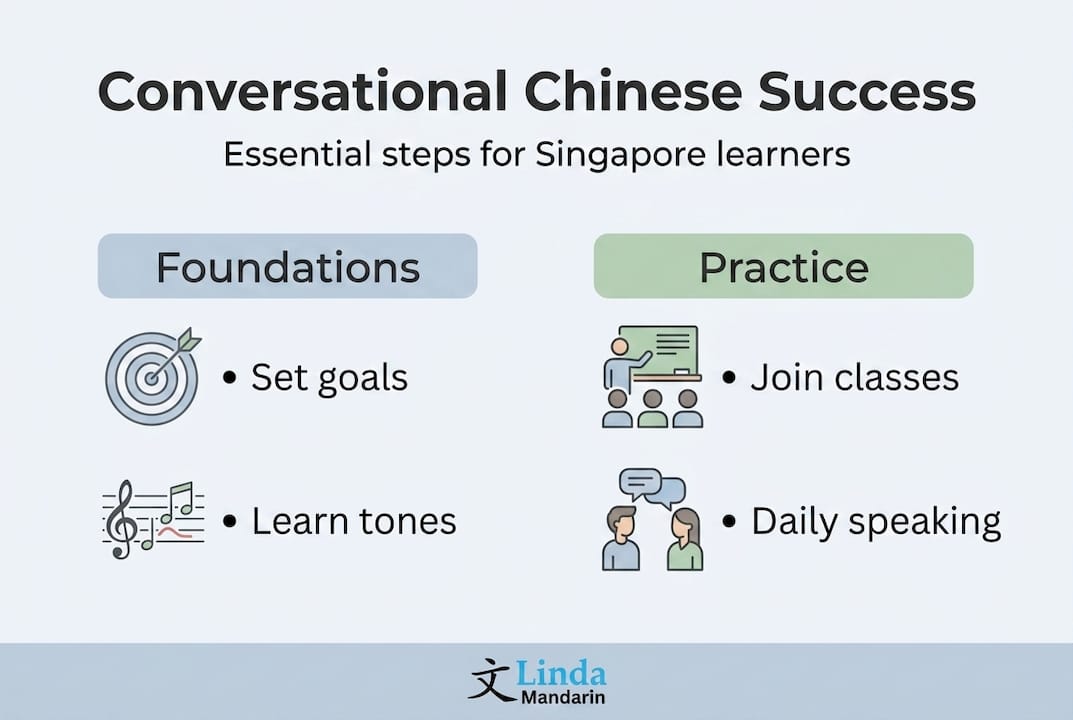
Master pinyin and the four tones. Pinyin is the romanized system for writing Mandarin pronunciation. It looks like familiar letters but sounds completely different. Tones are even more critical: Mandarin has four tones (plus a neutral one), and the same syllable “ma” can mean mother, hemp, horse, or scold depending on how you say it. Spend your first week on nothing but tones. Get a native speaker or instructor to correct your pronunciation early before bad habits set in.
-
Learn survival phrases first. Before grammar, before characters, get comfortable with twenty to thirty phrases you’ll actually use: greetings, ordering food, asking for directions, expressing thanks and apology, and saying you don’t understand. These phrases build your confidence immediately and make real-world practice possible.
-
Focus on listening before speaking. Most learners want to speak first, but listening is what trains your ear to process natural Mandarin speech. Spend at least thirty minutes daily listening to Mandarin through podcasts, shows, or YouTube. Even passive listening during your commute helps your brain recognize patterns.
-
Practice role-play scenarios. This is where formal learning meets the real world. In class or with a language partner, simulate real conversations: a client meeting, a dinner order, a phone call. Role-play builds the automatic response speed that grammar exercises alone never develop.
-
Speak with real people every week. No amount of app practice replaces live conversation. Well-rated conversational Chinese courses with strong student reviews (like the 4.7 out of 5 rating from 63 reviews seen across intensive formats) show that interaction-driven learning produces results adults actually notice.
-
Record yourself speaking. This is uncomfortable but incredibly effective. Record a thirty-second self-introduction in Mandarin, listen back, and note where your tones slip. Do this weekly and compare recordings over time. The improvement you hear will motivate you to keep going.
-
Set milestone targets. Don’t just aim to “learn Mandarin.” Set specific goals: “I want to hold a five-minute conversation about my work by week six.” Milestones give you something concrete to work toward.
Pro Tip: Learn ten new words per week, not one hundred. Ten words used in real sentences daily will stick. One hundred words memorized from a list will vanish by Friday.
Avoid common pitfalls and measure your progress
Even with the best plan, it’s easy to fall into common traps. Here’s how to stay on track.
Most adult learners plateau not because Mandarin is too hard, but because they repeat the same comfortable mistakes without realizing it. Knowing these traps in advance puts you years ahead.
The most common mistakes adult learners make:
- Neglecting tones in favor of vocabulary. Many learners assume context will compensate for wrong tones. It often doesn’t. Native speakers may not understand you at all, or worse, understand something completely different from what you intended.
- Relying only on textbook phrases. Textbook Mandarin often sounds stiff and unnatural to native speakers. Real conversational Mandarin uses contractions, filler words, and informal expressions that textbooks rarely teach. Mix in exposure to native speech from day one.
- Skipping speaking practice when busy. Adults have packed schedules. When pressure builds, practice is the first thing dropped. Five minutes of speaking practice still counts. Don’t let perfect be the enemy of consistent.
- Not tracking what you’ve learned. Without a record, you forget 70% of new vocabulary within a week. Use a vocabulary notebook or a spaced repetition app like Anki to review words regularly.
- Avoiding native speakers out of embarrassment. This is the biggest barrier for adult learners. Native speakers in Singapore and beyond are generally patient with learners. The fear of sounding foolish is far more damaging than the occasional mistake.
“The biggest breakthroughs came when I started treating every wrong tone as data, not failure. That mindset shift changed everything about how I practiced.”
How to measure your progress honestly. Every four weeks, test yourself with these checkpoints:
- Can you hold a three-minute conversation on a new topic without switching to English?
- Do you understand at least 50% of a Mandarin TV show without subtitles?
- Are your tones consistent, or do you revert to incorrect habits under pressure?
Look at Mandarin course levels to understand where you fall on a recognized scale. This helps you set realistic expectations and find the right next class when you’re ready to move up.
Adult learners in Singapore have consistently found that well-rated conversational courses work precisely because they build in regular feedback and structured conversation practice, two things self-study cannot fully replace.
Staying motivated when progress feels slow. Celebrate small wins publicly: tell a friend, post about it, or simply write it down. Learning a new language as a working adult is a significant commitment. Every conversation you complete in Mandarin, no matter how short, is real progress worth recognizing.
Why consistent, immersive practice outweighs shortcuts
Here’s something the language app industry doesn’t want you to hear: thirty days of app badges will not make you conversational in Mandarin. We’ve worked with adult learners in Singapore for over two decades, and the pattern is unmistakable. Learners who reach genuine conversational fluency are those who found regular, real interaction with other speakers, not those who optimized their study streaks.
The problem with shortcut-focused learning is that Mandarin isn’t just phonetics and vocabulary. It carries cultural context, humor, implied meaning, and social register. Knowing the word for “urgent” in Mandarin means little if you don’t understand when it’s appropriate to use urgency in a Chinese business context.
Exploring online Mandarin practice strategies shows how immersive digital environments can supplement structured learning, but the keyword is supplement. Real interaction, whether in class, with a language partner, or in a business meeting, trains the parts of your brain that apps simply don’t reach. Consistency over intensity is what actually makes conversational Chinese stick for busy adults in Singapore.
Ready to accelerate your Mandarin journey?
If you’re ready to turn these strategies into real-world results faster, structured support from an experienced school makes a measurable difference.
Linda Mandarin has been helping adults and professionals in Singapore build practical Mandarin skills since 2003. Whether you’re drawn to intensive Mandarin Chinese programs designed for fast progress, or you need business Mandarin courses tailored to professional settings, the school’s native-speaking, English-fluent instructors meet you exactly where you are.
Located right above Tanjong Pagar MRT in Singapore’s central business district, Linda Mandarin offers group, private, and online class options that fit real adult schedules. Explore all adult Mandarin classes and find the format that matches your goals, your timeline, and your lifestyle.
Frequently asked questions
How long does it take to become conversational in Mandarin Chinese?
With intensive courses, many adults reach basic conversational fluency in four to eight weeks of consistent practice. Structured programs like 4-week beginner courses at S$384 give you a concentrated foundation to build from quickly.
Is it better to learn Mandarin in a classroom or online?
Both formats are effective depending on your lifestyle. Classroom options give you live tone correction and social accountability, while onsite and online courses available together let you choose the flexibility that fits your schedule without sacrificing quality.
What should beginners focus on first when learning conversational Chinese?
Start with pinyin (the romanized pronunciation system) and the four Mandarin tones, then layer in twenty to thirty high-frequency daily phrases. Getting your tones right early prevents the most common barrier to being understood by native speakers.
How much does an intensive conversational Chinese class cost in Singapore?
A four-week intensive beginner conversational course in Singapore typically costs around S$384 plus fees, making it one of the most cost-effective structured learning options available for working adults.