TL;DR:
- Native Mandarin teachers offer cultural insights and natural pronunciation correction.
- Structured native-led classes enable adults to achieve conversational fluency quickly.
- HSK benchmarks align with native teacher instruction, enhancing measurable progress.
Most people assume that fluency in a language automatically makes someone a great teacher. It sounds logical, but it’s not quite right. Research shows that native Mandarin teachers bring distinct advantages, from cultural depth to more varied questioning techniques, that directly shape how quickly adult learners progress. In Singapore, where Mandarin fluency opens doors in business, social settings, and career advancement, understanding the difference between native and non-native instruction can change the outcome of your entire learning journey.
Table of Contents
- Defining a native Mandarin teacher
- How native Mandarin teachers enhance learning
- Certification and expertise: Why benchmarks like HSK matter
- Practical tips for choosing the right Mandarin course in Singapore
- The real impact: What most learners overlook about native Mandarin teachers
- Boost your Mandarin journey with native instructors in Singapore
- Frequently asked questions
Key Takeaways
| Point | Details |
|---|---|
| Native teachers accelerate learning | Classes led by native Mandarin teachers enable faster and deeper language acquisition. |
| Diverse teaching methods matter | Native teachers use more varied questioning and teaching strategies that boost engagement. |
| Face-to-face is more effective | Research shows face-to-face instruction from native teachers is more efficient than online lessons. |
| Certification legitimizes expertise | Mandarin proficiency tests like HSK help validate teachers’ skills and track student progress. |
| Choose wisely for your goals | Select courses with proven native instructors, structured curriculum, and measurable progress benchmarks. |
Defining a native Mandarin teacher
Having set the context, let’s clarify what a native Mandarin teacher truly means. The term gets used loosely, so it’s worth pinning down the specifics before you make any course decisions.
A native Mandarin teacher is someone who was born and raised in a Mandarin-speaking environment, typically Mainland China, Taiwan, or a community where Mandarin was the primary home language. This person acquired Mandarin naturally during childhood, absorbing not just vocabulary and grammar but also tonal patterns, idiomatic expressions, and cultural context. That intuitive cultural knowledge is impossible to fully replicate in a classroom setting, no matter how advanced a non-native learner becomes.
It helps to separate three categories:
- Native teachers: Mandarin was their first language. Cultural and linguistic intuition is automatic.
- Native-like teachers: Achieved near-native fluency through immersion or long-term study, but learned Mandarin as a second language.
- Non-native teachers: Proficient Mandarin speakers who teach from a learned rather than intuitive perspective.
Each category brings real value, but factors for Mandarin learning like pronunciation accuracy, tonal precision, and cultural context tend to be strongest with native instructors.
| Teacher type | Language intuition | Cultural depth | Adult learner outcomes |
|---|---|---|---|
| Native | Very high | Very high | Strong face-to-face results |
| Native-like | High | Moderate to high | Good, especially for structure |
| Non-native | Moderate | Limited | Variable, depends on training |
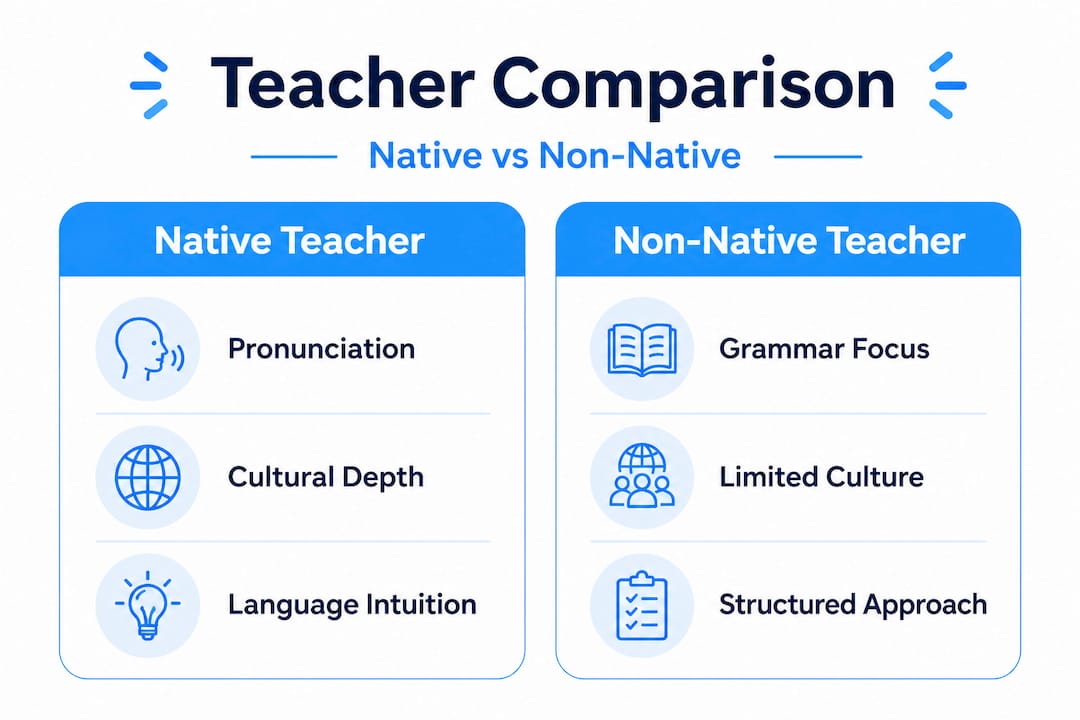
Studies show that native and native-like teachers perform better in face-to-face settings, and expert teachers (who are more often native) use significantly more diverse questioning, at 60% compared to 40% for less experienced instructors. That diversity in questioning keeps adult learners more engaged and pushes thinking beyond rote repetition.
Qualifications matter too. Look for teachers who hold professional teaching credentials alongside language certifications. The best instructors understand Mandarin course design that moves learners through structured stages rather than relying on informal conversation alone. Without that structure, many adult learners plateau quickly.
How native Mandarin teachers enhance learning
With a clear definition, let’s examine the tangible advantages of learning with native teachers. The benefits are concrete and measurable, not just anecdotal.
One of the biggest differences shows up in classroom dynamics. Native teachers naturally create environments where authentic Mandarin is the default. They correct tones instinctively because they hear deviations immediately. A non-native teacher might accept a mispronounced tone without recognizing the error, because their own processing of the language is slightly different.
Here is a practical comparison of what you experience in native-led versus non-native-led classes:
| Feature | Native-led class | Non-native-led class |
|---|---|---|
| Tonal correction | Immediate and accurate | May miss subtle errors |
| Cultural context | Embedded naturally | Added as supplemental content |
| Idiomatic expression | Used authentically | Often textbook-heavy |
| Questioning diversity | High (richer classroom dialog) | Moderate |
| Face-to-face engagement | Strong, less hesitation | More variable |
The questioning data is particularly striking. Expert teachers ask around 5,990 questions during teaching sessions compared to roughly 3,977 from novice instructors. More questions mean more student responses, more opportunities to practice speaking, and more corrections that build accuracy over time. For adults learning Mandarin for professional use, that level of interaction is exactly what accelerates progress.
“Reaching basic conversational fluency, roughly A1 to A2 on international language scales, within 3 months is achievable in a structured, native-led class environment for dedicated adult learners.”
The most effective Mandarin learning methods consistently emphasize consistent exposure, real-time feedback, and contextual usage. Native teachers deliver all three simultaneously, not as separate exercises.
Here’s how the learning progression typically unfolds in a well-designed native-led course:
- Weeks 1 to 4: Foundation tones, pinyin, basic greetings, and survival phrases built through repetition and real conversation.
- Weeks 5 to 8: Sentence construction, common daily scenarios, and introduction of written characters.
- Weeks 9 to 12: Conversational practice in realistic contexts, correction of tone habits, and introduction of professional vocabulary where relevant.
Following this kind of structured pathway, the benefits of learning Mandarin extend far beyond language itself. Adult learners report stronger cognitive flexibility, better cross-cultural communication skills, and a genuine boost in professional confidence when dealing with Mandarin-speaking colleagues or clients.
Pro Tip: Record yourself speaking Mandarin at the start of your course and again at week 12. The change in tonal accuracy and sentence fluency will be immediately obvious, and it’s one of the most motivating things you can do.
The role of Mandarin in your life shifts significantly once you move from textbook knowledge to natural fluency, and native teachers are the fastest route to that shift.
Certification and expertise: Why benchmarks like HSK matter
These advantages often go hand-in-hand with recognized teaching standards. Let’s look at how formal benchmarks strengthen both the teacher’s approach and your own measurable progress.
HSK (Hanyu Shuiping Kaoshi) is the internationally recognized Mandarin proficiency exam, used across China, Singapore, and globally as a standard measure of language ability. It runs from HSK 1 (beginner) to HSK 9 (near-native mastery), giving learners and employers alike a clear, objective benchmark.
Here’s why this matters for you as an adult learner:
- Structured preparation: Native teachers familiar with HSK know which vocabulary, grammar patterns, and listening skills each level demands, so every lesson works toward a measurable goal.
- Authentic exposure: Because native teachers speak Mandarin as it’s actually used, their language models closely match what appears in HSK listening and reading sections.
- Confidence building: Passing even HSK 1 or 2 gives you documented proof of progress, which is motivating and professionally useful.
- Global recognition: Whether you’re planning to work with Chinese partners, study in a Mandarin-speaking country, or advance within a Singapore-based company, an HSK certification adds credibility to your resume.
- Curriculum alignment: Schools that align their courses with HSK standards ensure you’re learning efficient, measurable, and internationally benchmarked content.
HSK certification is a common benchmark, and native teachers are particularly effective at helping students achieve rapid progress through it because their instruction mirrors natural language use rather than artificial exam-prep drills.
If you’re unsure where to start, understanding what HSK actually is gives you a useful framework for setting realistic goals at the beginning of your course. Most adult beginners in Singapore can reasonably target HSK 2 within six months with consistent study and a well-structured program.
Pro Tip: Ask your language school whether their curriculum maps directly to HSK levels. If it does, your everyday lessons double as exam preparation, saving you time and making your progress easy to measure.
Practical tips for choosing the right Mandarin course in Singapore
Now, let’s turn this understanding into practical action for your Mandarin learning journey. Knowing what to look for prevents costly mistakes and significantly improves your outcomes.
Singapore has many Mandarin learning options, from community classes to corporate programs, private tutors, and dedicated language schools. Not all are equal, and the difference between a good and a poor learning experience often comes down to a few key factors.
What to look for in a course:
- Native teacher background: Verify the instructor was raised in a Mandarin-speaking environment, not just that they speak fluent Mandarin.
- Professional teaching credentials: Fluency and teaching skill are different. Look for teachers with formal training in language instruction.
- Track record with adult learners: Adults learn differently from children. Choose a school with a clear history of results for working professionals and adult beginners.
- Curriculum structure: Open-ended conversation classes are useful but not sufficient on their own. You want a structured course that builds progressively.
- Class size: Smaller groups mean more speaking time per student. Large classes reduce the feedback frequency that native teachers provide.
- Flexible formats: Face-to-face is most effective for early learners, but online options allow you to maintain momentum when life gets busy.
Common pitfalls to avoid:
Many learners make the mistake of assuming any fluent Mandarin speaker makes a good teacher. This is the most common and costly error. Teaching requires pedagogical skill, patience, and the ability to diagnose learner problems. Native fluency is one ingredient, not the whole recipe.
Another pitfall is choosing a course based purely on cost or convenience. The benefits of learning Chinese in Singapore are significant for career advancement, and a poorly structured course that doesn’t build real skills wastes more than money. It wastes time you could have spent making genuine progress.
Empirical data supports that dedicated learners in native-led classes can achieve conversational fluency within three months. But “dedicated” is the key word. Three hours of class per week only works if you supplement it with daily listening practice, speaking exercises, and vocabulary review.
Tips for maximizing retention:
- Practice speaking with your teacher outside of drills, using Mandarin in natural back-and-forth conversation.
- Use spaced repetition for vocabulary rather than cramming.
- Watch Mandarin media (news, shows, short videos) to keep your ears calibrated to native speech rhythms.
- Set a specific target, such as HSK 2 in six months, to stay focused and measure progress.
Pro Tip: Don’t wait until you feel “ready” to speak. Fluency comes from making mistakes in front of a skilled teacher who can correct you in real time. The discomfort of early errors is the fastest path to accuracy.
The real impact: What most learners overlook about native Mandarin teachers
Reflecting on practical application, here’s a deeper look at what native teachers truly offer. And it goes well beyond correct pronunciation.
Most learners evaluate language courses based on vocabulary learned, tones improved, and test scores achieved. All of that matters. But there’s a layer of value in native instruction that rarely gets discussed, and it may be the most important factor in long-term fluency.
Language is a carrier of culture, not just meaning. When a native Mandarin teacher uses an expression like “吃苦” (chi ku, literally “eat bitterness”), they’re not just teaching you two words. They’re transmitting a worldview about resilience, persistence, and how Chinese culture frames difficulty as something to be digested and absorbed rather than avoided. No textbook fully captures that. A native teacher embeds it naturally into every example, every correction, every conversation.

This cultural immersion shapes how you actually communicate in real professional and social settings. For adults in Singapore using Mandarin for business communication, this distinction is significant. A business contact in Shanghai will respond very differently to someone who speaks textbook Mandarin versus someone who understands the cultural weight behind what they’re saying.
There’s also a mindset shift that happens when you learn from a native teacher. You stop translating in your head and start thinking in patterns. You develop adaptability because you’re exposed to how native speakers actually solve communication problems in real time. That’s a cognitive skill that transfers into negotiation, collaboration, and cross-cultural relationship building.
Many courses and learners underestimate the role of immersive, expert-guided exposure. They treat language learning as a skill to be memorized rather than a behavior to be developed. Native teachers challenge that assumption every single class because they don’t just speak the language. They live it.
Boost your Mandarin journey with native instructors in Singapore
Ready to apply these insights? Here’s how you can start learning with expert native teachers in Singapore.
At Linda Mandarin, every course is taught by experienced, certified native Mandarin instructors who are also fluent in English, so you get the full benefit of native cultural and linguistic expertise without losing clarity in instruction. Since 2003, we’ve helped hundreds of adult learners and professionals in Singapore reach practical, measurable fluency.
Whether you’re starting from zero or looking to strengthen your professional Mandarin, you can explore our intensive Mandarin course for faster results, browse our full range of Mandarin course levels to find the right fit, or view all Mandarin programs for adults including group, private, and online options. Located right above Tanjong Pagar MRT, we make it easy to learn consistently. Your native teacher is ready.
Frequently asked questions
What qualifies someone as a native Mandarin teacher?
A native Mandarin teacher is typically someone born and raised in a Mandarin-speaking environment, with native language fluency and deep cultural familiarity acquired naturally from childhood.
Is learning Mandarin faster with a native teacher?
Yes. Dedicated learners can achieve conversational fluency at the A1 to A2 level within three months in a structured, native-led class environment.
How does HSK certification relate to native Mandarin teachers?
HSK is an internationally recognized proficiency benchmark, and native teachers naturally align their instruction with authentic language use, which helps students progress through HSK levels efficiently.
What should adults look for when choosing a Mandarin course in Singapore?
Prioritize courses led by credentialed native teachers with proven results for adults, small class sizes for more speaking time, and a structured curriculum. Native-led classes consistently support faster progress to conversational fluency for dedicated learners.