TL;DR:
- Learning Mandarin as an adult in Singapore requires clear goals, consistent practice, and effective use of specialized tools. Engaging in real conversations and balancing self-study with guided learning accelerates fluency and cultural understanding. Avoid common pitfalls like over-memorization and skipping speaking to achieve practical, lasting proficiency.
Learning Mandarin as an adult in Singapore is one of the most valuable investments you can make, whether you’re an expatriate trying to connect with colleagues, a professional eyeing business opportunities in China, or simply someone who wants to enrich their personal life. The challenge is real: your schedule is packed, the tonal system feels foreign, and you’re not sure where to start. This guide cuts through the noise and gives you a clear, research-backed roadmap, from choosing the right tools on day one to building the kind of fluency that holds up in real business conversations.
Table of Contents
- What you need to get started
- Step-by-step Mandarin learning routine
- Balancing self-study and guided learning
- Common pitfalls and how to avoid them
- A fresh perspective: Real communication beats memorization
- Next steps: Accelerate your Mandarin learning in Singapore
- Frequently asked questions
Key Takeaways
| Point | Details |
|---|---|
| Spaced repetition works | Reviewing vocabulary at planned intervals boosts retention and efficiency. |
| Balanced routines win | Combining SRS, listening, reading, and communication produces faster, deeper learning. |
| Avoid memorization traps | Pure memorization can stall progress; active comprehension and real conversation truly build fluency. |
| Multiple learning formats | Mixing self-study, guided classes, and practical usage is the most effective approach. |
What you need to get started
Before you practice your first tone or download your first app, you need honest clarity on two things: your goal and your available time. These two factors shape every decision that follows.
Are you learning Mandarin for casual conversation with neighbors and friends? Or are you targeting a promotion that requires you to present in Mandarin to Chinese-speaking clients? The gap between these goals is significant, and conflating them leads to wasted effort. Write your goal down. Make it specific. “I want to hold a 10-minute business meeting in Mandarin by December” is useful. “I want to learn Mandarin” is not.
Once your goal is clear, estimate your weekly study time honestly. Research consistently shows that adults who commit to at least five focused hours per week make measurable progress within three months. Less than that, and progress becomes frustratingly slow.
Essential tools to have ready:
- SRS app (spaced repetition software): Anki is the most widely used free option. Pleco is excellent for Chinese-specific vocabulary lookup and card creation.
- Textbooks: The New Practical Chinese Reader series works well for structured grammar. Integrated Chinese is another strong choice popular in university programs.
- Listening resources: ChinesePod, Mandarin Corner on YouTube, and HSK-level graded readers with audio.
- Writing practice: A stroke-order app like Skritter, plus a physical notebook for character writing.
- Mandarin learning resources curated specifically for Singapore adults and professionals can save you significant research time.
Now, a quick word on SRS because it matters enormously. Spaced repetition is a learning method where you review vocabulary at expanding intervals rather than cramming or re-reading the same word list over and over. When you first learn a word, you review it the next day. Then three days later. Then a week later. Then a month later. The system spaces reviews based on how well you recalled the word, pushing harder items back into your rotation more frequently. This mirrors how long-term memory actually works, and it dramatically reduces the time needed to retain vocabulary permanently.
| Tool type | Recommended option | Best for |
|---|---|---|
| SRS flashcard app | Anki, Pleco | Vocabulary retention |
| Listening platform | ChinesePod, Mandarin Corner | Comprehension and tone exposure |
| Grammar textbook | New Practical Chinese Reader | Structured grammar progression |
| Writing practice | Skritter, physical notebook | Character recognition and stroke order |
| Vocabulary building | See building Mandarin vocabulary | Targeted word acquisition by topic |
Getting these tools in place before you start prevents the common trap of spending your first two weeks just figuring out what to use, which kills momentum before it begins.
Step-by-step Mandarin learning routine
With tools and resources in place, here’s how to structure your Mandarin learning routine for consistent progress.
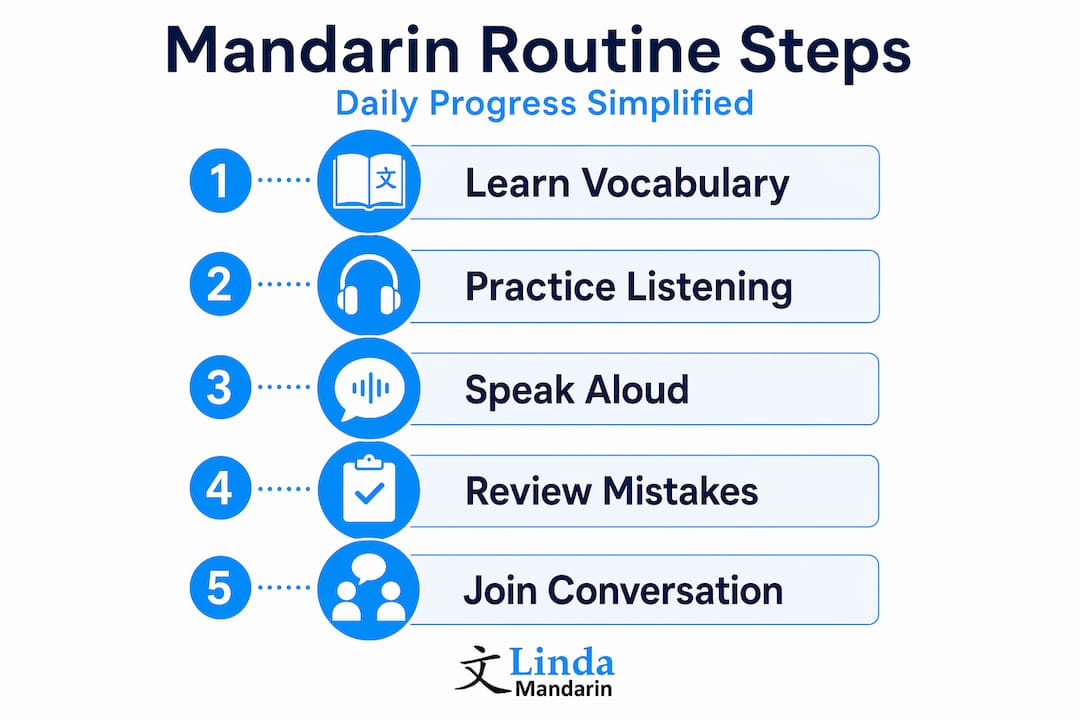
Consistency beats intensity. A 30-minute daily session beats a four-hour weekend cram session every single time. Here’s a practical daily and weekly structure you can adapt to your schedule:
Daily routine (30-45 minutes):
- SRS review (10 minutes): Open your Anki deck and clear your due cards first. Do not skip this. It is the backbone of your vocabulary growth.
- New vocabulary input (5-10 minutes): Add 5-10 new words related to your current lesson or conversation topic. Link them to example sentences, not just definitions.
- Listening practice (10 minutes): Play a podcast episode or short video at your current level. Focus on recognizing words you know, not understanding everything.
- Speaking or writing practice (10-15 minutes): Either record yourself speaking a few sentences aloud, write a short paragraph in characters, or practice a dialogue from your textbook.
Weekly routine additions:
- Review the week’s grammar points and write three original sentences using each new structure.
- Watch one longer Mandarin video (15-20 minutes) without subtitles, then again with subtitles to catch gaps.
- Have at least one real conversation, even if it’s short. Use a language exchange partner, a tutor session, or a class.
- Review your SRS statistics to identify which words you keep missing and create additional memory associations for those.
For those targeting formal certification, Mandarin test preparation requires an added layer of structure. Adults preparing for HSK specifically should align study materials to the HSK syllabus and exam structure, and build routines that cover listening, reading, and writing rather than vocabulary alone.
Pro Tip: Pair your SRS session with a 10-minute immersive listening session immediately after. You’ve just activated those vocabulary items in your working memory, and hearing them in real spoken Mandarin within the same sitting strengthens both recognition and comprehension simultaneously. This combination is one of the highest-value habits you can build.
| Study phase | Daily time | Weekly time | Key activity |
|---|---|---|---|
| Vocabulary (SRS) | 10 min | 70 min | Card review and new input |
| Listening | 10 min | 70 min | Podcasts, video, audio drills |
| Speaking | 10 min | 70 min | Dialogue practice, self-recording |
| Reading/Writing | 10 min | 70 min | Textbook, character writing |
Boosting your listening skills early in your learning journey pays dividends later. Tones that seem indistinguishable at first become natural when your ear has logged enough hours of real Mandarin speech.

Balancing self-study and guided learning
Once you’ve established your study routine, consider how to optimize your learning through the right mix of independent and guided options.
Self-study is powerful, but it has real limits. Without feedback, bad pronunciation habits calcify. Without structure, learners tend to drift toward what they enjoy rather than what they need. Here’s how the main options compare:
| Learning format | Strengths | Weaknesses |
|---|---|---|
| Self-study | Flexible schedule, low cost, self-paced | No feedback, easy to plateau, pronunciation errors go uncorrected |
| Group classes | Structured curriculum, peer practice, cost-effective | Fixed schedule, mixed pace with classmates |
| Private tutoring | Personalized, targeted feedback, fast progress | Higher cost, depends on tutor quality |
| Online classes (Zoom) | Flexible location, access to qualified teachers | Requires self-discipline, less immersive environment |
A key insight worth stating plainly: SRS is one component of a balanced approach, and you should not rely on it alone for all skills. Listening comprehension, real-time communication, and reading fluency require dedicated, separate practice that no flashcard app can fully replicate.
Signs you need guided learning, not just self-study:
- You’ve been studying for three months and still can’t hold a two-minute conversation.
- You’re unsure if your tones are correct and have no one to tell you.
- You keep avoiding writing or listening practice because it feels hard.
- You’re preparing for HSK 4 or above and feel stuck on reading comprehension.
- You need Mandarin specifically for business, where precision and register (formal vs. casual speech) matter.
Exploring online Mandarin learning options can bridge the gap between rigid schedules and the need for real instructor feedback. For many Singapore professionals, a hybrid model works best: structured weekly classes for guided feedback, and daily self-study using SRS and listening resources between sessions.
Pro Tip: Use your self-study time to prepare for your class, not just to catch up after it. Review vocabulary before a lesson so class time focuses on speaking and correction, not first exposure to new words. This simple shift doubles the value of every guided session.
Understanding the most effective Mandarin learning methods helps you choose the right combination for your specific goal rather than copying someone else’s approach.
Common pitfalls and how to avoid them
Understanding the right balance is key, but avoiding common mistakes will keep your progress steady.
Even motivated learners hit walls. The walls are almost always the same walls, which is good news: they’re predictable and preventable.
The most common mistakes adults make when learning Mandarin:
- Over-relying on memorization. Drilling vocabulary lists without using words in sentences is the number one reason people feel like their Mandarin isn’t improving despite hours of study.
- Ignoring tones. Skipping tone practice early on saves short-term discomfort but creates long-term communication breakdowns. Native speakers will genuinely struggle to understand you.
- Avoiding speaking. Many adults feel embarrassed about making mistakes, so they defer speaking practice indefinitely. This is the single biggest barrier to fluency.
- Skipping listening practice. Reading-focused learners often develop a disconnect between written and spoken Mandarin, struggling with speed and natural pronunciation in real conversations.
- Cramming instead of spacing. Studying for three hours the night before a class does almost nothing for long-term retention.
- No real-world application. Keeping Mandarin confined to a textbook means you never experience the gap between “study Mandarin” and “use Mandarin.”
Actionable fixes:
- Replace 20% of your flashcard time with sentence mining: find real sentences from podcasts or articles and learn words in context.
- Practice tones daily using minimal pairs (words that differ by only one tone) and record yourself to compare with native speakers.
- Commit to speaking at least 10 sentences aloud every single day, even alone, even awkwardly.
- Track your Mandarin vocabulary tips and monitor whether you’re actually using new words in conversation within 48 hours of learning them.
“SRS is effective for the retention of known vocabulary items, but it works best as a reviewing tool rather than a substitute for broader comprehension practice.” — Hacking Chinese
Burnout is also real. Adults juggling work and family alongside Mandarin study can hit a wall around the two-to-three month mark. The fix is not to push harder. It’s to temporarily reduce session length (even 15 minutes counts) rather than skipping entirely. Consistency across months matters far more than intensity across days.
A fresh perspective: Real communication beats memorization
Here is something most Mandarin learning guides won’t say directly: the learners who progress fastest in Singapore are not the ones with the biggest vocabulary lists. They are the ones who are willing to sound foolish early.
Memorization gives you quick wins. You can show someone your Anki statistics and feel productive. But fluency is not built in an app. It is built in moments of real pressure, when a client asks you a question in Mandarin and you have to respond, imperfectly, right now. That discomfort is not a sign you’re failing. It is the mechanism of actual learning.
Adults in Singapore often underestimate how much real conversation accelerates every other skill. When you speak, you activate vocabulary. When you listen to a response, you hear authentic tones. When you make a grammar mistake and someone looks confused, you remember that correction forever. No flashcard replicates that feedback loop.
For professionals specifically, Mandarin for business is not just about vocabulary from a business word list. It’s about understanding cultural nuance, knowing when to be formal or casual, and building enough comfort with the language that you can focus on the content of a meeting rather than the mechanics of forming sentences.
Our honest advice after working with adult learners for over two decades: commit to one real conversation per week, every week, from your very first month of study. It will feel uncomfortable for longer than you expect. Keep going anyway. That discomfort is exactly where your Mandarin is actually growing.
Next steps: Accelerate your Mandarin learning in Singapore
You have the framework. Now it’s time to put it into motion with the right learning environment behind you.
At Linda Mandarin, we’ve been helping Singapore adults and professionals build practical Mandarin skills since 2003. Whether you’re starting from zero or pushing toward business-level fluency, our courses are structured around real communication, not rote memorization. From beginner group classes to intensive private sessions and corporate training delivered via Zoom, every program is designed around your actual schedule and goals. Explore our full range of Mandarin programs for adults or review the specific Mandarin course levels to find the right starting point. Your next conversation in Mandarin is closer than you think.
Frequently asked questions
How long does it take for a Singaporean adult to learn basic Mandarin?
Most adults reach basic conversational ability within 6-12 months with consistent daily practice and regular real-life use. Prior exposure to Chinese dialects or characters can shorten this timeline noticeably.
What is spaced repetition and why is it effective?
Spaced repetition spaces vocabulary review over increasing time intervals to maximize long-term retention, working with how memory naturally consolidates information rather than fighting it. This makes it far more efficient than reviewing the same word list repeatedly.
Is self-study enough for HSK exam preparation?
Self-study can take you a long way, but HSK preparation specifically requires structured practice across listening, reading, and writing components aligned to the exam format, which guided learning handles more reliably.
What are the biggest mistakes adults make when learning Mandarin?
The most damaging mistakes are over-relying on memorization, skipping listening and speaking practice, and avoiding real conversations out of embarrassment. SRS alone cannot build the communication skills Mandarin fluency actually requires.