TL;DR:
- Many professionals in Singapore mistakenly believe conversational Mandarin alone ensures successful business relationships with Chinese-speaking partners.
- Effective business Chinese combines professional vocabulary, cultural intelligence, and context-specific communication strategies beyond casual conversation.
- Mastering this tailored skillset is essential for career advancement, negotiations, and leading meetings across Chinese business cultures.
Many professionals in Singapore assume that conversational Mandarin is their golden ticket to closing deals and building lasting partnerships with Chinese-speaking counterparts. It is not. Business Chinese is a distinct discipline, one that combines professional vocabulary, cultural intelligence, and context-specific communication strategies that go far beyond ordering coffee or making small talk at a social gathering. If you are serious about career advancement, cross-border negotiations, or leading meetings with Mainland Chinese partners, you need a targeted skillset. This guide breaks down exactly what business Chinese is, what skills matter most, and how you can build them systematically in Singapore.
Table of Contents
- Defining business Chinese: Beyond basic Mandarin
- Core skills: Communication essentials for business Mandarin
- Business Chinese in Singapore: Context and application
- How to learn business Chinese: Practical steps for professionals
- Why business Chinese training is a game-changer in Singapore
- Upgrade your business Mandarin skills with expert training
- Frequently asked questions
Key Takeaways
| Point | Details |
|---|---|
| Business Chinese defined | Business Chinese blends Mandarin, professional vocabulary, and cultural etiquette tailored for work settings. |
| Context matters | Always adapt script and register to match your business counterpart’s cultural background. |
| Skills for success | Mastering business Chinese means learning negotiation, formal correspondence, and business etiquette. |
| Learn through practice | Regular practice, targeted courses, and immersion help professionals build confidence and fluency. |
| Training is transformative | Strategic business Chinese training drives faster career advancement and enables cross-border business growth. |
Defining business Chinese: Beyond basic Mandarin
Now that we have established the importance of targeted skills, let us clarify what business Chinese actually entails.
Business Chinese uses Mandarin as its linguistic foundation but layers on professional registers, industry-specific vocabulary, formal etiquette, and culturally appropriate communication styles. Think of it this way: knowing how to speak Mandarin is like knowing how to drive a car. Business Chinese is knowing how to navigate a specific city during rush hour, with its own rules, shortcuts, and unspoken conventions.
One of the first things professionals often overlook is script choice. Singapore-targeting professional contexts generally align with Mandarin and Simplified Chinese for Mainland Chinese and Singaporean audiences, while Traditional Chinese remains relevant for Taiwan and Hong Kong-specific business targets. According to Kwintessential, the most suitable script and register depends entirely on your business counterparts, making audience awareness a non-negotiable first step.
Here is a quick comparison of what sets business Chinese apart from general Mandarin:
| Feature | General Mandarin | Business Chinese |
|---|---|---|
| Vocabulary scope | Everyday words and phrases | Industry terms, contract language, formal titles |
| Communication style | Casual and conversational | Formal registers, polite address forms |
| Script awareness | Typically Simplified Chinese | Simplified or Traditional, based on audience |
| Etiquette focus | Social norms | Meeting protocols, email conventions, hierarchy |
| Goal | Day-to-day interaction | Negotiations, presentations, partnerships |
Key elements that define effective business Mandarin include:
- Professional titles and forms of address: Using 您 (nín) instead of 你 (nǐ) in formal contexts signals respect immediately.
- Industry-specific vocabulary: Finance, law, logistics, and technology each carry their own Mandarin terminology.
- Written business conventions: Formal email openings, closings, and contract phrasing follow strict patterns.
- Tonal awareness in presentations: Pitch, pacing, and formality markers shift significantly in business settings.
Pro Tip: Always identify whether your counterpart uses Simplified or Traditional Chinese before preparing any written materials. Sending a document in the wrong script signals a lack of preparation and can undermine trust before a meeting even begins.
Core skills: Communication essentials for business Mandarin
With a clear definition in place, let us dive into the core skills you will need to succeed.

Business Chinese is tailored for workplace interactions, negotiation, correspondence, and professional presentations. Each of these contexts demands a distinct set of skills, and building them requires intentional practice rather than simple immersion.
Here is a comparison of casual versus formal business Mandarin communication:
| Scenario | Casual Mandarin | Business Chinese |
|---|---|---|
| Greeting a new contact | 你好! (Nǐ hǎo) | 您好,幸会幸会 (Nín hǎo, xìng huì xìng huì) |
| Requesting a meeting | 我们见面吧 | 冒昧打扰,请问是否方便安排一次会面? |
| Wrapping up an email | 再见 | 敬祝商祺 (business blessing closing) |
| Expressing disagreement | 我不同意 | 我有一些不同的看法,请允许我解释… |
The gap between these columns is significant. Getting it wrong in a boardroom or a formal email chain can damage your professional reputation faster than a missed deadline.
The benefits of business Chinese extend well beyond vocabulary. Here are the core skills to build, in order of priority:
- Formal greetings and introductions: Master the art of 自我介绍 (zìwǒ jièshào), including how to exchange business cards with both hands and what phrases to use in first meetings.
- Specialized business vocabulary: Build a working glossary for your specific industry. A finance professional needs different terms than a supply chain manager.
- Written etiquette for emails and contracts: Learn the structural conventions for Chinese business emails, including how to open, transition, and close with appropriate formality.
- Meeting protocols: Understand how agenda-setting, turn-taking, and consensus-building work in Chinese-led meetings, where direct confrontation is often avoided.
- Negotiation and persuasion in Mandarin: Practice phrase structures that allow you to push back, propose alternatives, or express reservations without causing offense.
Understanding the pros and cons of pursuing business Chinese helps you set realistic expectations too. It takes time and consistent practice, but the professional payoff is measurable.
Pro Tip: Do not just study vocabulary lists. Practice real email exchanges with a language partner or instructor, and role-play negotiations to build the fluency and confidence you need under pressure.
Business Chinese in Singapore: Context and application
Understanding where and how business Chinese fits into Singapore’s business landscape is crucial for practical application.
Singapore sits at a unique crossroads. It is a multilingual, multicultural city-state with deep economic ties to Mainland China, Taiwan, and Hong Kong simultaneously. That means the “right” version of business Chinese depends heavily on who is sitting across the table from you.
Singapore-targeting professional contexts generally align with Mandarin and Simplified Chinese for Mainland Chinese and Singaporean audiences. When your partners are from Taiwan or Hong Kong, however, Traditional Chinese and different cultural communication norms apply. This is not a minor detail. It is a signal of respect, preparation, and cultural intelligence.
“The most suitable script and register depends on your business counterpart(s).” — Kwintessential Blog
Here are the most common business scenarios where your business Chinese skills will be tested in Singapore:
- Client emails and proposals: Written communication requires accurate formal Chinese, correct script, and culturally appropriate tone. A poorly formatted email can suggest disrespect before any meeting takes place.
- Business presentations: Presenting in Mandarin to a Mainland Chinese delegation signals commitment to the relationship and shows cultural investment.
- Networking events: Singapore hosts hundreds of China-focused business events annually. Being able to introduce yourself, exchange pleasantries, and remember key phrases makes you memorable.
- Contract reviews and negotiations: Technical Mandarin for legal and commercial documents requires precision. One misunderstood term can have significant consequences.
- Video calls and virtual meetings: With remote business growing rapidly, professionals need clear spoken Mandarin skills adapted for digital contexts, including managing turn-taking and avoiding ambiguity.
Corporate Mandarin training programs designed specifically for Singapore’s business environment address all of these scenarios with context-specific practice, not generic language lessons. If you want to boost your business Mandarin skills for real-world professional use, your training needs to mirror the actual situations you will face.
How to learn business Chinese: Practical steps for professionals
Armed with context, let us explore actionable strategies to master business Chinese for your career.
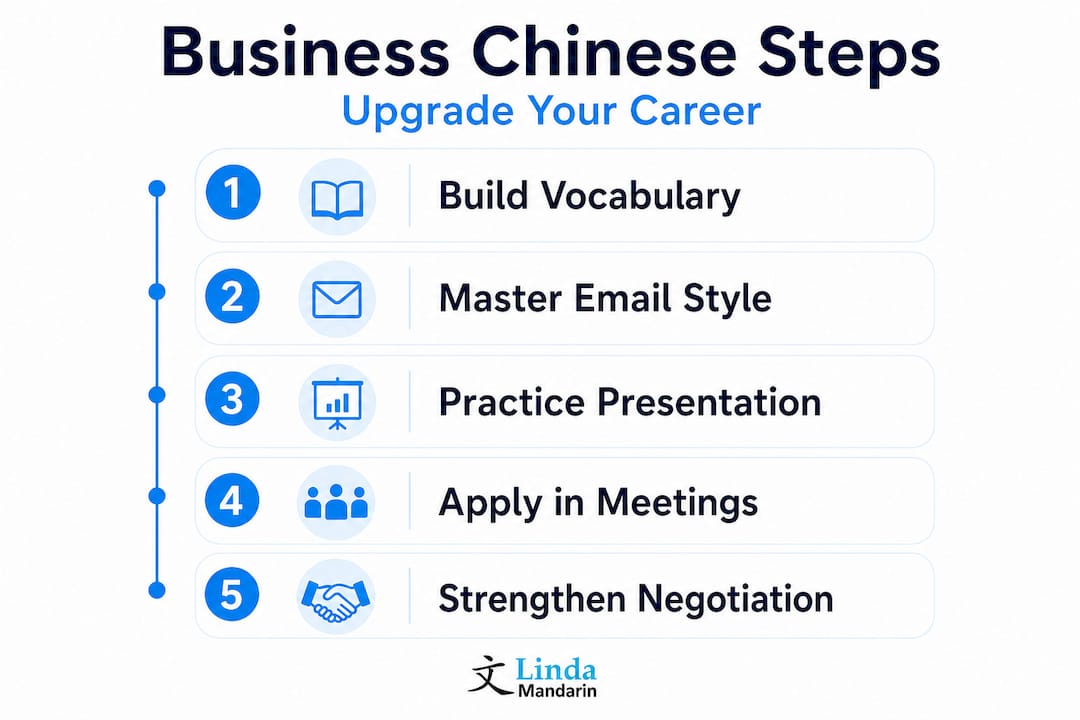
Business Chinese courses and context-specific training are available in Singapore for professionals across all industry sectors. The key is approaching learning strategically, not casually. Here is a proven step-by-step approach:
-
Identify your specific business Chinese needs: Are you preparing for client negotiations? Writing formal emails? Leading presentations? Your learning goal shapes your curriculum. A procurement manager in logistics needs different vocabulary than a marketing director pitching to Chinese media.
-
Set measurable language goals aligned to HSK standards: The HSK (Hanyu Shuiping Kaoshi) is the internationally recognized proficiency benchmark for Mandarin. Business Chinese learners typically target HSK 4 to HSK 6 for professional-level competency. Knowing your current level gives you a clear improvement roadmap.
-
Enroll in a targeted business Chinese program: Generic Mandarin classes teach you to survive. Business-focused programs teach you to thrive professionally. Look for courses that include role-playing, industry vocabulary modules, and practical writing exercises.
-
Leverage technology for daily practice: Language apps, online flashcard tools, and audio resources can reinforce vocabulary and listening skills between formal lessons. Consistency matters more than intensity.
-
Immerse yourself in real business contexts: Attend bilingual networking events, join Chinese business chambers, or volunteer to assist in cross-cultural meetings at work. Real exposure builds authentic fluency faster than any textbook.
-
Build a structured daily practice workflow: Research from language learning specialists suggests that music-based daily routines significantly improve language retention and make practice more sustainable over time. Even 15 to 20 minutes of focused daily review compounds dramatically across weeks and months.
There is a strong reason why Mandarin learning in Singapore is particularly effective compared to other locations. You are already immersed in a multilingual environment with native Mandarin speakers around you, Chinese-language media accessible everywhere, and real business interactions happening daily. That ambient exposure accelerates your progress when combined with structured training.
The professionals who advance fastest are those who treat career advancement with Chinese as a long-term professional investment, not a short-term project. They track their progress, seek feedback from instructors, and apply new skills immediately in real work situations.
Pro Tip: Within the first two weeks of any new business Chinese unit, find one real work situation where you can apply the new vocabulary or phrases. Even sending one formal email in Mandarin reinforces retention far more effectively than reviewing notes alone.
Why business Chinese training is a game-changer in Singapore
Having covered learning steps, it is worth stepping back and sharing what experts see as the true success factors in business Chinese development.
Here is the uncomfortable truth most language programs will not tell you: vocabulary alone will never make you an effective business communicator in Mandarin. Professionals who study word lists and pass HSK exams but skip the cultural and contextual layers of business Chinese class structure often plateau at a frustrating level. They can speak, but they cannot connect.
The professionals who break through and build genuine influence with Chinese-speaking partners share one common trait. They invest in understanding why Chinese business communication works the way it does, not just how to replicate its surface features. Why does directness sometimes signal disrespect? Why does silence in a negotiation indicate consideration rather than confusion? Why does the order of information in a business proposal matter as much as the content itself?
These questions are rooted in cultural frameworks that no vocabulary list addresses. And in Singapore’s unique environment, where Singapore-targeting professional contexts span Mainland Chinese, Taiwanese, and Hong Kong business cultures simultaneously, the ability to switch registers and cultural frames fluidly is what separates competent from exceptional.
Strategic business Chinese training builds this adaptive intelligence. It teaches you to read the room, match your register to the moment, and communicate with confidence across diverse Chinese-speaking business cultures. That kind of competency creates career leverage that lasts decades, not just the next quarter. The return on investment is not just in the deals you close. It is in the trust you build, the relationships that deepen over years, and the professional reputation that opens doors without you having to knock.
Upgrade your business Mandarin skills with expert training
Ready to take your business Chinese from functional to exceptional? The next step is finding training that is built specifically for professionals in Singapore, not generic language learners.
At Linda Mandarin, we have been helping professionals build real business Chinese skills since 2003. Our business Chinese programs for professionals are designed around actual workplace scenarios, covering everything from formal email writing and presentation delivery to live negotiation practice. If your organization needs a structured solution, our corporate business Mandarin training delivers customized curricula aligned to your industry and business objectives. Located above Tanjong Pagar MRT with flexible group, private, and online class options, we make it easy to boost your Mandarin skills around your professional schedule. Your next career breakthrough may start with a single conversation in Mandarin.
Frequently asked questions
Is business Chinese just formal Mandarin?
No, business Chinese includes specialized vocabulary, professional registers, cultural etiquette, and negotiation styles that go well beyond simply using formal grammar in Mandarin.
Which script should I use for business Chinese in Singapore?
For Singapore and Mainland China interactions, use Mandarin with Simplified Chinese; for Taiwan and Hong Kong business contexts, Traditional Chinese is the appropriate choice.
How can I quickly improve my business Chinese?
Combine targeted business-focused courses with regular daily practice and real-world application such as professional networking events, live negotiations, and formal email exchanges.
Are business Chinese skills relevant for cross-border deals?
Absolutely. Strong business Chinese skills open doors to cross-border partnerships across Mainland China, Taiwan, and Hong Kong, each requiring context-specific communication approaches to build genuine trust and close deals effectively.