TL;DR:
- The HSK is a globally recognized Chinese proficiency test essential for academic, professional, and personal milestones in Mandarin. Its new 2026 structure expands to nine levels, integrating speaking and translation components from Level 3 upward, emphasizing practical language skills. Proper preparation involves focused vocabulary study, graded reading, speaking practice, and mock exams, with native instruction accelerating cultural and linguistic competence for Singapore adults.
Most people assume the HSK is just another language test you sit, pass, and forget. It’s not. The HSK exam is a globally recognized proficiency standard for Mandarin Chinese, and in Singapore’s increasingly Mandarin-forward business environment, it carries real weight. Whether you’re learning Mandarin for career advancement, academic goals, or personal growth, understanding what the HSK exam is, how its new 2026 structure works, and how to prepare for it can make the difference between studying aimlessly and making measurable progress.
Table of Contents
- What is the HSK exam and why it matters
- The new HSK 3.0 exam structure and levels explained
- Comparing the old HSK 2.0 and new HSK 3.0 systems
- HSK exam registration, schedule, and fees for Singapore test takers
- Effective preparation strategies for adults taking the HSK exam in 2026
- Why the HSK exam is a strategic advantage for Singapore adults
- How Linda Mandarin supports adults preparing for the HSK exam in Singapore
- Frequently asked questions
Key Takeaways
| Point | Details |
|---|---|
| HSK definition | HSK is China’s official standardized test measuring Chinese proficiency for non-native speakers globally. |
| New 2026 format | HSK 3.0 introduces 9 levels, expanded skills tested including mandatory speaking from Level 3 and translation. |
| Singapore exam logistics | HSK exams in Singapore happen quarterly with fees depending on level and a combined oral and written test for Levels 3 and above. |
| Effective preparation | Master vocabulary, use graded reading materials, practice listening, and take timed mock exams to prepare well. |
| Career advantage | HSK certification boosts employability and communication skills for adults using Mandarin in Singapore’s diverse workforce. |
What is the HSK exam and why it matters
HSK stands for Hanyu Shuiping Kaoshi, which translates directly as “Chinese proficiency test.” It is China’s official standardized measure of Mandarin ability for non-native speakers, administered by China’s Ministry of Education through Chinese Testing International (CTI). Think of it as the Mandarin equivalent of TOEFL for English or DELF for French.
The exam is recognized worldwide by universities, employers, and governments as the standard benchmark for Chinese language ability. In practical terms, that means your HSK certificate carries weight whether you’re applying to a Chinese university, pursuing a scholarship, seeking a work visa, or interviewing for a role at a company with mainland China operations.
“The HSK certificate is valid without limitation in China and is analogous to the English TOEFL test.”
For adults in Singapore, the importance of HSK certification goes further than a line on a resume. Singapore sits at the intersection of Southeast Asian trade and Greater China’s economic network. Mandarin proficiency, verified by a credible certification, signals something employers can’t get from a self-reported “conversational” skill level on a LinkedIn profile.
Here’s where HSK certification adds value for Singapore-based adults:
- University applications to institutions in mainland China, Taiwan, and Hong Kong that require a minimum HSK level for admission or scholarship consideration
- Employment differentiation in finance, trade, logistics, and diplomacy, where Mandarin is increasingly a functional requirement rather than a bonus
- Visa and residency applications in China that ask for documented language proficiency
- Personal benchmarking that gives structure to self-directed language study
Now that you know what HSK represents and why it matters, let’s explore how the exam is structured in 2026.
The new HSK 3.0 exam structure and levels explained
The 9-level HSK 3.0 system launched as a pilot and fully replaces the older six-level framework. The new structure groups levels into three bands, each representing a distinct stage of language development.
| Band | Levels | Focus |
|---|---|---|
| Elementary | 1, 2, 3 | Basic vocabulary, everyday communication |
| Intermediate | 4, 5, 6 | Complex grammar, writing, translation |
| Advanced | 7, 8, 9 | Near-native fluency, nuanced language use |
Under HSK 3.0, the test components expand significantly. Listening and reading remain core at every level. But starting from Level 3, speaking is mandatory rather than optional, and from Level 4, translation tasks are introduced to reflect how language is actually used in professional settings.
What this means for you:
- Levels 1 and 2 test listening and reading only, making them accessible entry points for beginners
- Level 3 adds a mandatory speaking component, a notable shift from the previous system
- Levels 4 to 6 require you to demonstrate translation ability, writing fluency, and oral communication in one combined sitting
- Levels 7 to 9 assess near-native command of formal and literary Chinese, used for academic study and professional credentials in China
Pro Tip: If you’re an adult learner in Singapore targeting career advancement, Level 4 or 5 is the sweet spot. These levels signal practical business-level fluency without requiring the advanced literary knowledge of the upper tiers. Check out Linda Mandarin’s HSK preparation courses to identify the right entry point for your goals.
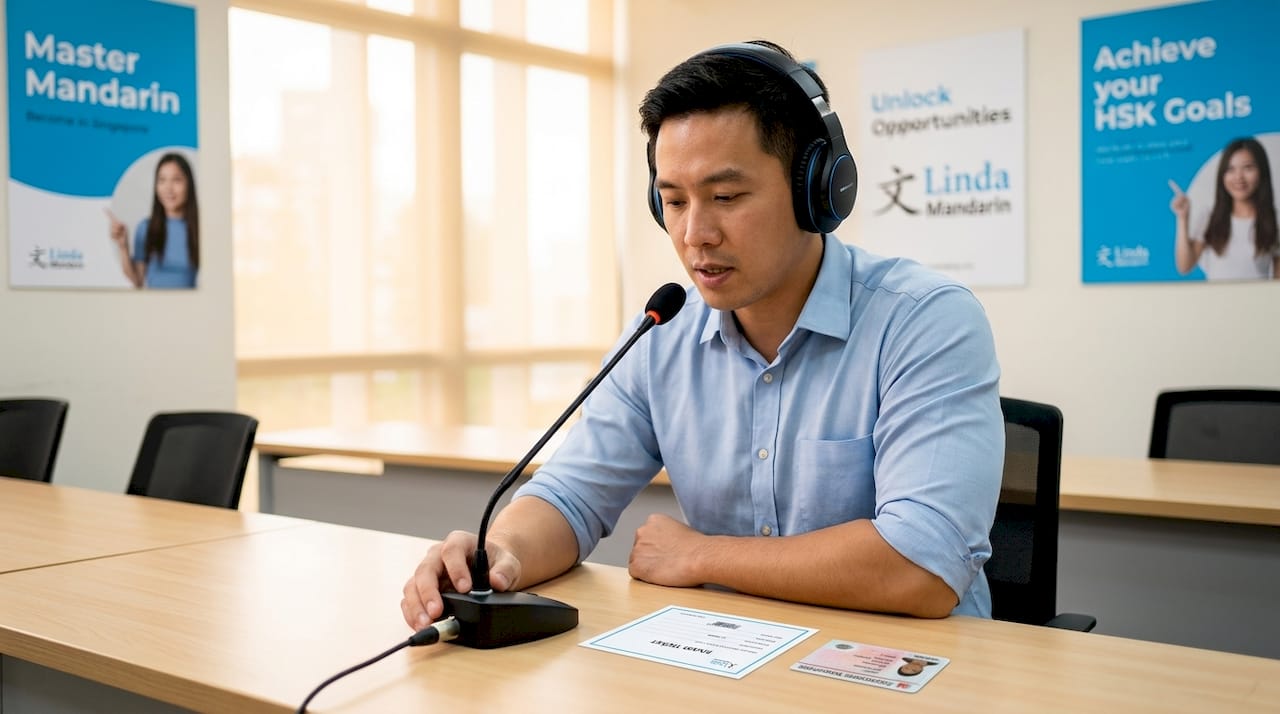
The speaking integration is the single biggest practical change in HSK 3.0. Previously, many learners passed written levels while avoiding the oral test entirely. That shortcut is now closed from Level 3 onward. For tips on acing the HSK under the new format, spoken practice needs to be part of your preparation from day one.
With the structure clear, let’s compare the old and new HSK systems to identify key changes that affect your preparation.
Comparing the old HSK 2.0 and new HSK 3.0 systems
This is where a lot of learners get confused, especially if they started studying under the older framework.
| Feature | HSK 2.0 (old) | HSK 3.0 (new, 2026) |
|---|---|---|
| Number of levels | 6 | 9 |
| Level bands | None | Elementary, Intermediate, Advanced |
| Vocabulary scope | ~5,000 words | ~10,900 words |
| Speaking test | Optional (HSKK separate) | Mandatory from Level 3 |
| Translation component | Not included | Introduced from Level 4 |
| Writing section | Limited | Expanded at Intermediate and Advanced |
| Existing certificates | Valid | Remain valid during transition |
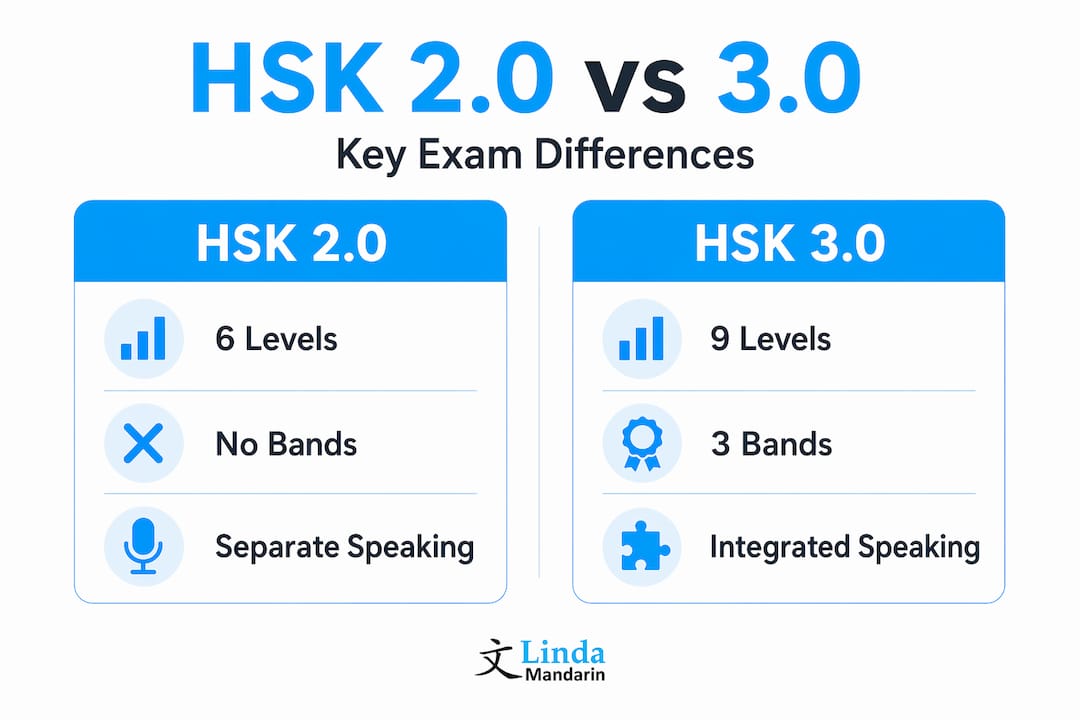
The most significant shift is the vocabulary requirement. HSK 3.0 expands vocabulary from roughly 5,000 words to about 10,900 and introduces new sections including translation and mandatory speaking at certain levels. That’s not just a bigger word list. It reflects a shift toward modern, practical language use, including terminology from technology, business, and current affairs.
Key changes to understand before you register:
- Your existing HSK 2.0 certificate remains valid. You don’t need to retake lower levels just because the system changed.
- If you’re starting fresh in 2026, you’re entering the 3.0 framework from the beginning.
- The nine-level system offers more granular checkpoints, which is genuinely useful for adult learners who want to track progress in smaller, more achievable steps.
- The benefits of HSK exam certification compound as you move up levels. Higher certifications unlock more doors.
Pro Tip: If you completed HSK Level 4 under the old system, you likely have competencies that map to around Level 5 in the new framework. Speak with an instructor before registering to avoid sitting a level that undersells your actual ability.
Understanding these changes helps you choose the right level and prepare effectively for the updated HSK exam. Next, let’s look at how to register and key test dates in Singapore.
HSK exam registration, schedule, and fees for Singapore test takers
In Singapore, HSK tests are held quarterly in 2026 on the following Saturdays:
- March 14, 2026
- June 27, 2026
- September 12, 2026
- December 12, 2026
Registration deadlines fall approximately six weeks before each test date. Results are typically announced four to five weeks after the exam.
| Test date | Registration deadline (approx.) | Results expected |
|---|---|---|
| March 14 | Late January | Late April |
| June 27 | Mid-May | Late July / Early August |
| September 12 | Late July | Mid-October |
| December 12 | Late October | Mid-January 2027 |
Registration fees vary by level, ranging from S$165 for Level 1 to S$315 for Level 6 with the advanced oral test included. Combined written and oral tests for Levels 3 to 6 require simultaneous registration, meaning you can’t sit just one component and add the other later.
Important practical notes:
- Test centers in Singapore have limited seats, so early registration matters
- All exams are computer-based, and some centers offer paper-based options for specific levels
- You’ll need a valid passport or Singapore NRIC for registration and on the test day
- The official information on HSK exam requirements and formats is worth reviewing before you commit to a date
Pro Tip: Register for the June sitting if you’re starting preparation now. That gives you roughly four to five months of structured study time, which is realistic for moving one to two levels under guided instruction.
Now that you know when and how to register, let’s cover strategies to prepare effectively.
Effective preparation strategies for adults taking the HSK exam in 2026
The best HSK preparation is focused and deliberate. Casual exposure to Mandarin, watching TV shows or chatting with colleagues, helps, but it won’t move the needle on exam performance without a structured approach. To prepare for HSK 3.0, focus on mastering vocabulary for your level, building reading fluency with graded stories, and practicing timed mock exams.
Here’s a preparation framework that works for busy adults:
- Start with the official vocabulary list. Every HSK level has a defined word list. Learn these first. Everything else, grammar, reading, listening, builds on vocabulary you already recognize.
- Read graded content at your level. Short stories and news articles written for your HSK level build reading speed and comprehension without overwhelming you with unknown words.
- Train your listening progressively. Start with slower, scripted audio and work toward natural-speed dialogues. HSK listening tasks test your ability to follow conversations in real time.
- Practice speaking out loud from Level 3 preparation onward. Record yourself, compare to native-speaker models, and get feedback. Fluency and accuracy both count.
- Take timed mock exams. Exam stamina is real. Knowing the material isn’t the same as being able to access it under time pressure. Simulate test conditions weekly as your exam date approaches.
- Use officially aligned study materials. Generic Mandarin apps may not map to the HSK 3.0 syllabus. Prioritize resources built specifically for the new system.
These Mandarin learning steps for Singapore adults reflect how structured progression outperforms casual study every time. Consistency beats intensity. Thirty minutes daily five days a week will take you further than two-hour weekend sessions.
Pro Tip: Pair your self-study with a class aligned to the HSK syllabus. Instructor feedback catches fossilized errors, which are wrong habits you’ve practiced so many times they feel correct. These are almost impossible to self-diagnose. Review these proven HSK exam tips to sharpen your approach further.
Why the HSK exam is a strategic advantage for Singapore adults
Here’s the perspective most language guides skip: the HSK isn’t just a certificate. It’s a forcing function for serious learning.
Most adult learners plateau. They reach a comfortable level of Mandarin where they can manage basic interactions, and without external pressure, they stop progressing. The HSK exam removes that comfort zone. It gives you a defined target, a test date, a fee paid, and real stakes. That structure produces results in ways that “I’ll practice when I have time” never does.
In Singapore’s workforce, business Chinese skills for career growth carry weight in sectors that are genuinely bilingual at the leadership level. Finance, trade, real estate, and government-linked industries increasingly expect functional Mandarin from professionals who interact with Chinese-speaking counterparts. An HSK Level 4 or 5 certificate tells a hiring manager something specific: this person can operate, not just survive, in a Mandarin-speaking environment.
There’s also something less measurable but equally real. Preparing for the HSK builds cultural literacy alongside language skills. The reading and listening components draw from real-life contexts like business, social situations, and current affairs, not tourist phrases. Adults who prepare properly for HSK Level 4 and above come away with a genuine feel for how Mandarin speakers think and communicate. That advantage shows up in meetings, negotiations, and relationships.
Learning Mandarin with native teachers accelerates this process considerably. Native instructors don’t just correct your tones. They model authentic speech patterns that no textbook captures cleanly. For an exam that tests real-world language use, that kind of exposure is preparation in itself.
The adults who treat HSK as a professional credential rather than a school exercise are the ones who use their Mandarin after they pass.
How Linda Mandarin supports adults preparing for the HSK exam in Singapore
If you’ve made it this far, you’re serious about the HSK exam, and that’s exactly the kind of learner Linda Mandarin is built for.
Linda Mandarin’s HSK preparation courses are structured around the official HSK 3.0 syllabus and taught by certified native Mandarin instructors who understand how busy adult schedules work. Classes run in-person at International Plaza above Tanjong Pagar MRT and online via Zoom, so your commute or travel schedule doesn’t have to derail your preparation. For organizations looking to equip staff with practical Mandarin skills, the corporate Mandarin training program delivers results at scale. Whether your target is HSK Level 3 or Level 6, or you’re building toward effective business Mandarin communication, Linda Mandarin’s instructors will tailor the path to your exam goals.
Frequently asked questions
What does HSK stand for and who is it for?
HSK stands for Hanyu Shuiping Kaoshi, which is the People’s Republic of China’s standardized test of Mandarin proficiency designed for non-native speakers, including learners of all nationalities seeking to certify their Chinese language skills.
How many levels does the HSK exam have in 2026?
The 2026 HSK 3.0 system has nine levels grouped into three bands: Elementary (1 to 3), Intermediate (4 to 6), and Advanced (7 to 9), offering finer distinctions in proficiency than the previous six-level framework.
Is speaking tested in the HSK exam?
Speaking is mandatory from Level 3 onwards under HSK 3.0, where the oral test is integrated into the same sitting as the written components for Levels 3 to 6.
Where can adults in Singapore take the HSK exam?
Adults register at authorized test centers in Singapore, with quarterly test dates in 2026 and registration deadlines approximately six weeks before each sitting.
What are effective ways to prepare for the HSK exam?
Prioritize the official vocabulary list for your target level, pair it with graded reading and listening practice, and complete timed mock tests regularly to build both accuracy and exam stamina.