TL;DR:
- Mandarin course levels are now aligned with the updated HSK 3.0 system and CEFR benchmarks, reflecting nuanced proficiency standards. Beginners must prioritize foundational pronunciation and Pinyin skills to progress confidently, especially in tonal accuracy. For professionals, targeting HSK 4 to 6 balances practical communication needs with career advancement opportunities.
If you’ve ever searched for a Mandarin class in Singapore and felt completely lost staring at “Beginner 1,” “HSK 3,” or “Intermediate Conversational,” you’re not alone. Mandarin course levels explained clearly are harder to find than you’d expect. Most adults assume “beginner” means easy. In reality, the first level of a well-structured course demands more from your brain than you’d anticipate, especially around pronunciation. Frameworks are also changing: mandarin course levels now reflect the updated HSK 3.0 system, which means older course descriptions may no longer match current standards.
Table of Contents
- Understanding Mandarin course level frameworks for adults
- Beginner to intermediate levels: What you really learn
- Advanced to expert levels: Skills and applications for career growth
- Why pronunciation foundation matters: The role of Hanyu Pinyin courses
- Choosing the right Mandarin level for your goals in Singapore
- Why adult Mandarin course structures in Singapore need rethinking
- Explore adult Mandarin courses tailored for Singapore’s professionals
- Frequently asked questions
Key Takeaways
| Point | Details |
|---|---|
| HSK 3.0 framework | The new nine-level HSK sets detailed standards for Mandarin proficiency including vocabulary and communicative tasks. |
| Pronunciation foundation | Early dedicated Pinyin training is vital for adult learners to master tones and improve speaking confidence. |
| Course level selection | Choosing the right course depends on your goals—conversational fluency or test certification—and placement assessments. |
| Advanced language skills | Higher levels focus on business, legal, and academic topics suited for professional growth in Singapore. |
| Local course options | Singapore offers flexible, structured Mandarin courses tailored to adults, including online and corporate training. |
Understanding Mandarin course level frameworks for adults
To make sense of course levels, first understand the main frameworks that set the proficiency standards. Two systems dominate adult Mandarin learning worldwide, and both are relevant in Singapore.
The most widely recognized is the HSK (Hanyu Shuiping Kaoshi), China’s official proficiency benchmark. The version most adults encountered was the six-level HSK 2.0. That system is now being replaced. HSK 3.0 is a nine-level framework replacing the 6-level 2.0 system, fully implemented in July 2026. The restructure adds more nuanced vocabulary targets, higher task complexity at each stage, and notably, handwriting requirements that were previously minimal at lower levels.
The second framework is the CEFR (Common European Framework of Reference), which many Singapore adult learners are already familiar with from studying English or other European languages. CEFR runs from A1 to C2. Many quality Mandarin programmes blend both systems, using HSK as the vocabulary and grammar backbone while referencing CEFR benchmarks to communicate practical communication goals. Here’s how the two systems map at a glance:
| HSK 3.0 Level | CEFR Equivalent | Approximate Vocabulary |
|---|---|---|
| HSK 1 | A1 | 500 words |
| HSK 2 | A2 | 1,272 words |
| HSK 3 | B1 | 2,245 words |
| HSK 4 | B2 | 3,245 words |
| HSK 5 | C1 | 4,316 words |
| HSK 6 | C1+ | 5,456 words |
| HSK 7-9 | C2 | 11,000+ words |
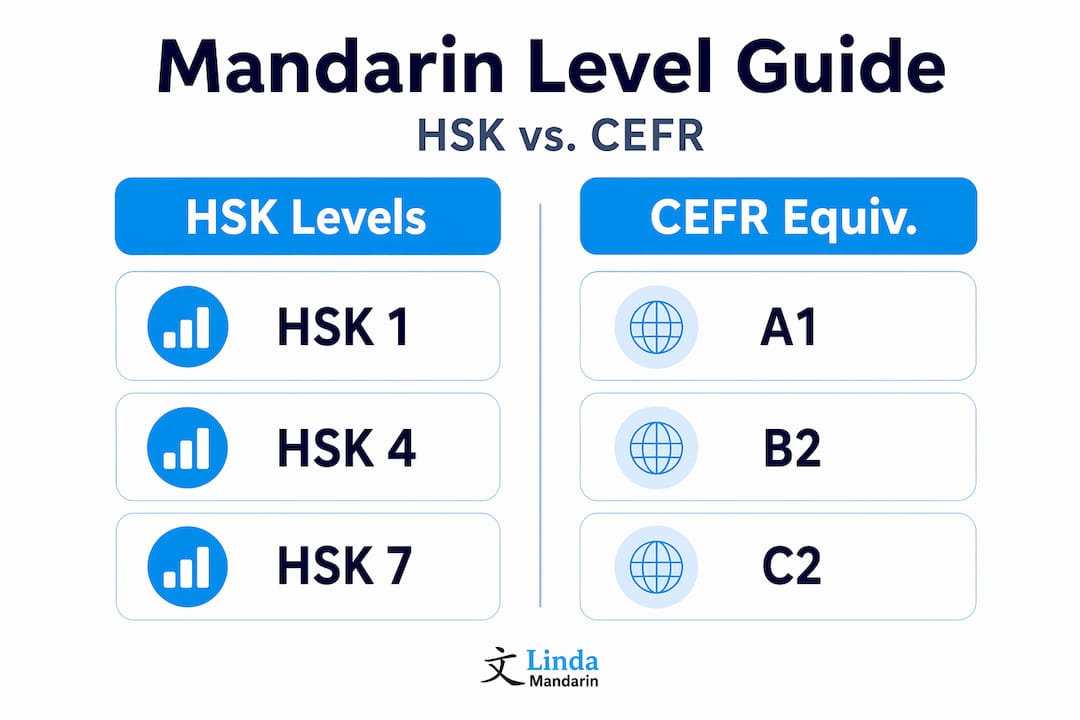
What this means practically: if you previously passed HSK 4 under the old system, your equivalent standing in HSK 3.0 may differ. Always check which version a course uses before enrolling.
Beginner to intermediate levels: What you really learn
Now that you know the frameworks, let’s explore what you will actually study at beginner and intermediate levels.
Beginner Mandarin is not just about “ni hao” and counting to ten. The real work begins with Pinyin, the romanized phonetic system for Mandarin. Every sound in Mandarin maps to a Pinyin spelling, and every syllable carries one of four tones (plus a neutral). Mispronouncing a tone changes the word entirely. That’s why beginner programmes include explicit support) for Pinyin pronunciation and real-life speaking situations such as shopping and directions. Skipping this foundation is the number one reason adult learners plateau early.
Here’s what a structured adult beginner progression actually looks like:
- Pinyin and tones — Learning the phonetic alphabet, mastering the four tones, and training your ear to distinguish between them in natural speech.
- Core vocabulary (300 to 500 words) — Greetings, numbers, dates, basic nouns and verbs. The focus is on producing correct sounds before adding complexity.
- Basic sentence structures — Subject-verb-object patterns, simple questions, and short responses relevant to daily life in Singapore, like ordering food or introducing yourself in a meeting.
- Reading and character recognition — Introduction to simplified Chinese characters. At beginner level, this runs alongside spoken practice rather than replacing it.
At intermediate level (roughly HSK 3 to 4), the scope widens considerably. You move from 1,000 words to around 2,000 to 3,000, and the scenarios shift from survival tasks to genuine conversation. Topics at this stage include expressing opinions, discussing emotions, describing work situations, and navigating workplace small talk. For professionals in Singapore, this is where Mandarin starts becoming genuinely useful in client meetings and networking.
Choosing the right starting point matters enormously. The choosing Mandarin levels process should factor in both your existing exposure and your specific communication goals.
Pro Tip: If you’ve ever studied Mandarin informally, for example through a spouse, colleagues, or apps, take a formal placement assessment before enrolling. Self-assessed beginners frequently place into Level 2 or 3 once formally tested, saving months of unnecessary review.
Advanced to expert levels: Skills and applications for career growth
After understanding beginner and intermediate content, let’s examine the advanced skills essential for professional success.
HSK Levels 5 and 6 are where Mandarin becomes a career asset rather than a nice-to-have. At this stage, learners command 3,600 to 5,400 words and can operate across demanding contexts:
- Business management discussions — Reporting, delegation, negotiation, and presenting recommendations in Mandarin.
- Legal and regulatory language — Contract terminology, compliance discussions, and understanding formal written communications.
- Social and interpersonal fluency — Discussing current events, cultural topics, and maintaining relationships across formal and informal registers.
Levels 7 to 9 are a different world entirely. Advanced HSK levels require mastery of up to 11,000 words and fluency in professional, academic, and social tasks including translation. The target learners at this stage are interpreters, sinologists, executives with China-facing portfolios, and academics. Tasks include two-way consecutive translation, drafting formal documents, and managing high-stakes communication like public relations scenarios or board-level presentations.
For most professionals in Singapore pursuing Mandarin for career advancement, a realistic target sits between HSK 4 and HSK 6. That range covers everything from managing a Chinese-speaking team to negotiating with counterparts in mainland China. If that’s where you’re headed, corporate Mandarin training that integrates business vocabulary with real workplace scenarios is worth prioritizing over a purely exam-focused course.

Why pronunciation foundation matters: The role of Hanyu Pinyin courses
Having seen course content, it’s clear pronunciation foundation is crucial. Here’s why dedicated Pinyin courses deserve more attention than most adults give them.
Mandarin tones are not decorative. They are structural. The syllable “ma” alone carries four completely different meanings depending on tone: mother, hemp, horse, and scold. That is not a quirk of the language. It’s the core mechanic. Adults who bypass systematic tonal training and jump straight into vocabulary acquisition end up with fossilized pronunciation errors that become increasingly difficult to correct later.
Here is what a structured Pinyin program actually covers:
- Initials and finals — The building blocks of every Mandarin syllable, analogous to consonants and vowels but with distinct rules.
- Tone production and tone pairs — Practicing each tone in isolation, then in combination, then in connected speech.
- Neutral tones and tone sandhi — The tone changes that occur in natural speech, which no app teaches systematically.
- Digital typing — Inputting Mandarin using Pinyin-based keyboard methods, essential for texting, emailing, and messaging in professional contexts.
Singapore’s Confucius Institute at NTU offers a 6-lesson Hanyu Pinyin course) focusing on initials, finals, tones, and digital typing methods, delivered over 18 hours with a post-course internal test. That format, covering all four pillars and tracking progress formally, is a useful model for what serious beginner pronunciation training looks like.
Adults who invest six to eight hours specifically in tonal training before starting a standard beginner course consistently advance faster and speak more confidently than those who don’t.
Pro Tip: Search for Hanyu Pinyin courses that specifically include digital typing practice. Being able to type in Mandarin is a practical skill that multiplies your daily exposure to the language through real communication, not just study.
Choosing the right Mandarin level for your goals in Singapore
To put all this knowledge to use, let’s explore how to pick the best Mandarin course level that fits your needs.
The single most common mistake adults make is enrolling based on perceived confidence rather than demonstrated ability. Someone who watched a lot of Taiwanese dramas may have excellent listening intuition but almost no active speaking or reading ability. That person needs a different course than someone who passed HSK 2 two years ago but has had no practice since.
Here’s a practical decision checklist:
- Check which HSK version the course uses. Courses still running on HSK 2.0 content may not prepare you for current certification exams. Blending CEFR and HSK systems helps adults select courses based on communicative needs versus certification goals. Know which matters more to you.
- Define your primary goal. Career advancement in a regional role, passing HSK for a visa or university application, or conversational confidence for daily life in Singapore each point toward different course priorities.
- Take a placement test before committing. A proper Mandarin placement test takes 15 to 30 minutes and saves you from either repeating content you already know or drowning in a class pitched above your current level.
- Ask about the course’s speaking-to-writing ratio. For professionals, spoken fluency almost always delivers faster practical returns than character writing, at least in the first two years.
The goal of selecting your Mandarin course level carefully is not perfectionism. It’s efficiency. Starting at exactly the right level accelerates your progress and keeps motivation high.
Why adult Mandarin course structures in Singapore need rethinking
Most Mandarin courses for adults in Singapore are built on a reasonable foundation, but there’s a structural problem few schools acknowledge openly. Pronunciation training is treated as a warm-up, something you sprinkle across the first few lessons of Beginner 1 before moving on to vocabulary and grammar. That sequencing is backwards for most adults.
Children acquiring Mandarin as a first language spend years hearing and producing sounds before they encounter characters. Adult learners in a typical 20-lesson beginner course get maybe three to four hours of tonal instruction, then spend the rest of the course compensating for shaky pronunciation through memorization. Underestimating beginner pronunciation support leads to slower progress); early tonal training has outsized benefits for adult learners. The research supports what experienced teachers already know intuitively.
The second structural gap is in how course levels are communicated to prospective learners. Telling someone a course is “Upper Intermediate” means almost nothing without context. Does that mean HSK 4 or HSK 5? Does it prioritize speaking or reading? Is it exam-focused or scenario-based? Adults making course decisions deserve transparent, specific information, not marketing language.
The fix isn’t complicated. Schools should front-load pronunciation training as a prerequisite or early standalone module. They should publish clear vocabulary targets and skill benchmarks per level. And they should integrate scenario-based speaking practice, actual workplace dialogues, client conversation simulations, and real Singapore contexts, into every level, not just advanced courses.
Learning Mandarin effectively as an adult in Singapore requires a different approach than traditional classroom methods designed for younger learners. The reward for getting the structure right is real: professionals who build their Mandarin on a solid pronunciation base and scenario-relevant vocabulary consistently reach functional fluency faster and retain it longer.
Explore adult Mandarin courses tailored for Singapore’s professionals
With a clear understanding of Mandarin course levels, you can confidently explore courses that match exactly where you are and where you want to go.
Linda Mandarin has been training adult learners and professionals in Singapore since 2003, with a curriculum fully aligned to the updated HSK 3.0 framework. Whether you’re starting from zero or picking up from a previous course, the structured Mandarin course details cover every stage from beginner Pinyin foundations to advanced business Mandarin. For teams and organizations, corporate Mandarin courses deliver targeted workplace vocabulary and communication skills built around real professional scenarios. Prefer studying on your own schedule? Online Mandarin courses via Zoom offer the same structured curriculum with the flexibility Singapore’s professionals need. Located right above Tanjong Pagar MRT, Linda Mandarin makes the commute easy too.
Frequently asked questions
What are the main Mandarin course levels for adults in Singapore?
Adult Mandarin courses are structured around the updated nine-level HSK 3.0 framework, which replaced the previous six-level system, combined with practical communicative milestones adapted to adult learning needs.
Why is a dedicated Pinyin course important for adult Mandarin beginners?
It builds accurate pronunciation and tonal control from the start, preventing mistakes from becoming habits. NTU’s 18-hour Pinyin program) is one example of how focused phonetics training improves speaking confidence early.
How do I choose the right Mandarin course level for my career goals?
Define whether you’re aiming for conversational fluency or official certification, verify the course uses HSK and CEFR standards relevant to your goal, and take a placement test to confirm your current level before enrolling.
Are advanced Mandarin courses suitable for business professionals in Singapore?
Absolutely. Levels 5 through 9 cover business management vocabulary, legal language, and professional communication tasks that directly support career advancement in roles with regional or China-facing responsibilities.