TL;DR:
- Professionals must master specialized business Mandarin vocabulary to build trust, signal respect, and negotiate effectively. Using culturally appropriate phrasing and understanding negotiation, meeting, and digital terminology enhances communication in Chinese business contexts. Practicing in real scenarios and deepening cultural awareness are essential to achieving fluency and success.
If you speak conversational Mandarin and assume that’s enough for a boardroom in Shanghai or a supplier negotiation in Shenzhen, you’re in for a rude awakening. This business Mandarin terminology guide exists precisely because the gap between casual Chinese and professional Chinese is wider than most learners expect. The vocabulary shifts, the tone tightens, and the entire communication strategy changes. Mastering Mandarin business vocabulary means learning how to build trust, signal respect, and move deals forward without ever sounding blunt or out of place.
Table of Contents
- Key takeaways
- Core business Mandarin vocabulary you actually need
- Modern and digital business Mandarin
- Cultural and etiquette vocabulary for business relationships
- How to actually learn and retain business Mandarin
- My honest take on mastering business Mandarin
- Take your business Mandarin further with Linda Mandarin
- FAQ
Key takeaways
| Point | Details |
|---|---|
| Business Mandarin is distinct | General conversational Mandarin does not translate directly to professional or negotiation contexts. |
| Phrasing signals professionalism | Softened, diplomatic commercial Mandarin terminology builds trust and preserves face in meetings. |
| Digital terms evolve fast | E-commerce and tech vocabulary are loan translations that are relatively easy to learn and adopt quickly. |
| Culture and language are inseparable | Titles, greetings, and humility phrases are core parts of business Chinese phrases, not optional extras. |
| Context beats memorization | Learning phrases in realistic scenarios like emails and meetings produces far better retention. |
Core business Mandarin vocabulary you actually need
The most productive way to approach Mandarin business vocabulary is by category. Trying to memorize a single long word list is inefficient. When you organize terms around the situations where you’ll actually use them, the learning sticks.
Negotiation terms
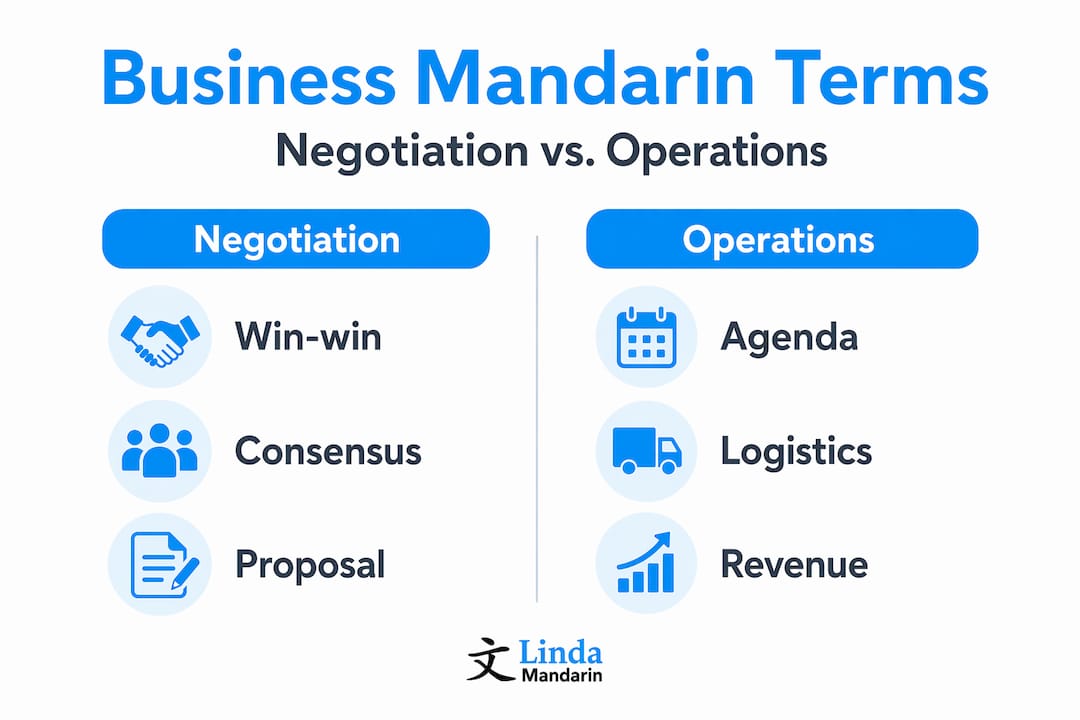
Negotiation in Chinese business culture operates on consensus, not confrontation. The goal is never to “win” against the other side. It’s to arrive at a mutually agreeable outcome while keeping everyone’s dignity intact. This is why consensus-building language dominates Chinese negotiation vocabulary.
A few terms you need immediately:
- 达成共识 (dáchéng gòngshí) — reach consensus. Use this to signal that you’re seeking alignment, not forcing a position.
- 双赢 (shuāngyíng) — win-win solution. Dropping this phrase in a negotiation signals you understand how Chinese business relationships work.
- 合作 (hézuò) — cooperation or collaboration. This word appears constantly in business correspondence and meetings.
- 我们考虑一下 (wǒmen kǎolǜ yīxià) — let us think about it. This is the polite way to avoid a hard “no” without appearing dismissive.
One of the most practical negotiation phrases involves framing your proposals indirectly. Diplomatic suggestion framing such as “Is it possible that we can…” (有没有可能我们可以… / yǒu méi yǒu kěnéng wǒmen kěyǐ…) keeps the door open and protects the other party’s face. It sounds softer than a direct statement, but that softness is the strategy.
Meeting vocabulary
Meetings have their own set of essential Mandarin for professionals. These terms come up in virtually every formal business meeting in a Chinese-speaking environment:
- 议程 (yìchéng) — agenda
- 目标 (mùbiāo) — objectives or goals
- 提案 (tí’àn) — proposal
- 总结 (zǒngjié) — summary or conclusion
- 跟进 (gēnjìn) — follow up
The phrase 我们今天的议程是… (wǒmen jīntiān de yìchéng shì…) means “Today’s agenda is…” and signals that you know how to run a structured meeting in Chinese.
Operations and commercial terms
For day-to-day commercial Mandarin terminology in operations, finance, and project management, here’s a quick reference:
| Negotiation Terms | Meeting and Operations Terms |
|---|---|
| 双赢 (win-win) | 议程 (agenda) |
| 达成共识 (reach consensus) | 目标 (objectives) |
| 合作 (cooperation) | 跟进 (follow up) |
| 让步 (concession) | 预算 (budget) |
| 条件 (conditions/terms) | 进度 (project progress) |
Pro Tip: Don’t just learn these terms in isolation. Write three sample sentences for each one, then say them aloud. The physical act of speaking the words in context accelerates recall faster than flashcard review alone.
Modern and digital business Mandarin
The digital economy has reshaped Chinese business communication, and the good news for learners is that many digital terms are direct loan translations. If you know the concept in English, you’re already halfway to the Chinese term.
Here are ten digital and tech business terms every professional should know:
- 电子商务 (diànzǐ shāngwù) — e-commerce. Used constantly in B2B and B2C contexts across China and Southeast Asia.
- 大数据 (dà shùjù) — big data. Appears in strategy meetings and pitch decks alike.
- 人工智能 (réngōng zhìnéng) — artificial intelligence (AI). Often shortened to AI even in Mandarin conversation.
- 平台 (píngtái) — platform. Whether it’s WeChat, Alibaba, or your own SaaS product, this is the word.
- 应用程序 (yìngyòng chéngxù) — app or application. You’ll also hear 应用 (yìngyòng) as a shorthand.
- 社交媒体 (shèjiāo méitǐ) — social media. Critical vocabulary for marketing and communications professionals.
- 云计算 (yún jìsuàn) — cloud computing. Standard in IT procurement and tech partnership discussions.
- 数字化 (shùzìhuà) — digitization or digital transformation. A phrase that dominates executive conversations in 2026.
- 数据隐私 (shùjù yǐnsī) — data privacy. Increasingly important given regulatory changes across the region.
- 直播 (zhíbō) — live streaming. If you’re working in retail, marketing, or e-commerce for Chinese markets, this is non-negotiable vocabulary.
What makes digital vocabulary particularly learnable is the logical construction of most terms. 大 (dà) means “big,” 数据 (shùjù) means “data.” Big data. The same pattern applies across most technology terminology. Once you recognize the building blocks, new terms become easier to decode on the fly.
Pro Tip: Follow Chinese business news on platforms like 第一财经 (Yicai) or 财新 (Caixin) for 15 minutes a day. You’ll encounter digital vocabulary in real context, which trains your ear to recognize terms before you ever need to say them yourself.

Cultural and etiquette vocabulary for business relationships
Language in Chinese business settings is not just about information transfer. It’s about signaling respect, acknowledging hierarchy, and building the kind of long-term trust that relationship-building in Chinese culture centers on. The word for this relational network is 关系 (guānxi), and you’ll never understand business Mandarin fully without understanding what it represents.
Here’s a practical sequence for professional relationship-building vocabulary:
-
Master formal greetings. The word 您好 (nínhǎo) is the respectful form of 你好. Using respectful address forms like 您 (nín) immediately signals that you understand the difference between casual and professional registers.
-
Use titles correctly. Address people as their title plus surname. A manager surnamed Wang becomes 王经理 (Wáng Jīnglǐ). Getting titles right shows awareness of organizational hierarchy, which matters enormously in Chinese workplaces.
-
Know your humility phrases. Phrases like 请多关照 (qǐng duō guānzhào), meaning “please take care of me” or “I look forward to your guidance,” are standard at first meetings. They signal deference and openness, which puts the other party at ease.
-
Learn dining and toast vocabulary. Business dinners are not social events. They are relationship-building opportunities with their own vocabulary. 干杯 (gānbēi) means “cheers” or literally “dry cup.” Saying 请多多指教 (qǐng duōduō zhǐjiào), “please offer me your guidance,” during a toast is a key networking phrase that lands well with senior counterparts.
-
Practice follow-up language. After a meeting or dinner, sending a brief message using 期待我们的合作 (qīdài wǒmen de hézuò), “looking forward to our cooperation,” keeps the relationship warm without being pushy.
The most common pitfalls include being too direct in disagreement, overusing Chinese idioms (成语 / chéngyǔ) when your proficiency doesn’t support it yet, and forgetting follow-up communication entirely. Any of these can undermine weeks of relationship-building.
Pro Tip: Before a formal meeting with a Chinese counterpart, research their title and company position. Addressing them correctly from the very first handshake sets the entire tone of the relationship. Getting this wrong is harder to recover from than a vocabulary mistake.
How to actually learn and retain business Mandarin
Memorizing vocabulary lists feels productive. In practice, it produces learners who know words but freeze in actual conversations. The research is clear: contextual phrase learning in realistic scenarios builds both retention and confidence far more effectively.
Here’s what actually works:
- Learn in chunks, not words. Instead of memorizing 预算 (budget) alone, learn 我们的预算是有限的 (our budget is limited) as a ready-made phrase you can deploy immediately.
- Simulate real scenarios. Write mock emails in Chinese, script a one-minute self-introduction for a business meeting, and practice a short negotiation dialogue with a language partner.
- Listen to Chinese business media. Podcasts, financial news programs, and earnings call transcripts from listed Chinese companies expose you to how commercial Mandarin terminology sounds in real use.
- Set a proficiency target tied to your goals. Programs designed for business communication, like those aligned to proficiency above Level 4 standards, focus specifically on business knowledge and communication skills, not just language mechanics.
- Review with spaced repetition. Apps like Anki let you create decks of business-specific phrases with audio. Twenty minutes a day compounding over three months produces measurable vocabulary gains.
The key insight here is that business Mandarin competence is both linguistic and cultural. You’re not just learning what words mean. You’re learning when to use them, how to frame them, and what effect they create on the listener. That dual focus is what separates effective business Chinese communication from technically correct but socially awkward language use.
For professionals who want to see a curated business Chinese vocabulary list organized by function, that’s a good place to benchmark where you currently stand.
Pro Tip: Pair every new vocabulary set with at least one cultural insight about when or why that phrase is used. Language and context are inseparable in business Mandarin. Learning one without the other leaves you perpetually one step behind.
My honest take on mastering business Mandarin
I’ve seen professionals with solid general Mandarin skills walk into a Chinese business setting and immediately lose the room. Not because they couldn’t speak. Because they spoke the wrong way. They were too blunt. They challenged positions directly instead of framing alternatives diplomatically. They skipped the relationship-building language at the start of a meeting and jumped straight to agenda items. The vocabulary was fine. The communication strategy was wrong.
What I’ve learned from working with business professionals over the years is that harmonious, collaborative language framing in Chinese negotiations isn’t just politeness. It’s the functional mechanism through which trust gets built and deals get done. Western adversarial negotiation instincts can derail a Chinese business relationship faster than any vocabulary mistake.
The professionals who make the biggest leap are the ones who stop treating business Mandarin as a translation exercise and start treating it as a new communication philosophy. When you understand why the language works the way it does, the vocabulary stops feeling like a list to memorize and starts feeling like a toolkit that makes sense. If you want to go deeper on how language shapes workplace outcomes specifically, the effective business communication angle is worth understanding before you walk into your next meeting.
— Paul
Take your business Mandarin further with Linda Mandarin
This guide gives you the vocabulary framework. What it can’t give you is the guided practice, real-time correction, and structured progression that turns knowledge into fluency. That’s where Linda Mandarin comes in. Since 2003, Linda Mandarin has trained adult professionals and corporate teams in Singapore to communicate with confidence in Mandarin business settings. The school’s instructors are certified native speakers fluent in English, which means they bridge the gap between what you know and what you need to know with precision.

Linda Mandarin’s corporate Mandarin training is built specifically for workplace communication, negotiation, and cross-cultural business interactions. For professionals who want faster results, the intensive Mandarin course accelerates your business vocabulary and speaking skills on a structured timeline. Classes are available in-person at the school’s location above Tanjong Pagar MRT or online via Zoom, giving you flexibility without sacrificing quality. If you’re serious about using Mandarin as a professional tool, this is where you build that capability.
FAQ
What is a business Mandarin terminology guide?
A business Mandarin terminology guide is a reference covering vocabulary, phrases, and communication strategies specific to professional Mandarin use in meetings, negotiations, and commercial settings. It goes beyond general language learning to address tone, cultural context, and industry-specific terms.
How is business Mandarin different from everyday Mandarin?
Business Mandarin uses formal registers, specific vocabulary for operations and negotiation, and culturally calibrated phrasing that prioritizes consensus and hierarchy. Everyday conversational Mandarin lacks the diplomatic framing and professional vocabulary that Chinese business contexts require.
What Mandarin phrases are most important for negotiations?
Phrases like 双赢 (win-win solution), 达成共识 (reach consensus), and softened proposal frames like 有没有可能我们可以… (is it possible that we can…) are foundational. Diplomatic framing is more effective than direct statements in Chinese negotiation settings.
How long does it take to become proficient in business Mandarin?
Reaching functional business Mandarin proficiency typically requires reaching above a mid-intermediate level of general Mandarin first. Business-focused programs build on that base to develop communication skills specific to professional and commercial contexts.
What cultural mistakes should professionals avoid in business Mandarin?
The most common errors include being too direct in disagreement, misusing formal titles, skipping follow-up communication, and overusing idioms before your proficiency supports them. Cultural missteps in language undermine trust faster than vocabulary errors.