TL;DR:
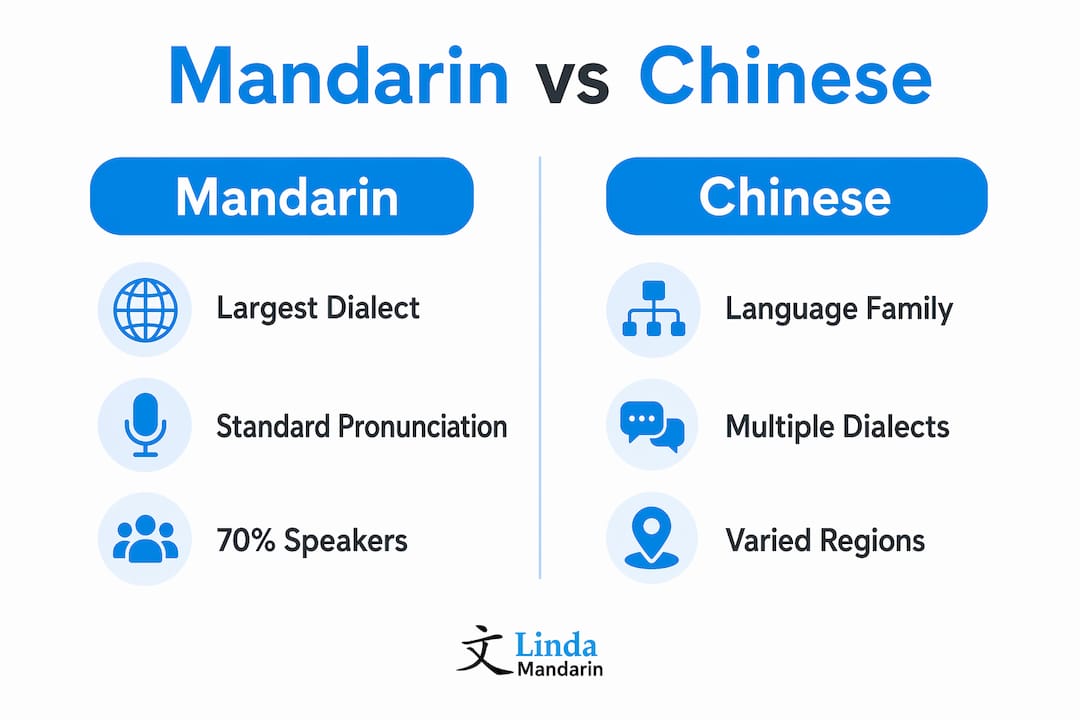
- Chinese is a family of related languages, with Mandarin being the largest and most widely spoken branch.
- Learning Mandarin provides a practical foundation, but it does not grant fluency in other Chinese varieties like Cantonese or Wu.
“Chinese” is a family of related languages, not a single language, and Mandarin is the largest and most widely spoken branch within that family. This distinction matters enormously if you are deciding what to learn, where to use it, or why someone from Shanghai and someone from Hong Kong may not understand each other in conversation. The difference between Mandarin and Chinese is essentially the difference between one member and the whole group. Mandarin Chinese explained properly means understanding that it sits inside a much broader linguistic category, one that includes Cantonese, Wu, Min, and several other distinct varieties. This article breaks down exactly how these languages relate, where they diverge, and what that means for you as a learner.
What does “Chinese” mean in linguistic terms?
“Chinese” is defined linguistically as the Sinitic branch of the Sino-Tibetan language family, covering a wide range of spoken varieties that differ substantially from one another. The Varieties of Chinese show significant differences in phonology, vocabulary, and syntax. Treating them as one language is like calling Spanish, Portuguese, and French the same thing because they share Latin roots.
The major branches of the Chinese language family include:
- Mandarin (官话, Guānhuà): Spoken across northern and southwestern China, and the basis for Standard Chinese.
- Cantonese (粤语, Yuèyǔ): Dominant in Guangdong province, Hong Kong, and Macau.
- Wu (吴语, Wúyǔ): Spoken in Shanghai and surrounding Jiangsu and Zhejiang provinces.
- Min (闽语, Mǐnyǔ): Includes Hokkien and Teochew, widely spoken in Fujian, Taiwan, and Southeast Asia.
- Hakka (客家话, Kèjiāhuà): Spread across multiple provinces and diaspora communities.
- Gan and Xiang: Spoken in Jiangxi and Hunan respectively.
All of these varieties are tonal, meaning pitch changes the meaning of a word. That is where the surface similarity ends. The number of tones, the tone patterns, the vocabulary, and even the sentence structure differ enough that a native Cantonese speaker and a native Mandarin speaker cannot hold a conversation without a shared written language or a third medium. Chinese language differences at the spoken level are not minor regional accents. They are, in many cases, the gap between full comprehension and total confusion.
The written character system creates a visual unity that masks this spoken diversity. A newspaper printed in Standard Chinese characters can be read by an educated person from Beijing and one from Guangzhou, even though they would pronounce every single character differently. This shared writing system is one reason the term “Chinese” persists as a single label despite covering what linguists would classify as a group of related but distinct languages.
Geographically, Chinese varieties map onto distinct regions with strong cultural identities. Cantonese carries the culture of southern China and the global diaspora. Hokkien connects communities across Taiwan, Malaysia, and Singapore. Each variety is not just a communication tool. It is a marker of heritage, family, and place.
What is Mandarin and how does it fit within the Chinese language family?
Mandarin is defined as a group of related dialects spoken natively by about 70% of Chinese speakers, making it the largest branch of the Sinitic languages with close to a billion native speakers. That scale alone explains why “Mandarin” and “Chinese” are so often used interchangeably in everyday conversation, even though the equation is linguistically inaccurate.

Within Mandarin itself, numerous dialects exist that are not completely mutually intelligible. The Mandarin spoken in Chengdu sounds noticeably different from the Mandarin spoken in Harbin. Both differ from the Mandarin spoken in Kunming. So even “Mandarin” is a group, not a single uniform speech form. The variety that most people mean when they say “learn Mandarin” is Standard Mandarin, which is based on the Beijing dialect and codified as the official spoken language of Mainland China.
Key facts about Standard Mandarin and its regional forms:
- Putonghua (普通话): The official standard in Mainland China, meaning “common speech.”
- Guoyu (國語): The official standard in Taiwan, meaning “national language.” Pronunciation and some vocabulary differ from Putonghua.
- Huayu (华语): The term used in Singapore and Malaysia, where Standard Mandarin is one of four official languages.
- Standard Mandarin is also one of the six official languages of the United Nations.
Mandarin’s geographic spread covers northern China, the northeast, the northwest, and large parts of southwestern China including Sichuan and Yunnan. This breadth is why it became the natural choice for a national standard. When the Chinese government promoted Putonghua through schools and state media in the 20th century, it was building on a variety that already had the largest native speaker base.
Pro Tip: If you are learning Mandarin for business in Singapore or Malaysia, focus on Huayu pronunciation norms and vocabulary. If your goal is working in Mainland China, Putonghua is your target. The differences are manageable but real, and knowing which standard you are learning saves confusion later.
Mandarin is taught in schools and broadcast through media as a lingua franca across China, but regional varieties maintain a strong cultural identity distinct from the standard. A person from Sichuan may speak Putonghua fluently at work and switch to the local Sichuan dialect at home. Both are “Mandarin” in the broad sense, but they are not the same spoken form.
How do Mandarin and other Chinese varieties differ linguistically?
Mandarin and Cantonese illustrate the depth of Chinese language differences better than any other pairing. Cantonese is largely unintelligible to Mandarin speakers despite both being Chinese varieties. The gap is not accent. It is tonal structure, vocabulary, and grammar.
The table below compares key linguistic features across three major varieties:
| Feature | Mandarin (Standard) | Cantonese | Wu (Shanghainese) |
|---|---|---|---|
| Number of tones | 4 (plus neutral) | 6 to 9 | 5 |
| Mutual intelligibility with Mandarin | N/A | Very low | Low |
| Spoken in | Northern/SW China, Taiwan, Singapore | Hong Kong, Guangdong, Macau | Shanghai, Jiangsu, Zhejiang |
| Written standard | Simplified or Traditional characters | Traditional characters | Simplified characters |
| Example: “I want to eat” | 我想吃 (Wǒ xiǎng chī) | 我想食 (Ngo5 soeng2 sik6) | Distinct local pronunciation |
The differences in phonology and grammar between Mandarin and varieties like Cantonese and Wu are structural, not cosmetic. Cantonese uses a final consonant system that Mandarin dropped centuries ago. Cantonese also preserves vocabulary from Classical Chinese that Mandarin has replaced with newer terms. These are not the differences between American English and British English. They are closer to the differences between Spanish and Romanian.
Tone sandhi, the way tones change depending on surrounding syllables, also varies across varieties. Mandarin has a well-documented sandhi rule where two consecutive third tones shift. Cantonese tone sandhi operates on entirely different principles. A learner who masters Mandarin tones starts from scratch when approaching Cantonese phonology.
The shared writing system provides a bridge for reading but not for speaking. Two people who cannot understand each other in conversation can exchange written messages using Standard Chinese characters. This is a genuinely unusual situation in world linguistics and explains much of the confusion around what “Chinese” means.
Common misconceptions about Mandarin vs Chinese
Saying “Mandarin vs Chinese” is itself a category error, because Chinese is the broad category and Mandarin is a part of it. This framing trips up learners constantly. Here is what actually gets misunderstood:
- “Chinese” means Mandarin: In casual use, yes. In linguistic terms, no. When a language school advertises “Chinese classes,” they almost always mean Standard Mandarin. But the label erases Cantonese, Hokkien, Wu, and every other variety.
- Dialects are just accents: The word “dialect” implies mutual intelligibility in most Western linguistic contexts. Chinese “dialects” often have none. Mutual intelligibility does not align with the language or dialect labels applied to Chinese varieties. Sociopolitical factors, not linguistic similarity, drive the grouping.
- Learning Mandarin means understanding all Chinese: A Mandarin speaker visiting Hong Kong without Cantonese will need English or written Chinese to communicate. Mandarin does not unlock the other varieties.
- All written Chinese is the same: Mainland China uses Simplified characters. Taiwan and Hong Kong use Traditional characters. The character sets overlap significantly but are not identical, and learners need to choose which system to study.
- Putonghua and Guoyu are identical: They are close but not the same. Vocabulary differences exist, and pronunciation of certain words diverges. A Taiwanese speaker and a Mainland speaker understand each other well, but the differences are real enough to notice.
Pro Tip: When you see “Mandarin learning myths” circulating online, most of them trace back to this core confusion. Reading up on common Mandarin misconceptions before you start a course saves you from building your expectations on a false premise.
Learners benefit from recognizing the pluricentric nature of Mandarin and choosing which standard suits their specific goals. If you are learning for professional use in Singapore, Huayu norms apply. If you are preparing for business travel to Beijing, Putonghua is the target. The core grammar and vocabulary are shared, but the fine-tuning matters.
Key takeaways
Mandarin is one branch of the Chinese language family, not a synonym for Chinese, and learners who understand this distinction make smarter decisions about what and how to study.
| Point | Details |
|---|---|
| Chinese is a language family | It includes Mandarin, Cantonese, Wu, Min, Hakka, and other distinct varieties. |
| Mandarin is the dominant branch | About 70% of Chinese speakers are native Mandarin speakers, making it the largest variety. |
| Standard Mandarin has three regional forms | Putonghua, Guoyu, and Huayu differ in pronunciation and vocabulary across Mainland China, Taiwan, and Singapore. |
| Spoken varieties are often mutually unintelligible | Cantonese and Mandarin speakers cannot understand each other in conversation despite sharing a writing system. |
| “Mandarin” in course listings means Standard Chinese | Learners should identify which regional standard applies to their personal or professional goals. |
Why the Mandarin vs Chinese confusion is worth taking seriously
Most people who ask about the difference between Mandarin and Chinese are not asking an academic question. They are trying to figure out what to learn. And that is exactly where the confusion does real damage.
I have spoken with adult learners who spent months in a Mandarin course, then visited Hong Kong and felt completely lost. They assumed that learning “Chinese” meant they would have some foothold in Cantonese-speaking environments. They had none. The written signs helped. The spoken language was a wall. That experience is not a failure of effort. It is a failure of framing.
The more useful mental model is this: think of Chinese the way you think of Romance languages. If you learn Spanish, you have not learned French. You have a head start, some shared vocabulary, and a structural intuition. But you cannot walk into a French conversation and expect to follow it. Mandarin and Cantonese have roughly that relationship, possibly wider.
What I find genuinely underappreciated is how much the shared writing system distorts people’s expectations. Because a Cantonese speaker and a Mandarin speaker can both read the same newspaper, outsiders assume the spoken gap is small. It is not. The writing system is a diplomatic agreement between communities that speak very differently. Recognizing that gap is not discouraging. It is clarifying. You know exactly what you are getting when you commit to Standard Mandarin, and you know what you are not getting.
For most adult learners with professional or conversational goals, Standard Mandarin is the right choice. It is the lingua franca of Mainland China, Taiwan, and Singapore’s formal register. It is the language of business meetings, government communication, and educated discourse across the Chinese-speaking world. The regional Mandarin standards are worth understanding, but they do not change the core investment. Learn Standard Mandarin well, and you have a tool that works across an enormous range of contexts.
— Paul
Start learning Standard Mandarin with the right foundation
If this article clarified what you are actually signing up for when you choose to learn Mandarin, the next step is finding a course built for adult learners with real-world communication goals.

Linda Mandarin has been training adults and professionals in Singapore since 2003, with courses ranging from beginner conversational Mandarin to advanced business Mandarin. Classes are available in group, private, and online Zoom formats, all taught by certified native Mandarin instructors fluent in English. Whether your goal is professional advancement, corporate communication, or personal fluency, you can explore adult Mandarin course levels to find the right fit. For organizations, Linda Mandarin also offers corporate Mandarin training tailored to team communication needs. The school is located at 10 Anson Road, Level 22, International Plaza, Singapore 079903, right above Tanjong Pagar MRT.
FAQ
Is Mandarin the same as Chinese?
Mandarin is not the same as Chinese. Chinese refers to a family of related languages, while Mandarin is the largest branch within that family, spoken natively by about 70% of Chinese speakers.
What is the difference between Mandarin and Cantonese?
Mandarin and Cantonese are distinct Chinese varieties with different tones, vocabulary, and pronunciation. Cantonese is largely unintelligible to Mandarin speakers in spoken conversation, despite sharing a written character system.
What is Putonghua vs Guoyu vs Huayu?
All three are forms of Standard Mandarin. Putonghua is the official standard in Mainland China, Guoyu is the standard in Taiwan, and Huayu is the term used in Singapore and Malaysia. They share the same core grammar but differ in some vocabulary and pronunciation.
Is Mandarin a dialect of Chinese?
Mandarin is technically a group of dialects within the Chinese language family, not a single dialect. Standard Mandarin, based on the Beijing dialect, is the codified official form used in schools, media, and government across Mainland China, Taiwan, and Singapore.
Which Chinese language should I learn as an adult?
Standard Mandarin is the most practical choice for adult learners with professional or conversational goals. It functions as the lingua franca across Mainland China, Taiwan, and Singapore, and is the variety taught in virtually all formal language programs.