TL;DR:
- Blended learning in Mandarin combines online practice with live instruction to enhance speaking proficiency effectively. Research confirms that alignment of online tasks, feedback, and real-world speaking activities leads to measurable gains in fluency, accuracy, and complexity for adult learners. The success of such programs depends on constructive alignment, positive learner attitudes, and deliberate practice during interactive live sessions.
Blended learning in Mandarin is defined as the structured integration of online practice and live face-to-face instruction to build communicative proficiency in Mandarin Chinese. This approach consistently outperforms single-modality methods because it combines the flexibility of asynchronous digital tools with the irreplaceable feedback of real-time speaking sessions. A 2026 study on blended speaking courses confirmed measurable pre-to-post gains in speaking complexity, accuracy, and fluency when learners follow a structured hybrid program. For adults and young adults balancing careers and personal commitments, this mandarin language blended approach offers the most practical path to real communication skills.
What does research say about blended learning in Mandarin?
The evidence for hybrid learning Mandarin is specific and growing. A 2026 blended speaking course study in Chinese higher education reported quantitative improvements across all three dimensions of speaking performance: complexity, accuracy, and fluency. That means learners were not just speaking more. They were speaking better, with more grammatical precision and richer sentence structures.
The same research identified a critical finding that most learners overlook. Learner attitudes mediate motivation in blended courses. This means your mindset toward the format directly shapes how much progress you make. Learners who approach online modules as genuine preparation for live sessions extract far more value than those who treat digital exercises as checkbox tasks.
Structured pre- and post-testing is another non-negotiable element. Without baseline and progress assessments, neither the learner nor the instructor can identify which speaking gaps the live sessions should target. Research from the PLOS ONE 2026 expert consensus on blended language module design emphasized that constructive alignment between outcomes, activities, and assessment drives results. Technology novelty alone does not.
“Meaning-focused interaction, not the technology itself, is what produces measurable language gains in blended Mandarin programs.” — PLOS ONE 2026 Expert Consensus
Three research-backed principles define effective blended Mandarin programs:
- Structured assessment: Pre- and post-tests that track speaking complexity, accuracy, and fluency
- Attitude cultivation: Explicit framing of online tasks as preparation for live speaking, not standalone study
- Communicative alignment: Every digital activity maps to a real-world speaking outcome practiced in class
These principles separate programs that produce real speakers from those that produce passive listeners who can pass a quiz but struggle in conversation.
How to design blended Mandarin courses for optimal speaking practice
Course design is where most blended programs succeed or fail. The PLOS ONE expert consensus on blended EFL module design in Chinese higher education identified constructive alignment as the top design priority. In practice, this means every online task must have a direct counterpart in the live session. If you practice ordering food using vocabulary flashcards online, your next live class should include a role-play at a restaurant.

Authentic interaction activities are the engine of speaking development. Role-plays, simulations, and scenario-based conversations force you to retrieve vocabulary under real communicative pressure, which is exactly the condition you face in actual Mandarin conversations. Passive listening exercises, by contrast, build recognition but rarely transfer to spontaneous production.
Here is a practical design sequence for a blended Mandarin module:
- Set the communicative goal first. Decide what the learner should be able to say or do by the end of the unit. For example: negotiate a business proposal in Mandarin.
- Assign online preparation tasks. Vocabulary drills, tone practice using audio tools, and grammar exercises that directly feed the target scenario.
- Run a synchronous speaking session. Use the live class exclusively for production: role-plays, peer dialogues, and instructor-corrected speaking tasks.
- Deliver targeted feedback. Address pronunciation, tones, and grammar errors identified during the live session, not generic corrections from the online platform.
- Assign a follow-up consolidation task. A recorded speaking response or written reflection that reinforces what was corrected in class.
Feedback alignment across modalities is the most underrated design factor. Misaligned feedback between online scoring and live teaching causes learners to practice errors repeatedly. If your online platform marks a tonal error as correct because it only scores character recognition, your live instructor must catch and correct that gap explicitly.
Pro Tip: Ask your instructor to review your online platform’s feedback reports before each live session. When the instructor knows which tones or grammar points the system flagged, they can target those exact gaps in real-time correction rather than covering generic material.
Mandarin teaching methods for adults that follow this constructive alignment model consistently produce faster speaking progress than programs that treat online and live components as separate tracks.
How does blended learning compare to purely online or face-to-face Mandarin?
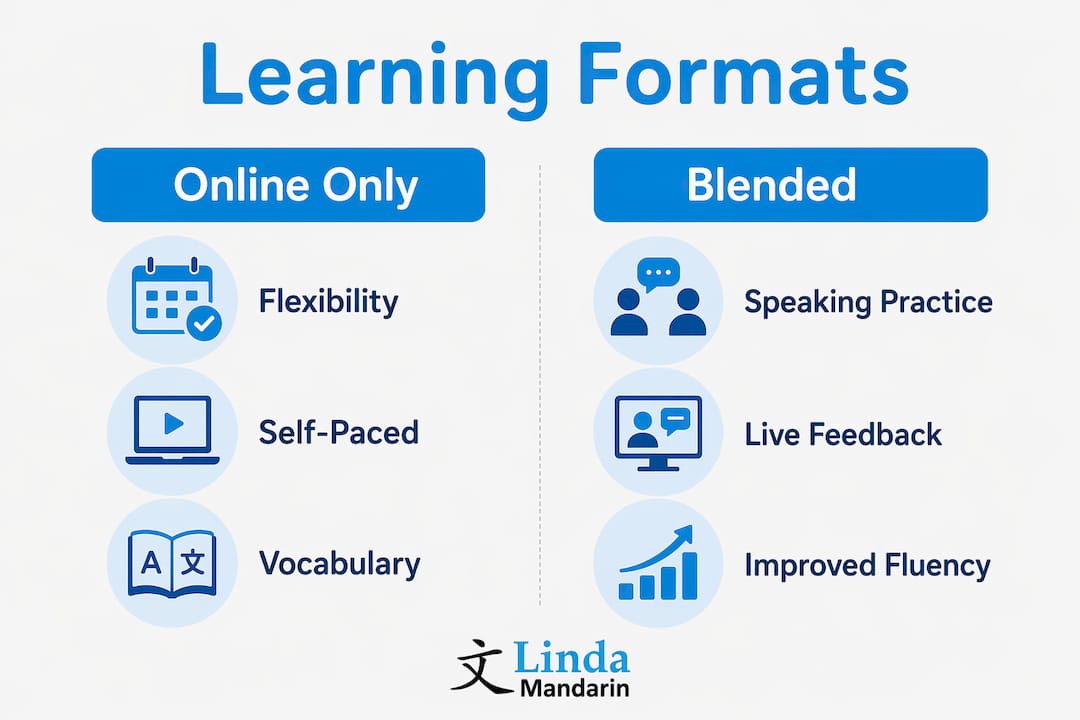
The differences between learning formats are not subtle. They determine whether you develop real speaking ability or accumulate passive knowledge that stalls in actual conversation.
| Format | Strengths | Limitations |
|---|---|---|
| Purely online | Flexible scheduling, self-paced, wide resource access | Limited real-time correction, low speaking accountability |
| Purely face-to-face | Immediate feedback, high interaction, tone correction | Fixed schedule, higher cost, less self-study structure |
| Blended (hybrid) | Combines flexibility with live correction, structured progression | Requires discipline across both modalities |
Purely online Mandarin courses deliver strong vocabulary and reading gains, but interactive live practice is what converts that input into speaking accuracy and fluency. This is the core limitation of exposure-only digital learning. You can recognize a tone pattern in a recording without being able to reproduce it under conversational pressure.
Face-to-face instruction solves the speaking problem but creates scheduling constraints that most working adults cannot sustain. A professional in Singapore cannot always commit to fixed weekly classes at a physical center, especially across multiple months of a structured program.
The blended approach resolves this by combining asynchronous online preparation with scheduled synchronous sessions. You complete vocabulary and grammar work on your own time, then arrive at the live session ready to practice production rather than spending class time on content delivery. This structure makes every live minute count, which matters enormously for adults with limited study time.
For adults exploring flexible Mandarin classes, the blended format is the most realistic path to sustained progress without sacrificing schedule flexibility.
What practical strategies can adult learners use in blended Mandarin programs?
Knowing the format is effective is not enough. How you engage with each component determines your actual outcomes. These strategies apply whether you are in a structured program or building your own hybrid routine.
- Align your online study to your next live session. Before each class, review the vocabulary and grammar you practiced digitally. Arrive with specific questions about pronunciation or usage, not just completed exercises.
- Treat synchronous speaking time as your highest-value minutes. Real-time correction from a qualified instructor converts online input into accurate production. Protect that time and engage actively rather than passively listening.
- Track your attitude, not just your progress. Research shows that positive learner attitudes mediate motivation in blended courses. When online tasks feel tedious, reframe them as preparation for the speaking goal, not as isolated drills.
- Use platforms with structured feedback. Choose online Mandarin courses that include pre- and post-assessments, not just content delivery. Platforms that track your tonal accuracy and grammar patterns give your instructor actionable data.
- Engage with peers in synchronous sessions. Peer dialogue in live classes builds the spontaneous response speed that self-study cannot replicate. Volunteer to speak first, make mistakes, and learn from corrections in real time.
Setting realistic goals matters more than most learners realize. Adults who try to replicate full-time student study hours alongside professional commitments burn out within weeks. A sustainable blended routine for a working adult typically means three to four hours of online self-study per week combined with one to two live sessions. That volume, sustained consistently over six months, produces the kind of speaking gains the research documents.
Pro Tip: Use a simple weekly log to record which online tasks you completed and which speaking errors your instructor corrected. Reviewing this log before each live session creates a feedback loop that accelerates error correction and keeps your motivation visible.
For adults building vocabulary alongside speaking skills, Mandarin vocabulary strategies designed for adult learners can complement the blended structure effectively.
Key takeaways
Blended learning in Mandarin produces the strongest speaking outcomes when online practice is directly aligned to live communicative tasks, supported by structured feedback and a positive learner mindset.
| Point | Details |
|---|---|
| Constructive alignment is non-negotiable | Every online task must map to a live speaking activity to drive real fluency gains. |
| Learner attitude drives motivation | Your mindset toward blended formats directly mediates how much progress you make. |
| Live correction is highest-value time | Synchronous sessions with instructor feedback produce the sharpest gains in accuracy and fluency. |
| Feedback must be aligned across modalities | Mismatched online and live feedback causes repeated errors that slow progress significantly. |
| Blended beats single-modality for adults | The hybrid format combines flexibility and interaction in a way neither purely online nor purely face-to-face learning can match. |
Why I think most adults underestimate the live session
After years of observing how adult learners approach blended Mandarin programs, the pattern is consistent. Learners invest heavily in the online component because it feels productive. They complete modules, earn completion badges, and track vocabulary counts. Then they arrive at the live session underprepared to speak, because they treated the digital work as the main event rather than the warm-up.
The research is unambiguous on this point. Synchronous speaking with live correction is where complexity, accuracy, and fluency actually develop. Online tools build the raw material. The live session is where you forge it into real communication ability.
The other mistake I see constantly is choosing a blended program based on the technology it uses rather than the instructional design behind it. Immersive platforms, VR environments, and AI pronunciation tools are genuinely useful when they are tied to communicative outcomes. When they are not, they are expensive distractions. The PLOS ONE expert consensus made this explicit: meaning-focused interaction outperforms technology novelty every time.
My honest advice is to audit your current program by asking one question. Does every online task I complete feed directly into what I practice in my next live session? If the answer is no, the program has an alignment problem, and you will feel it in your speaking progress within two months.
— Paul
Explore Linda Mandarin’s adult Mandarin programs
Linda Mandarin has been delivering professional Mandarin training in Singapore since 2003, combining structured online resources with live instruction from certified native-speaking instructors. Whether you are building conversational confidence or developing business Mandarin skills for professional contexts, the programs are designed around the same constructive alignment principles the research supports.
Classes are available in group, private, and online Zoom formats, with flexible scheduling designed for working adults. The school is located at 10 Anson Road, Level 22, International Plaza, Singapore 079903, right above Tanjong Pagar MRT. Explore the full range of adult Mandarin programs to find the format and level that fits your schedule and goals.
FAQ
What is blended learning in Mandarin?
Blended learning in Mandarin is the integration of structured online practice and live face-to-face or Zoom instruction to develop speaking, listening, reading, and writing skills. It combines the flexibility of self-paced digital tools with the real-time correction that drives speaking accuracy.
How effective is hybrid learning for Mandarin speaking skills?
A 2026 study confirmed measurable gains in speaking complexity, accuracy, and fluency from structured blended Mandarin courses. The gains are strongest when online tasks are aligned directly to live speaking activities rather than treated as separate study tracks.
How many hours per week should adults dedicate to blended Mandarin study?
A sustainable adult blended routine typically combines three to four hours of online self-study with one to two live sessions per week. Consistency over six months produces the speaking gains documented in research, without the burnout risk of trying to replicate full-time study hours.
Does learner attitude really affect blended Mandarin outcomes?
Research shows that learner attitudes directly mediate the relationship between course experience and motivation in blended speaking programs. Learners who approach online modules as preparation for live speaking extract significantly more value than those who treat them as isolated tasks.
What is the biggest design flaw in blended Mandarin programs?
Misaligned feedback between online platforms and live instruction is the most common and damaging design flaw. When online tools assess one set of skills and live sessions address different gaps, learners practice errors repeatedly without correction, which slows progress significantly.