TL;DR:
- Mandarin communication skills depend on tonal accuracy, vocabulary, cultural understanding, and active practice. Learning through demonstration, immediate feedback, and real-context speaking accelerates proficiency significantly. Adults should prioritize speaking from the start and focus on targeted, contextual practice to achieve fluency faster.
Mandarin communication skills are defined as the ability to speak, listen, and convey meaning accurately in Mandarin Chinese by combining tonal precision, vocabulary, sentence structure, and cultural understanding. The U.S. Foreign Service Institute classifies Mandarin as one of the most demanding languages for English speakers, estimating 2,200 class hours for professional proficiency. That figure is not a warning. It is a map. Understanding what Mandarin communication actually requires, and how to build those skills efficiently, is the fastest way to close the gap between where you are now and where you want to be. Tools like Anki, Pleco, and structured speaking practice with a qualified instructor make that path significantly shorter.
What are the key components of Mandarin communication skills?
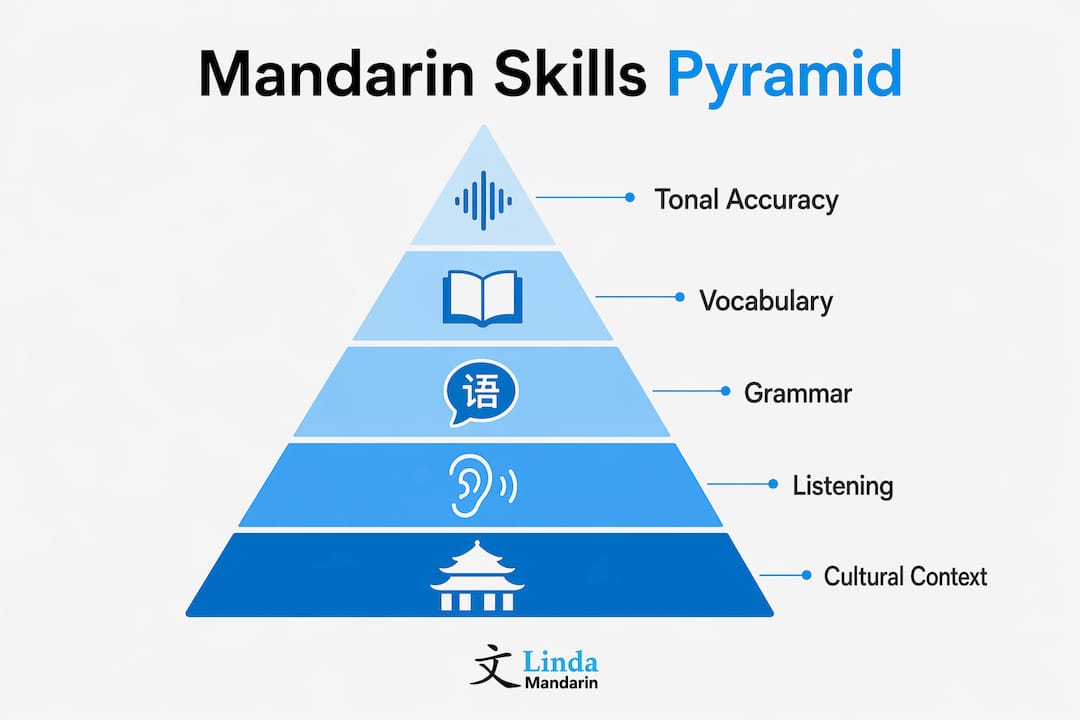
Mandarin communication skills rest on five interlocking pillars: tonal pronunciation, vocabulary, grammar, listening comprehension, and cultural context. Weakness in any one area creates friction across all the others. Knowing which pillar needs the most work is the starting point for every serious learner.
Tonal pronunciation
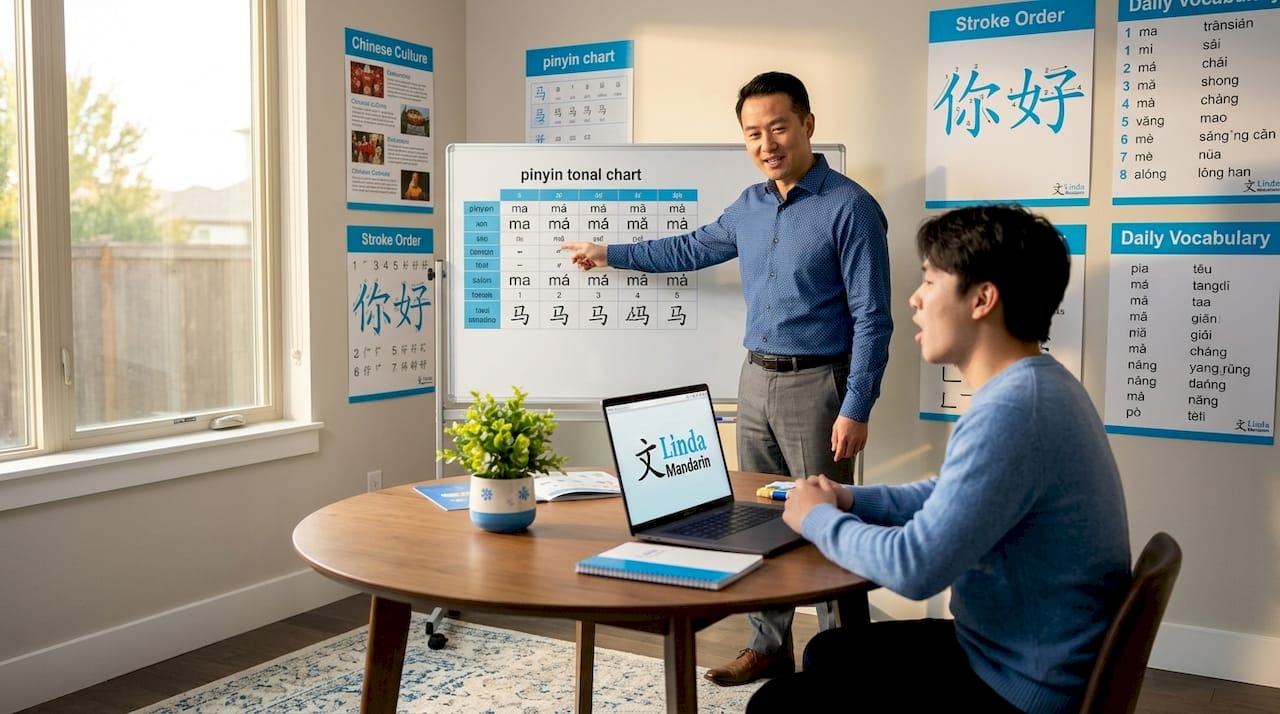
Mandarin uses four tones plus a neutral tone, and each one changes a word’s meaning entirely. The word “ma” can mean mother, horse, hemp, or scold depending on which tone you use. This is not a quirk of the language. It is the language. Mispronouncing a tone does not produce an accent. It produces a different word, which is why tonal accuracy is the single highest-leverage skill for beginners to prioritize.
Vocabulary and sentence structure
Mandarin sentence structure follows a subject-verb-object pattern similar to English, which makes basic grammar more accessible than many learners expect. The real challenge is vocabulary, particularly Chinese characters. Learning the 214 radicals that form the building blocks of characters helps you decode and memorize new words faster. Spaced repetition tools like Anki and Pleco are the most efficient way to build and retain vocabulary over time.
Cultural communication context
Effective Mandarin communication goes beyond grammar. Chinese communication culture places high value on respect, hierarchy, and indirect expression. Addressing a senior colleague or an older person with the correct honorific is not optional politeness. It signals competence and cultural awareness. Non-verbal cues, including silence, eye contact norms, and gift-giving etiquette, also carry communicative weight that no dictionary entry will explain.
- Tonal accuracy: Four tones plus neutral; mispronunciation changes meaning entirely
- Vocabulary depth: Study radicals first, then build with spaced repetition
- Grammar foundation: Subject-verb-object structure; learn measure words early
- Cultural fluency: Respect, hierarchy, and indirect communication are built into the language
- Listening comprehension: Regional accents and speech speed require dedicated ear training
Pro Tip: Record yourself speaking Mandarin for 60 seconds each day and compare recordings weekly. Tonal drift is almost impossible to catch in real time but obvious on playback.
Spoken and written Mandarin also differ significantly in register and vocabulary. Spoken Mandarin, especially in professional settings, uses shorter sentences and more context-dependent phrasing. Written Mandarin, even in business emails, tends toward more formal structures. Adult learners focused on workplace communication should prioritize spoken fluency first, then layer in written skills as confidence grows.
How do evidence-based teaching methods improve Mandarin communication skills?
The method you use to learn Mandarin matters as much as the hours you put in. A 2026 study at Prima Indonesia University compared demonstration-based teaching with lecture-only instruction across 36 Mandarin language students. The results were clear: demonstration methods significantly outperformed lectures in improving communication ability. Students who watched modeled speech, practiced actively, and received immediate feedback made measurably greater gains than those who passively absorbed grammar explanations.
“Communication improvement tends to come from demonstration and practice rather than lecture-only methods, as active use builds confidence and skill.” — Prima Indonesia University, 2026
This finding aligns with how adult learning actually works. Adults retain language best when they use it in context, not when they memorize rules in isolation. The implication for anyone studying Mandarin is direct: choose programs and methods that put speaking at the center, not at the end of the lesson.
| Teaching method | Outcome for communication skills |
|---|---|
| Lecture-only | Passive knowledge; limited speaking confidence |
| Demonstration + practice | Active skill use; measurable gains in communication ability |
| Tutor-led feedback sessions | Faster error correction; targeted tone and vocabulary improvement |
| Immersion and contextual practice | Doubles acquisition speed compared to classroom-only learning |
Taipei City’s 2026 program for migrant workers illustrates this principle at scale. The city launched an advanced speaking class in June 2026 specifically to strengthen real-world communication in situations like shopping, medical visits, and workplace interactions. The program did not add more grammar drills. It added more speaking practice tied to real contexts. That design choice reflects exactly what the research supports.
Active speaking practice with immediate feedback on tone and vocabulary errors accelerates skill acquisition faster than self-study alone. Working with a qualified instructor or language partner and focusing on one correction per session prevents overwhelm while building steady, measurable progress. For a deeper look at how different Mandarin teaching methods compare for adult learners, the differences in approach are worth understanding before you commit to a program.
What practical steps can adults take to improve their Mandarin skills?
A structured self-assessment followed by targeted practice is the most efficient route to real improvement. Aimless study, where you review vocabulary one day and watch a drama the next without a clear focus, produces slow and inconsistent results. The following process gives you a repeatable framework.
- Record a 3-minute spoken response on any topic in Mandarin. Listen back and note every error: wrong tones, vocabulary gaps, hesitation patterns, and grammar mistakes. This diagnostic recording is your baseline.
- Select three priorities from your error list to focus on for the next six to eight weeks. Common priorities include first-tone accuracy, measure word usage, and transitional phrases for conversation. Limiting your focus to three areas prevents the scattered effort that stalls most learners.
- Use spaced repetition daily. Anki and Pleco both allow you to build custom decks around your three priority areas. Fifteen minutes of spaced repetition per day outperforms two-hour cramming sessions for long-term retention.
- Practice real-context scripts. For workplace communication, write and rehearse scripts for specific situations: introducing yourself in a meeting, asking for clarification, or following up on a project. Workplace communication scripts tied to real situations are the fastest route to usable Mandarin in professional settings.
- Find a speaking partner or tutor. Language exchange apps connect you with native Mandarin speakers learning English. A structured session with a certified instructor, however, delivers faster gains because feedback is targeted and consistent.
Pro Tip: When practicing with a tutor, ask them to correct only your top-priority error for the first month. Receiving five corrections per sentence kills speaking confidence. One focused correction per session builds it.
Diagnostic speaking tasks that identify specific weaknesses allow learners to set goals that are genuinely actionable rather than vague. “Improve my Mandarin” is not a goal. “Reduce first-tone errors in timed speaking by 50% over six weeks” is. The specificity is what makes practice productive. For adults building vocabulary in parallel, a focused guide to building Mandarin vocabulary as an adult provides a structured approach that complements speaking practice without duplicating effort.
How does mastering Mandarin benefit personal and professional life?
Strong Mandarin communication skills open doors that language barriers keep firmly closed. The benefits operate across three distinct areas of life, and each one compounds the others.
- Professional advancement: Mandarin is the first language of over 900 million people. In Singapore, China, Taiwan, and across Southeast Asia, the ability to communicate directly in Mandarin signals commitment and cultural respect to Chinese-speaking colleagues and clients. Professionals who speak Mandarin in meetings, rather than relying on translation, build trust faster and negotiate more effectively.
- Cultural engagement: Language is the deepest form of cultural access. Reading a menu, understanding a Lunar New Year greeting, or following a conversation at a family dinner without needing a translator changes the quality of every interaction. These moments accumulate into genuine belonging.
- Personal confidence: The confidence that comes from being understood in a second language transfers to other areas of life. Adult learners consistently report that achieving conversational fluency in Mandarin, even at a basic level, increases their overall willingness to take on challenging goals.
Taipei City’s migrant worker program demonstrates the real-world stakes clearly. Workers who completed the advanced speaking class gained the ability to handle medical appointments and workplace disputes independently. That is not a small outcome. It is the difference between dependency and autonomy. Immersion and contextual practice can double acquisition speed compared to classroom-only learning, which means the path to these outcomes is shorter than most adult learners assume.
For adults in Singapore’s business environment, Mandarin for workplace communication is increasingly a practical skill rather than a cultural bonus. Companies with Chinese-speaking partners, clients, or leadership teams gain a measurable advantage when their staff can communicate directly and accurately in Mandarin.
Key takeaways
Mandarin communication skills require tonal accuracy, vocabulary depth, cultural fluency, and active speaking practice, and the most effective adult learners combine diagnostic self-assessment with demonstration-based instruction.
| Point | Details |
|---|---|
| Tones are non-negotiable | One wrong tone changes the word entirely; prioritize tonal accuracy from day one. |
| Demonstration beats lectures | Research shows active practice with feedback produces measurably better communication gains than passive instruction. |
| Diagnose before you practice | A 3-minute recorded speaking task reveals your real weaknesses faster than any textbook assessment. |
| Context accelerates fluency | Scripts tied to real situations, such as meetings or medical visits, build usable skills faster than abstract drills. |
| Immersion multiplies progress | Even short periods of contextual practice can double acquisition speed compared to classroom-only study. |
Why I think most adults are learning Mandarin the wrong way
After working with adult Mandarin learners across a wide range of backgrounds, the pattern I see most often is this: people spend months studying vocabulary lists and grammar rules, then freeze the moment a native speaker responds at normal speed. The problem is not effort. It is method.
Most adult learners treat speaking as the reward at the end of learning, something you do once you feel ready. That instinct is exactly backwards. Speaking is the practice. You get ready by doing it badly, repeatedly, with someone who can correct you. The discomfort of making tonal errors in front of another person is not a sign you are not ready. It is the mechanism by which you become ready.
The other mistake I see consistently is neglecting tone practice after the first few weeks. Learners move on to vocabulary and grammar because tones feel mastered once you can recite them in isolation. But producing accurate tones in connected speech, at conversational speed, under the cognitive load of forming a sentence, is a completely different skill. It requires months of dedicated practice, not days.
My honest advice: commit to speaking from your very first lesson, accept that you will sound wrong for a while, and find an instructor who corrects your tones before your grammar. That sequence produces fluent speakers. The reverse produces people who know a lot about Mandarin but struggle to use it.
— Paul
Build real Mandarin communication skills with Linda Mandarin
Linda Mandarin has been training adult Mandarin learners in Singapore since 2003, with courses designed specifically for conversational fluency and professional communication. Every program puts speaking at the center, with certified native instructors who deliver structured feedback from the first lesson.
Whether you need corporate Mandarin training for your team, a flexible online Zoom course that fits around your schedule, or a structured group class at the International Plaza center above Tanjong Pagar MRT, Linda Mandarin has a program built for your goals. Explore the full range of adult Mandarin programs and find the course level that matches where you are right now.
FAQ
What are Mandarin communication skills?
Mandarin communication skills are the combined ability to speak, listen, read, and write in Mandarin Chinese with tonal accuracy, vocabulary depth, and cultural awareness. Effective communication requires all four components working together, not just grammar knowledge.
How long does it take to reach basic conversational Mandarin?
The U.S. Foreign Service Institute estimates that basic conversational ability is achievable in 6 to 12 months of consistent practice. Professional proficiency requires approximately 2,200 class hours, making method and consistency the two most important variables.
Why is tonal accuracy so important in Mandarin?
Mandarin’s four tones and neutral tone change word meaning entirely. The word “ma” means four different things across four tones. Tonal errors do not produce an accent. They produce the wrong word, which is why tone practice must begin on day one and continue throughout your learning.
What is the most effective method for improving Mandarin speaking skills?
A 2026 study at Prima Indonesia University found that demonstration-based teaching with active practice significantly outperformed lecture-only methods. Working with a qualified instructor who models speech and provides immediate feedback produces the fastest and most measurable gains.
How can I use Mandarin communication skills in the workplace?
Practice scripts tied to real professional situations: meeting introductions, clarification requests, and project follow-ups. Taipei City’s 2026 migrant worker program demonstrated that real-context speaking practice builds usable workplace Mandarin faster than general language study.