TL;DR:
- Advanced business Mandarin encompasses industry-specific vocabulary, cultural competence, and scenario-based communication skills necessary for executive-level interactions in Mandarin-speaking environments. It focuses on negotiations, contracts, and cross-cultural dynamics, building upon foundational Mandarin proficiency to ensure effective professional communication. Tailored programs include industry-specific vocabulary, role-playing simulations, and authentic materials to accelerate real-world performance and career advancement.
Advanced business Mandarin is defined as the specialized set of language skills, industry-specific vocabulary, and cultural competence that professionals use to operate effectively in Mandarin-speaking corporate environments. This goes far beyond ordering food or asking for directions. At this level, you are conducting salary negotiations, presenting quarterly results, managing cross-border teams, and signing contracts, all in Mandarin. For executives and business professionals working with Chinese-speaking partners, clients, or colleagues, this skill set is not optional. It is the difference between being present in a room and actually leading the conversation.

What is advanced business mandarin and how is it defined?
Advanced business Mandarin is the professional-grade application of the Mandarin language within corporate contexts. The standard industry term for this discipline is Business Chinese or Corporate Mandarin, and it sits at the upper end of the language proficiency spectrum. General Mandarin teaches you how to communicate in everyday situations. Advanced business Mandarin teaches you how to communicate in professional settings where precision, tone, and cultural awareness directly affect outcomes.
The scope is broad. Specialized business areas covered at this level include salary negotiations, office politics, remote team management, contract signing, and cross-cultural networking simulations. That breadth reflects the reality of modern corporate life. A finance director in Singapore dealing with a Shanghai-based investment group needs different vocabulary than a logistics manager coordinating with a Shenzhen supplier.
Cultural competence is built into the framework. Understanding guanxi, the Chinese concept of relationship-building and social capital, is critical for business negotiations in Chinese-speaking markets. Without that cultural layer, even grammatically correct Mandarin can land poorly in a boardroom.
How does advanced business mandarin differ from general mandarin?
The gap between general Mandarin and advanced business Mandarin is significant. General Mandarin courses build foundational grammar, pronunciation, and conversational vocabulary. Advanced business Mandarin assumes that foundation exists and builds an entirely different skill set on top of it.
Here is what sets the two apart:
- Industry vocabulary: General Mandarin covers everyday words. Advanced business Mandarin introduces sector-specific terminology for finance, technology, logistics, manufacturing, and international sales.
- Communication scenarios: Lessons are structured around business meetings, performance reviews, client pitches, and contract discussions, not casual conversations.
- Simulated real-world applications: Scenario-based learning including simulated meetings, speech practice, and performance reviews is a core teaching method. This approach prepares you for actual workplace situations, not just textbook exercises.
- Cultural and etiquette knowledge: Knowing when to present a business card with two hands, how to address a senior executive, or how to decline a proposal without causing offense are skills that belong to this level.
- Written business communication: Advanced learners write formal emails, draft reports, and interpret contracts in Mandarin, skills that general courses rarely address.
Pro Tip: If you can hold a casual conversation in Mandarin but freeze when a Chinese client asks about payment terms, you are at the boundary between general and advanced business Mandarin. That gap is exactly what a business Mandarin course is designed to close.
The practical implication is clear. Professionals who stop at conversational Mandarin leave significant value on the table in negotiations, relationship-building, and career advancement.
What skills do you build in a business mandarin course?
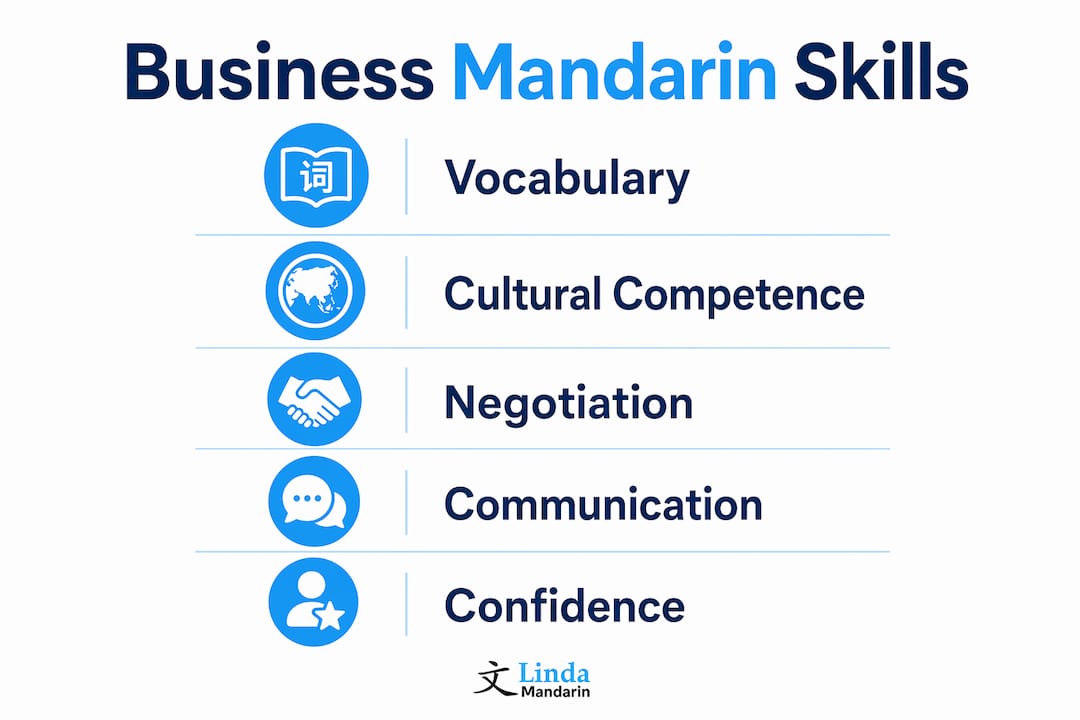
Business Chinese courses develop skills across all four communication modes: listening, speaking, reading, and writing, each calibrated for professional contexts. The competencies you build are directly tied to tasks you perform at work.
Here are the core skills developed through advanced Mandarin for business:
- Business meeting communication: You learn to follow rapid spoken Mandarin in meetings, ask clarifying questions, and contribute opinions without losing the thread of the discussion.
- Formal written correspondence: Writing professional emails, memos, and business proposals in Mandarin requires a different register than spoken language. Courses train you to match tone and formality to context.
- Contract and report reading: Authentic materials like emails, contracts, and reports are used to prepare learners for real workplace communication. Reading a supplier contract or a financial report in Mandarin is a distinct skill that requires targeted practice.
- Cross-cultural networking: You develop the language to build relationships at business dinners, industry events, and client meetings, including the small talk that Chinese business culture treats as a trust-building exercise.
- Negotiation language: This includes phrases for making offers, countering proposals, expressing disagreement diplomatically, and closing deals in Mandarin.
- Conflict resolution vocabulary: Managing disagreements or misunderstandings with Chinese partners requires specific language that avoids direct confrontation while still protecting your interests.
Pro Tip: Practice your negotiation phrases out loud, not just in writing. The rhythm and tone of spoken Mandarin in a negotiation carry as much weight as the words themselves. Record yourself and compare your delivery to native speaker examples.
Effective business Mandarin also builds confidence in cross-border communication, reducing misunderstandings and strengthening collaboration with Chinese partners. That confidence compounds over time. Every successful interaction reinforces your ability to perform in the next one.
How do programs tailor learning to your industry and role?
The most effective business Mandarin programs do not use a one-size-fits-all curriculum. Advanced business Mandarin is tailored to specific industries including finance, technology, logistics, manufacturing, education, and international sales. That customization ensures the vocabulary and scenarios you practice match the situations you actually face.
The table below shows how program content shifts based on industry and professional role:
| Industry / Role | Focus Areas |
|---|---|
| Finance and Banking | Investment terminology, financial reporting, regulatory language |
| Technology and IT | Product development vocabulary, vendor negotiations, technical documentation |
| Logistics and Supply Chain | Shipping terms, supplier communication, customs and compliance language |
| Sales and Business Development | Client pitching, pricing discussions, relationship management |
| HR and People Management | Performance review language, recruitment communication, team management |
Role-based customization matters just as much as industry focus. A sales manager needs fluency in persuasion and objection handling. An HR director needs vocabulary for performance conversations and employment contracts. A C-suite executive needs the language to represent their company in high-stakes meetings with Chinese counterparts.
Role-playing exercises and scenario simulations are the primary delivery method for this kind of targeted learning. You practice a supplier negotiation, then debrief on what worked and what did not. You simulate a board presentation, then refine your delivery. This method closes the gap between classroom learning and real-world performance faster than any other approach.
Corporate Mandarin training programs in Singapore, for example, are designed specifically for professionals who need language skills that apply immediately to their work, not skills they will use someday in a hypothetical scenario.
What methods and tools make business mandarin learning effective?
The instructional approach behind a business Mandarin course determines how quickly skills transfer to real situations. The most effective programs combine several methods rather than relying on any single one.
- One-on-one tutoring: Personalized learning through one-on-one sessions allows instructors to focus entirely on your professional goals, your industry vocabulary gaps, and your specific communication challenges. This format accelerates progress for busy executives.
- Online interactive classes: Live online Zoom sessions replicate the classroom experience with the flexibility professionals need. You can join from Singapore, Hong Kong, or anywhere else without interrupting your schedule.
- Scenario-based simulations: Simulated meetings, client calls, and negotiation exercises place you in realistic situations before you face them in real life. The pressure of performing in a simulation builds the muscle memory you need for actual business interactions.
- Authentic business materials: Using real contracts, emails, and industry reports as learning materials means your vocabulary practice is grounded in documents you will actually encounter at work.
- Pronunciation and tone training: Mandarin is a tonal language. Mispronouncing a word can change its meaning entirely. Dedicated pronunciation tools and feedback from native-speaking instructors correct errors before they become habits.
- Cultural immersion components: Etiquette training, understanding Chinese business customs, and learning how to read social cues in a Chinese corporate context are built into the curriculum, not treated as optional extras.
You can also find online Mandarin tutors who specialize in business contexts, which is a practical option for professionals who need flexible scheduling alongside structured coursework.
The combination of these methods produces learners who can perform in real business situations, not just pass a language test. That distinction is the whole point of advanced Mandarin for business.
Key takeaways
Advanced business Mandarin is a specialized professional skill set that combines industry vocabulary, cultural competence, and scenario-based communication training to prepare executives for real corporate interactions in Mandarin-speaking environments.
| Point | Details |
|---|---|
| Defined scope | Advanced business Mandarin covers negotiations, contracts, meetings, and cross-cultural communication, not everyday conversation. |
| Cultural layer | Understanding concepts like guanxi is non-negotiable for building and maintaining Chinese business relationships. |
| Industry customization | Effective programs tailor vocabulary and scenarios to your specific sector, whether finance, tech, or logistics. |
| Skill transfer | Scenario-based simulations and authentic materials accelerate the move from classroom learning to real-world performance. |
| Career impact | Mastering this skill set reduces miscommunication, builds partner trust, and opens doors to senior roles in cross-border business. |
Why most professionals underestimate this skill until it costs them
I have seen it happen more than once. A senior executive spends months building a relationship with a Chinese partner, then loses the deal in the final meeting because a poorly chosen phrase signals disrespect. No one told them that declining a proposal directly, without softening language, reads as an insult in many Chinese business contexts.
The importance of advanced Mandarin goes beyond vocabulary. It is about reading the room in a language where tone, register, and cultural subtext carry as much meaning as the words themselves. Most professionals focus on grammar and vocabulary and underestimate the cultural layer entirely. That is the layer that actually closes deals.
The other mistake I see is treating business Mandarin as a one-time course rather than a continuous practice. Language skills decay without use. The professionals who get the most value from their training are the ones who find ways to use Mandarin in real business interactions every week, whether that means switching to Mandarin in internal meetings, corresponding with Chinese clients in writing, or joining a business Chinese community that keeps them accountable.
The professionals who treat this as a long-term investment, not a box to check, are the ones who show up in a Shanghai boardroom and hold the room.
— Paul
Take your corporate mandarin to the next level with linda mandarin
Linda Mandarin has been training adult professionals and corporate teams in Singapore since 2003. The school’s corporate Mandarin training programs are built specifically for executives and business professionals who need language skills that work in real corporate situations. Lessons are delivered by certified native Mandarin instructors fluent in English, using scenario-driven methods that connect directly to your industry and role.
Classes are available in group, private, and live online Zoom formats, giving you the flexibility to learn without disrupting your schedule. Linda Mandarin is located at 10 Anson Road, Level 22, International Plaza, Singapore 079903, right above Tanjong Pagar MRT. Contact Linda Mandarin today to discuss a personalized course assessment and find the program that fits your professional goals.
FAQ
What is the difference between business mandarin and general mandarin?
General Mandarin covers everyday conversational skills. Business Mandarin focuses on industry-specific vocabulary, formal written communication, negotiation language, and cultural etiquette required in corporate settings.
How long does it take to reach advanced business mandarin proficiency?
The timeline depends on your starting level and how consistently you practice. Professionals with a conversational Mandarin base typically require 12–24 months of structured training to reach advanced business proficiency.
Can i learn advanced business mandarin online?
Yes. Live online Zoom classes with experienced instructors deliver the same scenario-based, interactive learning as in-person sessions, with the flexibility that busy professionals need.
Why is cultural knowledge part of a business mandarin course?
Cultural competence is built into advanced business Mandarin because language and culture are inseparable in Chinese corporate contexts. Understanding concepts like guanxi and business etiquette directly affects your ability to build trust and close deals with Chinese partners.
Which industries benefit most from advanced business mandarin training?
Finance, technology, logistics, manufacturing, and international sales professionals gain the most direct benefit, since these sectors involve frequent high-stakes communication with Mandarin-speaking clients, suppliers, and partners.