TL;DR:
- Mandarin pronunciation is based on 21 initials, 35 finals, and four tones, not connected to English phonetics. Mastering these elements through listening, physical practice, and daily drills is essential for clear communication. Working with a qualified instructor accelerates learning by correcting pronunciation errors early and effectively.
Mandarin pronunciation is the foundation of every conversation you will ever have in the language, built from 21 consonants, 35 vowel combinations, and four tones that change word meaning entirely. Most adult learners underestimate this system at first. They assume Pinyin, the official romanization system for Mandarin, works like English spelling. It does not. Pinyin is an independent phonetic system, and treating it like English is the single most common reason learners develop stubborn pronunciation habits that take months to correct. This mandarin pronunciation guide breaks the system down into its real components so you can build accurate speech from day one.
What is a Mandarin pronunciation guide and why does it start with Pinyin?
Mandarin pronunciation is structured around syllables, each made of an initial (a consonant sound), a final (a vowel or vowel combination), and a tone. Mandarin has 400 unique syllables, which expand to roughly 1,300 when tonal variations are counted. That number is surprisingly small compared to English. It means every syllable carries enormous weight, and mispronouncing even one element changes the word completely.

Pinyin maps these syllables to the Roman alphabet, but the letter values are not English. The letter “x” in Pinyin sounds like a soft “sh” made at the front of the mouth. The letter “q” sounds like an aspirated “ch” with the tongue near the teeth, not the back of the throat. Experts confirm that Pinyin is an independent system and learners must internalize this early to avoid ingrained mistakes.
The 21 initials
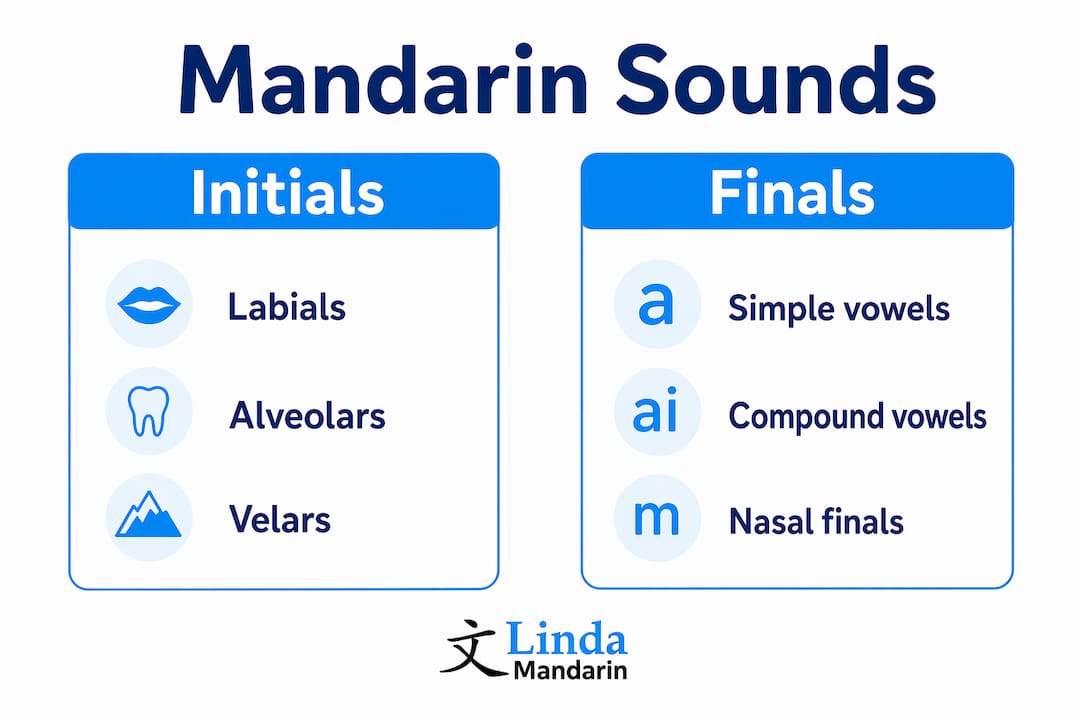
Mandarin initials cover six consonant groups: labials (b, p, m, f), alveolars (d, t, n, l), velars (g, k, h), palatals (j, q, x), retroflexes (zh, ch, sh, r), and sibilants (z, c, s). Each group uses a different part of the mouth. Palatals and retroflexes are the trickiest for English speakers because they have no direct English equivalent.
The 35 finals
Finals divide into three categories: simple vowels (a, o, e, i, u, ü), compound vowels (ai, ei, ao, ou, ia, ie, ua, uo, üe, iao, iou, uai, uei), and nasal finals (an, en, in, un, ün, ang, eng, ing, ong, ian, uan, üan, iang, uang, iong). The nasal finals ending in “ng” require the back of the tongue to rise and close off the throat, a position English speakers rarely use consciously.
Pro Tip: Print a Pinyin chart and cover the English hints. Force yourself to learn each sound from audio alone. This trains your ear before your mouth, which is the correct order.
| Category | Examples | Common challenge |
|---|---|---|
| Labial initials | b, p, m, f | Aspiration on “p” differs from English |
| Palatal initials | j, q, x | No English equivalent; tongue position is new |
| Retroflex initials | zh, ch, sh, r | Tongue curls back; unfamiliar for most learners |
| Compound finals | iao, uei, üan | Multiple vowels blend smoothly |
| Nasal finals | ang, eng, ong | Back-of-throat closure required |
How do the four Mandarin tones work and why are they critical?
The four tones are not optional decoration. They are part of the word itself. The syllable “ma” means four completely different things depending on which tone you use: mā (first tone, mother), má (second tone, hemp), mǎ (third tone, horse), and mà (fourth tone, to scold). A neutral fifth tone also exists for unstressed syllables. Mispronouncing tones changes meaning in ways that confuse or even offend native speakers.
Here is how each tone moves in pitch:
- First tone: High and flat. Hold a steady, high pitch from start to finish. Think of a musical note held constant.
- Second tone: Rising. Start mid-pitch and rise sharply, like asking a question in English (“What?”).
- Third tone: Dipping. Start mid, drop low, then rise slightly. In natural speech, the full dip only happens on isolated syllables.
- Fourth tone: Falling. Start high and drop sharply to low, like a firm command.
- Neutral tone: Short and light, with no fixed pitch. It follows the tone of the preceding syllable.
Tone sandhi is the rule that governs how tones change when they appear next to each other. The most important rule: two third tones in a row cause the first to shift to a second tone. So “nǐ hǎo” (hello) is actually spoken as “ní hǎo.” Even advanced learners miss this, and it is what separates fluent speakers from textbook readers.
“Tone recognition must come before tone production. Train your ear first, then your mouth will follow.” — Core principle at Linda Mandarin
Pro Tip: Record yourself saying all four tones of a single syllable, then compare your recording to a native audio model. The gap between what you think you sound like and what you actually sound like is where your real practice begins.
Common tone mistakes to avoid:
- Treating the third tone as a full dip-and-rise in every context. In connected speech, it usually just dips low.
- Ignoring tone sandhi and reading each syllable in isolation.
- Rushing through tones to sound fluent. Speed without accuracy creates confusion.
What common pronunciation traps do English speakers face?
Attempting to map English phonetics onto Pinyin causes long-term pronunciation problems. This is the core trap. English speakers see the letter “x” and say “ex.” They see “q” and say “kw.” Neither is correct.
The specific traps to watch for:
- The “buzzed i” sound: After retroflex initials (zh, ch, sh, r) and sibilants (z, c, s), the “i” is not a vowel. It is a syllabic consonant, a held buzzing sound made in the same position as the initial. “Zhi” does not rhyme with “see.” It sounds more like a sustained “jr” sound.
- Aspiration: In English, “p,” “t,” and “k” are aspirated at the start of words but not in the middle. In Mandarin, aspiration is a consistent, meaningful distinction. Hold a piece of paper in front of your mouth. “P” in Mandarin should blow the paper. “B” should not. This physical test works for “t/d” and “k/g” pairs too.
- Palatal sounds: “J,” “q,” and “x” require the tongue to press near the back of the upper teeth, not the roof of the mouth. English has no direct equivalent, so these require deliberate muscle training.
- Syllable timing: Mandarin is syllable-timed, meaning every syllable gets roughly equal time and clarity. English is stress-timed, meaning some syllables are long and others are swallowed. English speakers naturally reduce unstressed syllables. Mandarin does not allow this. Every syllable must be clear and complete.
Pro Tip: Practice minimal pairs: words that differ by only one sound or tone. For example, “bā” (eight) vs. “pā” (to lie flat). Drilling these pairs trains your ear and mouth to hear and produce the distinction reliably.
Correcting these habits takes focused repetition, not just more exposure. Passive listening alone will not fix a deeply ingrained English phonetic assumption. You need to isolate the problem sound, practice it in isolation, then reintegrate it into full syllables and words.
How can you practice and improve your Mandarin pronunciation?
Effective pronunciation practice follows a specific sequence. Skipping steps creates gaps that show up later as stubborn errors.
- Listen before you speak. Auditory input before speaking prevents fossilized errors. Spend the first week of any new sound category listening to native audio only. Do not attempt to produce the sound until you can recognize it reliably.
- Use an audio-enabled Pinyin chart. Interactive Pinyin charts with audio cover every syllable-tone combination. Click each cell, listen, repeat, and compare. This is the most efficient tool for systematic coverage.
- Drill initials and finals in isolation. Practice each initial with a neutral vowel before combining it with finals. Then practice finals alone. Only combine them once both feel natural.
- Record and compare. Record yourself producing a syllable, then play a native model immediately after. Your brain will hear the gap. This feedback loop accelerates correction faster than any other method.
- Practice daily in short sessions. Fifteen minutes of focused pronunciation work every day outperforms two hours once a week. Muscle memory builds through repetition over time, not through marathon sessions.
- Work with a qualified instructor. A certified native speaker can identify errors you cannot hear yourself. This is especially true for tones, where self-assessment is unreliable early on. Boosting your listening skills is a parallel skill that accelerates everything else.
| Practice method | Best for | Frequency |
|---|---|---|
| Audio Pinyin chart | Systematic sound coverage | Daily, early stage |
| Minimal pair drills | Aspiration and tone distinction | Daily, any stage |
| Self-recording | Identifying personal error patterns | 3–4 times per week |
| Instructor feedback | Correcting errors you cannot hear | Weekly |
| Native audio immersion | Natural rhythm and tone sandhi | Daily, ongoing |
The most common mistake at this stage is rushing to speak full sentences before individual sounds are stable. Sentences introduce too many variables at once. Isolate the problem, fix it, then scale up.
Key takeaways
Mandarin pronunciation requires mastering 21 initials, 35 finals, and four tones as a unified system, not as separate skills layered on top of English phonetics.
| Point | Details |
|---|---|
| Pinyin is not English | Treat Pinyin as an independent phonetic system to avoid long-term pronunciation errors. |
| Tones change meaning | All four tones plus tone sandhi rules must be learned early for clear communication. |
| Aspiration is physical | Test consonant aspiration with a piece of paper to build the correct muscle habit. |
| Listen before speaking | Develop tone recognition through auditory training before attempting to produce sounds. |
| Daily short practice wins | Fifteen minutes of focused daily drilling builds muscle memory faster than weekly sessions. |
Why pronunciation is a long game, not a quick fix
I have worked with adult Mandarin learners long enough to say this plainly: the learners who improve fastest are not the ones with the best ear at the start. They are the ones who accept that pronunciation is a physical skill, like learning a new sport, and they practice accordingly.
The frustration I see most often comes from learners who spend weeks on vocabulary and grammar, then wonder why native speakers struggle to understand them. The answer is almost always tones and aspiration. You can know every word in a sentence and still be incomprehensible if the tones are wrong. That is not a flaw in the language. It is how the language works.
What actually helps is developing what I call auditory sensitivity: the ability to hear the difference between your own output and a native model. Most learners skip this step. They practice speaking without listening critically. The gap between what they produce and what they intend to produce stays invisible until a native speaker looks confused.
The learners who make real progress spend more time listening than speaking in the early months. They use effective learning strategies that prioritize input before output. They record themselves constantly. They are not embarrassed by the gap. They use it as data.
Tone mastery is the turning point. Once your tones are reliable, your confidence in speaking changes completely. Conversations that felt like guesswork start to feel like actual communication. That shift is worth every awkward drilling session.
— Paul
Structured Mandarin training at Linda Mandarin
Pronunciation is best corrected early, and it is best corrected with a qualified instructor who can hear what you cannot.

Linda Mandarin has been training adult Mandarin learners in Singapore since 2003, with classes designed specifically for conversational and professional communication. The school’s certified native instructors provide direct feedback on tones, aspiration, and rhythm in every session. Courses run as group classes, private lessons, and online Zoom sessions, so your schedule does not have to change to fit your learning. The school is located at 10 Anson Road, Level 22, International Plaza, right above Tanjong Pagar MRT. View the full range of adult Mandarin courses or explore the dedicated Pinyin and pronunciation course to build your foundation correctly from the start.
FAQ
What is Pinyin and why does it matter for pronunciation?
Pinyin is the official romanization system for Mandarin Chinese, using Roman letters to represent Mandarin sounds. It is an independent phonetic system and does not follow English letter values, so learners must study it separately from English phonics.
How many tones does Mandarin have?
Mandarin has four main tones plus a neutral tone. Each tone assigns a distinct pitch contour to a syllable, and using the wrong tone changes the word’s meaning entirely.
What is tone sandhi in Mandarin?
Tone sandhi refers to tone changes that occur when certain tones appear next to each other in speech. The most common rule is that two consecutive third tones cause the first to shift to a second tone, as in “nǐ hǎo” spoken as “ní hǎo.”
Why do English speakers struggle with Mandarin consonants?
English speakers struggle because Mandarin uses aspiration as a meaningful distinction between consonants like “b” and “p,” and includes palatal and retroflex sounds with no English equivalent. These require deliberate physical practice, not just exposure.
How long does it take to get Mandarin pronunciation right?
With daily focused practice, most adult learners develop reliable tone recognition within 2–3 months and consistent production within 4–6 months. Working with a qualified instructor shortens that timeline significantly by catching errors early.