TL;DR:
- Mandarin cross-cultural communication blends language skills with cultural understanding to build trust. Mastery of tones, phrases, and norms like face preservation is essential for professional success. Consistent daily practice and genuine cultural curiosity accelerate learning and strengthen relationships.
Mandarin for cross-cultural communication is the ability to use Mandarin alongside cultural fluency to build trust, reduce misunderstandings, and strengthen professional relationships with Chinese colleagues and clients. This skill set goes beyond vocabulary. It combines linguistic accuracy with cultural literacy, specifically knowledge of concepts like mianzi (face), indirect speech, and relationship etiquette. Reaching conversational fluency typically takes 12–18 months of consistent daily study, while professional proficiency can demand up to 2,200 hours. Professionals who commit to both the language and the culture gain a measurable edge in negotiations, team dynamics, and client relationships.
What are the key Mandarin language skills for cross-cultural communication?
Mandarin’s phonetic system, called Pinyin, is the entry point for every adult learner. Pinyin maps Chinese sounds to the Roman alphabet, giving you a reliable pronunciation guide before you tackle characters. The four tones are not optional extras. They are the difference between saying “mother” (mā) and “horse” (mǎ), and getting them wrong creates real confusion in professional settings.

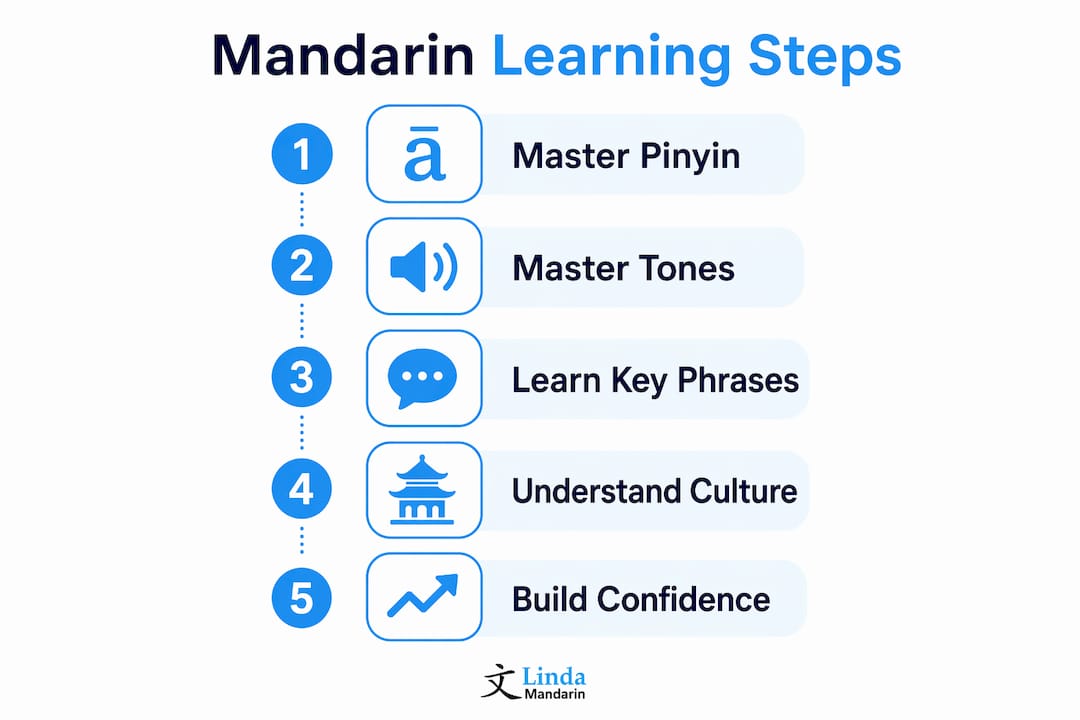
Focusing the first 1–2 weeks exclusively on Pinyin and the four tones builds a phonetic foundation that prevents costly mistakes later. Skipping this step is the most common error adult learners make. Tonal errors that form early tend to stick, and incorrect tonal habits typically solidify after three months, making them significantly harder to correct.
Beyond pronunciation, vocabulary acquisition works best through phrases and sentence patterns rather than isolated characters. Prioritizing phrases over characters builds pragmatic communication faster. You learn how words function in real conversations, not just how they look on a page.
Key foundational skills to develop early:
- Pinyin mastery: Learn the phonetic system in the first two weeks before moving to characters.
- Tone accuracy: Practice all four tones daily. Treat each tone as part of the word itself, not a separate layer.
- Phrase-based vocabulary: Learn greetings, polite expressions, and common business phrases as complete units.
- Listening practice: Expose yourself to native speech early to train your ear for tonal patterns.
- Sentence structure: Mandarin follows a subject-verb-object order similar to English, which makes basic sentence building accessible.
Pro Tip: Treat tones as relative pitch differences within your own vocal range. You do not need to match a native speaker’s exact pitch. Focus on the relative pitch pattern for each tone, and your accuracy will improve faster.
How does understanding Chinese cultural norms enhance Mandarin communication?
Cultural literacy is not a bonus skill for Mandarin learners. It is a core requirement. Successful business communication in Mandarin requires knowledge of mianzi (face) and indirect refusal patterns to build trust in professional negotiations. Without this knowledge, even grammatically correct Mandarin can damage relationships.
Mianzi refers to a person’s social reputation and dignity. Causing someone to lose face in front of colleagues, even unintentionally, can permanently harm a professional relationship. Preserving face means framing criticism privately, avoiding direct confrontation, and acknowledging seniority in group settings.
Indirect communication is equally important. When a Chinese colleague says “I’ll think about it” or “this might be difficult,” these phrases often signal a polite refusal. Interpreting indirect speech cues accurately is more valuable than native-level fluency in early professional interactions. Misreading a polite “no” as genuine consideration leads to wasted time and strained relationships.
“Fluency requires both linguistic skill and deep cultural understanding to accurately translate intent and maintain communication integrity.” This principle applies directly to every professional who works across Chinese cultural contexts.
Practical cultural norms to know:
- Greetings: Address people by their title and surname first. Using first names too early signals disrespect.
- Business card exchange: Receive cards with both hands and read them carefully before setting them down. Never write on a card or stuff it in a pocket.
- Silence: Silence in a meeting is not awkward. It signals thought and respect. Do not rush to fill it.
- Nonverbal cues: Avoid strong eye contact with senior figures. Nodding signals listening, not agreement.
- Hierarchy: Acknowledge seniority in seating, speaking order, and decision-making discussions.
Learning culture alongside language reduces the risk of communication failures and helps professionals interpret indirect messages accurately. The two skills reinforce each other.
Which Mandarin phrases are vital for professional cross-cultural interactions?
Practical phrases build rapport faster than perfect grammar. A Chinese colleague who hears you attempt a genuine greeting in Mandarin responds differently than one who receives English only. The gesture signals respect and cultural awareness, which directly influences how the relationship develops.
Start with these core expressions for professional settings:
- Nǐ hǎo (你好): Standard greeting, appropriate in most professional contexts.
- Nǐ hǎo ma? (你好吗?): “How are you?” Use with colleagues you know.
- Xièxiè (谢谢): “Thank you.” Use it often. Gratitude is always well received.
- Bù hǎo yìsi (不好意思): “Excuse me” or “I’m sorry to trouble you.” This phrase shows humility and politeness in requests.
- Qǐng wèn (请问): “May I ask?” A polite opener before any question in a meeting.
- Wǒ míngbái (我明白): “I understand.” Signals active listening during discussions.
- Zhè ge zěnme shuō? (这个怎么说?): “How do you say this?” Shows willingness to learn and earns goodwill.
For handling disagreement or refusal, indirect framing works best. Instead of “no,” use “Zhè ge kěnéng yǒu diǎn nán” (This might be a bit difficult). This preserves face for both parties and keeps the conversation open.
Pro Tip: Focus your first month on phrases that build rapport, not perfect grammar. A warm, culturally aware greeting in Mandarin opens more doors than a grammatically flawless sentence delivered without cultural context. Check out cross-cultural Mandarin phrases used in business settings to build your phrase bank.
Mandarin proficiency signals cultural openness that directly influences collaboration success in global business. Even basic phrases communicate that you have invested effort in understanding the other person’s world.
What are effective methods to learn Mandarin for professional proficiency?
The most effective learning method for busy professionals is short, daily practice rather than long, infrequent sessions. Daily 20-minute sessions produce better cognitive retention of tonal patterns and vocabulary than weekend-only study marathons. Consistency is the single biggest predictor of progress.
A structured approach for professionals:
- Weeks 1–2: Tones and Pinyin only. Do not move to vocabulary or phrases until you can produce all four tones reliably. This investment pays off for the entire learning journey.
- Weeks 3–8: Core phrase acquisition. Learn 5–10 phrases per week focused on greetings, meeting language, and polite expressions. Use audio resources to hear native pronunciation.
- Months 3–6: Listening and speaking practice. Join a structured class or online course that forces you to speak early. Mistakes at this stage are normal and necessary.
- Months 6–12: Cultural and contextual learning. Add cultural training alongside language practice. Learn how business conversations flow, how decisions get made, and how hierarchy shapes communication.
- Ongoing: Integrate Mandarin into your daily routine. Label objects at your desk, listen to Mandarin podcasts during your commute, and practice phrases before meetings with Chinese counterparts.
Technology supports each stage. Flashcard apps build vocabulary through spaced repetition. Audio courses train your ear. Online Zoom classes with certified instructors give you real-time feedback that apps cannot provide. The most effective Mandarin learning methods combine listening, speaking, reading, and cultural training rather than focusing on one skill alone.
Pro Tip: Speak from day one, even badly. Professionals who wait until they feel “ready” to speak Mandarin delay their progress by months. Embrace early mistakes as data, not failure. Your Chinese colleagues will respect the effort far more than the accuracy.
Developing a consistent learning habit is the structural challenge most adult learners underestimate. Building Mandarin practice into an existing routine, such as morning coffee or a lunch break, removes the decision fatigue that kills consistency.
Key Takeaways
Mandarin for cross-cultural communication requires combining tonal accuracy, phrase-based vocabulary, and cultural literacy to build trust and effectiveness in Chinese professional environments.
| Point | Details |
|---|---|
| Tones come first | Master Pinyin and all four tones in the first two weeks to avoid habits that are hard to reverse. |
| Cultural literacy is non-negotiable | Understanding mianzi and indirect speech patterns matters as much as grammar in professional settings. |
| Phrases beat isolated words | Learn Mandarin in sentence patterns and contextual phrases to communicate pragmatically from the start. |
| Daily practice wins | Twenty minutes of daily study produces better retention than long, infrequent sessions. |
| Cultural signals build trust | Even basic Mandarin greetings signal respect and openness, directly improving professional relationships. |
Why cultural humility is the real skill most Mandarin learners overlook
Most professionals who decide to learn Mandarin focus entirely on the language mechanics. They download apps, memorize vocabulary lists, and track their tone accuracy. That focus is necessary but not sufficient. The professionals I have seen make the fastest progress in Chinese business environments are not the ones with the largest vocabulary. They are the ones who approach every interaction with genuine curiosity about the other person’s cultural frame.
Cultural humility means accepting that you will misread situations, that silence means something different than you expect, and that a “yes” in a meeting may not mean agreement. It means asking questions rather than assuming. It means noticing when a colleague seems uncomfortable and adjusting your approach rather than pushing forward.
The small language gestures matter enormously. Attempting a greeting in Mandarin, using the correct title, or pausing respectfully before responding signals that you see the other person as a full cultural actor, not just a business contact. That signal builds trust faster than any formal negotiation tactic.
My honest advice: start your cultural training on day one, not after you reach conversational fluency. The two skills build on each other. Language gives you the words; culture gives you the meaning. Without both, you are only half communicating.
— Paul
Linda Mandarin’s adult courses for cross-cultural communication success
Linda Mandarin has been training adult professionals in Singapore since 2003, with courses designed specifically for conversational and business Mandarin use. The school’s programs cover speaking, listening, reading, and cultural competence in a structured format aligned with international language standards.

Whether you prefer flexible online Zoom classes or in-person sessions at the school’s location above Tanjong Pagar MRT, Linda Mandarin offers group, private, and corporate Mandarin training options to fit your schedule. Certified native instructors fluent in English guide every lesson, making the learning experience practical and directly applicable to your workplace. View the full range of adult Mandarin course levels to find the right starting point for your professional goals.
FAQ
How long does it take to learn Mandarin for business use?
Conversational fluency typically takes 12–18 months of consistent daily study, while professional proficiency can require up to 2,200 hours. Daily practice of 20–60 minutes accelerates progress significantly compared to infrequent study.
What is mianzi and why does it matter in Mandarin communication?
Mianzi refers to a person’s social reputation and dignity in Chinese culture. Protecting face in professional interactions builds trust and prevents relationship damage that can be difficult to repair.
Should I learn Mandarin characters or focus on speaking first?
Focus on speaking and Pinyin first, especially in the first 1–2 months. Phrase-based learning builds practical communication skills faster than character memorization for professionals with workplace goals.
How do I handle indirect communication in Chinese business settings?
Treat ambiguous affirmations like “I’ll think about it” as likely polite refusals. Interpreting indirect cues accurately is more important than grammar perfection in early professional interactions.
Can online Mandarin classes work for busy professionals?
Online Zoom classes with certified instructors provide real-time feedback and flexible scheduling that suits professional routines. Linda Mandarin offers online options specifically designed for adult learners balancing work and study.