An effective adult Mandarin course syllabus is task-based, covers all four skills plus pronunciation, and maps outcomes to clear level bands rather than vague progress claims. Most run in 10-week modules delivering roughly 20 to 40 contact hours, mixing formative checks with a final performance test. This guide walks through a sample 10-week module, explains how assessments should work, and shows where to find course options built around this structure.
TL;DR:
- Most adult Mandarin courses are 10-week modules offering 20 to 40 hours of task-based, skills-integrated instruction focused on real-world use.
- Course outcomes are aligned with level bands like beginner, intermediate, and advanced, emphasizing practical tasks such as self-introductions or work presentations rather than vocabulary counts.
- Frequent formative assessments and two major evaluations per module ensure learners demonstrate their ability to communicate in interpretive, interpersonal, and presentational modes.
- Blended learning combining in-person practice with online review and immersion activities effectively supports busy adult learners.
- Placement testing involves a short conversation and character recognition task to match learners to appropriate levels, avoiding misclassification based on self-assessment.
Table of Contents
- What Should an Adult Mandarin Course Syllabus Cover?
- A Sample 10-Week Module You Can Copy
- How Should Skills and Assessments Be Structured?
- Teaching Methods and Resources That Actually Work
- Realistic Pacing for Busy Adult Learners
- How Does Placement Testing Work Before You Start?
- What Grammar and Vocabulary Should Each Level Cover?
- How Do You Keep Adult Learners Motivated?
- How Do You Get Real Speaking Practice With Native Speakers?
- How Should Learner Goals Shape the Syllabus?
- Why Task-Based Syllabi Beat Vocabulary Lists
- Where Linda Mandarin Fits Into This Syllabus
- Sources
- FAQ
What Should an Adult Mandarin Course Syllabus Cover?
A syllabus worth following ties every unit to something you can actually do, not just words you can recognize. Introduce yourself at a networking event. Handle a delivery mix-up in Mandarin. Give a two-minute update at a team meeting. That’s the difference between a vocabulary list and a real Mandarin course outline.
Level bands matter more than most learners realize, because they set expectations for what a given stretch of study should produce.
- Beginner/elementary (survival level): Learners can exchange personal information, describe a daily routine, and get through basic transactions. A typical module runs 10 weeks and about 20 hours, with outcomes tied directly to survival tasks rather than character counts.
- Intermediate: Learners handle workplace small talk, give simple verbal reports, and manage routine services like banking or scheduling. Modules here often run 10 weeks and deliver about 30 hours, with tasks resembling what a B1-level speaker should manage.
- Upper-intermediate/advanced: Focus shifts to professional communication, structured presentations, and denser reading material. Standard modules stay at 10 weeks, but intensive formats push contact hours well beyond that, sometimes into the 150 to 180 hour range across a full intensive Putonghua sequence for advanced learners.
The HSK 3.0 framework offers a useful external benchmark here. It organizes each level by topic, task, and grammar point rather than pure vocabulary volume, which gives adult learners a way to check whether their course outcomes actually line up with a recognized standard. Culture and business etiquette shouldn’t sit outside the syllabus as an afterthought either. Knowing how to hand over a business card, when to use formal versus casual pronouns, or how to soften a disagreement in a meeting is as much a syllabus outcome as any grammar point.
A Sample 10-Week Module You Can Copy
Interactive, task-based modules typically run 10 weeks and deliver 20 to 40 hours of formal instruction per module, which gives enough runway to build a task, practice it, and test it before moving on. Here’s what that looks like in practice for a conversational or business-track adult class.
- Weeks 1 to 2: Pinyin and tone mastery, survival phrases, and self-introductions, reinforced through short role-plays.
- Weeks 3 to 4: Daily routines, giving directions, and basic transactions, with listening comprehension drills layered in.
- Weeks 5 to 6: Workplace conversations or business greetings, including email phrasing and short spoken presentations.
- Weeks 7 to 8: Problem-solving role-plays (a customer complaint, a scheduling conflict) paired with intermediate grammar patterns like comparative structures.
- Week 9: An integrated task, such as presenting a short workplace scenario, followed by instructor feedback.
- Week 10: A summative check combining a presentational speaking task with a short written piece, plus a diagnostic pointing toward the next level.
Each session inside that arc tends to follow a similar shape: a 5 to 10 minute warm-up, 30 to 40 minutes of task practice, 10 to 15 minutes of focused grammar, and a final 10 minutes briefing the next assignment. This structure mirrors the pattern seen in comprehensive Mandarin I course design, where unit topics build directly on daily-life content and cultural material rather than isolated grammar drills.
How Should Skills and Assessments Be Structured?
Assessment in an adult Chinese language syllabus works best when it mirrors real communication, not a written quiz disconnected from actual conversation. Three modes cover this well:
- Interpretive: Listening to a voicemail or reading a short WeChat message and answering comprehension questions.
- Interpersonal: A live, unscripted exchange, like negotiating a meeting time with a partner.
- Presentational: A prepared piece, whether a short talk or a written email, delivered without back-and-forth.
Frequent formative checks (mini role-plays, short recordings, weekly quizzes) catch problems early, and two summative checks per module, one at the midpoint and one at the end, confirm whether the task-based outcomes actually landed. A reasonable mastery target for an intermediate module might be a three-minute unscripted workplace introduction or a short, coherent email written without a dictionary.
Statistic callout: University-based intensive programs often build in 20 to 30 formative assessments across a single semester, which shows how much of the grading weight in a serious program sits in small, frequent checks rather than one big final exam. If you’re comparing programs, our guide to assessing Mandarin proficiency breaks down how to read those checkpoints.
Teaching Methods and Resources That Actually Work
Task-based classroom activities beat passive drilling for adults almost every time. Structured role-plays, workplace simulations, short presentations, and built-in culture discussions keep the material tied to something usable. Spiral sequencing matters too: a grammar point introduced in week 3 should reappear in week 7 inside a harder task, not vanish after a single quiz. Pronunciation deserves early, heavy investment, since intelligibility gains in the first few weeks translate directly into confidence later on.
Blended delivery tends to work well for busy adults. In-person sessions handle the interactive, high-stakes practice, like role-plays and presentations, while Zoom sessions cover drilling, review, and flexible scheduling around work commitments. Outside class, a syllabus should point learners toward a dedicated pronunciation module, graded readers, audio podcasts, spaced repetition tools for character retention, and a phrasebook geared toward business situations rather than tourist basics.
Pro Tip: Treat the first two weeks of pronunciation work as non-negotiable, even if it feels slow. Adults who skip ahead to vocabulary before locking in tones spend months unlearning bad habits later.
Certain language schools have run adult Mandarin programs since 2003, with syllabi aligned to international standards and instruction delivered by native Mandarin instructors fluent in English. Classes often run from central locations with group, private, and online formats available for adults balancing work and study.
Realistic Pacing for Busy Adult Learners
A single 10-week module usually asks for class contact hours plus another 3 to 6 hours of independent practice per week, front-loaded toward pronunciation and daily speaking drills rather than passive review.
- One module completed: Survival-level tasks (introductions, basic transactions, simple directions).
- Three modules completed: Everyday workplace competence, including small talk, routine service interactions, and short reports, though individual pace varies with prior exposure and practice consistency.
- Acceleration tactics: Short daily immersion windows (a podcast during a commute), micro-learning habits (10 minutes of character review before bed), and dedicated speaking practice rather than passive listening alone.
How Does Placement Testing Work Before You Start?
Most structured adult programs start with a short spoken and written diagnostic rather than a generic multiple-choice test. A placement conversation might ask you to introduce yourself, describe your job, and answer a few unscripted follow-up questions, while a written component checks character recognition and basic sentence construction. This matters because dropping a false beginner into a survival-level class wastes both time and money, and pushing an intermediate speaker with shaky tones into an advanced class just buries a fixable pronunciation problem under harder material.
A good placement process also separates speaking ability from reading and writing ability, since adults with prior exposure (heritage speakers, past classroom study, or years of casual listening) often show lopsided skills across the four areas. Someone might speak comfortably but read almost nothing, or vice versa. The diagnostic should flag that gap explicitly rather than averaging it into one score. Expect the process to take somewhere between 15 and 30 minutes, sometimes over a call for online applicants, with an instructor making a judgment call rather than relying purely on a written score. If a program skips this step entirely and lets you self-select a level, treat that as a signal the syllabus behind it might be less rigorous than it looks on paper.
What Grammar and Vocabulary Should Each Level Cover?
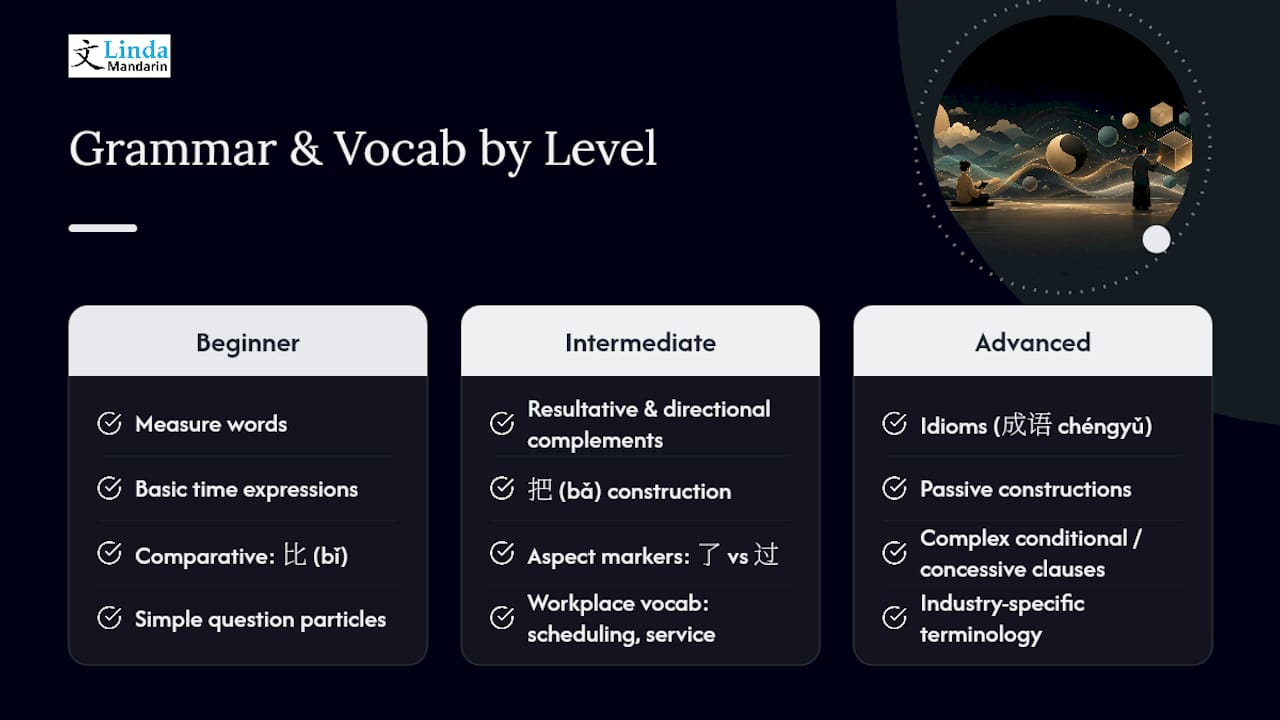
Grammar scope should track tightly with the level band, not float independently of it. At the beginner stage, expect measure words, basic time expressions, the comparative structure with 比 (bǐ), and simple question particles. Vocabulary stays anchored to survival domains: numbers, family terms, food, transport, and basic workplace nouns, typically landing somewhere in the 150 to 300 word range across a module.
Intermediate grammar adds resultative and directional complements, the 把 (bǎ) construction for object handling, and more nuanced aspect markers like 了 (le) versus 过 (guò). Vocabulary expands into workplace-specific domains: scheduling language, service industry terms, and the polite register needed for client-facing conversations. This is also where business etiquette vocabulary, like appropriate greetings and hierarchy-aware phrasing, should get explicit attention rather than incidental mention.
Advanced syllabi shift toward idiomatic expressions (成语 chéngyǔ), passive constructions, and complex conditional and concessive clauses used in negotiation or persuasive speech. Vocabulary at this stage moves into abstract and professional territory: industry-specific terminology, nuanced emotional or opinion language, and the kind of formal register needed for presentations or written reports. A syllabus that never states these targets explicitly, leaving grammar and vocabulary scope vague between levels, makes it nearly impossible to judge whether a course is actually progressing you or just repeating easy material at a slower pace.
How Do You Keep Adult Learners Motivated?
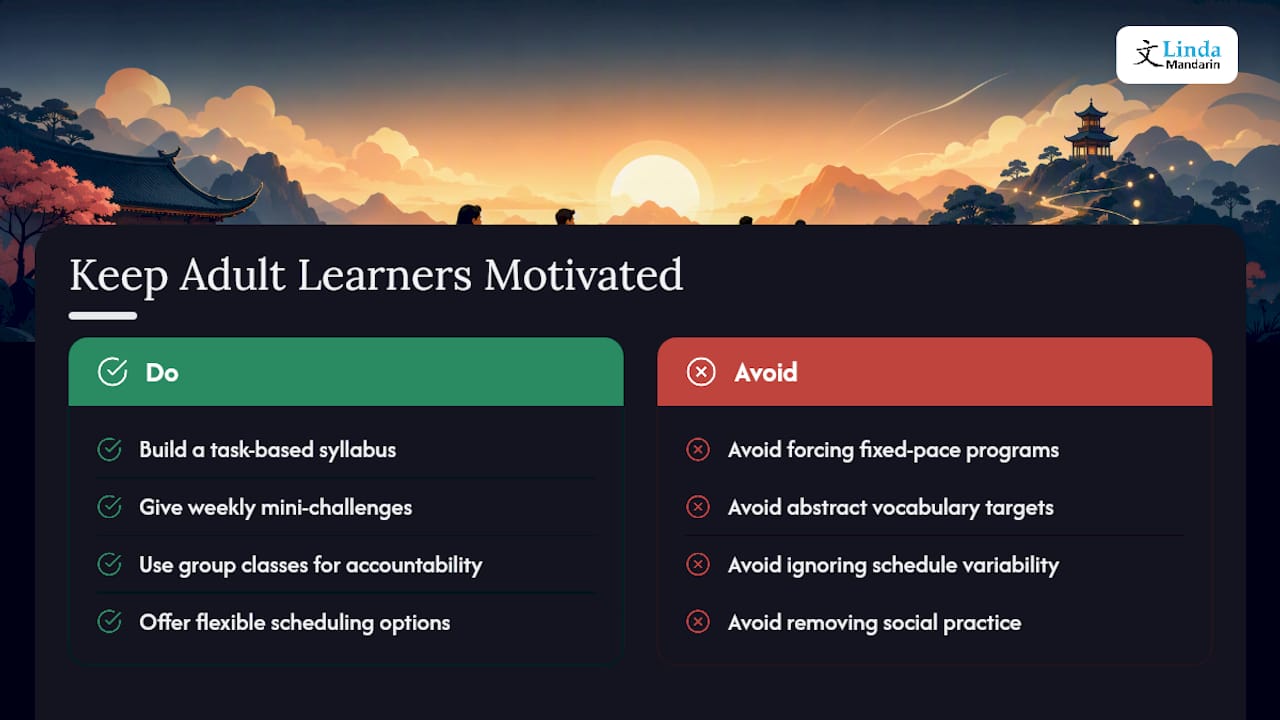
Adult learners drop out for predictable reasons: work travel disrupts a fixed schedule, early progress feels slow, or the material never connects to anything they actually need. A syllabus built around real tasks, rather than abstract vocabulary targets, sidesteps a good chunk of that problem simply by making progress visible. Finishing a module by successfully ordering a business dinner in Mandarin feels like an achievement in a way that memorizing 200 flashcards never does.
Spacing out small wins matters as much as the big module-end test. Weekly mini-challenges, like recording a 60-second self-introduction and comparing it to the recording from three weeks earlier, give learners concrete proof that the effort is compounding. Group classes add a social incentive too. Showing up matters more when classmates are expecting you, and a bit of friendly competition during role-plays pushes speaking practice further than solo study usually manages.
Flexible scheduling removes one of the biggest, and most avoidable, causes of adult dropout. A class selection guide built around working adults’ schedules helps match course intensity to actual availability, rather than forcing a fixed-pace program onto an unpredictable calendar. Retention also improves when a learner understands why a given unit exists. A syllabus that states the goal upfront, “by the end of this unit, you’ll handle a supplier call independently,” gives adults a reason to push through the slower grammar-heavy sessions instead of losing motivation halfway through.
How Do You Get Real Speaking Practice With Native Speakers?
Classroom role-plays only go so far. A syllabus that stops at instructor-led drills misses the unpredictability of a genuine conversation, where a native speaker might use slang, speak faster than expected, or answer in a way that doesn’t match the textbook script. Building real exposure into the course design solves this in a few practical ways.
Rotating conversation partners within group classes forces learners to adjust to different speaking speeds and accents rather than getting used to one instructor’s careful pacing. Recorded exchanges, where a learner records a short dialogue and an instructor gives targeted pronunciation feedback, catch tone errors that live conversation moves past too quickly to correct. Structured “problem” scenarios, like a mock customer service call or a negotiation over a delayed shipment, push learners to react in real time instead of reciting memorized lines.
Outside the classroom, low-stakes immersion helps close the gap between textbook Mandarin and how people actually talk. Watching a short segment of Mandarin news or a drama clip with subtitles, then trying to summarize it out loud, builds listening stamina that classroom drills alone rarely reach. Language exchange meetups or online conversation partners add another layer, though a syllabus should frame these as supplements to structured instruction, not replacements for it, since unguided practice tends to reinforce existing mistakes as often as it fixes them. Instructors fluent in English but native in Mandarin bridge this gap well, catching errors immediately while still explaining the fix in a way learners understand the first time.
How Should Learner Goals Shape the Syllabus?
A syllabus built for a traveler heading to Taipei for two weeks looks nothing like one built for a finance professional preparing for client calls in Shanghai, even if both learners start at the same proficiency level. Travel-focused learners need heavy emphasis on transactional language: ordering food, asking directions, negotiating prices at a market, and handling transportation. Grammar depth matters less here than sheer phrase fluency and listening comprehension under real-world noise and speed.
Business-focused learners need the opposite balance. Grammar precision, professional register, and written communication (emails, short reports) carry more weight than tourist phrases ever will. A syllabus serving this group should integrate business communication scenarios directly into the module structure rather than treating them as an optional add-on unit near the end of the course.
Academic learners, meanwhile, often need stronger reading and writing foundations earlier than conversational learners do, since coursework or research demands sustained engagement with written Chinese rather than just spoken fluency. A well-designed adult Chinese language syllabus asks about the learner’s actual goal before the first class starts, then weights the four skills and vocabulary domains accordingly. A one-size-fits-all module that spends equal time on all three goal types usually shortchanges everyone a little, rather than serving any one group well.
Why Task-Based Syllabi Beat Vocabulary Lists
Vocabulary lists feel productive because they’re easy to measure, but measuring words learned tells you almost nothing about whether someone can actually function in Mandarin. A learner who can recite 500 flashcards but freezes when a colleague asks a real question hasn’t gained much. Task-based design forces a different kind of accountability: can you do the thing, not just recognize the word.
The flexibility argument gets underrated too. Adults juggling work and family don’t fail language courses because the material is too hard. They fail because the format doesn’t fit their week. Pairing a rigorous task-based syllabus with genuinely flexible delivery, and instructors who are both native speakers and fluent explainers in English, solves more retention problems than any clever curriculum trick.
— Paul
Where Linda Mandarin Fits Into This Syllabus
Linda Mandarin puts this exact structure into practice for adults in Singapore, rather than leaving it as theory. The school has run conversational and business-focused Mandarin programs since 2003, with a syllabus aligned to international HSK standards and taught by native Mandarin instructors who are fluent in English. Classes run in group, private, or online Zoom formats from the school’s location at 10 Anson Road, Level 22, International Plaza, Singapore 079903, right above Tanjong Pagar MRT.

If you’ve read this far because you’re comparing what a real course outline should look like against what’s actually on offer, the adult course level page breaks down how each stage, from beginner survival Mandarin through business-track advanced modules, maps to the kind of task-based outcomes covered above. Professionals managing team-wide language needs can look at corporate Mandarin training for group-based options built around workplace scenarios rather than generic classroom content. Whichever format fits your schedule, the next step is simple: check which course level matches your current ability and book a spot before the next 10-week module starts.
Sources
A few sources shaped the structure above and are worth a direct look if you want to dig deeper into any one piece.
- Chinese Mandarin Course 3022 (Confucius Institute/Sydney University) course outline
- Mandarin I Comprehensive course syllabus (IMSA)
- HSK 3.0 syllabus: topics, tasks, and grammar by level (HSKStory)
- Putonghua programme outlines and intensive course descriptions (CUHK / YCCLA)
FAQ
How Long Does a Typical Mandarin Course Module Last?
Most adult modules run 10 weeks, delivering 20 to 40 hours of instruction depending on whether the format is standard-paced or intensive.
What Should a Beginner Mandarin Curriculum Include?
A beginner module should cover pronunciation and Pinyin, basic tones, survival phrases, and self-introductions, with outcomes tied to real tasks like handling a simple transaction rather than a fixed vocabulary count.
How Are Adult Mandarin Students Assessed?
Programs typically combine frequent formative checks, like short recordings or mini role-plays, with two summative assessments per module covering interpretive, interpersonal, and presentational tasks.
Can I Learn Business Mandarin Through Online Zoom Classes?
Yes. Blended delivery using Zoom for drills and review alongside in-person sessions for role-plays and presentations works well for working adults, and some providers offer this format for business-focused adult programs.
How Do I Know Which Mandarin Level to Start At?
A short placement conversation covering basic speaking, listening, and reading tasks is the standard way to determine starting level, since self-assessment often misjudges lopsided skills like strong speaking paired with weak reading.