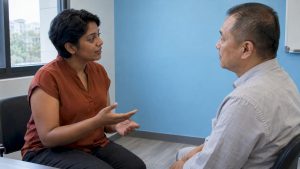
Medical Chinese training teaches you the Mandarin you need to talk with patients: asking about symptoms, explaining a plan, and showing care in a way an older patient understands. It is a language skill, not a Chinese medicine qualification. The most reliable route is a solid conversational base first, then healthcare vocabulary and role-play on top, with a teacher who corrects your tones as you practise. At Linda Mandarin, our conversational and private classes in Singapore are built for exactly that base.
TL;DR
- Medical Chinese is about communicating with Mandarin-speaking patients. It is not the same as studying traditional Chinese medicine, which is a regulated profession in Singapore.
- Courses that work combine clinical vocabulary with role-play and supervised practice, not word lists alone.
- Build everyday conversational Mandarin first, then layer on body parts, symptoms and history-taking phrases.
- Private lessons suit a shift schedule and a specific clinical setting. Group and online Zoom classes suit steady, structured progress.
- Hospitals and clinics can arrange corporate training so a whole team learns together.
Table of Contents
- What medical Chinese training actually teaches
- Who needs healthcare Mandarin in Singapore
- What level of Mandarin should you have first?
- How to study medical Chinese step by step
- How long does it take?
- Choosing the right course format
- What to look for when choosing a course
- A sample first month for a nurse or clinic staff member
- Our approach to healthcare Mandarin
- Start with the course that fits your starting point
- FAQ
- Sources
What medical Chinese training actually teaches
The phrase gets mixed up with two other things, so it helps to separate them.
Medical Chinese (healthcare Mandarin) is language learning for people who work in or around healthcare: nurses, doctors, allied health staff, pharmacists, patient service staff and medical students. The goal is safe, clear conversation with patients and families.
Traditional Chinese medicine (TCM) is a clinical discipline. Singapore’s regulations define it as acupuncture, TCM-based diagnosis and treatment, prescribing herbal medicine and regulating the body’s functional states. Becoming a registered TCM physician also requires a recognised TCM qualification, any qualifying examination the Board sets, and fitness and propriety under those same regulations. That is a professional pathway in its own right, and it is separate from learning to speak Mandarin at work.
So if you searched this phrase hoping to study acupuncture or herbal prescribing, you are looking at a TCM programme. If you want to speak with patients in Mandarin, you are in the right place.

The typical content
A useful medical Mandarin syllabus covers the moments that happen in every consultation:
- Greeting the patient and confirming their name and what brought them in.
- Asking about pain: where, how long, how strong, what makes it better or worse.
- Body parts and organ systems.
- Medical history: past illnesses, allergies, current medicines, family history.
- Explaining a simple examination (“please take a deep breath”, “does it hurt here?”).
- Giving instructions: how to take medication, when to return, what to watch for.
- Reassurance and courtesy phrases, which matter as much as vocabulary.
The published research gives a concrete picture. A peer-reviewed US programme, Medicine in Mandarin, ran 32 hours over 16 weeks, two hours a week, and aimed at medical histories, general physical examinations, health counselling and culturally informed care. Singapore examples look similar. A Singapore Medical Association account describes medical students taking short Chinese and Malay classes covering basic conversation and commonly used clinical vocabulary. Another Singapore professional body says its language programmes introduce medical terminology alongside the culture and history behind a language, with the aim of basic conversation for talking to patients in their own language.
Notice the pattern: short, focused, practical. Nobody is expected to become a literary scholar. The target is a working conversation.
Who needs healthcare Mandarin in Singapore
Singapore is multilingual, and many older patients are most comfortable in Mandarin or a dialect. The Ministry of Health has stated that effective communication between staff and patients matters for patient safety, and that public healthcare institutions use language courses and local assimilation programmes to improve it. In the same reply, MOH noted that more than 2,000 foreign nurses benefited from a training-fund scheme for language courses between 2009 and 2013.
The need shows up at every level of training too. Singapore’s Lee Kong Chian School of Medicine includes medical language and dialect skills, Mandarin, Malay and Hokkien as appropriate, within its clinical communication training. A 2025 Lianhe Zaobao report described foreign nurses learning Mandarin and Malay so they could understand patients and speak with older patients.
In practice, these learners tend to fall into a few groups:
- Foreign-trained nurses and allied health staff who are new to Singapore and want patients to feel understood.
- Doctors and medical students who see Mandarin-speaking patients in clinics and wards.
- Hospital and clinic administrators, pharmacists and front-desk staff who handle appointments, payments and medication questions.
- Expatriate professionals in healthcare companies, such as medical device and pharmaceutical teams, who work with Chinese-speaking clients and colleagues.
- Adults who care for an elderly parent or in-law and want to follow a consultation.
If you are in one of these groups, you do not need to be advanced. You need to be able to hold a simple exchange accurately.
What level of Mandarin should you have first?
Start with this honest check: can you introduce yourself, ask a simple question, and understand a short answer in Mandarin? If not, begin with general conversational Mandarin. Clinical phrases are built from the same raw material: tones, basic sentence patterns, numbers, time words and question forms. If those are shaky, a memorised symptom phrase will fall apart the moment the patient answers differently from the script.
Here is why that matters. Mandarin is tonal, so the same syllable can mean different things depending on pitch. In a clinical setting, mispronouncing a word may be merely awkward in a social setting but unhelpful when you are asking where it hurts or how often a medicine is taken. A tutor who listens to you and corrects tone in real time is worth a lot at this stage.
A practical level guide
| Your starting point | What to do first | Then add |
|---|---|---|
| Complete beginner | Beginner group class or private lessons for tones, greetings, numbers | Body parts, simple symptom questions |
| Can handle daily small talk | Conversational course to widen sentence patterns | Symptom, history and instruction vocabulary |
| Comfortable in conversation | Targeted private lessons on clinical scenarios | Role-play with realistic patient situations |
| Team of mixed levels | Corporate training tailored to your workplace | Shared scripts for common patient interactions |
How to study medical Chinese step by step
The research on structured medical Mandarin programmes points to a method that works for busy professionals. The Medicine in Mandarin curriculum taught organ-system vocabulary through lectures, group discussion, role-play, games and peer presentations, and reinforced terms with Chinese characters, pinyin and audio. It also had learners practise authentic history-taking with Mandarin-speaking community volunteers under instructor supervision.
Here is that approach as a routine you can follow.
Step 1: Fix your tones and basic sentences
Spend the first weeks on pronunciation, numbers, time, and the question patterns you will use constantly (“Where?”, “How long?”, “Do you have…?”). This step is where most self-taught learners go wrong, because an app cannot tell you that your tone changed the meaning. In our classes, our native Mandarin instructors, who are fluent in English, teach through interactive, communication-focused lessons, so you are corrected while you speak.
Step 2: Build vocabulary by body system
Learn terms in groups rather than alphabetically: head and neck, chest and breathing, stomach and digestion, bones and joints, skin. Say each word aloud with its pinyin. Add the Chinese characters over time if you want to read forms and medicine labels; for spoken patient care, pinyin and audio carry you a long way.
Step 3: Learn the history-taking script
Build one short sequence you can run from memory: name, main complaint, when it started, how severe, what helps, allergies, current medicines. Practise it until the sentences come out evenly, then practise the patient’s likely answers, because listening is the harder half.
Step 4: Role-play real situations
This is the step that turns vocabulary into skill. Act out an outpatient visit, a ward round, a pharmacy counter, a discharge. Swap roles so you hear the patient’s side. Private lessons are strongest here, because the tutor can build scenarios around your actual department.
Step 5: Add cultural and courtesy language
Patients, especially older ones, respond to respectful forms of address and a calm tone. Learning how to soften a question or reassure someone is part of the course, not an extra. Our Chinese culture training is offered alongside our corporate programmes for teams that want this dimension.
Step 6: Practise with real Mandarin speakers
Once you are confident, use your new phrases with Mandarin-speaking colleagues, friends or family, and ask them to tell you what sounded natural. Short, regular sessions beat one long weekend cram.
How long does it take?
There is no single number, because it depends on three things: your starting level, how many hours you can protect each week, and whether you practise out loud. The Medicine in Mandarin curriculum gives one reference point for a focused clinical course: 32 hours of instruction for a targeted set of skills. That is for learners aiming at defined clinical tasks, not general fluency.
For a working professional, a realistic plan looks like this:
- Beginners build the conversational base first. Expect this to take months of weekly classes before clinical phrases feel natural.
- Learners with some Mandarin can move to clinical scenarios sooner, because the base is already there.
- Everyone progresses faster with a regular weekly rhythm than with irregular intensive bursts, and by speaking, not only reading.
If your timetable is irregular, our guide on fitting Mandarin into a busy schedule has practical routines that suit shift work.
Choosing the right course format
Private lessons
Best when you work shifts, have a specific clinical setting, or want to move quickly. Our Conversational Private Mandarin Class is S$1,730 per student, one-off, and the Business Chinese Private class is S$1,980. Private classes let the tutor shape the content around the scenarios you face. See our conversational course page for details.
Group classes
Best for building the foundation with a steady structure and the energy of classmates. Our Conversational Group Mandarin Class is S$600 per student, one-off, and the Beginner 1 Group Class is S$500 to S$600 per student. The group class schedules show what is running.
Online Zoom classes
Best when your hospital, clinic or home is far from town, or your hours do not fit a fixed commute. Our Online Chinese Course (Conversational Mandarin) is S$1,580 per student, one-off, and the Business Mandarin version is S$1,880. Details are on our online course page.
Corporate training
Best when a ward, clinic group or healthcare company wants several people to learn together. Our corporate Mandarin training is designed around the needs of the organisation, and we have a track record training Fortune 500 companies. Pricing for corporate programmes is not published, so we quote after understanding your team.
What to look for when choosing a course
Whatever you pick, check these points against the course description:
- Native instructors who explain in English. You need clear models of pronunciation and a teacher who can explain why a phrase works.
- Speaking practice built into every lesson. Role-play and conversation should take up much of the class time.
- A structured progression. A clear path from beginner to advanced prevents gaps. Our course levels page lays out how we organise this.
- Flexibility. Group, private and online options let you change format as your schedule changes.
- Customisation. If your goal is clinical, the lesson content should be shaped around it, as our customised programmes are.
- Convenient location. Our centre is at 10 Anson Road, Level 22, International Plaza, Singapore 079903, right above Tanjong Pagar MRT, which suits those travelling between hospitals and the city.
For a wider view of how to compare options, read our guide to choosing Mandarin classes in Singapore.
A sample first month for a nurse or clinic staff member
To make this concrete, here is how a learner with no Mandarin might use four weeks of two short sessions each:
- Week 1: Greetings, names, numbers one to a hundred, and the four tones. Goal: introduce yourself and count aloud.
- Week 2: Question words and time expressions. Goal: ask “when did it start?” and understand a number or a day in the answer.
- Week 3: Body parts and the words for pain, fever, cough and tiredness. Goal: ask where it hurts and what kind of pain it is.
- Week 4: A full short role-play of a simple consultation, plus courtesy phrases. Goal: complete the exchange with a classmate or tutor playing the patient.
This is an illustration of how the pieces fit, not a promise of a result: individual progress depends on practice time and starting level.
Our approach to healthcare Mandarin
We have taught Mandarin to adults in Singapore since 2003, and the pattern we see in professional learners is consistent: they want to be understood, quickly and correctly.
Our view is that clinical Mandarin is built on a conversational foundation. If the tones, the sentence patterns and the listening are solid, the medical vocabulary slots in. If they are not, the vocabulary lists do not help when a real person answers in a way you did not expect.
That is why our courses emphasise real-life communication and progressive learning, and why our native Mandarin instructors, fluent in English, teach interactively. Group classes give you a steady structure, private lessons let us shape scenarios around your own work, and online Zoom classes remove the commute. For teams, we design corporate training around the people and the setting.
If you want to see how this applies to clinical work, our clinical Mandarin guide for healthcare professionals is a good next read.
Paul
Start with the course that fits your starting point
If you are new to Mandarin, our Beginner 1 Group Class (S$500 to S$600 per student) or a Conversational course builds the base that clinical conversation relies on. If you already speak some Mandarin and want lessons shaped around your own work, the Conversational Private Mandarin Class (S$1,730 per student) lets your tutor build the scenarios with you. Healthcare teams can ask about customised corporate training. Browse the options on our conversational Mandarin page or start at Linda Mandarin.
FAQ
Is medical Chinese training the same as learning traditional Chinese medicine?
No. Medical Chinese training is language learning so you can talk with Mandarin-speaking patients. Traditional Chinese medicine is a clinical discipline, and Singapore’s regulations require a recognised qualification and Board requirements to register as a TCM physician. If your aim is better patient communication, a Mandarin course is the right route.
Do I need to know Chinese characters to learn healthcare Mandarin?
Not to begin with. For spoken patient conversation, pinyin, which is the Roman-letter spelling of Mandarin sounds, together with audio practice, carries most of the load. Programmes in the research reinforce terms with characters, pinyin and audio. You can add characters later if you want to read labels or forms.
Can I learn medical Mandarin online?
Yes. Our online Zoom classes cover conversational and business Mandarin with a live instructor, which builds the speaking and listening base. Many learners then take private sessions to practise specific clinical scenarios. See our online course page for the formats.
Can a hospital or clinic train a whole team together?
Yes. Our corporate Mandarin training is designed around an organisation’s needs, so a ward or clinic team can learn shared phrases and routines. Contact us through the corporate training page to discuss your team’s situation.
Why does patient language matter in Singapore?
The Ministry of Health has said that clear communication between staff and patients supports patient safety, and public healthcare institutions use language courses to improve it. Many older patients are most at ease in Mandarin, so even a basic working level makes a real difference.
Sources
- Traditional Chinese Medicine Practitioners (Registration) Regulations, Singapore Statutes Online
- Language competency of foreign healthcare staff, Ministry of Health Singapore
- Medicine in Mandarin: Introducing Native Language Training, PubMed Central
- Basic & Advanced Language Programmes, Singapore Medical Society of Australia and New Zealand
- The Path Upon Graduation, Singapore Medical Association
- Joint curriculum development, Imperial College London and Lee Kong Chian School of Medicine
- 印度籍护士学华语方言马来语 要让病人听得懂, 联合早报