The best Chinese course for an adult in Singapore is one that matches your goal (everyday conversation or work Mandarin), your schedule and the way you learn, and that gets you speaking from the first lesson. At Linda Mandarin, we have taught adults at our Tanjong Pagar centre since 2003, with group, private and online Zoom formats, and the choices below will help you see which one fits you.
TL;DR
- Start from your goal: conversational Mandarin for daily life and travel, or business Mandarin for meetings, clients and emails. The course content differs from the first week.
- Group classes are the most economical way in: our Beginner 1 and Conversational group classes are S$500-600 and S$600 per student. Private lessons cost more (S$1,730 for conversational) because the lesson is built around you.
- Online Zoom classes suit busy schedules and frequent travellers, and our online courses cover both conversational and business Mandarin.
- A good course has a clear level structure, native instructors who explain in English, and plenty of speaking practice. Check these before you enrol.
- Companies can train teams through corporate programmes, and we also run a Business Chinese writing workshop.
Table of Contents
- What kinds of Chinese courses can adults take in Singapore?
- Which level and goal fit you?
- Group, private, online or corporate: choosing the format
- What a good course teaches, and how you use it
- How long does it take to become conversational?
- What do Chinese courses cost in Singapore?
- How to judge a course before you enrol
- Start with the course that fits your goal
- FAQ
- Sources
What kinds of Chinese courses can adults take in Singapore?
Search for “Chinese courses” and you will see a mixed bag: university electives on Chinese culture, school programmes for students, short video-led courses on global platforms and language schools for working adults. They are not interchangeable. Singapore’s language landscape also explains why the options are so varied. English is the main working language, and the government adopted a bilingual education policy in 1966, with Mandarin taught as a mother tongue to Chinese Singaporeans. Mandarin is therefore everywhere around you, yet if you did not grow up with it, you still need structured teaching to start using it.
For adults who did not study Mandarin at school, the courses worth looking at fall into four types:
- Conversational Mandarin: speaking and listening for daily life, shopping, travel, friends and family.
- Business Mandarin: vocabulary and phrasing for meetings, negotiation, introductions, calls and written communication.
- Reading and writing courses: Chinese characters (hanzi), which are a separate skill from speaking.
- Corporate training: customised programmes for a team, often paired with Chinese culture and business etiquette.
We teach all four at our centre at 10 Anson Road, Level 22, International Plaza, right above Tanjong Pagar MRT, and online over Zoom. You can see the full list on our course levels page.
Which level and goal fit you?
Most learners get stuck choosing a level, so here is a plain way to decide.
Complete beginner
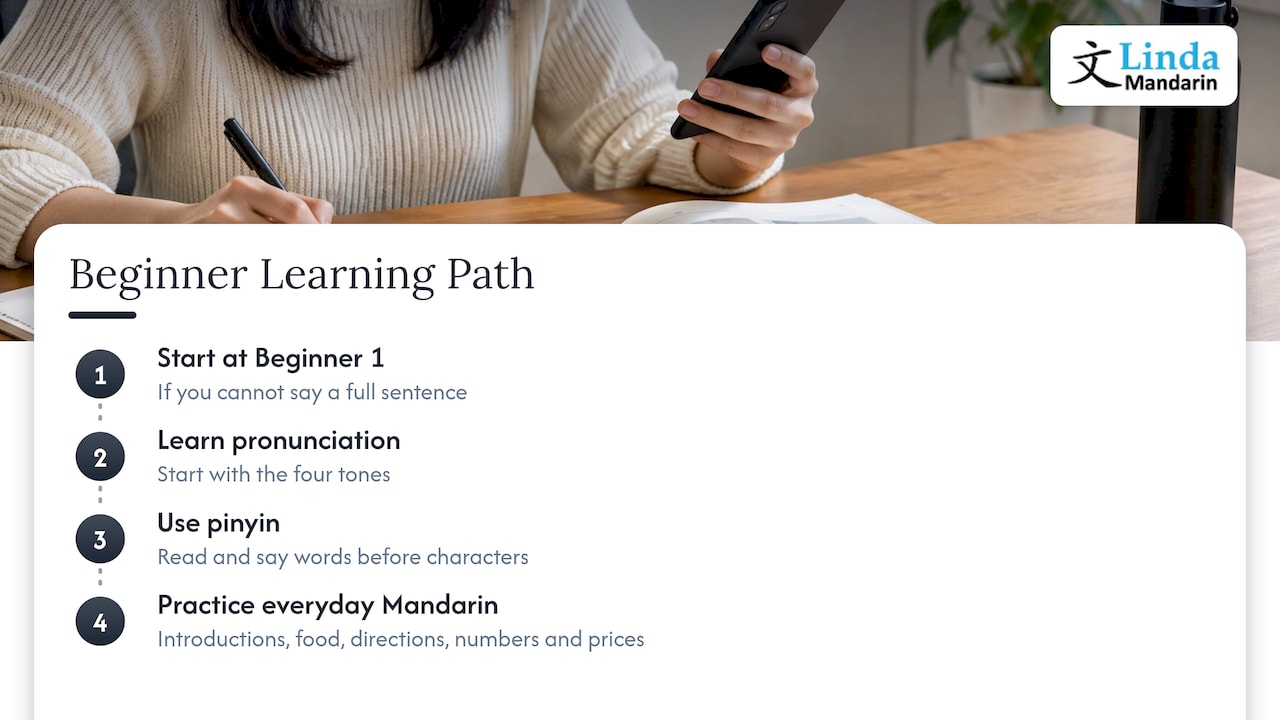
If you cannot yet say a full sentence in Mandarin, start at Beginner 1. You learn pronunciation first, including the four tones, which change the meaning of a word. Mandarin has a system called pinyin that writes the sounds with the Roman alphabet, so you can read and say new words before you learn a single character. A beginner course should teach you to introduce yourself, order food, ask for directions and handle numbers and prices within the first weeks. Our Chinese lessons for beginners guide explains where to start in more detail.
Some Mandarin already
If you can follow slow speech and manage short exchanges but freeze in longer conversation, an intermediate level is the right place. The aim there is to speak in connected sentences and to understand natural speed. Our Intermediate Level sits within the conversational Chinese programme.
Working professional
If you already speak some Mandarin and need it for work, go to business Mandarin directly. A general conversation course will teach you how to order lunch; a business course teaches you how to open a meeting, make a proposal, follow up with a client and write a clear message. Our business Chinese programmes are built around exactly these tasks.
Learning for culture or travel
Expatriates and visitors often want to understand the people and customs as much as the grammar. A conversational course with a native instructor gives you the phrases and the context, such as greetings, politeness and dining habits. If you are planning a move to mainland China, a resource such as the Shanghai newcomer checklist shows the everyday situations where basic Mandarin helps most, and those are the situations to rehearse in class.
Group, private, online or corporate: choosing the format
Format affects your progress as much as the syllabus. Here is how the options compare at Linda Mandarin, using the prices published on our site.
| Format | Best for | Published fee |
|---|---|---|
| Beginner 1 group class | First-time learners who want structure at a lower cost | S$500-600 per student |
| Conversational group class | Learners practising speaking with classmates | S$600 per student |
| Business Mandarin group class | Professionals who want work-focused practice | S$500-600 per student |
| Conversational private class | Fast progress, a flexible pace, specific goals | S$1,730 per student |
| Business Chinese private class | Executives with tight schedules and specific work needs | S$1,980 |
| Online course, Conversational Mandarin | Learning over Zoom from home or while travelling | S$1,580 per student |
| Online course, Business Mandarin | Business Mandarin over Zoom | S$1,880 per student |
Fees are as published on our site; the current schedule and fees are on our class schedule and fees page, and the breakdown in our guide to what adults pay for Mandarin classes.
Group classes
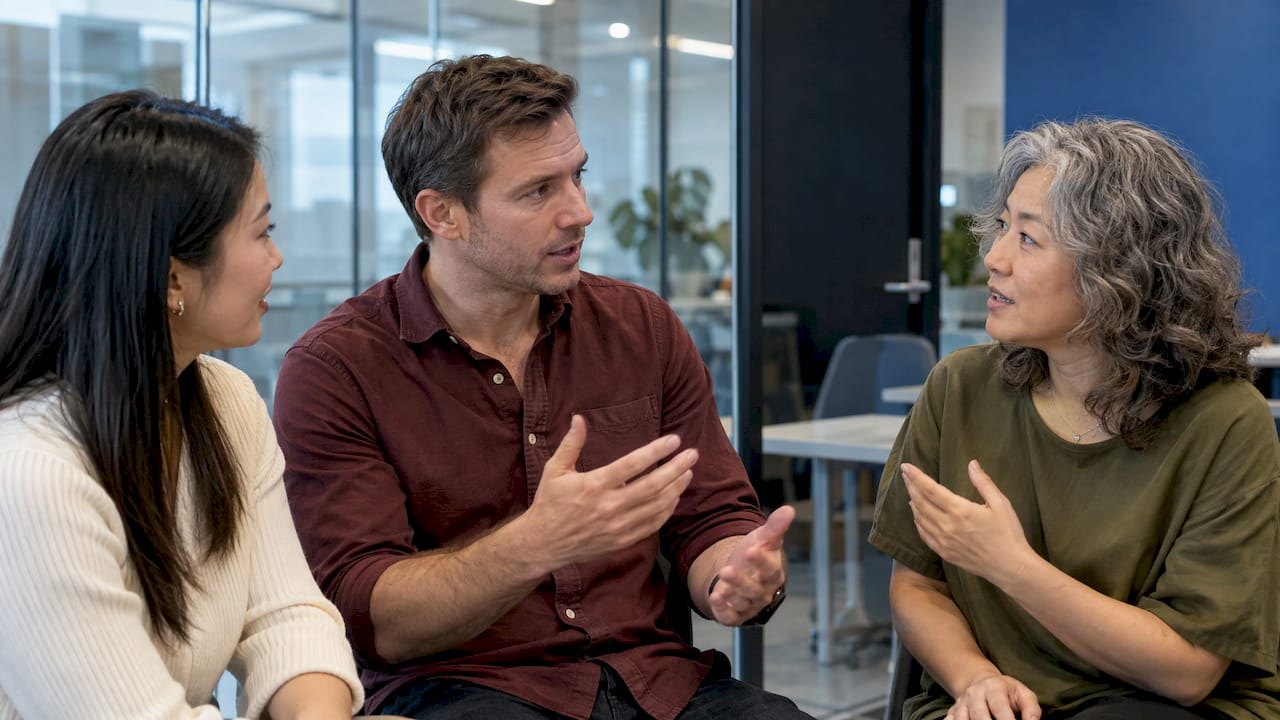
A group gives you classmates to practise with, a steady rhythm and the lowest fee. You hear other people make mistakes and fix them, which speeds up your own learning. Our group class schedules are published so that you can see which timetable fits around work.
Private classes
Private lessons suit you if your timetable is unpredictable, if you want to focus on a specific skill such as presentations, or if you want the whole lesson to revolve around your own vocabulary. Every minute is your speaking time. See our private Chinese course for details.
Online Zoom classes
Online classes remove the commute and work for people who travel or live far from the city centre. Our online Chinese courses keep the same communication focus as the classroom, with live interaction with a native instructor rather than recorded videos. That live practice is the main difference from the self-paced courses you find on global learning platforms, where nobody corrects your tones.
Corporate training
If several colleagues need Mandarin, a company programme lets the content be shaped around your industry, your clients and your timetable. We have a track record of training teams from Fortune 500 companies, and our corporate Chinese Mandarin training can include Chinese culture training. The corporate programme has no published price, so you request a quote based on your team’s needs.
What a good course teaches, and how you use it
A useful adult course trains four skills: speaking, listening, reading and writing. For most learners, speaking and listening come first and matter most. Here is what that looks like in real situations.
- Daily life: greeting neighbours, ordering at a hawker stall, bargaining at a market, taking a taxi, talking to a colleague’s parents.
- Work: introducing yourself to a new client, small talk before a meeting, making a phone call, following a presentation, writing a short email. Our guide to Mandarin for business communication shows how.
- Travel and culture: reading a menu, asking for help, understanding festivals and gift-giving etiquette.
Characters are worth learning once your speaking is steady. They take time, and a dedicated reading and writing course makes them manageable. If your job involves written Chinese, our Business Chinese Writing Workshop focuses on writing for the workplace.
How long does it take to become conversational?
There is no universal answer, because it depends on how often you attend and how much you practise between lessons. Many adult learners who attend regularly and practise between classes reach comfortable everyday conversation in about 6 to 12 months, a timeline we explain in our guide to becoming conversational in Singapore. The habits that make the biggest difference are simple:
- Attend consistently. One missed week in a beginner course is a lot of new material.
- Speak out loud every day, even for five minutes. Tones are physical, and your mouth needs repetition.
- Use what you learned within 48 hours: say it to a colleague, a taxi driver or a friend.
- Review pinyin and vocabulary little and often rather than in one long weekend session.
More routines are in our practical tips for success in beginner Mandarin.
What do Chinese courses cost in Singapore?
Fees depend on four things: whether the lesson is group or private, how many hours the course includes, the topic (business courses cost more than general conversation) and the delivery (classroom or online). Group courses are the entry point. In our published fees, a group course costs S$500-600 per student, while a private conversational course costs S$1,730 because you receive one-to-one teaching.
When you compare fees, look at what you are buying. Ask how many lessons the course has, how long each lesson is, how many students are in a group, whether materials are included and how levels progress. A lower price per course is not a lower price per useful hour if the class is large or the course ends before you can use what you learned. Our price guide walks through these costs.
How to judge a course before you enrol
Whatever school you consider, check these points:
- Instructors: native Mandarin speakers who are fluent in English can explain why a tone or a sentence structure works in a way you understand. Our instructors are certified native Mandarin speakers fluent in English.
- Syllabus: a clear sequence of levels, so you know where you start and what comes next. Our syllabus follows international standards for Chinese learning, and you can see the levels on our course levels page.
- Teaching approach: the lesson should be interactive and centred on real conversations, not only on the teacher talking.
- Location and format: a centre you can reach easily after work. Ours is above Tanjong Pagar MRT, and online Zoom lessons are available if travelling is hard.
- Fit: a trial lesson shows you how the teaching feels. You can book our Chinese trial class.
We also explain what to expect in our article on the truth about Mandarin classes in Singapore.
Our view
After more than twenty years of teaching adults in Singapore, we believe the most common reason people stop learning Mandarin is not difficulty but a mismatch between the course and the learner’s real life. A professional who needs to host a client lunch does not need the same first month as someone preparing to talk with a partner’s family.
That is why we offer conversational and business tracks, group, private and online formats, and corporate programmes that can be shaped around a team. Our instructors are certified native speakers fluent in English, and every lesson is designed around communication: you speak, you listen, you use it.
Our advice: choose the course for the situation you want to handle in three months, and pick the format you will actually attend every week.
Paul
Start with the course that fits your goal
If you want to speak Mandarin with confidence at work or in daily life, the quickest path is a structured course with live practice. At Linda Mandarin, Beginner 1 group classes start at a published S$500-600 per student, and our conversational courses and business courses take you further. Visit us at 10 Anson Road, Level 22, International Plaza, or join online over Zoom.
You can also start with a trial class to see how a lesson feels, or visit Linda Mandarin to see every programme.
FAQ
What is the best form of Chinese to learn?
For living and working in Singapore, Mandarin is the standard spoken form taught in classrooms and used in business with mainland China and Taiwan. It is the form our courses teach. Pinyin lets you read and say words from the start, and characters can follow as your speaking grows.
Can I learn Chinese online instead of in a classroom?
Yes. Live online Zoom classes give you real-time interaction with a native instructor, so you still get corrections on pronunciation and tones. We offer online courses in both conversational and business Mandarin, priced at S$1,580 and S$1,880 per student respectively.
Do I need to know any Chinese before I start?
No. Beginner 1 is designed for people with no Mandarin at all. If you are unsure of your level, our course levels page describes each stage, and a trial class helps you find where you fit.
Is a group or a private class better for me?
Choose a group class if you want a lower fee and enjoy practising with others. Choose a private class if your schedule changes a lot or you need Mandarin for specific work tasks, because the lesson is built around your goals.