A good Chinese business email does five things in a fixed order: it opens with the recipient’s surname and title, states the purpose in the first line, makes one clear request, closes with a measured sign-off, and ends with a signature in the standard order. This guide gives you the phrases for each part, with pinyin and English, and shows where learners most often go wrong. If you write for colleagues, clients or suppliers in Singapore, China or Hong Kong, you can copy the patterns below straight into your drafts.
TL;DR
- Open with surname + title (for example 王经理), then 您好. Greeting with 您好 alone feels abrupt in formal mail.
- Subject lines work best as reason, content and name, kept within about 30 characters, with the key point in the first 15 to 20.
- Make requests with 请您…, 麻烦您… or the more formal 烦请…, and close with 此致 敬礼, 顺祝商祺 or 祝好 depending on how formal the relationship is.
- In a sales email, keep to three short sentences and one call to action. Put the recipient’s title before your own company.
- Signature order: name, job title, company, then WeChat and phone. A bilingual English and Chinese signature suits Singapore.
Table of Contents
- Start with the salutation: name and title first
- Opening lines that state your purpose
- Subject lines: reason, content, name
- Making requests politely
- Follow-up emails without blame
- Writing a sales email in Chinese
- Closing the email: sign-offs by level of formality
- Email signatures in Chinese
- CC etiquette in Chinese business email
- Which phrases to avoid
- Where Linda Mandarin fits in
- Our view on learning email Chinese
- FAQ
- Sources
Start with the salutation: name and title first
In English, “Dear Mr Tan” and “Hi” are both acceptable. In Chinese business writing the line that names the person comes first, on its own line, and the greeting follows it. A common form is surname + title + 您好, for example 王经理,您好, or 张总,您好, (“Manager Wang, hello”; 总 is short for 总经理 or 总裁, a general manager or president). According to one guide to Chinese business email openings, starting with 您好 alone and no name line is considered impolite.
A few rules cover most cases:
- Formal, first contact: 尊敬的王经理: (zūnjìng de Wáng jīnglǐ, “Respected Manager Wang”). Use it for senior people or a first email.
- Established working relationship: 王经理,您好: is enough.
- Peers or close colleagues: 小李,你好: with 你 instead of the respectful 您.
- A group: 各位好 or 大家好. The same guide notes that 您们好 is a grammatical error, because 您 already carries the respect, so plurals use 各位 or 大家 instead.
- No known name: 您好, alone is acceptable only when you truly cannot find the recipient’s name, such as a general company inbox.
Singapore adds a local twist. Code-switching is normal in the workplace here, and one guide to formal Chinese greetings notes that pairing a Mandarin greeting with English, such as “Good morning, 您好,” can signal respect across cultures. In a mixed Singapore team, an English first line followed by a Chinese body is perfectly natural.
Opening lines that state your purpose
Chinese business readers expect to learn why you are writing before anything else. These openers cover most situations:
| Chinese | Pinyin | Use |
|---|---|---|
| 感谢您的来信。 | gǎnxiè nín de láixìn | Replying: “Thank you for your email.” |
| 我写这封邮件是为了… | wǒ xiě zhè fēng yóujiàn shì wèile… | “I am writing in order to…” |
| 关于…事宜 | guānyú… shìyí | “Regarding the matter of…” |
| 根据我们上次的沟通… | gēnjù wǒmen shàngcì de gōutōng… | “Following our last discussion…” |
| 冒昧给您发邮件。 | màomèi gěi nín fā yóujiàn | First contact: “Forgive me for writing unannounced.” |
| 经王总介绍,冒昧给您发邮件。 | jīng Wáng zǒng jièshào… | “Introduced by Mr Wang, I am writing to you.” |
These patterns appear in common lists of business email phrases with pinyin. The referral opener is worth remembering: when someone introduced you, name them in the first line and, as is common practice, copy them on the email.
A worked example for a Singapore supplier writing to a regular client:
李经理,您好:
感谢您的来信。关于下周的产品演示,我想确认时间和地点。
That is two sentences, and the reader knows the topic and the action at once.
Subject lines: reason, content, name
A vague subject such as 您好, 资料 or 请查收 gets ignored or filtered. Writers of Chinese business mail keep subjects short and specific. Three patterns work reliably.
- Reason | content | name. One subject line guide gives the formula 事由|内容|姓名, for example 应聘|市场运营专员|张敏 (applying | marketing operations specialist | Zhang Min). It also advises putting key information in the first 15 to 20 characters and keeping the whole subject near 30, because phones show only the front of the line.
- 关于 + matter + purpose. For example 关于2026年合作方案的沟通 (“Regarding the 2026 cooperation proposal discussion”). This is a very common structure and it reads as formal and clear.
- Bracket tags. 【会议通知】 (meeting notice) or 【紧急】 (urgent) at the front, followed by the matter. Reserve 紧急 for a real, confirmed deadline, and avoid piling up exclamation marks, which look like spam.
Name the object and the action. A subject like 请核对论坛简介的资料范围 (please check the scope of the forum profile material) tells the reader what to do, while 跟进合作事宜 (following up on cooperation) does not, as cross-border email guidance from Starbay Media points out.
One more detail: do not mix Simplified and Traditional characters in the same subject, since it can look like an encoding error. Singapore uses Simplified Chinese, as does mainland China. For Hong Kong, Traditional characters are standard at local and public-sector organizations, so check your reader before you choose.
Making requests politely
Chinese business writing softens requests with verbs that acknowledge the effort you are asking for. Choose by formality:
- 请问… (qǐngwèn): “May I ask…” Neutral and useful for questions.
- 请您… (qǐng nín): “Please…” The everyday polite request.
- 麻烦您… (máfan nín): “Could I trouble you to…” Warm, and common between colleagues.
- 烦请… (fánqǐng): A more formal “kindly”, common in business, as in 烦请查收附件 (please find the attachment).
- 能否… (néngfǒu): “Would it be possible to…” Good when you are unsure the request is feasible.
- 期待您的回复 (qīdài nín de huífù): “I look forward to your reply.”
This courtesy has research behind it. A study of 100 workplace emails from each of three national groups at a freight-forwarding multinational, published in ESP Across Cultures, found Chinese writers used more mitigated, relationship-oriented phrasing, with frequent “please”, than the more direct Emirati writers. Translating a blunt English instruction word for word into Chinese will therefore sound harsher than you intend.
Give a reason for any deadline, and state the time zone when you write across markets. 请您在周五下午五点(新加坡时间)前回复,因为我们需要在下周一提交报价 (“Please reply by Friday 5 pm Singapore time, because we need to submit the quotation next Monday”) is clear and courteous in one sentence.
Follow-up emails without blame
The risk in a follow-up is sounding accusatory. A tested pattern checks whether the message was seen and offers help instead of pressure: 想跟进一下周五会议的安排。不知道您是否已经看到上一封邮件?如果还需要其他信息,请告诉我。 (“I’d like to follow up on Friday’s meeting arrangements. I wonder whether you saw my previous email? If you need any other information, please let me know.”) This follows a follow-up pattern that avoids blame.
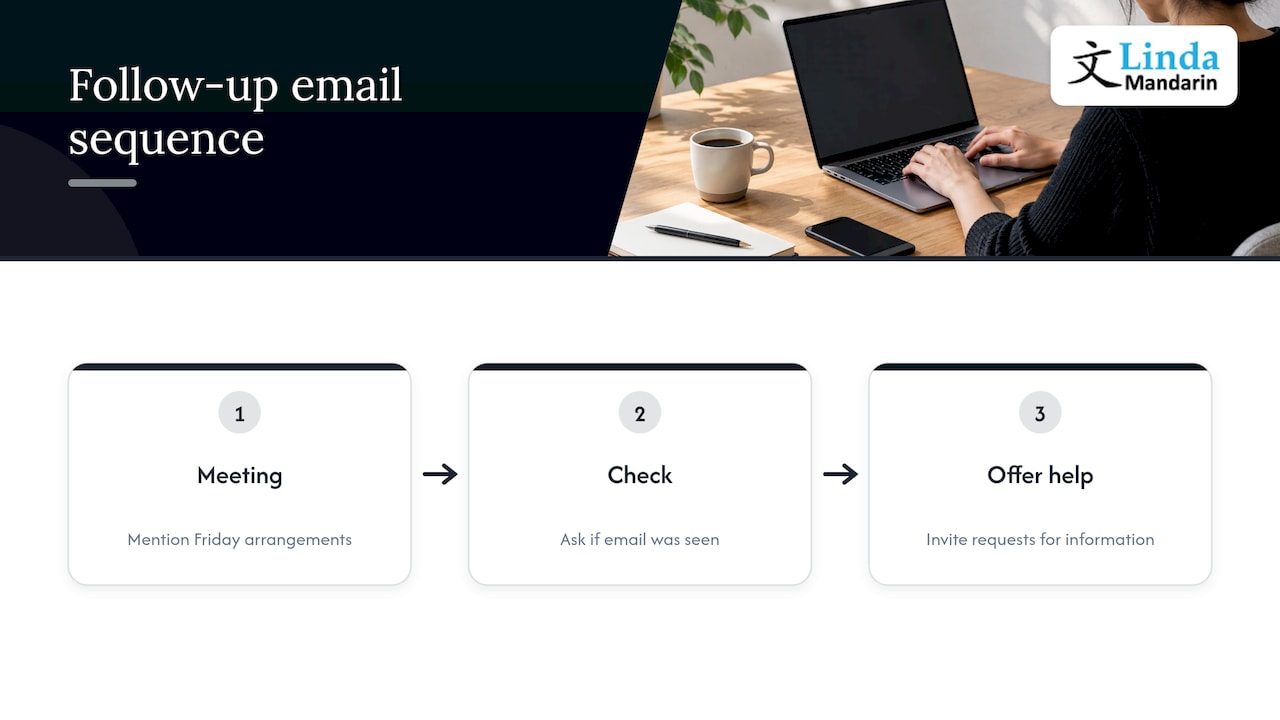
Two habits prevent most misunderstandings. First, a reply of 收到 (“received”) only means the message arrived. Check which points the reply actually covers before you treat the item as agreed. Second, treat silence as “pending confirmation”, never as approval. Starbay Media’s guidance makes the same point: a clear cross-border email is one that reduces the recipient’s guessing, with the required reply and its limits stated in the first paragraph.
A closing line that works nearly everywhere: 如有任何问题,请随时联系我。 (rúyǒu rènhé wèntí, qǐng suíshí liánxì wǒ: “If you have any questions, please contact me at any time.”)
Writing a sales email in Chinese
A cold email in Chinese follows a different logic from its English counterpart. The most useful model comes from the Hong Kong Baptist University’s Applied Chinese resource on sales letters, which organises a direct-sales letter along the AIDMA sequence: attention (a title that grabs), interest (an opening that says why you are writing), desire (features, benefits and inducement, using bullet points or tables), then memory and action (a summary, a sincere close, a call to act and contact details). The letter also carries the sender’s position and name, the date, and a note on sales terms and validity dates, to avoid disputes.
For a short email rather than a full letter, one outreach guide suggests:
- A short subject, about seven characters, so it shows fully on a phone.
- An opening that uses the recipient’s title and something specific to their company, for example 张总,您好,关于贵司在深圳市场的拓展 (“Mr Zhang, regarding your company’s expansion in Shenzhen”). 贵司 is the honorific for “your company”.
- Three short sentences: why you, why now, what you propose.
- One call to action, such as 能否方便沟通30分钟? (could we talk for 30 minutes?) or 方便加个企业微信吗? (may I add you on WeChat Work?).
The same source warns that opening with 我是XX公司的销售 (“I am a salesperson at…”) is the weakest first line, and that very long emails lower reply rates. Better first-contact openers are 冒昧给您发邮件,打扰之处敬请谅解 (“forgive me for writing unannounced”) or 通过贵司官网了解到XX产品,希望进一步咨询 (“I learned about your product through your website and would like to enquire further”).
Closing the email: sign-offs by level of formality
Pick the closing that matches your relationship, not the one that sounds most impressive.
| Closing | Pinyin | When to use |
|---|---|---|
| 祝好 | zhù hǎo | Safe for almost everyone |
| 祝工作顺利 | zhù gōngzuò shùnlì | Business contacts, a step up from 祝好 |
| 顺祝商祺 | shùn zhù shāngqí | Formal business correspondence |
| 此致 / 敬礼 | cǐzhì / jìnglǐ | Traditional letter closing: 此致 ends the last paragraph, 敬礼 sits on its own line |
| 谢谢 | xièxie | Quick replies to colleagues |
Formal mail then gives the name, the organisation and the date in year, month, day order (2026年11月26日). The 此致 敬礼 and 祝好 hierarchy is laid out in more detail in a guide to Chinese email closings.
Email signatures in Chinese
The usual order is name, job title, company, WeChat ID, then phone number. The email address need not be repeated, since it already appears in the message header. For cross-border work the same guide suggests a bilingual signature, which suits Singapore well:
Zhang Wei (张伟)
Senior Manager 高级经理
XX Technology Co., Ltd. XX科技有限公司
WeChat: zhangwei123 | Mobile: +65 XXXX XXXX
For Hong Kong audiences, a professional signature typically carries full name, job title, department if relevant, company, phone and email, and many professionals show both their English and Chinese names, according to a Hong Kong email guide. Use Simplified Chinese for mainland counterparts.
CC etiquette in Chinese business email
Copying people in is a signal as well as a convenience. Four habits keep you on safe ground:
- CC a referrer. When someone introduced you, copy them and say so in the opening line (经王总介绍…).
- Respect the hierarchy. Address the main recipient by name and title, and add senior colleagues in CC only when they need to see the decision, not to pressure the reader.
- Say why people are copied. A short note such as 抄送王总,供您参考 (“copying Mr Wang for your reference”) removes any guesswork.
- Do not copy a boss on a first follow-up. Escalation by CC reads as blame, which cuts against the gentle follow-up pattern above.
These are working conventions rather than rules, so watch how your Chinese counterparts copy people on their own emails and match them.
Which phrases to avoid
- 您们好: ungrammatical, use 各位好.
- Starting with 您好 and no name line in a formal email.
- 你 with senior or new contacts. Keep 您 until they invite you to relax.
- Word-for-word English such as 我希望你很好 (“I hope you are well”), which sounds unnatural. 祝您工作顺利 does the job.
- Subject lines that only say 您好, 有一事相求 or 资料.
If your team writes in both languages, the discipline carries across: one clear purpose, one clear action. A guide to business English for professionals makes a similar case for the English side of the inbox.
Where Linda Mandarin fits in
Phrases on a page are the easy part. The hard part is choosing the right level of formality in real time, and writing a reply to a client by the end of the day. Linda Mandarin has taught Chinese to adults and professionals in Singapore since 2003, with native Mandarin instructors who are fluent in English. Our Business Chinese Writing Course focuses on written business communication, and our Business Chinese Private class is $1,980 one-off, while the Business Mandarin Group Class is $500 to $600 per student. If you prefer to learn from your desk, the Online Chinese Course (Business Mandarin) is $1,880 per student. Teams can look at our corporate Chinese training.

Our centre is at 10 Anson Road, Level 22, International Plaza, Singapore 079903, right above Tanjong Pagar MRT. You can also read our guide on how to write Chinese emails for professional success or book a trial class.
Our view on learning email Chinese
Most learners come to us with a phrase list and one problem: they do not know which phrase fits which person. A Chinese email is a small exercise in relationship management. The surname and title line, the choice between 您 and 你, the sign-off and the signature all tell the reader how you see them.
That is why we teach writing together with speaking. When you can say a request aloud in a meeting and then write it in an email, the structure sticks. Our syllabus emphasises real-life communication and progressive learning, and our instructors are certified native speakers who work in English with you, so you can ask why one closing is right and another is not.
If you write Chinese email every week, a short run of private business classes with your own emails as material is the fastest route we know. If you are building a team’s skills, group and corporate formats let colleagues practise the same templates together.
Paul
FAQ
How do I greet someone in a Chinese business email?
Put the recipient’s surname and title on the first line, such as 王经理,您好:. For a first or very formal email use 尊敬的 before the name. For a group, use 各位好 or 大家好.
What is a good subject line for a Chinese business email?
Use reason, content and name, for example 会议通知|第四季度销售回顾|李明, or the 关于… pattern. Keep it near 30 characters with the key information at the front.
How do I end a Chinese business email?
For most business mail, 祝工作顺利 or 祝好 is right. For formal correspondence, use 此致 followed by 敬礼 on its own line, or 顺祝商祺, then your name, company and the date.
Should I use Simplified or Traditional characters in Singapore?
Use Simplified Chinese for Singapore and mainland China recipients. Traditional characters are standard in Hong Kong local and public-sector organizations, so match your reader and never mix the two in one subject line.
Can I write part of the email in English?
Yes. Code-switching is common in Singapore workplaces, so an English greeting followed by a Chinese body is natural. Keep the Chinese part’s greeting, request and sign-off in the correct formal forms.
Sources
- Langhacks: Chinese business email openings
- Langhacks: cold outreach emails in Chinese
- Langhacks: Chinese email closings
- Avatalks: formal ways to say hello in Chinese
- Business Email in Chinese: common phrases with pinyin
- AdeptWrite: email subject lines
- Starbay Media: cross-border email subject lines
- HoiSum: Hong Kong business email guide
- Hanyu Guide: requests and follow-ups in Chinese email
- ESP Across Cultures: communication styles at work
- HKBU Applied Chinese: sales letters