Yes, a Mandarin trial class is worth it, as long as you treat it as a short decision session and not as a taster lesson. In 45 to 60 minutes you can check your level, hear how the teacher explains tones, find out whether you are asked to speak, and see whether the format (classroom or Zoom, group or private) suits your week. At Linda Mandarin in Singapore, you can book a Chinese trial class for our group, private and online formats and make that decision before you pay for a full course.
The rest of this article shows what a good trial class covers, what to watch for in the room, how to judge the result, and how to work out the full cost of continuing.
TL;DR
- A trial class is worth it when you use it to judge three things: whether the level is right, whether you speak during the lesson, and whether the teacher’s style suits how you learn.
- Go in with one clear goal, such as ordering food, handling client small talk or running a meeting, so you can tell whether the lesson moves you towards it.
- Try the format you will actually study in. Zoom and classroom lessons feel different, and so do group and private lessons.
- Before you enrol, get the total cost in writing: tuition, registration, books and any other fees.
- Decide within a day or two, while the lesson is fresh, using the short scorecard below.
Table of Contents
- Why a trial class is worth your time
- What happens in a good trial class
- What to listen for in the lesson
- Group, private or Zoom: try the format you will actually use
- If your goal is work: what a business trial should show
- A five-point scorecard to use right after the lesson
- Work out the real cost before you decide
- Perspective
- Book a trial at our Tanjong Pagar centre or on Zoom
- After the trial: how to decide
- FAQ
- Sources
Why a trial class is worth your time
A Mandarin course is a commitment of weeks or months. A course description cannot tell you whether the teacher corrects your tones kindly, whether the pace suits you, or whether you will actually speak or mostly listen. Only an actual lesson shows that.
There is a second reason that matters for adults. Most of you are fitting Mandarin around a job, travel or family. A lesson that is slightly too slow or too fast costs more than money: it costs the evenings you were going to spend on it. Singapore’s public community courses give a sense of the shape of a beginner programme. One listed beginner course for adults with no background, for example, runs eight sessions of 1.5 hours and covers Hanyu Pinyin (the system that writes Mandarin sounds in the Roman alphabet), practical conversations, basic grammar and simple character recognition. That is roughly 12 hours of class time, which you will spend alongside your day job. A single trial session is a small price against that.
The approach also holds up outside Mandarin. Course-comparison guides recommend a quick preview of the teaching style, and one of them says a five-minute preview can save you from a frustrating purchase because no teaching style is better in itself, only better or worse for how you learn.
What happens in a good trial class
Formats differ, but a trial class that helps you decide usually has four parts.
- A short conversation about your goal. The teacher asks why you are learning Mandarin, where you will use it and what you already know. If you say “client dinners in Shanghai” or “talking to my in-laws”, the lesson should bend towards that.
- A quick check of your level. This can be a few questions, a short exchange in Mandarin or a look at what you can read. Complete beginners will often be asked to repeat sounds. People with some Mandarin will be asked to answer questions.
- A sample of real teaching. You should learn something you can use within the hour: a self-introduction, a few useful phrases for your situation, or a correction to a sound you have been getting wrong.
- A recommendation. At the end, the teacher should tell you which level and format fit, and what a realistic path looks like.
A checklist for choosing a language school in Singapore published by a local directory suggests a good placement process includes a short test or conversation and the chance to move up or down in the first two lessons. That is a sensible standard to hold any trial against.
What to listen for in the lesson
You are not grading the teacher’s Mandarin. You are checking whether this lesson will help you improve. Use these checks.
Do you speak, and does the teacher respond to what you say?
Speaking is the skill adults most want and the one that is easiest to skip in a poorly designed class. Count how many times you open your mouth. In a good session you should be producing sentences, not only listening to explanations. Notice whether the teacher corrects you in a way you can act on: “your second tone needs to rise more” is useful, “good, again” is not.
Are tones handled early and clearly?
Mandarin has four tones plus a neutral one, and the same syllable can mean different things depending on the pitch. A teacher who explains tones with simple contrasts and has you practise them is giving you the foundation. Our instructors are certified native Mandarin speakers who are fluent in English, which means that when a concept is confusing, they can explain it in the language you think in.
Is the content connected to your goal?
Ask yourself the fit question from a course-comparison guide: can you complete the sentence “This course is best for someone who wants to…” with your own goal? If you can fill the blank in confidently after the trial, the course is aimed at you. If you cannot, the content is too generic.
Does the pace feel right?
You want to feel stretched but not lost. If you understood everything effortlessly, the level is probably too low. If you were nodding without following, it is too high. Either way, the right response is to ask for a different level, not to give up on Mandarin.
Are the practicalities clear?
Ask how long each session is, how many sessions make up the course, how many students are in the group and what the schedule looks like. A local checklist advises that a provider should be able to state the class-size cap, total contact hours and session length up front. Our class schedule and fees page sets out the details for each programme.
Group, private or Zoom: try the format you will actually use
The most common mistake is trying one format and enrolling in another. A lively group trial tells you little about how a private course would feel, and a classroom trial tells you little about a Zoom course. Pick the format that fits your life first, then try that one.
| Format | Best for | What to check in the trial | Published price at Linda Mandarin |
|---|---|---|---|
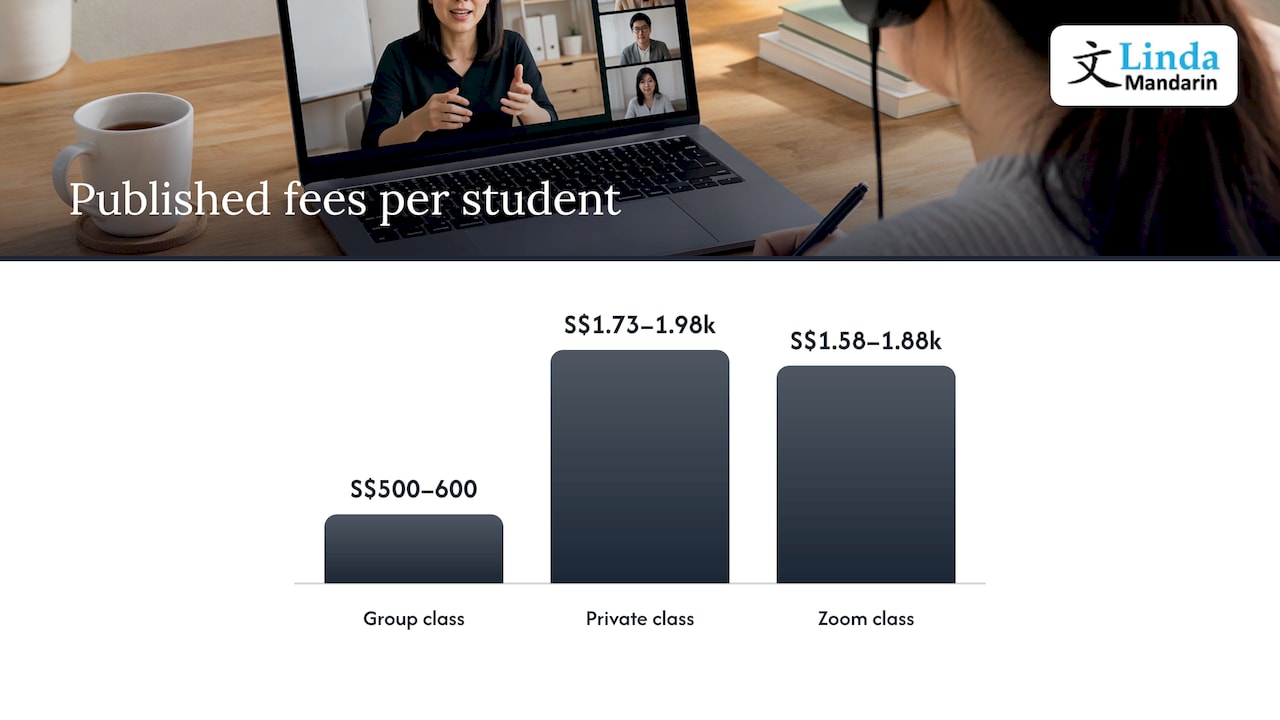
| Group class (classroom) | Learners who like peer energy and a steady routine | Do you get enough speaking turns? Is the pace shared comfortably? | Beginner 1 Group Class: S$500-S$600 per student. Conversational Group Mandarin Class: S$600 per student |
| Private class | Busy professionals, or anyone with a specific goal or deadline | Is the lesson built around your situation? | Conversational Private Mandarin Class: S$1,730. Business Chinese Private class: S$1,980 |
| Online Zoom class | Frequent travellers, or people who want to skip the commute | Audio quality, screen sharing, how the teacher keeps you speaking | Online Chinese Course (Conversational Mandarin): S$1,580. Online Chinese Course (Business Mandarin): S$1,880 |
These are the prices published on our programme pages, listed per student as one-off course fees. You can read each one on its page: conversational courses, online courses, business courses and the Beginner 1 group class.
If you are comparing a group class with a private one, think about the trade-off in plain terms. Group classes cost less per head and give you classmates to practise with. Private lessons put every minute on your goals and are easier to fit around travel and meetings.
If your goal is work: what a business trial should show
Professionals have a different test. A business Mandarin trial should be about the situations you actually face: introducing your company, small talk before a meeting, phone calls, emails, negotiating. If the whole trial is about ordering noodles, it is a conversational class, which is fine if that is what you want, but not what you came for.
Bring a real scenario. For example: “I need to introduce my team to a supplier in Guangzhou next quarter.” Then see how the teacher responds. A good business lesson will give you vocabulary and sentence patterns for that exact moment, and show you the polite forms that matter in a work setting. Our business Chinese for businessmen page and our article on why business Chinese is worth learning explain how it differs from everyday Mandarin.
If you are arranging training for a team, the same logic applies at company level, and our corporate Mandarin training page describes what we offer for organisations.
A five-point scorecard to use right after the lesson
Write down your answers within an hour of finishing, while the lesson is fresh. Score each from 1 to 5.
- Level: Was the content challenging but followable?
- Speaking: Did I say enough in Mandarin, and was I corrected usefully?
- Goal fit: Can I name something from the lesson I will use this week?
- Teacher: Did the explanations make sense to me, and would I look forward to the next lesson?
- Logistics: Do the time, place or Zoom setup fit my real week for the full length of the course?
A total of 20 or more is a strong sign. If one item scores 1 or 2, ask whether it can be fixed, for example by moving to a different level or time slot, before you decide the course is wrong. If several score low, a different format may be the answer. The aim is a decision you can explain to yourself.
Work out the real cost before you decide
The course fee is only part of what you pay. Before enrolling anywhere, ask for an itemised quote. A Singapore pre-booking checklist lists registration fees of S$50 to S$150, textbooks of S$30 to S$120 and GST as costs to add to tuition, and recommends asking for the refund terms in writing.
Ask these questions at the end of any trial:
- What is the total, including registration, materials and tax?
- How many sessions, and how long is each?
- What happens if I miss a class?
- Can I move level in the first lessons if it does not fit?
- What is the next start date for my format?
Use the published course prices above as your starting point and check the fee and schedule pages for your chosen class. If you need a longer-run plan, our weekly Mandarin study plan for a full-time job shows how to fit lessons and practice into a working week.
Perspective
A trial class is the most honest part of choosing a Mandarin school. A brochure shows you the syllabus. A trial shows you what it feels like to be taught from it.
At Linda Mandarin we have taught Mandarin in Singapore since 2003, and our approach is structured but interactive: lessons are built around real communication, so you speak, listen, read and write in ways that match how you will use the language. Our syllabus follows international standards, and our instructors are certified native speakers who are fluent in English.
We would rather you came in with a goal and a question than with no expectations. Tell us whether you want to hold conversations with friends, speak with clients or manage a meeting, and the trial can be about that. Adults learn fastest when the lesson belongs to them.
We also offer group, private and online Zoom formats, so the trial can match the way you will study, whether that is a classroom at Tanjong Pagar or a screen at home.
Paul
Book a trial at our Tanjong Pagar centre or on Zoom
Our centre is at 10 Anson Road, Level 22, International Plaza, Singapore 079903, right above Tanjong Pagar MRT, which makes a lunchtime or after-work lesson easy to reach. If you prefer to study from home or while travelling, our online Zoom courses cover conversational and business Mandarin.
You can arrange a Chinese trial class in the format you are considering, or browse all course details first.
Not sure which level suits you? Our guide to Mandarin courses for beginners in Singapore and the article on how trial classes help working adults decide walk through the choice step by step.
After the trial: how to decide
There are three sensible outcomes.
Enrol. The scorecard is strong, the format fits and the total cost is clear. Choose the start date and commit to a weekly routine. The first month matters most, and regular short practice beats occasional long sessions.
Adjust. The lesson was good but the level, time or format was off. Ask for a different level or format and take another look. Often that is all it takes, because a good teacher at the wrong level feels like the wrong teacher.
Wait. The timing is wrong, for example a heavy work season or a long trip. That is a reasonable answer too. Note what you liked, and come back when you can attend consistently. Consistency is what turns a trial into fluency.
One principle holds in all three: do not decide under pressure. A Singapore checklist flags same-day “promotion ending tonight” pressure as a sign to slow down. You should be able to take your scorecard home, think, and answer in a day or two.
If you are still weighing up what to look for in a school overall, our guides on choosing Mandarin classes in Singapore and how to choose a Chinese language course go through the criteria in more depth.
FAQ
How long should a Mandarin trial class be?
Long enough to cover a goal conversation, a short level check and some real teaching, which usually means 45 to 60 minutes. Shorter than that, you will see the teacher but not your own progress. Ask how long the session is when you book so you can plan the time.
Should I try more than one teacher or school?
It can help to compare, especially if you are choosing a private tutor. One language-learning writer suggests sampling several tutors before settling, and says deciding that a tutor is not for you is a normal part of the process. For most adults, one well-chosen trial in the format they plan to use, with the scorecard above, is enough to make a confident decision.
Can I take a trial class if I am a complete beginner?
Yes. A beginner trial usually focuses on sounds, tones and a first self-introduction, so you leave able to say something real. Beginner courses are designed for people starting from nothing: a community beginner course, for instance, begins with Hanyu Pinyin and simple conversations. Our Beginner 1 Group Class is the starting point for new learners.
Is a trial class on Zoom as useful as one in person?
It is useful if you plan to study online, because it shows you the audio, the screen-sharing and how the teacher keeps you speaking. If you will study in a classroom, try that format instead. Match the trial to the way you will actually learn.
What should I bring to a trial class?
Bring your goal in one sentence, an example of a situation where you want to use Mandarin, and your questions about schedule and total cost. If you are choosing a business course, bring a real scenario such as a meeting or a client call.
Sources
- OnePA: Basic Conversational Mandarin for Adults
- KakiList: Language School in Singapore, 12 Questions to Ask First
- Virversity: How to Compare Online Courses Before You Buy
- Hacking Chinese: How to find the perfect Mandarin tutor for you