The fastest path to effective chinese clients communication is a task-based Mandarin program built around three things: Pinyin and tone accuracy, high-frequency business phrases, and regular role-play with a native-speaking instructor. Programs like those at Linda Mandarin structure lessons this way because it maps directly to real client interactions instead of textbook chapters. Start small: pick one scenario, such as a phone introduction, and rehearse it out loud today.
TL;DR:
- Prioritizing Pinyin and tones through daily drills significantly reduces mispronunciations that can alter meaning, which is crucial in negotiation and pricing discussions.
- Incorporating scenario-based role-play with native instructors accelerates confidence in real client interactions, especially when focusing on introducing oneself, meetings, and email exchanges.
- A targeted micro-plan of practicing two sessions weekly with five to ten minutes of daily drills leads to measurable milestones like delivering a confident one-minute self-introduction within months.
- Private online lessons offer flexible rescheduling and personalized feedback, making them ideal for busy professionals seeking rapid progress without sacrificing key industry vocabulary.
- Building trust through consistent effort, respectful language, and cultural norms often outweighs perfect grammar in establishing long-term relationships with Chinese clients.
Table of Contents
- Why Chinese Clients Communication Starts With the Right Learning Sequence
- Which Course Format Fits Your Schedule and Goals?
- How to Build a Lesson Plan Around Real Client Scenarios
- How Long Does It Take to Get Client-Ready in Mandarin?
- Cultural Norms That Shape Every Client Conversation
- Reading the Signals: Non-Verbal Cues in Chinese Business Settings
- Understanding Who Actually Makes the Decision
- Handling Misunderstandings Without Damaging the Relationship
- Why Trust and Guanxi Matter More Than Perfect Grammar
- Instructor Perspective: Quick, Classroom-Proven Tips for Rapid Progress
- How Linda Mandarin Supports Professionals Ready to Communicate With Chinese Clients
- Sources
- FAQ
Why Chinese Clients Communication Starts With the Right Learning Sequence
Most professionals waste months on the wrong material because they treat Mandarin like a school subject instead of a working tool. The sequence that actually produces results for client-facing roles is speaking and listening first, reading and writing later, since a practical learning sequence for business Mandarin prioritizes Pinyin, tones, greetings, and functional phrases before characters ever enter the picture.
Pinyin and tones come first because a single misplaced tone changes a word’s meaning entirely. “Mai” said with a rising tone means “buy.” Said with a falling tone, it means “sell.” Get that wrong in a negotiation and you have a real problem. Practice with short drills: record yourself saying the four tones on one syllable, then compare against a native speaker’s audio. Ten minutes a day for two weeks builds more accuracy than a month of passive listening.
Once tones feel stable, move to greetings and self-introduction templates. A confident 20-second self-introduction, name, company, role, purpose of the meeting, is worth more in week one than a stack of vocabulary flashcards. From there, layer in phrases for meetings, project updates, scheduling, and short written follow-ups over WeChat or email.
Numbers, dates, and currency deserve special attention. Mispronouncing a number during a pricing discussion or misreading a delivery date can cause real operational mistakes, not just awkward moments. Drill these separately from general vocabulary, since they show up in nearly every client conversation.
A realistic micro-plan for busy professionals looks like this:
Week 1:
- Master the four tones and Pinyin basics through daily 10-minute drills
- Build a 20-second self-introduction and rehearse it five times
- Learn 15 high-frequency greeting and courtesy phrases
Months 1 to 3:
- Add meeting vocabulary: agenda items, scheduling, confirming next steps
- Practice numbers, dates, and currency until errors drop to near zero
- Introduce short written phrases for email and messaging follow-ups
- Begin light role-play with a native-speaking instructor weekly
Pro Tip: Record every role-play session on your phone. Listening back exposes tone mistakes your ear misses in the moment, and it gives your instructor something concrete to correct.
Which Course Format Fits Your Schedule and Goals?
The delivery format matters almost as much as the content. Private 1-on-1 lessons give you rapid correction and content shaped entirely around your industry, which suits executives with narrow, high-stakes vocabulary needs. Small-group classes cost less and add peer practice, useful for building conversational fluency through back-and-forth exchange rather than instructor-only correction. Corporate training aligns an entire team on shared vocabulary and etiquette, which matters when multiple colleagues interact with the same Chinese clients or partners.
Online Zoom classes have closed most of the gap with in-person learning. When taught by trained native instructors using structured role-play, Zoom sessions can match in-person outcomes for pronunciation and professional nuance, since the correction loop, the instructor hearing your tone and fixing it immediately, works the same over video as it does across a table.
Executive and blended programs that combine task-based language instruction with intercultural context tend to perform best for working professionals. Research on executive Mandarin programs shows that scenario-based practice, small class sizes, and flexible delivery produce workplace-ready skills faster than generic conversational courses.
A few scheduling notes worth acting on:
- Two 90-minute sessions per week outperform one long weekly session for retention.
- Homework between lessons should be five to ten minutes of targeted drilling, not passive review.
- Micro-practice, saying one phrase out loud three times before a real client call, builds muscle memory faster than studying alone.
Pro Tip: If your schedule is unpredictable, choose private online lessons over group classes. You can reschedule around client meetings without losing the whole class’s momentum.
How to Build a Lesson Plan Around Real Client Scenarios
Generic textbook study rarely translates into confidence on an actual client call. Business Mandarin training built around workplace tasks, greetings, meetings, emails, negotiation snippets, produces far more usable skill than chapter-by-chapter vocabulary lists.
Start by picking your six highest-priority scenarios:
- Introducing yourself and your role in a first meeting
- Giving a short project or status update
- Handling a routine phone call with a client
- Negotiating a small point, price, timeline, or scope
- Writing a short professional email or message
- Following up after a meeting with next steps
Each scenario becomes a mini-lesson with four parts: a clear goal (what you need to accomplish), the vocabulary that scenario actually requires, a sample role-play script, and a corrective feedback loop where your instructor flags mistakes in real time. This structure turns lesson time into rehearsal for something you will actually do, not abstract practice.
Build a rehearsal routine you can run between lessons: read the script aloud once, record yourself saying it twice, then try it without looking at the page. This takes under five minutes and compounds fast over a few weeks.
Industry adaptation matters too. A finance professional needs vocabulary around figures, contracts, and risk language. A manufacturing client-facing role needs terms for specifications, delivery timelines, and quality issues. Tech professionals often need project-management and product-update vocabulary. Ask your instructor to swap generic scenario vocabulary for your industry’s actual terms, since scenario-based professional vocabulary training works best when it mirrors the words you will use on the job, not a textbook’s default examples.
Pro Tip: Write your six scenarios down before your first lesson and hand the list to your instructor. It saves weeks of generic small talk practice you don’t actually need.
How Long Does It Take to Get Client-Ready in Mandarin?
Progress in business Mandarin is measurable if you set the right milestones instead of chasing vague fluency. A realistic first target is a confident one-minute self-introduction delivered without hesitation. The next milestone is a five to ten minute meeting update where you can answer a follow-up question without switching to English. After that comes short professional WeChat or email messages you can write without a translation app.
Practice frequency shapes your timeline more than raw hours studied. Two structured sessions a week with five to ten minutes of daily drilling tends to produce steady progress; daily intensive study compresses that timeline considerably.
Useful milestones to track:
- A one-minute self-introduction delivered smoothly, without pausing to translate
- A five to ten minute meeting update handled independently
- Short client messages written correctly without translation software
- A recorded role-play your instructor signs off on as client-ready
Assessment doesn’t need to be formal. Recorded simulations, a instructor sign-off after a mock client call, or a simple in-class evaluation each give you a clear signal of readiness. Speaking even basic Mandarin signals respect and investment in the relationship, and it improves your ability to catch negotiation nuance that a translator might miss entirely. That alone makes early, imperfect practice worth more than waiting for fluency.
Cultural Norms That Shape Every Client Conversation
Language skill only carries a client relationship so far without an understanding of the etiquette around it. Meetings in Chinese business settings often open with small talk before substantive discussion begins, rushing straight to the agenda can read as abrupt. Business cards are typically exchanged with both hands, and it’s worth taking a moment to look at the card before putting it away rather than pocketing it immediately.
Titles and seniority carry real weight. Address counterparts by their title and surname rather than a first name until invited otherwise, and direct comments or questions toward the most senior person in the room first, even if a junior colleague is doing most of the talking.
Saving face, for yourself and for the other party, shapes how disagreement gets expressed. Direct public criticism of a client’s proposal in a group setting can damage a relationship even when the underlying feedback is fair. Softer phrasing, or raising concerns privately, tends to land better.
Gift-giving and hosting also follow patterns worth knowing: modest gifts are appreciated more than expensive ones, and reciprocating a meal invitation is generally expected rather than optional. None of this replaces language skill, but pairing accurate Mandarin phrases with the right etiquette is what actually builds a working relationship. Resources on Chinese business culture and etiquette pair well with scenario practice for exactly this reason.
Reading the Signals: Non-Verbal Cues in Chinese Business Settings
Words carry only part of the message in a Chinese business conversation. A pause before answering a question is often deliberation, not confusion or reluctance, and rushing to fill that silence can come across as pushy. Learn to sit with it.
Eye contact tends to be more measured than in many Western business cultures. Steady but not constant eye contact reads as respectful; prolonged direct staring can feel confrontational. A slight nod during conversation often signals attentive listening rather than agreement, which trips up a lot of first-time visitors who assume a nod means “yes.”
Tone of voice matters as much as word choice. A calm, measured delivery during a disagreement signals professionalism, while raised volume or visible frustration can shut a conversation down fast. Watch for indirect phrasing too: “this might be difficult” or “we will consider it” often functions as a polite no, rather than a genuine maybe. Recognizing that shift in language, even without perfect vocabulary, prevents a lot of miscommunication down the line.
Physical space and posture also send signals. Standing slightly farther apart than you might in casual American business settings is normal, and leaning in too closely can feel like an overstep. None of these cues require fluent Mandarin to read, but noticing them alongside your growing vocabulary sharpens how accurately you interpret a client’s actual position.
Understanding Who Actually Makes the Decision
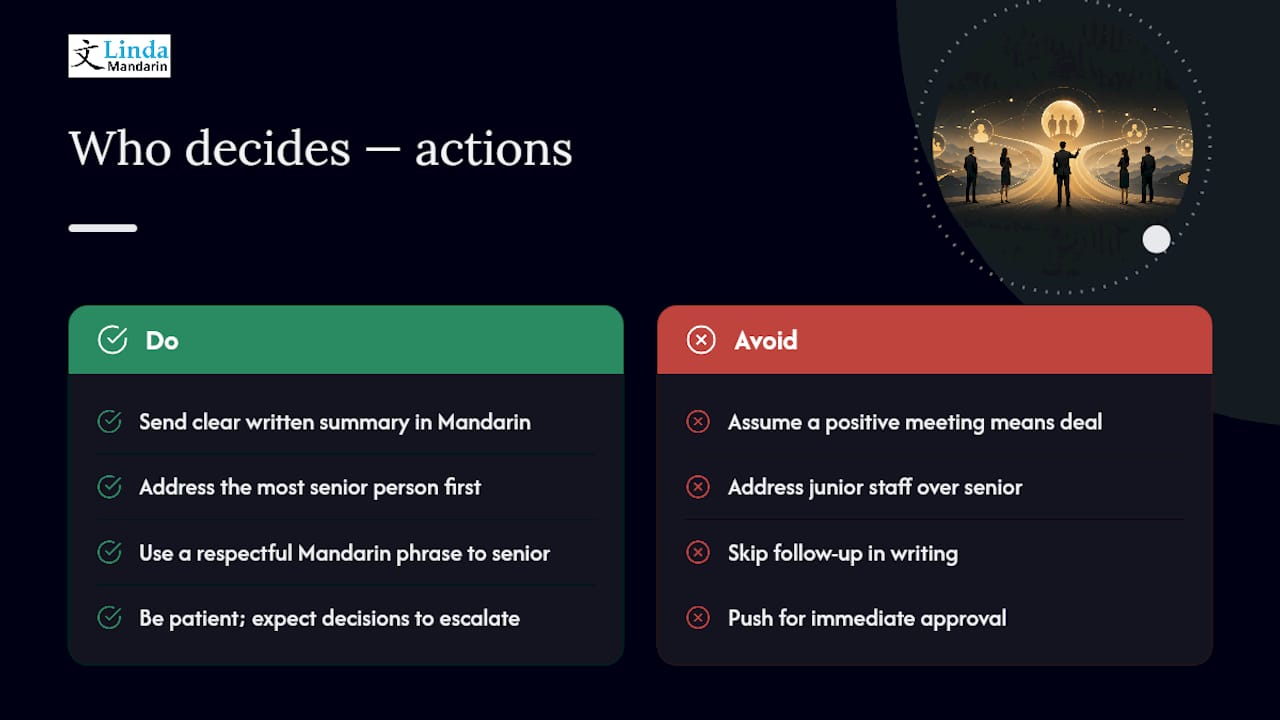
Chinese companies frequently operate with more centralized decision-making than many Western organizations, particularly in privately held firms and state-linked enterprises. The person speaking most during a meeting is not always the person with final authority. Decisions often move up a hierarchy for approval even when a mid-level manager appears fully engaged and enthusiastic in the room.
This matters practically: don’t assume a positive meeting means a deal is close. It may simply mean the conversation is being relayed upward for a decision that could take days or weeks. Patience here isn’t passive, it’s strategic. Following up with a clear, respectful written summary after a meeting (in Mandarin, if you can manage it) gives decision-makers something concrete to review internally.
Hierarchy also shapes who should be addressed directly. In group meetings, the most senior person present usually expects to be acknowledged first, even in a room full of technically qualified colleagues. Ignoring this, even unintentionally, by addressing a junior staffer more than a senior one can read as a lack of awareness rather than simple friendliness.
Understanding this structure changes how you use your Mandarin skills. A well-timed, respectful phrase directed at the right person in the room often carries more weight than a longer explanation aimed at whoever seems most responsive. Mandarin’s role in business communication within Chinese multinational contexts shows that language skill paired with cultural awareness of hierarchy accelerates decision-making and builds the kind of credibility that speeds up approvals rather than stalling them.
Handling Misunderstandings Without Damaging the Relationship
Miscommunication happens, even with strong language skills, and how you handle it matters more than avoiding it entirely. The instinct to over-explain or repeat a point louder rarely helps. Instead, slow down, restate the point in simpler terms, and confirm understanding with a direct but polite question rather than assuming clarity.
When a genuine conflict or disagreement surfaces, avoid resolving it in a large group setting if possible. A private conversation, even a short one, preserves everyone’s standing and tends to produce a more honest exchange than a public back-and-forth. This ties back to the concept of face: correcting someone or pushing back hard in front of colleagues can escalate a small issue into a larger relationship problem.
Written follow-up helps more than most professionals realize. After a tense or unclear conversation, a short, calm email or message summarizing what was discussed and what happens next gives both sides a shared reference point and reduces the chance of the same misunderstanding recurring.
If the language barrier itself caused the confusion, own it plainly rather than deflecting. A simple acknowledgment, in Mandarin if possible, that you misspoke or misunderstood, followed by a clear correction, tends to be received better than pretending the mistake didn’t happen. This is where scenario-based rehearsal pays off directly: professionals who have already practiced a “clarifying a misunderstanding” script handle these moments with far less friction than those improvising for the first time under pressure.
Why Trust and Guanxi Matter More Than Perfect Grammar
Guanxi, the network of trust and mutual obligation built over time, often matters more to a Chinese client than technical accuracy in your Mandarin. A slightly imperfect sentence delivered with genuine effort and respect frequently lands better than a flawless phrase that feels rehearsed and impersonal.
Building guanxi takes consistency, not a single impressive gesture. Regular, low-pressure check-ins, remembering small personal details from previous conversations, and following through reliably on commitments all contribute more to trust than any single meeting. Sharing a meal, when the opportunity arises, remains one of the most effective settings for relationship-building outside formal business discussion.
Language plays a direct role here. Using a client’s preferred title, greeting them by name in Mandarin, or sending a short holiday message in Chinese during a major festival, these small efforts signal investment in the relationship beyond the transaction at hand. Over time, that investment tends to translate into smoother negotiations, more candid conversations, and clients who give you the benefit of the doubt when something goes wrong.
None of this replaces solid business fundamentals, but it does explain why two vendors with similar pricing and quality can get very different treatment from the same Chinese client. The one who invested in the relationship, language included, usually wins the longer-term partnership.
Instructor Perspective: Quick, Classroom-Proven Tips for Rapid Progress
The single biggest shift I see in learners: scenario-based role-play, rehearsing a real client call rather than reading a textbook dialogue, builds usable confidence faster than any other method. Programs with native instructors fluent in English, task-based modules, and syllabuses aligned with international HSK standards, like the ones taught at Linda Mandarin, exist because this approach works. Try one role-play scenario this week. Better yet, book a trial lesson and see how fast a single focused session moves the needle.
— Paul
How Linda Mandarin Supports Professionals Ready to Communicate With Chinese Clients
If everything above sounds like a lot to organize alone, that’s exactly what structured courses solve. Linda Mandarin has run adult Mandarin training since 2003 from its center at 10 Anson Road, Level 22, International Plaza, right above Tanjong Pagar MRT, and its programs are built around the same task-based approach this article describes: Pinyin, high-frequency business phrases, and instructor-led role-play from lesson one.

A few formats fit particularly well with the priorities covered here:
- The Conversational Private Mandarin Class suits professionals who want rapid, personalized correction on their own schedule, priced at $1,730 one-off per student.
- The Business Chinese Private class targets client-facing vocabulary directly, at $1,980 one-off, with a Business Mandarin Group Class option available for $500 to $600 per student.
- The Online Chinese Course (Business Mandarin) delivers the same role-play structure over Zoom for $1,880 one-off, ideal for professionals juggling travel or irregular hours.
- Corporate Chinese Mandarin Training aligns entire teams around shared vocabulary and etiquette for organizations with multiple client-facing staff.
Every format uses native Mandarin instructors fluent in English and a syllabus designed to build practical communication skills, so lesson time converts directly into skills you can use on your next client call. If you’re ready to move past studying alone, book a trial lesson or request corporate training details and start with the one scenario that matters most to your work right now.
Sources
- Why learn Mandarin for business: 7 strategic reasons | CEIBS Europe
- Chinese Language and Culture for Business (CLCB) brochure — LSE / CIBL
- The role of Mandarin in business communication in Chinese multinationals — literature review
FAQ
How Long Does It Take to Learn Business Mandarin for Client Work?
Most part-time professionals reach a confident one-minute self-introduction and basic meeting phrases within a few months of consistent practice. A five to ten minute independent meeting update typically takes longer and depends heavily on practice frequency, with intensive study compressing the timeline considerably.
Is Online Zoom Training as Effective as In-Person Classes?
Yes, when taught by experienced native instructors using structured role-play, Zoom lessons can match in-person outcomes for pronunciation and professional nuance. Linda Mandarin’s Online Chinese Course (Business Mandarin) uses this same structure for $1,880 one-off per student.
Do I Need to Learn Chinese Characters to Communicate With Clients?
Not immediately. Speaking and listening, built through Pinyin, tones, and high-frequency phrases, come first, with reading and writing introduced later as your needs expand.
What’s the Best Course Format for a Busy Executive?
Private 1-on-1 lessons, whether in person or online, tend to suit executives best because they allow rapid rescheduling and content tailored to your exact industry vocabulary. Linda Mandarin’s Business Chinese Private class is built specifically for this, offered for a one-off fee as published.
How Much Does Business Mandarin Training Cost?
Pricing varies by format: private business Mandarin lessons run at a one-off fee, while group classes are charged within a range per student, according to Linda Mandarin’s program pages. Corporate training pricing is available on request.