Mandarin pronunciation comes down to two things: Pinyin (the initial and final sounds that build each syllable) and four tones layered on top. Learn those building blocks with native audio, then drill them daily, and correct Chinese pronunciation stops being a mystery. The fastest path is a short, repeatable loop: listen to a native sample, mimic it, record yourself, and compare the two side by side.
TL;DR:
- Mastering the 400 common syllables in Mandarin allows you to pronounce any word, once initial, final, and tone are learned accurately.
- Correct pronunciation relies heavily on native audio exposure and consistent practice with tools controlling playback speed and tone accuracy.
- The main trouble spots are differentiating similar consonant pairs like j/q/x versus zh/ch/sh/r, and mastering tone sandhi rules such as the third-tone slip.
- Focusing on accurate tone production and minimal pairs understanding improves naturalness faster than vocabulary expansion alone.
- Guided feedback from teachers or online courses speeds up error correction compared to self-study, especially for nuances like tone shifts and aspiration.
Table of Contents
- What Makes Chinese Pronunciation Different From English
- Where to Hear and Check Your Pronunciation
- The Sounds That Trip Up Almost Every English Speaker
- A Compact 4-Week Practice Routine for Busy Adults
- Why Coached Feedback Speeds Things Up
- Pronunciation, Characters, and Reading: How They Connect
- Mandarin Versus Other Chinese Dialects: What Changes and What Doesn’t
- Common Pronunciation Errors That Have Nothing to Do With English
- Bookmark These for Daily Practice
- Why Pronunciation Is the Part Worth Getting Right Early
- Ready to Fix Your Pronunciation With Guided Practice?
- Sources
- FAQ
What Makes Chinese Pronunciation Different From English
Every Mandarin syllable breaks into three parts: an initial (the leading consonant sound), a final (the vowel or vowel combination that follows), and a tone (the pitch pattern riding on top). Combine those three elements and you get the entire spoken language. The Mandarin sound system consists of roughly 400 distinct syllables, a number that sounds intimidating until you realize it’s a closed set. English has thousands of possible syllable shapes. Mandarin recycles the same 400 building blocks across every word in the language, so once you can produce them accurately, you can pronounce anything you read.
The syllable math: About 400 syllables cover all of spoken Mandarin. Master the initials, finals, and tones once, and you’ve unlocked the pronunciation of every word you’ll ever encounter.
Tone is where most learners get tripped up first, because English doesn’t use pitch to change word meaning. Mandarin has four primary tones plus a fifth “neutral” tone that carries no strong pitch of its own:
- First tone (mā): flat and high, like holding a note steady
- Second tone (má): rising, like asking “really?”
- Third tone (mǎ): dips low then usually rises slightly, often just staying low in fast speech
- Fourth tone (mà): sharp and falling, like a firm command
- Neutral tone: short, unstressed, attached to certain grammatical particles
Say the syllable “ma” in each of those four tones and you get four completely different words, one of which means “mother” and another which, spoken carelessly, can mean “to scold.” That’s the complete tone system at work, and it’s why guessing at tones is the single most common source of confusion for beginners.
A handful of Pinyin letters also don’t map onto English the way you’d expect. C sounds like “ts” in “cats,” not like an English “k” or “s.” Q sounds close to “ch” but with the tongue flatter against the roof of the mouth. X sounds like a soft “sh,” somewhere between “she” and a whistled “s.” And the zh/ch/sh/r group requires curling the tongue tip backward, a retroflex position English speakers rarely use. A simple mnemonic: think of j/q/x as the “smiling” consonants (said with the tongue low, mouth relaxed) and zh/ch/sh/r as the “curling” consonants (tongue tip pulled back toward the roof of the mouth).
Where to Hear and Check Your Pronunciation
You cannot fix what you cannot hear, so audio tools matter more in Mandarin than in almost any other language you might study. Three types of resources cover nearly everything a beginner or intermediate learner needs:
- Interactive pinyin charts with clickable audio for every initial, final, and tone combination, ideal for isolating a single troublesome sound
- Text-to-speech (TTS) engines for typing full sentences and hearing natural-speed native playback
- Pronunciation dictionaries that offer multiple native speaker samples per word, useful for confirming a sound you’re unsure about
An audio-enabled pinyin table lets you click through every initial and final paired with all four tones, which is the single best way to isolate a sound you keep getting wrong. Use it slowly at first, then speed up once your ear adjusts. TTS tools work best in sentence mode rather than single-word mode, because that’s where tone sandhi (the way tones shift when strung together) actually shows up. Download the MP3s when a tool allows it so you can loop a single phrase without hunting for it again.
Pro Tip: Set your TTS playback speed to 75% for the first week of drilling a new sound, then push it back to full speed once you can mimic the slow version cleanly three times in a row.
When picking a tool, run it through a quick checklist: does it use a native voice rather than a robotic approximation, does it render tones accurately rather than flattening them, can you control playback speed, and does it offer both single-syllable and full-sentence audio? A tool that fails any of those four tests will teach you bad habits faster than no tool at all.
The Sounds That Trip Up Almost Every English Speaker
Most pronunciation mistakes cluster around a handful of predictable trouble spots. Fix these five and you’ll sound dramatically more natural almost overnight.
- J/Q/X versus Zh/Ch/Sh/R. These are two separate consonant series that English speakers constantly blur together. Practice minimal pairs like ji versus zhi, or qi versus chi, saying each with an exaggerated tongue position (flat and forward for j/q/x, curled back for zh/ch/sh/r) until your mouth remembers the difference without thinking.
- Z/C/S and the aspiration problem. Mandarin distinguishes aspirated consonants (a puff of air) from unaspirated ones in ways English doesn’t mark clearly. Hold a tissue an inch from your mouth: consonants like p, t, k, and c should visibly move it; their unaspirated cousins b, d, g, and z should barely stir it.
- The ü vowel and the “buzzy i.” The ü vowel comes from saying “ee” while rounding your lips like you’re about to whistle. After j, q, and x, it’s written as plain u but still pronounced ü, which trips up nearly every new learner who trusts the spelling over the sound. Separately, the vowel in zhi/chi/shi/ri/zi/ci/si isn’t a clean “ee” at all. It’s a buzzing, almost consonant-like vowel with no direct English equivalent.
- -n versus -ng endings. These change meaning (fan versus fang, for example) and English speakers routinely swallow the distinction. Practice pairs out loud, exaggerating the back-of-throat closure for -ng.
- Tone drift under sentence pressure. When a third tone is followed by another third tone, the first one shifts to sound like a second tone. This 3rd-plus-3rd sandhi rule is one of the few tone-change patterns you need to memorize outright, since it happens constantly in ordinary speech.
Pro Tip: Record yourself saying each minimal pair, then play your version immediately after the native audio. Your ear will catch differences your mouth still can’t feel.
A Compact 4-Week Practice Routine for Busy Adults
Fifteen to twenty five minutes a day, done consistently, beats an hour once a week every time. Each session follows the same simple shape:
- Warm-up (3 minutes): Run through the pinyin chart audio for five syllables you struggled with yesterday.
- Targeted drill (7 minutes): Pick one trouble spot (j/q/x, ü, -n/-ng) and repeat minimal pairs against native audio.
- Tone drill (7 minutes): Use a TTS tool to practice the same syllable across all four tones, then in short two-syllable combinations.
- Sentence and recording (5 minutes): Read three sentences aloud, record yourself, and compare against native playback.
Structure the four weeks by priority rather than trying to fix everything at once:
- Week 1: Pinyin basics. Get comfortable with the full initial and final chart before worrying about speed.
- Week 2: Tricky consonants. Hammer j/q/x versus zh/ch/sh/r and the aspirated pairs until they’re automatic.
- Week 3: Vowels and endings. Focus on ü, the buzzy i, and -n versus -ng.
- Week 4: Tones in phrases. Move from isolated syllables to full sentences, paying attention to sandhi shifts.
Check your progress the same way each week: record a short passage, compare it against native audio, and run through a minimal-pair checklist for the sounds you targeted. If the same error shows up in week three that showed up in week one, that’s the signal to get outside feedback rather than keep drilling alone. Structured step-by-step pronunciation exercises can fill in gaps in this routine if you want more guided repetition between sessions.
Why Coached Feedback Speeds Things Up
Self-study catches maybe half of your pronunciation errors, because your ear gets used to your own mistakes faster than it should. A teacher hears the gap between what you’re saying and what you think you’re saying, and corrects it before it calcifies into habit. That’s the real value of guided lessons: not motivation, but targeted correction you genuinely cannot give yourself.
Formats that work particularly well for pronunciation specifically:
- Private lessons, where every minute of correction is aimed at your specific errors
- Small conversational group classes, where you hear multiple native speaker voices and get comparative feedback
- Online Zoom classes with recorded homework review, useful if you want coaching without commuting
If you try a trial lesson anywhere, ask three questions before committing: will the instructor correct tones in real time, will they record sessions so you can review them later, and will you get specific pronunciation homework rather than generic conversation practice? A practical guide to learning Mandarin online covers what to expect from remote coaching formats if that fits your schedule better than an in-person class.
Pronunciation, Characters, and Reading: How They Connect
Chinese characters don’t spell out their own pronunciation the way an alphabet does, which means Pinyin functions as the bridge between sound and script for every new learner. When you read a character for the first time, you’re not sounding it out phonetically. You’re recalling the Pinyin you already memorized for that specific word.
This creates a practical sequencing question that trips up a lot of self-taught learners: should you learn Pinyin first, or dive into characters right away? The stronger approach is Pinyin first, characters second, because trying to guess pronunciation from character shape alone leads to persistent, hard-to-correct errors. Once your ear and mouth already know how a word sounds, attaching the character to it is a matter of memory, not decoding.
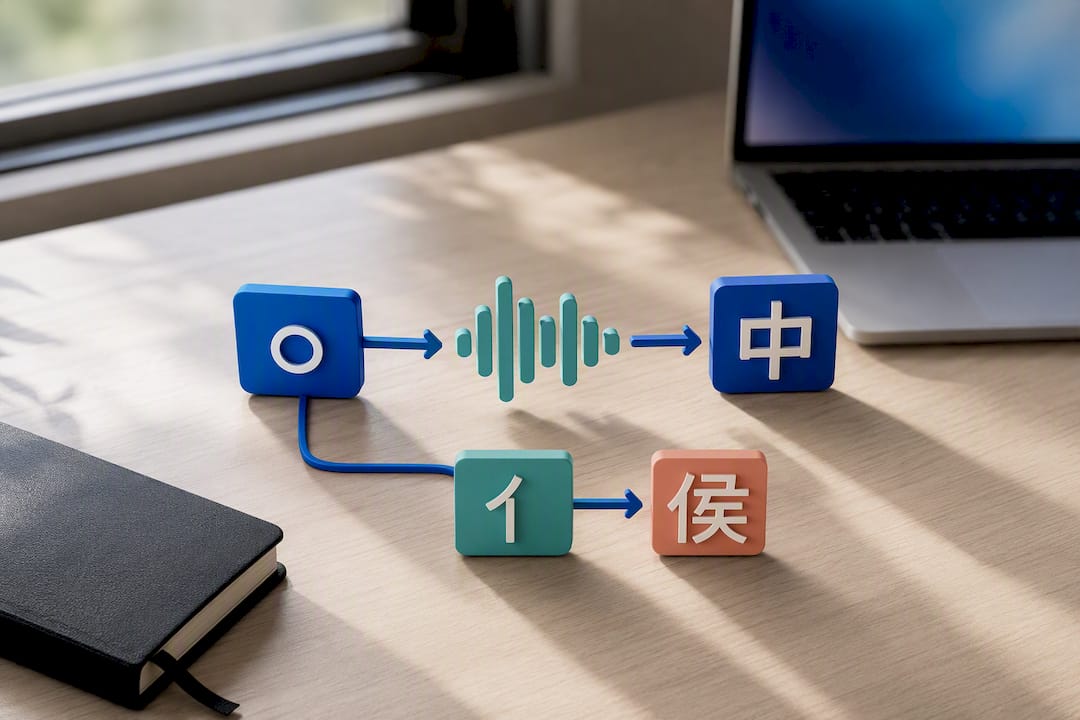
There’s a deeper payoff here too. Many characters share a phonetic component, a piece of the character that hints at pronunciation even though it’s not a reliable spelling system. Recognizing those components speeds up reading once your pronunciation is solid, because you start predicting how an unfamiliar character might sound based on pieces you already know. Skip solid pronunciation training, though, and that shortcut never develops. You end up memorizing each character in isolation, which is slower and far less durable. Treating Pinyin as a permanent tool rather than training wheels you’ll eventually discard also keeps your typing, dictionary lookups, and listening comprehension sharp long after you’ve moved on to reading full sentences in characters.
Mandarin Versus Other Chinese Dialects: What Changes and What Doesn’t
Standard Mandarin pronunciation, the version taught in nearly every course and app, is based on the speech patterns of northern China. Other Chinese language varieties, including Cantonese, Hokkien, and Shanghainese, are distinct spoken languages with their own tone systems, sound inventories, and in some cases six or more tones instead of Mandarin’s four. Learning Mandarin pronunciation does not transfer directly to any of these.
Even within Mandarin-speaking regions, accents vary noticeably. Speakers in parts of northern China sometimes add an “r” coloring to certain finals (a feature you’ll notice heavily in Beijing speech). Speakers in the south, including much of Taiwan and Southeast Asia, often soften or merge the retroflex zh/ch/sh/r sounds with their flatter j/q/x counterparts, and may not distinguish -n from -ng endings as sharply as textbook standard requires.
None of this should worry a beginner. Learn the standard textbook pronunciation first, the version taught in structured courses and reflected in every audio tool mentioned in this article. Once your foundation is solid, regional accents become easy to recognize and adjust to, the same way an American English speaker eventually tunes into Australian or Scottish accents without relearning the language from scratch. Trying to absorb regional variation before the standard system is set only slows down the whole process.
Common Pronunciation Errors That Have Nothing to Do With English
Some mistakes aren’t about English interference at all. They show up because Mandarin’s tone system is genuinely unfamiliar territory, and they hit learners from many language backgrounds equally hard.
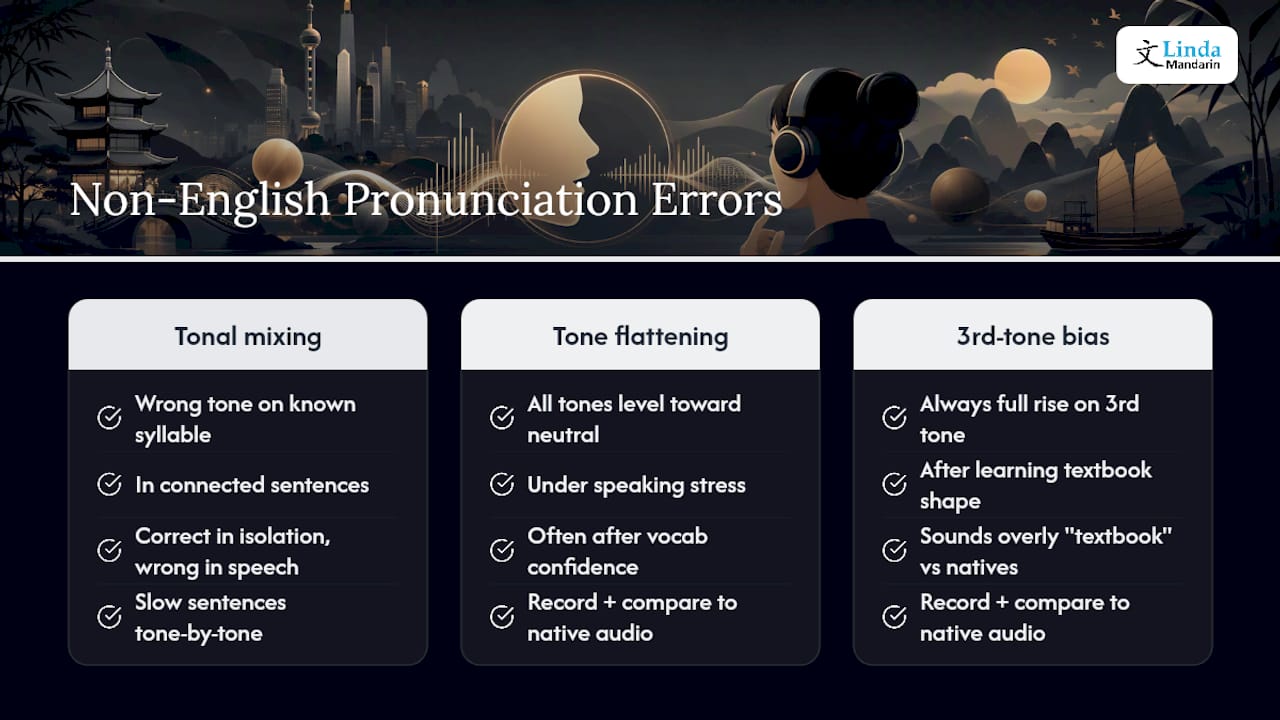
Tonal mixing is the big one: applying the wrong tone to a syllable you actually know how to pronounce correctly otherwise. This happens most often in longer sentences, where a learner nails the tones on individual words in isolation but scrambles them the moment those words string together at conversational speed. The fix isn’t more vocabulary. It’s slowing sentences down, tone by tone, before speeding back up.
A close cousin is tone flattening, where a learner unconsciously reduces all four tones toward a similar, neutral pitch, especially under the stress of trying to speak quickly. This often happens right after a learner starts feeling confident with vocabulary. Fluency pressure builds faster than tone accuracy does, and tones are usually the first thing to slip.
Third-tone overcorrection is another pattern worth watching for: learners who’ve just learned the textbook third-tone shape (dip low, then rise) start applying the full rising motion every single time, even in the middle of fast connected speech where native speakers usually just keep it low and flat. Ironically, sounding “too textbook” on the third tone is itself a giveaway of a non-native speaker.
Fixing all three comes back to the same habit: record yourself often, and compare against native audio rather than trusting how correct your own speech feels in the moment.
Bookmark These for Daily Practice
Keep one interactive chart and one TTS tool open on a daily basis rather than hunting for new resources every week:
- Interactive pinyin table: best for single-syllable audio and isolating specific initials, finals, or tones
- Structured pronunciation lessons: best for guided vowel and consonant exercises with built-in audio
- Pinyin notes and tone-sandhi rules: best as a reference when a tone change doesn’t make sense
Pick your two favorites and use them every day. Rotating tools constantly slows down the habit-forming repetition that actually builds accuracy.
Why Pronunciation Is the Part Worth Getting Right Early
Pronunciation is the most front-loaded skill in Mandarin. Unlike vocabulary or grammar, which keep expanding for years, the sound system is a fixed, closed set you can genuinely master in weeks rather than months. That’s the part most learners underestimate: the early wins come fast, and they compound. Get your tones and your tricky consonants solid in month one, and everything you learn afterward, every new word, every new sentence pattern, sits on a stable foundation instead of a shaky one.
The habit that breaks bad pronunciation fastest is brutally simple: record yourself, then listen back next to native audio. Most learners skip this because it’s uncomfortable to hear your own mistakes. Do it anyway. It’s the single fastest way to catch errors that feel correct in your own head but sound off to everyone else.
If you’ve been drilling on your own and keep hitting the same wall, a short trial lesson with corrective feedback can usually diagnose in twenty minutes what would take you weeks to self-correct through recordings alone. That’s not a knock on self-study. It’s just where a second set of ears, one trained to catch exactly these errors, earns its value.
— Paul
Ready to Fix Your Pronunciation With Guided Practice?
Everything in this article works as a self-study routine, but pronunciation errors that survive weeks of solo practice usually need a trained ear to catch them. Linda Mandarin’s conversational Mandarin classes, offered as both private and group sessions, build tone correction and sound drills directly into every lesson, with native-speaking instructors who catch the gaps a recording app can’t. If your schedule doesn’t allow for in-person sessions, the online Zoom courses deliver the same corrective feedback with recorded homework review, so you can hear exactly what changed between attempts. Professionals who need pronunciation clarity specifically for workplace contexts can look at the business Mandarin classes instead. All of Linda Mandarin’s adult courses run from its training center at 10 Anson Road, Level 22, International Plaza, Singapore, directly above Tanjong Pagar MRT, with both physical and online class formats available depending on what fits your routine.
Sources
- Pinyin notes (CTCFL / Oxford)
- Pinyin Table – pinyin, 中文拼音解决方案
- Getting started with Chinese 1: Pronunciation Guide: 1.1
FAQ
How Do You Pronounce Chinese Correctly?
Correct Chinese pronunciation means producing the right initial, final, and tone for every syllable, then matching native speech rhythm in full sentences. The most reliable method is listening to native audio, mimicking it, recording yourself, and comparing the two recordings side by side until the gap closes.
How Can I Check My Own Chinese Pronunciation?
Record yourself reading a sentence aloud, then play a native audio version of the same sentence immediately afterward and compare them directly. Interactive tools that offer single-syllable audio playback make it easier to isolate exactly which sound or tone is off.
What Is the Chinese Pronunciation System Called?
The standard romanization system used to represent Mandarin pronunciation is called Pinyin, which spells out each syllable’s initial, final, and tone using the Latin alphabet plus tone marks. It’s the foundation for reading, typing, and pronouncing any Mandarin word, even before you learn its character.
How Do I Find the Pronunciation of a Specific Word in Mandarin?
Type the word into a text-to-speech tool or pronunciation dictionary to hear a native audio sample, or look up its Pinyin spelling to see the tone marks written out. Checking the full tone pattern matters just as much as the letters themselves, since the same Pinyin spelling with a different tone is often a completely different word.