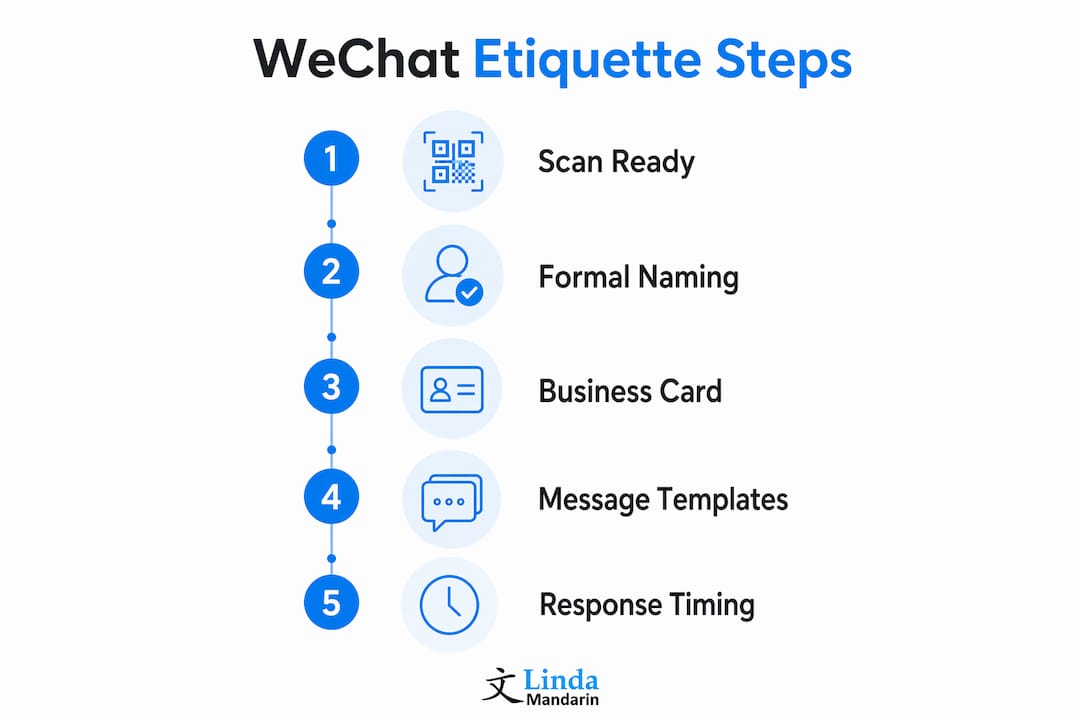
In Chinese business digital exchanges, relationship-preserving behavior — fast acknowledgment, respectful address, and careful use of WeChat features — matters as much as the message itself. Before anything else, do these four things: add your full name, company, and meeting context to every WeChat friend request; have your QR code ready before networking events; send a brief acknowledgment within a few hours of any business message; and use WeChat’s 120-second recall window immediately if you send something incorrect. Custom context notes significantly increase friend-request acceptance rates. Two cultural concepts drive everything: mianzi (face, meaning dignity and reputation) and guanxi (relationships, meaning your network of trust). Linda Mandarin’s business Mandarin courses are built around exactly these dynamics.
- Add a context note to every friend request (name + company + event)
- Acknowledge Hongbao (red packets) publicly and promptly
- Verify links and QR codes before clicking
- Use the 2-minute recall for any message sent in error
- Practice two templates per week until the phrasing feels natural
Table of Contents
- 1. How to exchange WeChat contacts the right way
- 2. Message templates you can copy right now
- 3. WeChat Moments and profile etiquette
- 4. Response timing and hierarchy signals
- 5. Cybersecurity is part of professional conduct
- 6. How mianzi and guanxi shape every digital interaction
- 7. Quick dos and don’ts for digital business interactions
- 8. How to practice these skills effectively
- 9. Email vs. WeChat: knowing which channel to use
- 10. Handling digital misunderstandings politely
- Key Takeaways
- Why small habits matter more than perfect Mandarin
- Build real confidence with Linda Mandarin’s business Mandarin training
- Useful sources
- FAQ
1. How to exchange WeChat contacts the right way
The junior party or service provider is expected to have their QR scanner ready. The senior contact typically presents their code. This is not a rigid rule, but defaulting to it signals awareness of hierarchy.
Your verification note should follow this format every time:
Set your profile display name as Title + Surname (e.g., Manager Chen / 陈经理). Keep a business card image saved on your phone so you can share it instantly. If you’re traveling to China, have a local SIM or eSIM ready — losing mobile data mid-introduction is the kind of awkward pause that sticks.
Pro Tip: Open your QR scanner and your business card image before you hand your phone to anyone. Fumbling through apps in front of a senior contact reads as unprepared.
2. Message templates you can copy right now
These templates cover the four most common scenarios. Use 您 (nín) for seniors and formal contacts; 你 (nǐ) is fine for peers once rapport is established. Limit yourself to one or two conservative emojis — a or — and only in semi-formal exchanges, never in the first message to a new contact.
Initial contact:
Meeting confirmation:
Follow-up:
Thank-you note:
Yifang Literature (乙方文学) — a recognized rhetorical style used by service providers — layers polite phrases, modal particles, and careful emoji use to soften requests without sounding sycophantic. It’s worth studying if you regularly communicate with Chinese clients.
3. WeChat Moments and profile etiquette
WeChat boundaries between personal and professional life are far more fluid than in Western markets. Your Moments feed is visible to colleagues and clients, so treat it as a curated professional window, not a personal diary.
Post industry milestones, team achievements, and relevant articles. Avoid political content, late-night social photos, and anything that could embarrass a colleague who’s in the same shot. Use the “Mute Moments” feature for contacts who post aggressive promotions — it keeps the relationship intact without cluttering your feed.
Three-day visibility is a widely used privacy setting that limits how far back visitors can scroll through your posts. Treat it as deliberate image management, not evasiveness.
| Scenario | Suggested Amount | Notes |
|---|---|---|
| Thank-you gesture | lucky numbers; safe for most professional contexts | |
| Team celebration | a slightly more generous amount; appropriate for group chats | |
| Avoid | Any amount with 4 | Associated with death in Chinese culture |
| Avoid | an amount associated with a slang insult; never use this amount |
Use the Transfer function for actual business payments. Hongbao (red packets) are for goodwill gestures, not invoices.
Pro Tip: When a colleague sends a Hongbao in a group chat, claim it and say thank you publicly in the chat. Silence after claiming reads as rude, and it damages guanxi faster than most people expect.
4. Response timing and hierarchy signals
Timely acknowledgment is a professional obligation in Chinese business communication, not a courtesy. A quick reply signals reliability; a slow one signals indifference, even when you’re genuinely busy.
For routine messages, acknowledge within a few hours. For directives from a senior contact, faster is always better. You don’t need a full answer immediately — “收到,稍后回复您” (Shōudào, shāohòu huífù nín / “Received, I’ll follow up shortly”) buys time without leaving someone waiting.
Seniority shapes who speaks first. In group chats, seniors often set the tone by posting first. Juniors should avoid jumping ahead of them. When a senior posts a Moment, a quick “like” or short positive comment is a low-effort, high-value signal of respect.
Address contacts as 职位+姓 (title + surname) until invited to use a first name. 老师 (lǎoshī, literally “teacher”) is a respectful term used broadly for mentors, senior colleagues, and experts — it’s never wrong to use it when in doubt. For meeting follow-ups, send your thank-you message within 24 hours, not 72.
Avoid voice messages longer than 30 seconds in business group chats. The 60-second voice message is a known irritant — it forces the recipient to listen in sequence and can’t be skimmed. Use @mentions sparingly; they push a notification and carry a sense of urgency.
5. Cybersecurity is part of professional conduct
Information security is a professional obligation in Chinese business contexts, not just an IT concern. Verifying a link before clicking it protects both your company data and your relationship capital — a phishing incident traced back to your account damages trust quickly.
Before clicking any link or scanning a third-party QR code, confirm the sender’s identity through a separate channel (a voice call or a message on a different platform). When in doubt, scan within a protected environment.
File-sharing etiquette matters too. Name files clearly: YYYYMMDD_Company_Topic_v1.pdf. State the file’s purpose in your message before sending, and request a brief acknowledgment after sharing anything sensitive.
- Verify first: Confirm sender identity before clicking links or scanning unknown QR codes
- Name files clearly: Use YYYYMMDD_Company_Topic_v1.pdf format every time
- State the purpose: One sentence in the message explaining what the file contains
- Request acknowledgment: “请确认收到” (Qǐng quèrèn shōudào / “Please confirm receipt”)
- Use Transfer, not Hongbao, for payments: Mixing them creates confusion and looks unprofessional
- Recall immediately: If you send the wrong file or message, use the 120-second recall without delay
Pro Tip: If a message looks suspicious — even from a known contact — ask for voice confirmation before forwarding anything. Accounts get compromised; a quick call takes 20 seconds.
6. How mianzi and guanxi shape every digital interaction
Mianzi (面子) is your social reputation — the dignity others extend to you and that you protect for them. Guanxi (关系) is the web of relationships that makes business possible. Every digital action either builds or erodes both.
Liking a colleague’s Moment, acknowledging a Hongbao, replying quickly to a group message — these are not small gestures. They are deliberate acts of reciprocity that signal you take the relationship seriously. Skipping them, even once, can register as a slight.
Softening a request preserves face for both parties. Instead of “Send me the report by Friday,” try: “如果方便的话,能否在周五前发送报告?” (Rúguǒ fāngbiàn dehuà, néng fǒu zài zhōuwǔ qián fāsòng bàogào? / “If it’s convenient, could you send the report by Friday?”). The meaning is identical; the tone is entirely different.
For U.S. learners, the shift to think about is this: in Chinese business culture, digital communication is continuous relationship maintenance. Every message is a small deposit or withdrawal from a shared account of trust.
7. Quick dos and don’ts for digital business interactions
Do:
- Add full context (name, company, role, event) to every WeChat friend request
- Acknowledge Hongbao publicly and immediately in group chats
- Use 您 (nín) for seniors and formal contacts until told otherwise
- Keep voice messages under 30 seconds and offer a text summary
- Like or comment briefly on a senior contact’s Moments post
Don’t:
- Send links or QR codes without explaining what they are
- Post political content or late-night party photos on Moments
- Claim a Hongbao and say nothing
- Use animated GIFs or casual stickers in formal business chats
- Use more than two emojis in a single business message
Emoji guidance: and are safe in semi-formal contexts. Animated GIFs and playful stickers belong in personal chats only. When in doubt, use none.
Mistake recovery: Recall the message within 120 seconds, follow with a brief apology (“非常抱歉,发错了” / Fēicháng bàoqiàn, fā cuò le / “Very sorry, sent the wrong message”), and send a private clarification if the error was sensitive.
8. How to practice these skills effectively
Micro-practice beats marathon study sessions. Pick two templates from Section 2, write them out by hand, then type them into a practice chat with a study partner. Do this three times a week. Within a month, the phrasing stops feeling foreign.
Role-play is the fastest path to real confidence. Simulating a WeChat group scenario — where you have to respond to a senior’s message, acknowledge a Hongbao, and confirm a meeting time, all within a few minutes — builds the kind of muscle memory that reading alone never does.
Look for training that includes native instructor feedback on actual messages you write, not just grammar drills. Linda Mandarin offers online Zoom adult courses and corporate training programs focused on business Mandarin and practical digital communication. Courses include role-play, simulated group chat scenarios, and instructor feedback on tone and phrasing — the exact skills this guide covers.
When evaluating any training option, ask three questions: Does it include role-play? Is the instructor a native Mandarin speaker with business experience? Will you get feedback on real messages you write?
Pro Tip: Practice your friend-request verification note until you can type it in under 60 seconds. That one habit alone signals professionalism before a single meeting takes place.
9. Email vs. WeChat: knowing which channel to use
Email and WeChat serve different functions in Chinese business, and mixing them up signals inexperience. Email is for formal proposals, contracts, and documentation — anything that needs a paper trail. WeChat is for relationship maintenance, quick confirmations, and real-time coordination.
In email, use a formal subject line, full salutation, and structured paragraphs. Avoid emojis entirely. Response expectations are slower — 24 to 48 hours is standard. In WeChat, shorter is better. A three-sentence message is often more effective than a detailed paragraph. Professional conduct requires matching the platform to the message type.
One practical rule: never send a contract or sensitive document for the first time via WeChat. Send it by email, then follow up on WeChat to confirm receipt. That sequence respects both the formality of the content and the speed of the relationship.
10. Handling digital misunderstandings politely
When something goes wrong in a digital exchange — a misread tone, an accidentally forwarded message, a delayed reply that offended — the instinct to over-explain publicly is usually the wrong move. Address it privately first.
Send a direct message: “非常抱歉造成误解,我想私下解释一下” (Fēicháng bàoqiàn zàochéng wùjiě, wǒ xiǎng sīxià jiěshì yīxià / “Very sorry for the misunderstanding, I’d like to clarify privately”). This preserves the other person’s face by keeping the correction out of the group chat. A public correction, even a gentle one, can feel like a public rebuke.
If the misunderstanding happened in a group chat and others saw it, a brief, calm acknowledgment in the group (“抱歉,我表达不清楚” / Bàoqiàn, wǒ biǎodá bù qīngchǔ / “Sorry, I wasn’t clear”) followed by a private message to the key person is the right sequence. Never escalate in writing. If the issue is serious, move to a phone call.
Key Takeaways
Digital etiquette in Chinese business is relationship maintenance in real time — every message, like, and acknowledgment either builds or erodes trust.
| Point | Details |
|---|---|
| Contextualize friend requests | Always include your name, company, role, and meeting context in every WeChat request. |
| Acknowledge Hongbao immediately | Claim and thank publicly in group chats; silence after claiming damages guanxi. |
| Verify before you click | Confirm sender identity before opening links or scanning unfamiliar QR codes. |
| Use the 120-second recall | If you send an incorrect message, recall it within 120 seconds and follow with a brief apology. |
| Linda Mandarin for guided practice | Online Zoom and corporate training programs cover business Mandarin and digital etiquette through role-play and native instructor feedback. |
Why small habits matter more than perfect Mandarin
Most U.S. learners approach Chinese business communication as a language problem. It’s actually a habit problem. The people who build strong guanxi fastest are not the ones with the largest vocabulary — they’re the ones who reply quickly, acknowledge gestures, and get the small social signals right consistently.
Start with one change this week: write your WeChat verification note, memorize it, and use it the next time you add a contact. Then practice one thank-you template. That’s it. Two small habits, repeated, compound into real professional credibility over months.
The cultural gap is real, but it’s learnable. Every template in this guide represents a pattern that native speakers use daily. Borrow the pattern, practice the phrasing, and the confidence follows.
Build real confidence with Linda Mandarin’s business Mandarin training
Most learners know the rules intellectually but freeze when it’s time to type a real message to a real contact. That gap between knowing and doing is exactly what structured practice closes.

Linda Mandarin’s corporate Chinese Mandarin training and online Zoom adult courses are built for professionals who need immediately usable skills, not textbook theory. Native-speaking instructors with business backgrounds run role-play scenarios that mirror real WeChat group dynamics, message drafting, and cultural etiquette situations. Teams get customized programs; individual learners get flexible group or private class formats. If you want to go from reading this guide to actually using these skills with confidence, view the course details and reach out to Linda Mandarin to find the right format for your schedule and goals.
Useful sources
- StartChina Travel: The Unwritten Rules of WeChat — Hongbao amounts, recall function, group chat politics
- The World of Chinese: Yifang Literature — polite phrasing and emoji strategy
- ChinaComes: WeChat Moments Etiquette — three-day visibility and Moments norms
- Hicom Asia: Digital Etiquette — professional conduct and platform selection
- U.S. Trade.gov: China Business Travel Guide — cybersecurity as professional obligation
- Linda Mandarin: Business Chinese Training — adult business Mandarin courses and corporate programs
FAQ
What should I write in a WeChat friend-request note?
Include your full name, company, role, and where you met. Custom context notes significantly increase acceptance rates compared to blank requests.
How many emojis are appropriate in Chinese business messages?
One or two conservative emojis — such as or — are acceptable in semi-formal WeChat exchanges. Use none in formal emails or first messages to new contacts.
What is the WeChat recall window?
You have exactly 120 seconds to recall a sent message before it becomes permanent. Use it immediately if you send something incorrect, then follow with a brief apology.
How does email differ from WeChat in Chinese business?
Email is for formal documents and contracts; WeChat is for quick coordination and relationship maintenance. Send sensitive documents by email first, then confirm receipt on WeChat.
How do mianzi and guanxi affect digital communication?
Mianzi (face) and guanxi (relationships) mean every digital action — a quick reply, a liked Moment, a public Hongbao acknowledgment — carries social weight. Skipping these signals can damage trust faster than most Western professionals expect.