Singapore Mandarin and Mainland Putonghua are mutually intelligible siblings, not the same language in different clothes. Singaporeans and Mainland Chinese speakers understand each other in almost every conversation, but Singapore Mandarin carries its own phonetic habits, borrowed vocabulary, and syntax patterns shaped by decades of contact with English, Malay, and southern Chinese dialects. For formal or interregional communication, lean on Standard Mandarin. For everyday rapport in Singapore, expect and welcome the local flavor.
TL;DR:
- Singapore Mandarin heavily incorporates loanwords from Malay, English, and southern Chinese dialects, which can cause confusion for Mainland Chinese speakers unfamiliar with these terms.
- Pronunciation differences such as reduced retroflex consonants do not significantly affect understanding, as context helps clarify meaning in casual conversation.
- Formal communication in Singapore uses Standard Mandarin, but everyday speech often features colloquial patterns, particles, and local vocabulary that differ from Mainland norms.
- Learning Standard Mandarin first, then gradually incorporating local vocabulary and speech habits, is the most effective approach for adult learners in Singapore.
- Singapore Mandarin is a legitimate regional variety, emphasizing the importance of language flexibility and register switching rather than strict correctness.
Table of Contents
- What Is Singapore Mandarin vs Mainland Putonghua?
- How Does Singapore Mandarin Sound Different?
- What Vocabulary Differs Between Singapore and Mainland Mandarin?
- Grammar Differences: How Sentence Structure Shifts
- Do Singaporeans and Mainland Chinese Understand Each Other?
- How Should Adult Learners in Singapore Approach This?
- Is Singapore Mandarin a Legitimate Variety of Chinese?
- Where to Learn Standard Mandarin and Local Register in Singapore
- Sources
- FAQ
What Is Singapore Mandarin vs Mainland Putonghua?
Mandarin in Singapore goes by a specific local name: Huayu (华语). It’s one of four official languages in the country, and it functions less like an import from Beijing and more like a regional variety that grew up under different pressures than its Mainland counterpart.
That growth happened in two distinct lanes. Standard Singaporean Mandarin (SSM) is the version taught in classrooms, broadcast on the news, and used in official government communication. It hews close to Putonghua grammar and pronunciation. Colloquial Singaporean Mandarin, sometimes nicknamed Singdarin, is what actually gets spoken at hawker centers, in offices, and among friends. It freely mixes in English, Malay, and southern Chinese dialect vocabulary, plus grammatical shortcuts that would raise eyebrows in a Beijing classroom.
The historical path here matters. Before the 1980s, Singapore’s Mandarin media landscape leaned heavily on Taiwanese and Hong Kong influence: Taiwanese pop songs, Hong Kong dramas dubbed into Mandarin, and textbooks that didn’t always match Mainland conventions. The government’s Speak Mandarin movement, launched in 1979, pushed a unifying standard across a population that spoke Hokkien, Teochew, Cantonese, and other dialects at home. Later waves of Mainland Chinese immigration and business contact added a second layer of influence, nudging Standard Singaporean Mandarin closer to Putonghua norms over time.
A few practical anchor points:
- Singapore uses simplified Chinese characters, aligning its script with Mainland China rather than Taiwan’s traditional system.
- Broadcast pronunciation and textbooks largely follow pinyin standards.
- Formal domains (courts, ministries, national news) default to Standard Singaporean Mandarin.
- Casual domains (family dinners, marketplace haggling, WhatsApp chats) default to the colloquial form.
If you’ve wondered what kind of Chinese Singaporeans actually speak, the honest answer is: both, depending on who’s listening.
How Does Singapore Mandarin Sound Different?
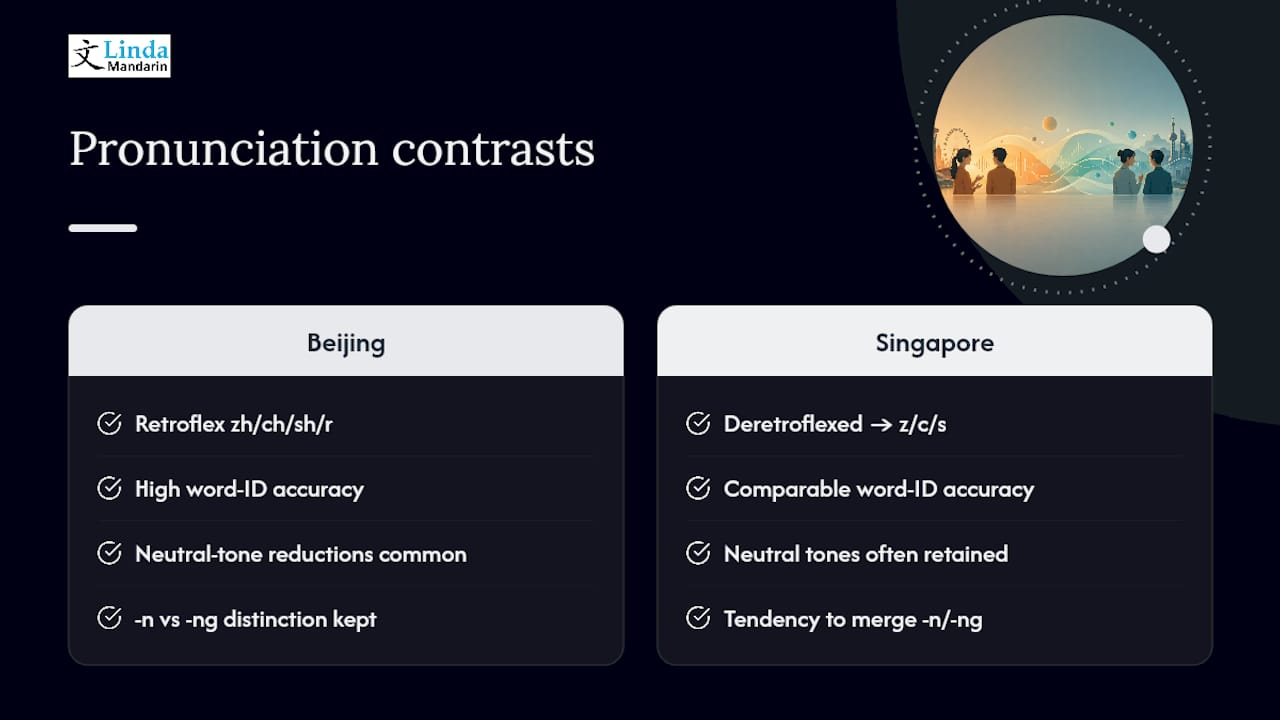
The most noticeable difference lands in the mouth before it lands in the dictionary. Mainland Putonghua, especially the Beijing standard, leans on retroflex consonants, the tongue-curled sounds behind zh, ch, sh, and r. Singapore Mandarin tends to flatten these into their alveolar cousins (z, c, s), a pattern linguists call deretroflexion.
Quick stat: A 2023 acoustic study of Singapore Mandarin bilinguals measured this contrast directly and found reduced retroflex/alveolar distinction in production, yet comprehension tests showed no measurable drop in word identification compared with Beijing speech.
That last part deserves emphasis, because it counters a common assumption. People often expect that if pronunciation shifts, understanding suffers. It doesn’t, at least not in controlled listening tests. Singapore listeners and Mainland listeners identified words at comparable rates even when the retroflex sounds were softened or merged.
A few other phonological patterns worth knowing:
Tone behavior in Singapore Mandarin sometimes skips the neutral-tone reductions that Mainland speakers apply automatically to certain grammatical particles and suffixes. Where a Beijing speaker might lighten a syllable to a near-toneless mumble, a Singaporean speaker often keeps it fuller and more evenly stressed. There’s also a documented tendency toward merging final nasal consonants, blurring the line between -n and -ng endings in casual speech, a feature that shows up across several Southeast Asian Mandarin-speaking communities, not just Singapore.
None of this creates real ambiguity in normal conversation. Context does the heavy lifting that phonetic precision would otherwise handle. If you’re a learner trying to sound more neutral, the fix is mechanical rather than mysterious: practice minimal pairs like shi versus si, record yourself, and compare against Mainland audio. Shadowing news broadcasts from Mainland sources for ten minutes a day retrains the tongue faster than passive listening ever will.
Pro Tip: Don’t chase a “neutral” accent by memorizing rules. Record three minutes of your own speech weekly and compare it against a Mainland news clip. Your ear will catch drift long before your brain formalizes what’s wrong.
What Vocabulary Differs Between Singapore and Mainland Mandarin?
This is where the two varieties diverge most visibly, and where a Mainland visitor is most likely to get genuinely confused. Singapore Mandarin absorbed loanwords from Malay, English, and southern Chinese dialects over generations of daily contact, and many of those words never made it into standard Putonghua at all.
Some of the most common examples:
- 巴刹 (bāshā) — “market” or “wet market,” borrowed from the Malay word pasar. A Mainland speaker would typically say 市场 (shìchǎng).
- 德士 (déshì) — “taxi,” a phonetic loan from English. Mainland Mandarin uses 出租车 (chūzūchē).
- 组屋 (zǔwū) — public housing flats, a term specific to Singapore’s housing board system and essentially meaningless outside the country.
- 巴仙 (bāxiān) — “percent,” from the English “per cent,” used alongside the standard 百分之 construction.
Beyond nouns, colloquial Singapore Mandarin frequently imports Singlish pragmatic particles straight into Mandarin sentences. A speaker might say something equivalent to “他很忙的 lah” or tack on “咯” (lor) at the end of a statement to soften it or signal resignation, patterns that come directly from Singapore’s multilingual sentence-final particle system. None of this appears in Mainland speech, where such particles either don’t exist in Mandarin or come from different sources entirely.
For cross-regional communication, the rule is simple: strip out the local nouns and particles when speaking with someone from Beijing, Shanghai, or Guangzhou, unless you’ve explained the terms first. Say 出租车 instead of 德士 in a business call with a Shanghai client, and you’ll avoid the three seconds of confused silence that follows an unfamiliar loanword. Local vocabulary builds warmth and belonging in Singapore; it creates friction almost everywhere else in the Mandarin-speaking world.
Grammar Differences: How Sentence Structure Shifts
Grammar is where the differences get subtle but genuinely systematic, not just anecdotal quirks. Three patterns come up again and again in comparisons between the two varieties.
Adverb placement around verbs. In colloquial Singapore Mandarin, you’ll often hear something like 你吃先 (roughly, “you eat first”), placing the adverb 先 after the verb. Standard Putonghua flips this to 你先吃, with the adverb preceding the verb. Both are understood everywhere, but the post-verbal placement is a Singapore hallmark, likely influenced by parallel structures in Hokkien and Malay.
Classifier simplification. Mandarin uses different measure words for different object categories, a system that gets genuinely elaborate in Mainland speech: 一颗糖, 一杆枪, 一辆车, each noun paired with its “correct” classifier. Singapore Mandarin often defaults to the general-purpose classifier 一粒 for a broader range of small, round, or countable objects than Mainland norms would typically allow, smoothing over distinctions that Mainland speakers keep separate.
Aspect markers. This is where the corpus evidence gets specific rather than impressionistic. A pilot corpus study comparing Singapore, Mainland China, and Taiwan Mandarin found that certain aspect markers, including 过 (indicating past experience) and 着 (indicating ongoing state), appear at measurably lower relative frequencies in Singapore Mandarin than in Mainland data. The same research noted that Singapore usage sometimes patterns closer to Taiwan Mandarin than to Mainland conventions in these grammatical domains, suggesting a shared regional drift among non-Mainland varieties rather than a purely Singapore-specific quirk.
None of these patterns are grammatical errors. They’re stable, rule-governed differences that a fluent Singapore speaker uses consistently, and a well-trained ear picks them up within a few conversations. A short comparison:
| Feature | Mainland pattern | Singapore colloquial pattern |
|---|---|---|
| Adverb placement | 你先吃 (adverb before verb) | 你吃先 (adverb after verb) |
| Classifier for small objects | Category-specific (颗, 个, 只) | Broader use of 一粒 |
| Aspect marker 过/着 frequency | Higher relative frequency | Lower relative frequency |
None of this shows up as “wrong” Mandarin in Singapore itself. It’s simply the local dialect of a pluricentric language doing what dialects do.
Do Singaporeans and Mainland Chinese Understand Each Other?
Mostly, yes, and the gap is far narrower than it might sound on paper. Comprehension studies consistently show high mutual intelligibility between Singapore and Mainland speakers, with the acoustic and grammatical differences functioning more like an accent and a regional vocabulary layer than a barrier.
Trouble spots do exist, and they cluster in predictable places:
- Rare local lexemes. Words like 巴刹 or 组屋 stop a Mainland listener cold because there’s no context clue to fall back on.
- Heavy particle stacking. A sentence loaded with lah, lor, and other Singlish-influenced particles can obscure the core meaning for an outside listener unfamiliar with the pattern.
- Minimal-pair ambiguity. In fast, casual speech, the softened retroflex sounds occasionally blur distinctions between similar-sounding words, though context almost always resolves it within a sentence or two.
The practical fix is a register switch, not a full relearning. Default to Standard Mandarin, standard vocabulary, minimal particles, clearer retroflex articulation, in formal meetings, interviews, or any conversation with someone from outside Singapore. Shift toward the local register when you’re building rapport with Singaporean colleagues, friends, or hawker stall regulars, where dropping in a lah or a 德士 signals belonging rather than sloppiness.
How Should Adult Learners in Singapore Approach This?
If you’re learning Mandarin as an adult in Singapore, the sequencing matters more than most course brochures let on. Build Standard Mandarin competence first. It’s what gets you understood clearly in business meetings, government offices, and conversations with Mandarin speakers from Mainland China, Taiwan, or Malaysia. Standard forms travel; colloquial forms don’t always.
Once that foundation is solid, layering in local vocabulary and pragmatic particles becomes a genuine asset rather than a distraction. Sprinkling in the right loanword at the right moment, ordering at a hawker stall with 巴刹 vocabulary, softening a request with a well-placed particle, signals cultural fluency that textbook Mandarin alone never delivers.
Study priorities split cleanly by goal:
- Business and professional learners: prioritize Standard Mandarin grammar, formal vocabulary, and presentation-ready pronunciation before touching colloquial features.
- Social and casual learners: balance standard fundamentals with targeted exposure to common particles and loanwords used in daily Singapore conversation.
- Anyone job-hunting or client-facing: treat register-switching as a trainable skill, not an instinct you either have or don’t.
Pro Tip: Ask any Mandarin course in Singapore how much class time goes toward listening practice with Mainland audio versus local speech. A program that ignores one side leaves you unprepared for half your real-world conversations.
For structured guidance on sequencing this kind of study, proven steps for learning Mandarin in Singapore and choices around Singapore’s Mandarin dialects both lay out practical starting points worth reading before picking a course.
Is Singapore Mandarin a Legitimate Variety of Chinese?
Singapore Mandarin isn’t a broken or degraded version of “real” Mandarin. Scholarly work increasingly frames it as a pluricentric variety, meaning Mandarin has multiple legitimate regional centers of gravity, Beijing, Taipei, Singapore, each with internally consistent rules shaped by its own history of language contact. That framing matters because the alternative, treating every non-Mainland form as a lesser deviation, actively discourages the kind of pragmatic bilingualism that fluent speakers actually practice every day.
The real skill isn’t picking a side between “correct” Mainland Mandarin and “casual” Singapore Mandarin. It’s switching between registers the way a fluent English speaker switches between a boardroom and a barbecue. A Singaporean professional who code-switches from Standard Mandarin in a client call to Singdarin over lunch isn’t speaking worse Mandarin at lunch. They’re speaking appropriately for the room.
That’s the cultural takeaway worth holding onto: linguistic flexibility, not linguistic purity, is what actually signals mastery here.
— Paul
Where to Learn Standard Mandarin and Local Register in Singapore
Understanding the difference between Standard Mandarin and colloquial Singapore speech is one thing. Building the actual skill to move between them is another, and that’s where structured, guided practice earns its keep over trial and error at the hawker center. Com runs adult conversational and business Mandarin courses at its central training space at 10 Anson Road, Level 22, International Plaza, right above Tanjong Pagar MRT, and the same curriculum runs live over Zoom for anyone who’d rather train from home or the office.
Courses run in group, private, or online formats, with instruction focused on the speaking and listening skills that actually get used in meetings, client calls, and daily conversation, not just exam drills. Business professionals looking to communicate with Mainland partners without stumbling over local vocabulary can start with the course levels overview to find the right entry point, or go straight to corporate Mandarin training if the goal is training a whole team. If you’re weighing intensive progress against a steady weekly pace, the intensive Mandarin course is worth a look before you commit to a schedule.
Sources
- Contrastive alveolar/retroflex phonemes in Singapore Mandarin bilinguals — 2023 study
- Singapore Mandarin: Its Positioning, Internal Structure and Corpus Planning — Lin (2018)
- Pilot corpus study comparing aspect marking across Singapore, Mainland China and Taiwan — ACL anthology
- Singaporean Mandarin — Wikipedia
FAQ
Can Lee Kuan Yew Speak Mandarin?
Yes. Singapore’s founding prime minister famously learned Mandarin as an adult and later championed the Speak Mandarin movement that shaped Standard Singaporean Mandarin’s role in schools and media.
What Percentage of Singapore Speaks Mandarin? Exact current usage figures vary by survey and household context and aren’t reliably summarized by a single public statistic.
Mandarin, or Huayu, is one of Singapore’s four official languages and is widely spoken among the Chinese population, though exact current usage figures vary by survey and household context and aren’t reliably summarized by a single public statistic.
Does Mark Zuckerberg Speak Mandarin or Cantonese?
Mark Zuckerberg has publicly spoken Mandarin, not Cantonese, most notably in a widely circulated question-and-answer session at Tsinghua University conducted largely in Mandarin.
Why Is Singapore 75% Chinese?
Singapore’s Chinese majority traces back to migration from southern China, particularly Fujian and Guangdong provinces, during the colonial trading-port era, which established the demographic base that persists today.
Should I Learn Standard Mandarin or Singapore Colloquial Mandarin First?
Standard Mandarin first. It’s understood everywhere, including in formal settings and cross-regional conversations, while colloquial features are easier to pick up naturally once your fundamentals are solid.
Is Singapore Mandarin Easier to Learn Than Mainland Mandarin?
Not inherently easier, just different in emphasis. Singapore Mandarin uses simplified characters like Mainland Mandarin, but its heavier reliance on context and mixed vocabulary can actually complicate listening comprehension for a beginner.