TL;DR:
- Learning Chinese character writing relies on muscle memory, structure, and radicals rather than artistic talent.
- Following proper stroke order, understanding radicals, and practicing with focus and consistency build practical writing skills over time.
Learning how to write Chinese characters feels overwhelming at first. You look at a single character and see a dense tangle of lines without any obvious logic. But that logic absolutely exists. Writing Chinese characters is about building muscle memory through smart repetition and understanding structure, not artistic talent or photographic memory. This guide walks you through the foundational rules of strokes, the system of radicals, proven practice techniques, and the most common mistakes to avoid so you can build real writing ability from day one.
Table of Contents
- Key takeaways
- How to write Chinese characters: starting with strokes
- Radicals and character structure
- Practice techniques that build real skill
- Common mistakes and how to avoid them
- My honest take on learning to write Chinese
- Take your Chinese writing further with structured learning
- FAQ
Key takeaways
| Point | Details |
|---|---|
| Master stroke order first | Correct stroke sequence affects legibility and is required for digital character recognition. |
| Learn radicals as building blocks | The 50 to 100 most common radicals function like a periodic table, unlocking patterns across thousands of characters. |
| Practice quality beats quantity | Writing a character 5 to 10 focused times beats mindlessly copying it 50 times with errors. |
| Use digital tools strategically | Apps like Skritter provide real-time stroke feedback that accelerates accurate muscle memory development. |
| Avoid perfectionism early | Communicative, readable handwriting is the goal. Aesthetic perfection comes much later, if at all. |
How to write Chinese characters: starting with strokes
Every Chinese character, no matter how complex, is built from a set of basic strokes. Before you write a single full character, you need to know these strokes and the rules that govern their sequence.
The seven core stroke types
The official stroke order standard for the 8,105 most commonly used characters classifies strokes into five primary categories: horizontal (横, héng), vertical (竖, shù), left-falling (撇, piě), dot (点, diǎn), and turning (折, zhé). In practice, learners work with seven common stroke forms that cover almost everything you will encounter as a beginner.
| Stroke Name | Direction | Example Character |
|---|---|---|
| Héng (horizontal) | Left to right | 三 (three) |
| Shù (vertical) | Top to bottom | 十 (ten) |
| Piě (left-falling) | Upper right to lower left | 人 (person) |
| Nà (right-falling) | Upper left to lower right | 人 (person) |
| Diǎn (dot) | Short press, varies | 心 (heart) |
| Zhé (turning) | Changes direction mid-stroke | 口 (mouth) |
| Gōu (hook) | Ends with a flick | 小 (small) |
The five stroke order rules you must follow
Stroke order is not arbitrary. The standardized stroke order system exists because it produces the most natural pen flow, keeps proportions balanced, and allows computerized character recognition to function correctly. The five core principles are:
- Top to bottom. You always write the upper part of a character before the lower part.
- Left to right. For characters with side-by-side components, the left component comes first.
- Horizontal before vertical. When strokes cross, draw the horizontal line first.
- Outside before inside. For enclosures like 口, draw the frame before filling it in.
- Close last. When an enclosure has a bottom stroke, that closing stroke comes after the interior content.
Applying these rules consistently is what separates a readable handwritten character from one that looks distorted. A character written with wrong stroke order tends to have uneven spacing and proportions because the natural weight distribution of the pen changes.
Pro Tip: Use a tool like Skritter or the stroke order diagrams inside Pleco to check your order on any new character before you practice it. Correcting stroke order before it becomes habitual saves hours of relearning later. You can also explore Chinese stroke order rules and common mistakes on the Linda Mandarin blog.
Radicals and character structure
Once you understand strokes, the next breakthrough comes from understanding why characters look the way they do. That answer lies in radicals and structural logic.

What radicals actually are
A radical is a recurring graphic component that usually provides a clue to a character’s meaning. For example, the water radical 氵 appears in 海 (sea), 河 (river), and 泳 (swim). Spotting it tells you the character likely relates to water before you even know the pronunciation. The most common radicals number between 50 and 100, and once you know them, you can decode the logic behind thousands of characters rather than treating each one as a fresh mystery.
Alongside the semantic radical, most characters also contain a phonetic component, a part that hints at pronunciation. This combination of meaning clue plus sound clue is the underlying architecture of the majority of Chinese characters. Learning to spot both pieces transforms character learning from memorization into pattern recognition.
The three main character structures
Characters are not arranged randomly. They follow predictable spatial layouts that you can recognize on sight:
- Left-right structure. The character splits into a left component and a right component. Example: 明 (bright) combines 日 (sun) on the left and 月 (moon) on the right.
- Top-bottom structure. One component sits above the other. Example: 男 (male) places 田 (field) above 力 (strength).
- Enclosure structure. One component wraps around another. Example: 国 (country) encloses 玉 (jade) inside a border.
Mnemonics that actually work
Breaking characters into smaller parts and creating mnemonic stories accelerates learning dramatically compared to rote drilling. Take the character 好 (good). It combines 女 (woman) on the left and 子 (child) on the right. A simple story: a woman with a child represents something good. That visual story takes 10 seconds to create and sticks far longer than writing the character 30 times without thinking about it.
When you learn to memorize Chinese characters this way, you also make writing easier because you are not trying to recall a shape. You are reconstructing a story you already know.
Practice techniques that build real skill
Understanding strokes and radicals gives you the map. Consistent, smart practice is how you actually travel the territory. Here is a structured approach that works for adult learners with limited time.
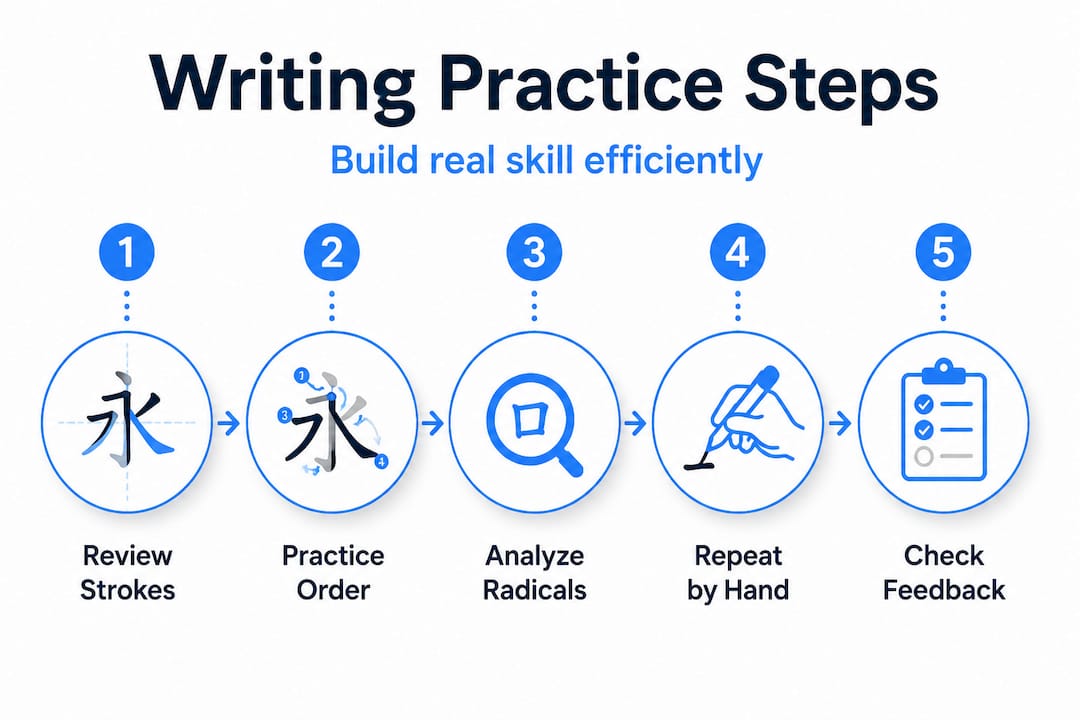
A four-step writing practice routine
- Study the character in context first. Before writing, see the character used in a word or sentence. This gives your memory a semantic hook that pure copying cannot provide.
- Check the stroke order. Look up the correct sequence using an app or reference sheet before touching your pen. Never guess and then practice the guess.
- Write it 5 to 10 focused times. Focused repetitions of 5 to 10 times with full attention to each stroke build accurate muscle memory. If you notice an error forming, stop and restart rather than drilling the mistake.
- Review with spaced repetition. Add the character to a spaced repetition system and review it at the intervals the software schedules. Apps like Skritter and Anki schedule optimal review intervals that keep characters in long-term memory without over-drilling.
| Tool | Best For | Key Feature |
|---|---|---|
| Skritter | Stroke order practice | Real-time stroke feedback |
| Anki | Long-term retention | Custom writing prompts and scheduling |
| Pleco | Reference and look-up | Built-in stroke order animations |
| Gridded practice paper | Physical handwriting | Guides proportion and spacing |
Why gridded paper still matters
Many learners skip physical writing entirely in favor of digital tools. That is a mistake for beginners. Writing on gridded paper forces you to manage proportion, which is something screen-based practice often handles automatically. Each character should fill roughly the same-sized square with consistent margins. When you practice this on paper, you train your hand to produce balanced, readable characters rather than cramped or oversized ones.
Pro Tip: Combine physical and digital practice. Write each character by hand five times on grid paper, then immediately type it using a Pinyin input method on your phone. Typing Chinese using Pinyin reinforces pronunciation and creates a second mental pathway that strengthens recall for handwriting.
Using basic Chinese writing strategies that combine spaced repetition with paper practice is one of the most time-efficient approaches available to adult learners.
Common mistakes and how to avoid them
Most learners who struggle with Chinese character writing are not lacking talent. They are repeating a small set of fixable mistakes.
- Ignoring stroke order until later. Many beginners decide to “fix stroke order eventually.” This never happens. Once wrong muscle memory forms, it takes three to five times as long to correct as it would have to learn correctly from the start.
- Drilling without attention. Writing a character 50 times while watching television does almost nothing for retention. Muscle memory develops through mindful, consistent practice, not sheer volume.
- Chasing perfection too early. Spending 20 minutes trying to make one character look beautiful while ignoring 19 others on your study list is a common beginner trap. Communicative handwriting, the kind that conveys the correct character clearly, is the actual goal.
- Studying characters in isolation. A character practiced alone, without a word or sentence, is harder to recall in real use. Always connect new characters to at least one word you already know or are learning.
- Skipping self-assessment. Most learners do not check their own output critically. Compare your written character against the printed version every few repetitions. Spot the differences before they become permanent habits.
“Communicative handwriting prioritizes conveying meaning over penmanship aesthetics, ensuring practical writing ability.”
Hacking Chinese
Pacing also matters more than most guides admit. Trying to learn 30 new characters daily for two weeks will leave most adult learners burned out with poor retention across the board. Learners can retain 10 to 15 new characters daily with over 85% long-term retention when using radical decomposition, mnemonics, and spaced repetition together. That is a realistic, sustainable target that compounds dramatically over months.
My honest take on learning to write Chinese
I have worked with adult Mandarin learners across very different backgrounds, and the single biggest factor separating those who make real progress from those who plateau is not how much time they spend. It is whether they treat characters as a system or as a list.
The learners who struggle tend to approach each new character as an isolated item to memorize by shape. The ones who accelerate treat every character as a puzzle made of pieces they already know. Once you start seeing 清 (clear water) as the water radical plus a phonetic component you have seen before, the character stops feeling foreign. It becomes a predictable combination.
I have also noticed that the handwriting versus typing debate creates unnecessary anxiety. You do not need to choose. Early on, handwriting trains your eye and hand to understand proportions and stroke flow in ways that typing simply does not. But typing reinforces pronunciation and reading speed. Both are useful. The mistake is abandoning handwriting once you discover how fast you can type with Pinyin input.
The other thing I would push back on is the idea that stroke order is just a formality. Beyond legibility, correct stroke order is what makes the pen feel natural on the paper. When you write with the correct sequence, the strokes connect smoothly. When you do not, the pen constantly moves in awkward directions and the character never quite looks right, even if the individual strokes are correct. Following mastering Mandarin writing tips that emphasize structure from the start is not perfectionism. It is efficiency.
Persist with the system, practice with attention, and trust that the initial difficulty dissolves faster than you expect.
— Paul
Take your Chinese writing further with structured learning

Understanding stroke order and radicals on your own gets you started, but progressing from beginner writing to confident, practical Mandarin communication requires a structured environment with expert feedback. Linda Mandarin has been training adult learners and professionals in Singapore since 2003, and its courses are specifically built for working adults who need real-world writing and communication skills, not just academic exercises.
Whether you are learning for personal development or want to build Mandarin for business communication, Linda Mandarin offers group classes, private lessons, and online Zoom sessions that fit around your schedule. Companies looking to build Mandarin competency across teams can also explore the corporate Mandarin training program, designed for professionals operating in Chinese-speaking business environments. Classes are held at 10 Anson Road, Level 22, International Plaza, Singapore 079903, right above Tanjong Pagar MRT, with flexible online options available for learners outside Singapore.
FAQ
What are the basic rules of Chinese stroke order?
The five core rules are: top to bottom, left to right, horizontal before vertical, outside before inside, and close the enclosure last. Following these consistently produces balanced, legible characters and is required for correct digital character input.
How many strokes does a typical Chinese character have?
Common everyday characters average between 5 and 15 strokes. Simpler characters like 人 (person) have just 2, while complex ones like 赢 (to win) have 17. Beginners typically start with characters in the 4 to 8 stroke range.
How long does it take to learn to write Chinese characters?
With focused daily practice of 30 to 45 minutes using spaced repetition and radical-based memorization, most adult learners can write 300 to 500 functional characters within six months. That range covers practical everyday and conversational use.
Do I need to learn both simplified and traditional Chinese characters?
Most learners choose based on their goal. Simplified characters are used in mainland China and Singapore. Traditional characters are used in Taiwan, Hong Kong, and many overseas communities. For business use in Singapore, simplified is the practical starting point.
Is handwriting still worth learning when typing is so common?
Yes. Handwriting trains stroke order, proportion, and the visual logic of characters in ways that typing does not replicate. It also builds the mental map of character structure that makes reading and typing faster over time.