Your destination decides the test: choose HSK if Mainland China, Singapore, or a Simplified-character workplace is your target, and choose TOCFL if Taiwan study, work, or immigration is the goal. The scripts differ (Simplified for HSK, Traditional for TOCFL), and the 2026 rollout of HSK 3.0 narrowed the gap at beginner levels, so equivalency at the top end still needs a careful look before you commit to either exam.
TL;DR:
- The HSK test is more widely recognized globally, especially in mainland China and Singapore, while TOCFL is mainly preferred for Taiwan-specific contexts.
- HSK’s vocabulary at beginner levels now closely matches TOCFL’s Band A after the 2026 update, but higher bands diverge in skill emphasis and density.
- Testing frequencies are higher for HSK outside Taiwan, making it easier to schedule, whereas TOCFL sessions are less frequent and may require early planning.
- Employers in Greater China prefer HSK, but some multinational companies may accept either score; always verify requirements directly.
- Preparing for either exam requires using official vocabulary lists, practicing under timed conditions, and considering structured courses for efficient progress.
Table of Contents
- HSK vs TOCFL: The Core Differences at a Glance
- How TOCFL and HSK Levels Line Up After HSK 3.0
- What Each Exam Actually Tests, and How the Format Differs
- Where Universities and Employers Actually Accept Each Score
- How to Choose Between HSK and TOCFL in Five Steps
- Building a Study Plan Around Your Chosen Exam
- Getting Structured Support for Either Exam
- The History Behind Two Very Different Exams
- How Policy Shifts Are Reshaping Both Exams
- Do Employers Outside Greater China Recognize These Scores?
- How Long Certificates Last and When You Need to Retest
- Pick One Test, Commit, and Adjust Later if Needed
- Start Preparing With Structured Mandarin Courses
- Sources
- FAQ
HSK vs TOCFL: The Core Differences at a Glance
The two tests split along lines that go deeper than which characters appear on the page. HSK comes from Mainland China and centers on Simplified characters; TOCFL comes from Taiwan and centers on Traditional characters. That single fact drives almost everything else, from which vocabulary you memorize to which region will actually accept your certificate without a second look.
HSK is administered through China Testing International (CTI), while TOCFL falls under Taiwan’s Steering Committee for the Test of Proficiency, known as SC-TOP. Each body sets its own test calendar, fee schedule, and center network, and each publishes its own official guidance rather than sharing a single global standard.
Vocabulary divergence catches a lot of learners off guard. A taxi is 出租车 in Mainland usage but 计程车 in Taiwan; a subway is 地铁 versus 捷运; a potato is 土豆 versus 马铃薎. Study only one system and you can walk into the other exam and stall on words you never learned, even at a level where your grammar and reading speed are solid.
Structurally, the two exams also organize differently:
- HSK 3.0 runs a three-band, nine-level structure, bundling speaking and translation into the higher bands rather than offering them as separate certificates.
- TOCFL uses three bands, A, B, and C, each split into two levels, for six levels total, and keeps listening, reading, speaking, and writing largely modular so you can certify one skill without the others.
- HSK test dates run frequently across many cities worldwide, including Singapore, while TOCFL sessions are less frequent outside Taiwan and require earlier planning if you are testing abroad.
- Both bodies publish current schedules and center lists online, and checking those pages before you set a target date saves you from planning around a session that does not exist in your city that quarter.
If you are weighing options and see conflicting advice online about which test is “harder” or “more useful,” most of that confusion traces back to which region the writer had in mind. TOCFL or HSK is rarely a universal answer. It is almost always a regional one.
How TOCFL and HSK Levels Line Up After HSK 3.0
Equivalency tables have circulated for years, but the 2026 HSK 3.0 rollout changed the math, especially for beginners. The safest way to read any HSK vs TOCFL comparison table now is as a rough guide, not a conversion chart.
| TOCFL band/level | Approximate HSK 3.0 level | Rough CEFR equivalent | What it typically permits |
|---|---|---|---|
| Band A (Levels 1-2) | HSK 1-2 | A1-A2 | Basic survival conversation, simple forms |
| Band B (Levels 3-4) | HSK 3-4 | B1-B2 | Daily work tasks, general conversation, some study programs |
| Band C (Levels 5-6) | HSK 5-6 | B2-C2 | Undergraduate coursework, professional roles, advanced translation |
Beginner levels now line up more closely than they used to, since HSK 3.0’s updated vocabulary requirements at the entry bands narrowed the earlier gap with TOCFL’s Band A. The mismatch shows up more at the middle and top of the scale, where HSK’s higher bands compress speaking and translation into fewer, denser levels while TOCFL keeps those skills separated through Band C.
Treat any single “TOCFL Level 4 equals HSK Level 5” claim with some skepticism. Listening accents differ (Taiwan Mandarin carries distinct tones and vocabulary from Mainland standard Putonghua), task formats differ, and the exams were never built to be interchangeable. A TOCFL Band C credential tells a Taiwan university something specific about your readiness for lecture-hall Mandarin; an HSK 5 or 6 tells a Mainland employer something specific about your reading and writing speed. The overlap is real, but it is not exact.
What Each Exam Actually Tests, and How the Format Differs
HSK 3.0’s structure changed in 2026, and the practical effect for test takers is a tighter link between level and real-world tasks. Lower levels emphasize vocabulary and grammar recognition; the higher bands bundle speaking and translation directly into the certificate, so a high HSK score signals broader skill coverage in a single test session.
TOCFL keeps things modular. You can sit listening and reading for a Band A or B certificate without touching the optional speaking and writing components, which suits learners who only need to prove one skill for a specific requirement, such as a workplace that only cares about your reading comprehension.
- HSK listening sections generally allow limited replay depending on the level and format, which changes how you take notes during the test.
- TOCFL’s listening and reading sections each run around 60 minutes, with question formats that shift noticeably between Band A and Band C.
- Scoring on both exams works on a pass or fail basis per level rather than a single running scale, so a candidate either clears a level’s threshold or does not, with no partial credit carried forward.
- Both exams test reading and listening at every level, but writing and speaking only enter as mandatory components at HSK’s higher bands and as optional add-ons under TOCFL.
Pro Tip: If a program only requires reading and listening, TOCFL’s modular design lets you skip the writing and speaking sessions entirely, saving both test fees and prep time compared to a bundled HSK equivalent.
Audio playback rules deserve their own mention. Higher HSK levels and TOCFL’s Band B and C listening sections increasingly move toward single-play audio, which means you cannot rely on a second listen to catch a missed detail. That single change reshapes how you should practice months before test day.
Where Universities and Employers Actually Accept Each Score
Mainland Chinese universities and Mainland employers overwhelmingly favor HSK, since it is built on the Simplified script and vocabulary those institutions actually use day to day. Taiwan universities, and workplaces operating in Traditional-character environments, favor TOCFL for the same reason in reverse.
Some multinational employers accept either certificate, particularly companies with offices across both Mainland China and Taiwan, since they care more about general proficiency than script preference. That flexibility is not guaranteed, though, and the only reliable way to know is direct confirmation with the specific institution or HR department handling your application, rather than assuming a general reputation carries over to your exact case.
Before you commit to months of prep, verify the requirement directly:
- Check the exact wording of the admissions or job posting requirement, since “Chinese proficiency test” sometimes means one specific exam, not either.
- Email admissions or HR and ask which certificate and which minimum level they require, in writing if possible.
- Confirm through TOCFL’s official registration and test-center portal if Taiwan is involved, since level naming conventions occasionally shift between announcements.
- For programs specifying a TOCFL minimum, note that some Taiwan university programs officially recommend Level 4 or 5 as an entry benchmark.
How to Choose Between HSK and TOCFL in Five Steps
Cutting through the noise on HSK vs TOCFL comes down to a short sequence of decisions, not a personality quiz about which culture you prefer.
- Name your single primary goal. Studying in Beijing, working with a Mainland firm, or living in Singapore points to HSK. Studying in Taipei, working with a Taiwan-based company, or pursuing Taiwan residency points to TOCFL.
- Match your materials to the script you will actually read. If your textbooks, flashcards, and target job all use Simplified characters, keep training in that script rather than splitting attention.
- Verify the exact credential the institution or employer names, including the specific level, before you register for anything.
- Check the exam calendar for your city. HSK sessions run more frequently in most locations outside Taiwan, so confirm dates early if TOCFL is your target and you are testing abroad.
- Skip dual preparation unless both regions are genuinely part of your long-term plan. Preparing for both tests at once usually slows progress on either one, since script switching divides study time that would otherwise build fluency faster in a single system.
Pro Tip: If you are still unsure which region will matter more in five years, default to HSK first. It has broader international recognition and more frequent test sessions, and a strong HSK foundation still transfers useful vocabulary and grammar if you later need to add TOCFL for Taiwan-specific plans.
Building a Study Plan Around Your Chosen Exam
Vocabulary targets differ by level and by test, so start from the official word lists rather than a generic app deck. HSK 3.0’s published vocabulary bands tell you precisely how many words each level expects, and TOCFL’s official test guide breaks down what each band’s listening and reading sections actually demand.
For an adult learner studying part-time, expect roughly two to four months per level at the lower bands and considerably longer once you reach territory requiring translation or extended writing. Learners switching scripts, say, a Simplified-trained learner adding TOCFL prep, should master one script and level fully before layering in the second rather than studying both simultaneously, since parallel script training tends to slow recognition speed on both sides.
Listening practice deserves special attention given the shift toward single-play audio at higher levels. Train with recordings you only allow yourself to hear once, and practice writing key details while the audio still plays rather than waiting until it ends.
- Pull vocabulary lists directly from the official HSK or TOCFL sites rather than third-party compilations that sometimes lag behind level updates.
- Rotate practice tests from official sources with timed conditions that match real exam length.
- If you are building HSK-specific study habits, a structured breakdown of HSK levels and a plan built around the pass-rate structure can shortcut months of guesswork.
- Browse general Mandarin learning resources for supplementary listening and reading material beyond the official word lists.
Getting Structured Support for Either Exam
Self-study works for some learners, but plenty of adults preparing for HSK or TOCFL find that structured, instructor-led sessions cut months off the timeline, particularly for listening under single-play conditions and for the speaking components that self-study apps handle poorly. A well-established language school has trained adult learners in Singapore since 2003, with a syllabus aligned with international HSK standards and native Mandarin instructors fluent in English.
Course formats map fairly directly onto exam prep needs. Intensive HSK-focused sessions suit learners on a fixed test date; online conversational classes over Zoom suit learners building general fluency before committing to a specific test; and business Mandarin classes suit professionals whose Chinese requirement centers on workplace communication rather than an exam certificate at all.
- Confirm your target level and timeline before your first lesson so the instructor can pace the course correctly.
- Ask about group versus private formats, since private lessons move faster for learners with a firm exam date.
- Trial a session to check teaching style fit before committing to a full course length.
The History Behind Two Very Different Exams
HSK traces back to the 1980s, developed in Beijing as Mainland China opened further to international students and businesses needing a standardized measure of Mandarin ability. Early versions were considerably narrower in scope than today’s exam, and the test has been revised multiple times since, with the 2026 HSK 3.0 update representing the most significant restructuring in years, expanding to nine levels across three bands and integrating speaking and translation directly into higher-level certification.
TOCFL grew out of a different need entirely. Taiwan developed its own proficiency test to serve Traditional-character learners and to support Taiwan’s own higher education and immigration systems, which historically had no reason to route through a Mainland-administered exam. SC-TOP has managed and refined TOCFL over the years, adjusting band structures and adding modular skill testing to give learners more flexibility than a single bundled certificate would allow.
The two tests essentially grew up serving separate political and educational ecosystems, which explains why they never fully converged on a shared standard. Each reflects the priorities of the government and institutions that built it: Mainland China’s emphasis on broad, standardized measurement for a huge international applicant pool, and Taiwan’s emphasis on flexible, skill-specific certification for a smaller, more specialized pool of learners heading toward Taiwan universities and workplaces. Understanding that origin story helps explain why comparing the two feels like comparing two different philosophies of testing, not just two vocabulary lists.
How Policy Shifts Are Reshaping Both Exams
Language policy in both regions has moved in ways that ripple directly into exam design. Mainland China’s continued push to promote Simplified Chinese and standard Putonghua internationally shows up in HSK’s expanding international test-center network and in the 2026 HSK 3.0 restructuring, which broadened level granularity partly to serve a wider range of international learners and institutions abroad.
Taiwan’s education reforms have leaned toward emphasizing Traditional character literacy and local Mandarin variants as markers of cultural identity, and that priority shapes how SC-TOP maintains TOCFL’s modular structure and its emphasis on skills relevant to Taiwan’s own university and workplace needs. Neither test is purely academic. Both carry the fingerprints of the government bodies that fund and administer them.
For adult learners, the practical takeaway is straightforward: exam structures are not fixed forever. HSK 3.0’s 2026 changes proved that a major test can be restructured with a few years’ notice, and TOCFL has adjusted its own band definitions in past cycles too. Building your study plan around current official guidance, and checking that guidance again close to your actual test date, protects you from studying toward a level definition that has since shifted.
Do Employers Outside Greater China Recognize These Scores?
Outside Mainland China, Taiwan, and Singapore, recognition gets thinner and less predictable for both exams. HSK tends to carry broader name recognition internationally simply because more employers and universities worldwide have encountered it, given Mainland China’s larger economic footprint and the sheer number of HSK test centers operating globally.
TOCFL recognition outside Greater China is more limited and concentrated among institutions with specific ties to Taiwan, such as universities running Taiwan exchange programs or companies with Taiwan-based operations. That does not mean TOCFL lacks value elsewhere. It means the case for holding it usually needs to connect back to a Taiwan-specific goal rather than general international mobility.
If your ambition is Chinese proficiency recognized broadly across a career that might touch multiple countries, HSK generally offers wider name recognition outside Greater China. If your path runs specifically through Taiwan, TOCFL remains the more relevant credential regardless of its narrower international footprint, since the institutions that matter for your goal already know exactly what it certifies.
How Long Certificates Last and When You Need to Retest
Both HSK and TOCFL certificates carry a validity period that most institutions and employers apply, though the exact window varies by admissions office or employer policy. Many programs treat scores as valid for two years from the test date, a common threshold for language proficiency certificates generally.
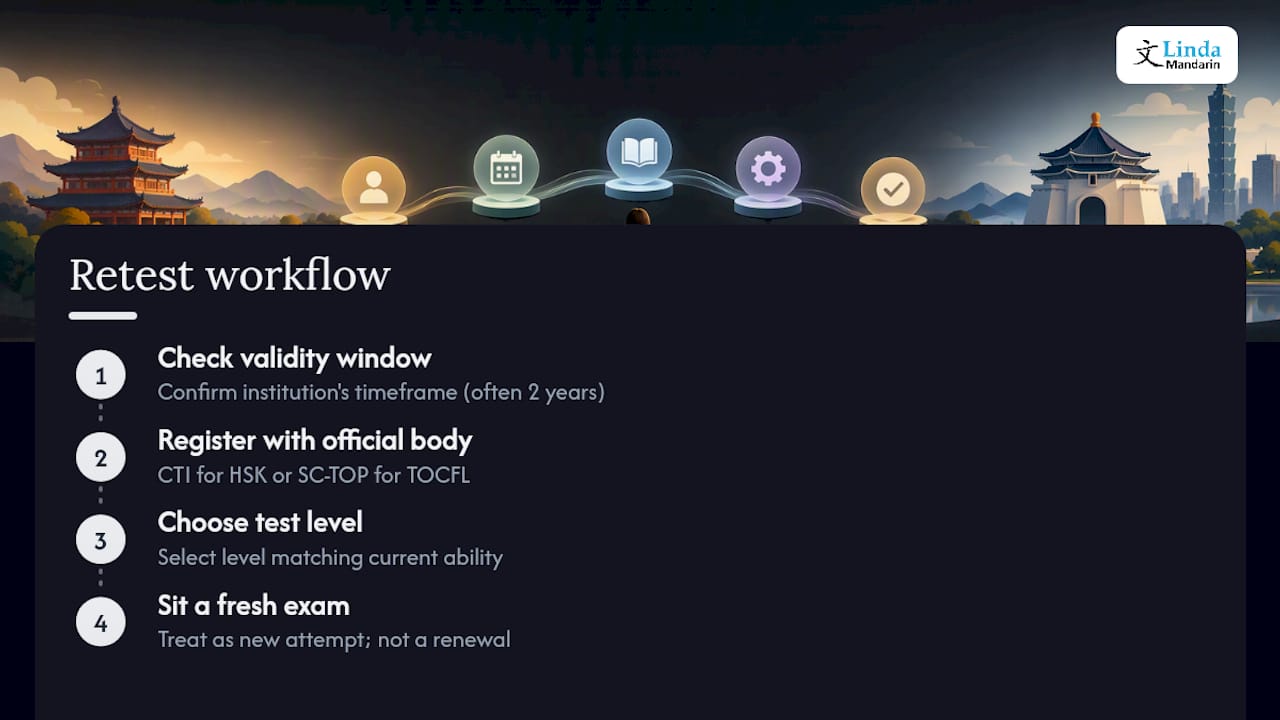
If your certificate is close to expiring and you still need it for an application, register for a retake rather than assuming an older score will pass review. Retaking either exam works the same way as the first attempt: register through the official body (CTI for HSK, SC-TOP for TOCFL), pick a level based on your current ability rather than your previous certificate, and treat the retest as a fresh attempt rather than a renewal of the old one.
Score improvement between attempts is common for learners who study actively between tests, since neither exam penalizes retaking or averages your scores together. If an institution’s requirement changes, say, a program raises its minimum HSK level after you already certified at a lower one, you will need to retest at the higher level rather than appeal the existing certificate. Always check the specific validity window stated by the institution requesting your score, since that window can be shorter or longer than the general two-year norm depending on the requester’s own policy.
Pick One Test, Commit, and Adjust Later if Needed
The learners who waste the most time are the ones who try to hedge between HSK and TOCFL from day one. Pick the test tied to your actual destination, commit to it fully, and only add the other certificate later if your plans genuinely expand to include both regions. Dual certification makes sense for a narrow group of people. For everyone else, it is a slower path to the same result.
— Paul
Start Preparing With Structured Mandarin Courses
Deciding between HSK and TOCFL is only half the battle. The other half is building the vocabulary, listening speed, and speaking confidence to actually pass. The school offers group, private, and online Zoom classes for adults in Singapore, with a syllabus aligned with international HSK standards and native instructors who teach in English when needed.
If HSK is your target, the HSK exam preparation course walks through vocabulary, listening drills under exam conditions, and writing practice level by level. If your goal is broader conversational or business fluency rather than a specific certificate, the online Mandarin courses let you study by Zoom from anywhere, with conversational Mandarin priced at $1,580 and business Mandarin at $1,880 per student. For professionals who need Chinese specifically for workplace use, the Business Chinese Private class runs $1,980 one time. Com’s training center sits at 10 Anson Road, Level 22, International Plaza, Singapore 079903, right above Tanjong Pagar MRT. Visit the course page for your target level and reach out to discuss a study timeline that fits your exam date.
Sources
- Tocfl
- TOCFL official website
- TOCFL to HSK Equivalent: Every Level Compared (Zhong Chinese)
- TOCFL vs HSK: Differences, Levels, and Which Chinese Test to Take – italki
FAQ
Is TOCFL or HSK Harder?
Neither test is universally harder. Difficulty depends on your script familiarity and which region’s vocabulary you already know, though HSK 3.0’s 2026 update narrowed the beginner-level difficulty gap that used to make TOCFL’s early bands feel more approachable to some learners.
Is TOCFL A2 Equivalent to HSK 2?
Roughly, yes. TOCFL’s Band A, which covers Levels 1 and 2, maps approximately to HSK 1 and 2 and to CEFR A1 through A2, though the two tests use different vocabulary sets and question formats even at this level, so treat the mapping as a general guide rather than an exact match.
Is HSK Recognized in Singapore?
Yes, HSK is widely recognized in Singapore, where Simplified Chinese is the standard script taught in schools and used in most business and academic settings. Programs like Com’s HSK exam preparation course are built specifically around this local demand for HSK-aligned training.
Is HSK 5 Considered Fluent?
HSK 5 generally represents strong intermediate to advanced proficiency, sufficient for many university programs and professional roles, but it falls short of full native-level fluency. HSK 5 and 6 map roughly to CEFR B2 through C1, a level suited to complex conversation and professional communication rather than complete mastery of every register of the language.