Yes, you can learn to speak conversational Mandarin without ever learning a single character, and thousands of adults do it every year. The catch is that “conversational” has a ceiling: you will order food, negotiate a taxi fare, and chat with coworkers, but you will not read a menu, a contract, or a text message. This path suits travelers, busy professionals, and anyone whose goal is talking, not reading, and it works best when tone training gets the same attention that character study would otherwise receive.
TL;DR:
- Mastering tones and pronunciation early through pinyin and audio drills is essential because tone errors significantly hinder understanding in spoken Mandarin.
- Practice with phrase-based role-plays, shadowing, and structured repetition improves fluidity and helps internalize tone shifts and homophones in context.
- Relying solely on pinyin without correction or tone training leads to persistent mistakes that limit real conversational ability and comprehension.
- A well-designed eight to twelve-week plan focusing on sound mastery, core vocabulary, and real conversations can achieve basic unscripted dialogue skills.
- Skipping characters is feasible for conversational goals, but learners should incorporate a small set of common characters to navigate essential reading situations and official documents.
Table of Contents
- How Do You Learn Mandarin Without Characters?
- What Drills Build Speaking Skill Without Characters?
- What Does an 8 to 12 Week Speaking-Only Study Plan Look Like?
- When Does Skipping Characters Cause Real Problems?
- What Tools Actually Support Speaking-First Learning?
- Why a Structured Program Speeds Up a Speaking-First Path
- What Adults Get Wrong About Skipping Characters
- Ready to Build Real Speaking Skills, Faster Than Solo Study
- Sources
- FAQ
How Do You Learn Mandarin Without Characters?
The mechanics of a character-free path rest on two tools doing the job that characters normally do: pinyin and tone. Pinyin is the romanization system that spells Mandarin sounds using the Latin alphabet, and it functions as a legitimate on-ramp to pronunciation rather than a shortcut you’ll regret later. Learners can start speaking and practicing tones almost immediately using pinyin, which is exactly why speaking-first programs lean on it so heavily.
Pinyin has real limits, though. It was designed to teach reading and typing to Chinese schoolchildren who already spoke the language, not to carry the full weight of vocabulary acquisition for adult foreign learners. The history of Chinese romanization systems shows several competing schemes existed before pinyin standardized in the 1950s, and none of them were built to replace characters entirely. You’ll still bump into characters on street signs, restaurant menus, and official forms. Pinyin gets you talking; it doesn’t make characters disappear from the world around you.
Tones matter more than most beginners expect. Mandarin uses four main tones plus a neutral tone, and changing the tone on a syllable changes its meaning entirely, the same way changing a vowel in English turns “bit” into “bat.” A tone-first approach to speaking Mandarin treats tone as an inseparable part of each word, not an optional accent layered on top. Skip that step and you’ll build a vocabulary that native speakers can’t parse, even if your pronunciation of the consonants and vowels is flawless.
Without characters to anchor words visually, your memory has to rely on different hooks. Three work well together:
- Audio anchors: the sound of the word, stored as a spoken chunk rather than a written one.
- Pinyin cues: the spelling as a phonetic reminder, useful for looking words up but not for recall on its own.
- Contextual phrases: the word embedded in a sentence you’ve actually used, which sticks far better than an isolated vocabulary item.
Two pitfalls trip up almost every speaking-only learner. The first is tone sandhi, where tones shift when certain syllables sit next to each other, most famously the third-tone-before-third-tone rule that turns the second syllable’s tone upward. Isolated tone drills teach you the four tones in a vacuum, but tone sandhi and connected-speech effects require phrase-level practice to actually internalize. The second pitfall is homophones. Mandarin has a limited number of syllable-tone combinations spread across a much larger vocabulary, so context does a lot of heavy lifting that characters would otherwise do visually. The fix for both is the same: practice in phrases and sentences, never in isolated syllables.
What Drills Build Speaking Skill Without Characters?
Progress in a character-free path comes from repetition with feedback, not passive listening. The methods below work whether you’re studying alone with an app or working with a tutor, and they scale from fifteen minutes a day to a full immersion schedule.
- Minimal-pair tone drills. Practice word pairs that differ only in tone, such as mā (mother), má (hemp), mǎ (horse), and mà (to scold). Say each one aloud, record yourself, and compare against a native audio model. Ten minutes a day of this for two weeks does more for your ear than a month of passive listening.
- Shadowing. Play a short native audio clip, pause after each phrase, and repeat it aloud trying to match rhythm and tone exactly, not just the words. Graded dialogues built for beginners work better than random podcast clips because the pacing and vocabulary are controlled.
- Spaced repetition with audio, not text. Standard flashcard apps show you a character or a word and ask for a translation. A speaking-first version needs the opposite: a spoken prompt that asks for a spoken answer. Audio flashcards that pair spoken prompts with spoken answers keep retrieval practice oriented toward your mouth and ear instead of your eyes.
- Structured role-play. Take one scenario, ordering coffee, asking directions, introducing yourself, and run it with a tutor or language partner until the exchange feels automatic. Then change one variable (the drink, the destination, the name) and run it again. This single-variable-swap technique turns one memorized phrase into a dozen usable ones without adding new vocabulary load.
- Live conversation reps. Private tutors, structured language exchanges, and AI conversation partners each offer something different: tutors catch tone errors in real time, exchanges force you to handle unpredictable responses, and AI partners give you unlimited low-pressure reps at odd hours. Rotate between them rather than relying on just one.
Correction is the piece most self-taught learners skip, and it’s the one that separates steady improvers from people who plateau at month three. A tutor who corrects your tones in the moment, rather than after a paragraph, trains your ear far faster than delayed feedback ever will.
Pro Tip: Record thirty seconds of yourself speaking once a week, on the same day, saying roughly the same type of content. Listening back to week 1 versus week 6 will show you progress that day-to-day practice hides completely.

What Does an 8 to 12 Week Speaking-Only Study Plan Look Like?
A staged plan keeps a character-free learner from wandering aimlessly through vocabulary lists with no sense of what “done” looks like at each stage. The sequence below assumes 30 to 45 minutes of daily practice, adjustable up or down depending on how much time you actually have.
Weeks 1 to 2: sounds and survival phrases. Focus entirely on the Mandarin sound inventory, the pinyin system, and the four tones plus neutral tone. Beginner pathways that prioritize audio and sound-mastery before vocabulary tend to produce cleaner pronunciation later, because bad habits formed in week one are hard to unlearn in week eight. By the end of week two, aim for a small set of survival phrases such as greetings, numbers, “how much,” “where is,” and basic courtesy expressions.
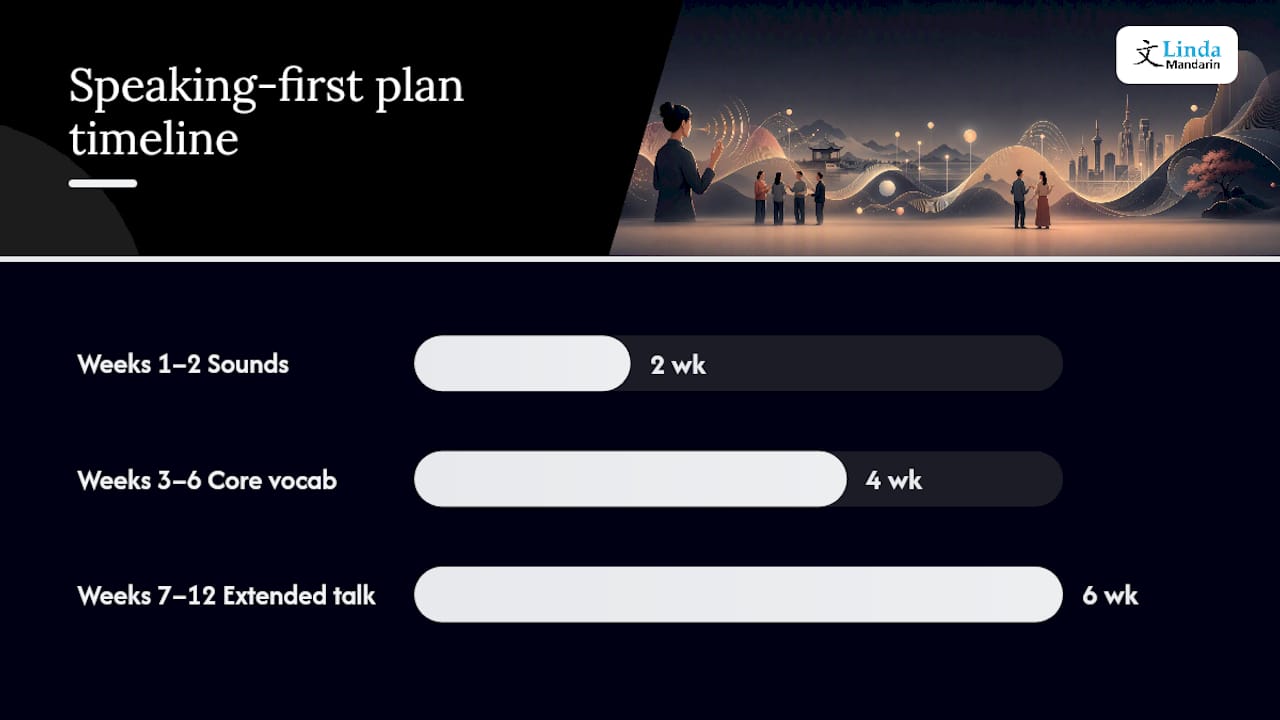
Weeks 3 to 6: core vocabulary and scenarios. Expand toward a working set of several hundred words and phrases, built around real situations rather than abstract word lists. Ordering food, asking for directions, small talk about work and family, and handling money are the four scenario categories that cover most early conversations. Practice each scenario as a full exchange, not a list of disconnected phrases, and keep running your role-plays with the single-variable-swap method from the drills above.
Weeks 7 to 12: extended dialogue and real testing. This stage shifts from scripted exchanges to less predictable conversation. Listen to longer graded dialogues, hold guided conversations with a tutor on open topics, and, if you can, test yourself with a native speaker who doesn’t know your script. This is where you find out whether you can actually understand a reply you didn’t rehearse for.
Track progress with three checkpoints rather than guesswork:
- Weekly recordings compared against a native model for tone accuracy.
- Tutor check-ins that grade you on comprehension, not just vocabulary recall.
- Timed listening tasks, such as understanding a one-minute dialogue and answering three questions about it without replaying.
By week 12, most learners following this pace can hold a basic unscripted conversation on familiar topics, which is a realistic outcome though not full fluency. That’s a realistic outcome, not a fluency claim, and it’s exactly the outcome a speaking-first path is built to deliver.
When Does Skipping Characters Cause Real Problems?
The speaking-only path breaks down in a handful of predictable situations, and knowing them ahead of time saves you from an awkward surprise later. Official documents, some restaurant menus, street signs, and any reading-only material (contracts, forms, written instructions) will stop you cold if you have zero character recognition. Certain jobs, long-term residency situations, or academic programs may also require basic literacy that pure conversation skill doesn’t cover.
None of these problems require abandoning the speaking-first approach, they just require a few workarounds:
- Speech-to-text and translation apps turn a written menu or sign into something you can hear or read in English on the spot.
- Asking for a pinyin version works in plenty of restaurants and official settings, especially in places with tourism infrastructure.
- Typing instead of handwriting solves most real-world needs, since modern input methods let you type using pinyin without ever handwriting a stroke.
- Learning a small set of survival characters closes most remaining gaps without committing to full literacy.
That last point is worth taking seriously. A targeted set of 50 to 150 characters, chosen for frequency and practical value (numbers, exits, restrooms, common menu items, danger signs), removes a surprising amount of daily friction for a few hours of study. Community discussion among self-taught learners consistently reflects the same trade-off: conversational competence is achievable without early character study, but full literacy gets added later, if at all, once speaking goals are met. Treat those 50 to 150 characters as a cheap insurance policy, not a betrayal of your speaking-first plan.
What Tools Actually Support Speaking-First Learning?
Not every app or class labeled “Mandarin” is built for a speaking-only goal, and picking the wrong tool wastes months. Look for five specific features before committing time or money to any resource:
- Native audio as the default, not a bonus feature bolted onto a text-heavy course.
- Pinyin-first scripts rather than characters presented as the primary text, with pinyin as an afterthought.
- Speech recognition or tutor feedback that catches tone errors instead of just word choice.
- Short, graded dialogues built around real scenarios, not vocabulary lists disguised as conversations.
- A review schedule that brings words back at increasing intervals, so you’re not relearning the same phrase for the tenth time.
When evaluating a tutor or a structured class, ask directly whether the course corrects tones in every session or only when something goes badly wrong. A program that treats tone correction as routine, not remedial, is built for speaking outcomes. Com’s pronunciation guides for beginners and its step-by-step pronunciation walkthrough are both built around that same principle: tone and sound come before anything else.
For self-study between lessons, curated audio-based listening resources fill the gap between classes without pulling your attention toward characters you don’t need yet. Outside any single provider, free audio and listening materials from language-learning resource sites are worth sampling if you want extra listening reps without extra cost. General study-habit guidance, like the practice tactics that support consistent daily practice, matters just as much as any single app, since consistency beats any one tool’s feature list.
Why a Structured Program Speeds Up a Speaking-First Path
Self-study gets you far, but a structured class solves the one problem self-study can’t fix on its own: reliable, real-time correction. There are adult conversational and business Mandarin programs available that map directly onto a speaking-first goal, with both in-person classes located centrally above Tanjong Pagar MRT and live online Zoom classes for learners who can’t commit to a physical schedule.
Programs built for spoken outcomes tend to share a few structural elements worth checking for before enrolling anywhere:
- Structured pinyin and tone modules early, not scattered across random lessons.
- Frequent spoken correction, ideally every session, rather than occasional feedback.
- Audio homework, so practice between classes stays oriented toward speaking and listening instead of writing drills.
- Reusable conversational templates, phrases built to be adapted to new situations, the same single-variable-swap principle used in the drills above.
Before committing to any adult program, ask what a typical learner can do after eight weeks, how often tones get corrected in class, and whether lessons are built around real conversation scenarios or textbook dialogue. Instructors who are native Mandarin speakers fluent in English can explain tone errors clearly, which helps learners avoid confusion. The clearest sign a program fits a speaking-first goal is simple: can you have a slightly longer, slightly messier conversation in week eight than you could in week one? If a program can’t answer that question concretely, keep looking.
What Adults Get Wrong About Skipping Characters
Most adults who choose a speaking-only path do it for a good reason: they want to talk to people, not pass a literacy exam, and their time is genuinely limited. The mistake I see most often isn’t skipping characters, it’s skipping tones while telling yourself pinyin alone will carry the weight. Pinyin tells you what letters to say. It doesn’t train your mouth or your ear, and those two things are the entire game in spoken Mandarin.
The second trap is avoiding correction because it’s uncomfortable. Nobody enjoys being told their tone was wrong for the fifth time in one lesson, but that discomfort is the fastest route to fixing it. Set small, specific goals, ten new phrases a week, one clean recording a week, rather than vague ones like “get better.” Vague goals don’t tell you when you’ve succeeded. Specific ones do, and that’s what keeps adult learners going past the point where most people quit.
— Paul
Ready to Build Real Speaking Skills, Faster Than Solo Study
Self-study with pinyin, audio drills, and role-play scenarios gets you a long way, but nothing replaces a teacher who catches your tone mistake mid-sentence instead of three lessons later. Com runs its adult conversational and business Mandarin programs specifically for learners who want speaking results without the detour through character study, delivered either in person at 10 Anson Road, Level 22, International Plaza, right above Tanjong Pagar MRT, or through live online Zoom classes if travel isn’t practical for you.

Class formats include private online lessons for learners who want one-on-one tone correction, small focused pronunciation modules for people rebuilding weak fundamentals, and group conversation classes for anyone who learns better with peers to practice against. Every format keeps the same priority: spoken accuracy and usable conversational templates over passive vocabulary memorization. If you’re weighing your options, browse the course levels to see which starting point matches where your speaking currently sits, and reach out to get a realistic sense of your timeline before you commit.
Sources
- Learning Chinese with pinyin: easier than you think | Language Institute Regina Coeli
- These 108 basic Chinese words and phrases give you a practical starting point for Mandarin | Fluent in 3 Months
- Speak Mandarin from day one (tone emphasis) — HeyTomo
- Learn Chinese from Zero — A Free 30-Step Path (No Sign-Up) – The Pure Language
FAQ
Can You Learn Chinese Without Learning Characters?
Yes. Adults can reach solid conversational ability using pinyin, tone training, and audio-based practice alone, though reading menus, signs, and official documents still requires some character recognition.
Is Mark Zuckerberg Fluent in Mandarin?
No. Zuckerberg has given public speeches in Mandarin and studied the language for years, but linguists and native speakers who reviewed his speeches generally describe his level as conversational rather than fluent.
Can Mandarin Be Self-Taught?
Yes, to a meaningful degree, especially for speaking and listening skills using pinyin, audio drills, and structured practice, though most self-taught learners eventually add a tutor or class to fix tone errors that are hard to hear in your own speech.
What Is the Fastest Way to Learn Mandarin Chinese?
Prioritizing sound and tone mastery before vocabulary expansion, then drilling short conversational scenarios with real-time correction from a tutor, is widely considered the fastest route to usable spoken Mandarin, faster than starting with characters or grammar rules.
Do I Need Pinyin to Learn Spoken Mandarin?
Not strictly, but pinyin makes it far easier to look up pronunciation, use apps, and type on a phone, so most speaking-first learners use it as a practical tool even though it isn’t a required substitute for characters.