TL;DR:
- Mandarin characters convey meaning through logograms, while Pinyin provides phonetic pronunciation using the Latin alphabet. Learning both systems together helps adult learners achieve true reading, writing, and speaking proficiency in Mandarin. Combining Pinyin with character recognition ensures effective communication and cultural understanding.
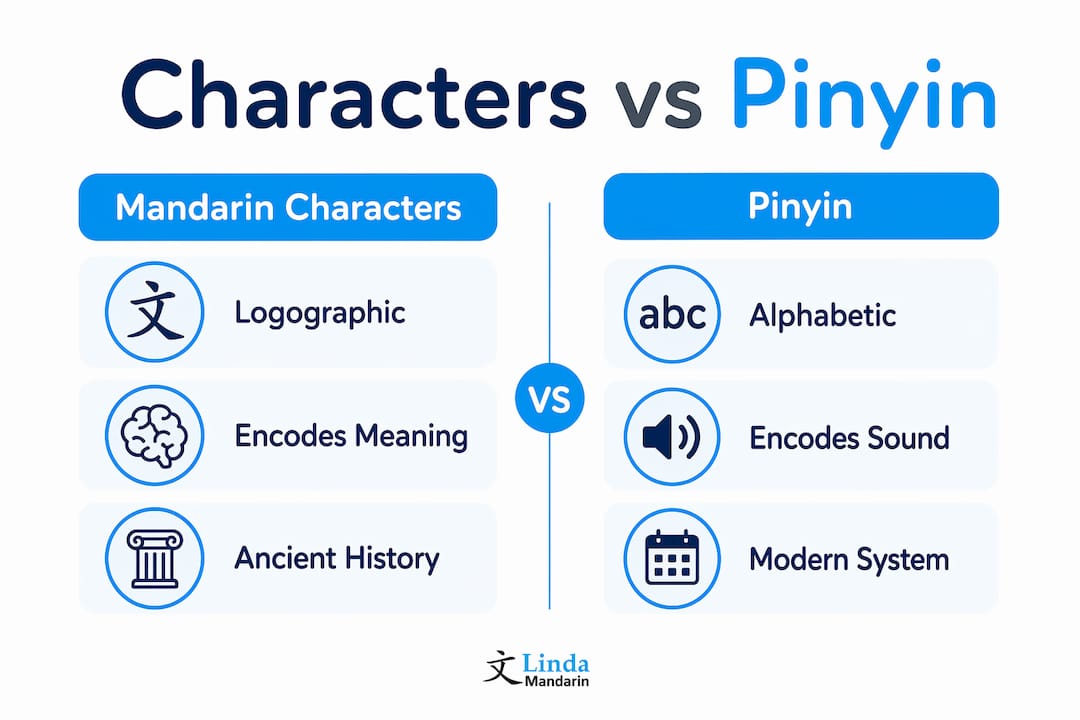
Mandarin characters (Hànzì) are logographic symbols that convey meaning, while Pinyin is the phonetic transcription system that represents their pronunciation using the Latin alphabet and tone marks. These two systems are the foundational tools of Mandarin Chinese, and understanding how they differ is the first step toward real language competence. Mandarin characters vs pinyin explained clearly shows that neither system replaces the other. Characters carry meaning; Pinyin carries sound. Adult learners who grasp this distinction early avoid the most common trap in Mandarin study: treating Pinyin as a substitute for actual reading and writing.
What are Mandarin characters and how do they work?
Mandarin characters are logograms representing morphemes, the smallest units of meaning in the language. Each character stands for one syllable and one meaning unit. A character does not spell out its pronunciation the way English letters do. You must learn both its shape and its sound separately.
Characters are built from components called radicals. Radicals give semantic or phonetic clues about a character’s meaning or sound. For example, the radical for “water” (氵) appears in characters related to rivers, swimming, and liquids. Recognizing radicals does not unlock every character automatically, but it dramatically reduces the memorization load over time.
Written Chinese exists in two forms: Simplified and Traditional. Simplified characters are used in mainland China and Singapore. Traditional characters are used in Taiwan and Hong Kong. The core meanings are identical; the visual forms differ in stroke count and complexity. Adult learners in Singapore typically start with Simplified characters, which is the form taught at Linda Mandarin.
- Each character represents one syllable and one meaning unit.
- Radicals provide semantic or phonetic hints within a character.
- Simplified characters are standard in mainland China and Singapore.
- Traditional characters are used in Taiwan and Hong Kong.
- Characters must be memorized for shape, meaning, and pronunciation separately.
The cultural weight of characters is significant. Chinese writing has a documented history spanning more than 3,000 years. Reading characters connects you directly to literature, signage, menus, and professional documents. No amount of Pinyin knowledge replaces that ability.
Pro Tip: Learn the 100 most common radicals before memorizing full characters. Radicals appear repeatedly across thousands of characters, so this investment pays off faster than rote memorization of individual characters.
What is Pinyin and how does it represent Mandarin pronunciation?
Pinyin is the official romanization system for Mandarin Chinese, adopted in mainland China in 1958 and now used globally for teaching pronunciation and digital input. It uses the 26 letters of the Latin alphabet plus four tone diacritics to represent every sound in Mandarin. Pinyin is not a writing system for daily communication. It is a pronunciation aid and an input tool.

Every Pinyin syllable consists of two parts: an initial and a final. Initials are the consonant sounds at the start of a syllable. Finals are the vowel sounds or vowel combinations that follow. For example, in “māo” (cat), “m” is the initial and “ao” is the final.
The four tones plus a neutral tone are what make Mandarin a tonal language. Tone changes alter meaning dramatically. The classic example uses the syllable “ma”:
| Pinyin | Tone | Meaning |
|---|---|---|
| mā | First tone (high, flat) | Mother |
| má | Second tone (rising) | Hemp |
| mǎ | Third tone (falling then rising) | Horse |
| mà | Fourth tone (sharp falling) | To scold |
The neutral tone carries no diacritic and is spoken lightly and briefly. Missing a tone does not just make you sound foreign. It changes the word entirely.
One major challenge for English speakers is that Pinyin consonants do not match English sounds. The letter “b” in Pinyin represents an unaspirated sound closer to a soft English “p.” The letter “p” in Pinyin is strongly aspirated, like the “p” in “pot” with a puff of air. This reversal trips up most beginners who assume Pinyin reads like English.
- Initials: consonant sounds (b, p, m, f, d, t, n, l, g, k, h, etc.)
- Finals: vowel sounds or combinations (a, o, e, i, u, ü, ai, ei, ao, ou, etc.)
- Four tones marked by diacritics: ā, á, ǎ, à
- Neutral tone: no diacritic, spoken lightly
- Tone placement follows specific rules based on the vowels present in the final
Pro Tip: Never assume a Pinyin letter sounds like its English equivalent. Learn each initial and final sound from a native speaker or audio resource before practicing full words. Wrong pronunciation habits formed early are hard to correct later.
How do Mandarin characters and Pinyin differ in form, function, and use?
The differences between Pinyin and characters go deeper than appearance. Pinyin is classified as a phonemic transcription tool, not a second writing system. Characters are the actual script of the Chinese language. This distinction matters for how you study each one.
Characters encode meaning. Pinyin encodes sound. A single Pinyin syllable like “shì” can correspond to dozens of different characters, each with a different meaning. Without the character, the meaning is ambiguous. This is exactly why Chinese people do not write in Pinyin for daily communication. The language has too many homophones for Pinyin alone to carry meaning reliably.
| Aspect | Mandarin characters | Pinyin |
|---|---|---|
| Script type | Logographic | Alphabetic (Latin) |
| Primary function | Conveys meaning | Represents pronunciation |
| Usage context | Reading, writing, all formal text | Learning, typing, dictionaries |
| Ambiguity | Low (each character is distinct) | High (many homophones) |
| Learning focus | Shape, stroke order, meaning | Sound, tone accuracy |
| Digital role | Output (what appears on screen) | Input method for typing |
Pinyin enables typing on digital devices by letting users type the romanized sound, then select the correct character from a list. This is how virtually every smartphone user in China types Chinese text. The character is the destination; Pinyin is the route to get there.
A common misconception among beginners is that mastering Pinyin means they can read Chinese. It does not. A learner who reads only Pinyin cannot read a Chinese newspaper, a restaurant menu, or a business card. Pinyin appears in textbooks and learning materials, but almost never in real-world Chinese text.
Pro Tip: When you see a new character in your textbook, always read the Pinyin annotation first to lock in the correct pronunciation. Then cover the Pinyin and practice saying the character from memory. This two-step habit builds both pronunciation and character recognition simultaneously.
How to learn Pinyin and characters together effectively
The most effective approach starts with Pinyin and builds toward characters. Pinyin gives you the phonetic foundation you need before tackling the visual complexity of characters. Skipping this step leads to mispronunciation habits that persist for years.
A structured learning sequence looks like this:
- Master Pinyin initials and finals. Spend the first two to three weeks learning every initial and final sound in isolation. Use audio from a native speaker to calibrate your ear.
- Learn the four tones with Pinyin examples. Practice tone pairs and tone sandhi rules. Reference a Mandarin pronunciation guide to build accuracy early.
- Introduce high-frequency characters alongside Pinyin. Start with the 100 most common characters. Always learn the Pinyin alongside the character, never separately.
- Use Pinyin as a typing input method. Practice typing characters on your phone using Pinyin input. This reinforces the connection between sound and symbol.
- Transition to reading characters without Pinyin support. Gradually remove Pinyin annotations from your study materials. This is the step most learners delay too long.
- Practice listening and speaking with Pinyin annotations. In early stages, annotate listening exercises with Pinyin to track unfamiliar sounds.
The biggest mistake adult learners make is staying in the Pinyin comfort zone too long. Pinyin serves a secondary educational role and is not designed for long-term use as a reading crutch. The goal is always to read and write characters fluently.
Tone accuracy deserves consistent attention throughout every stage. A dedicated resource on solving tone problems can help you identify and fix specific errors before they become ingrained habits. Consistent tone practice with Pinyin tone marks is the fastest path to being understood by native speakers.
Key Takeaways
Mandarin characters encode meaning while Pinyin encodes sound, and adult learners need both systems working together to achieve real Mandarin proficiency.
| Point | Details |
|---|---|
| Characters carry meaning | Each Hànzì represents one syllable and one meaning unit, not a sound sequence. |
| Pinyin is a pronunciation tool | Pinyin is a phonemic transcription aid for learning and typing, not a writing system. |
| Tones change word meaning | The same Pinyin syllable with different tones produces entirely different words. |
| Pinyin alone is insufficient | Homophones make Pinyin ambiguous; characters are required for clear written communication. |
| Learn Pinyin first, then characters | Mastering pronunciation before characters prevents mispronunciation habits that are hard to correct. |
Why both systems matter more than most learners expect
From my experience working with adult Mandarin learners, the single biggest frustration I see is the moment someone realizes their Pinyin fluency has not translated into reading ability. They can pronounce words beautifully, but they cannot read a menu or a street sign. That gap is real, and it comes from treating Pinyin as an endpoint rather than a starting point.
What surprises most learners is how quickly characters start to feel logical once you understand radicals. The character for “forest” (森) is literally three “tree” characters (木) stacked together. That kind of visual logic is everywhere in the writing system. Pinyin gives you the sound; characters give you the meaning and the culture behind it.
The learners who progress fastest are the ones who refuse to let Pinyin become a crutch. They use it as a scaffold, then kick it away. They also take tones seriously from day one, because correcting tone errors after months of practice is genuinely painful. Start precise, stay precise.
If you are an adult learning Mandarin for work or personal growth, treat both systems with equal respect. Neither one is harder than the other. They are just different tools for different jobs. The goal is to use them together until you no longer need to think about either one.
— Paul
Build your Mandarin foundation at Linda Mandarin
Linda Mandarin has delivered adult Mandarin training in Singapore since 2003, with courses covering both Pinyin pronunciation and character reading from the very first lesson. Classes run in person at 10 Anson Road, Level 22, International Plaza, right above Tanjong Pagar MRT, and online via Zoom for learners who prefer flexible scheduling.

Whether your goal is conversational confidence or professional business Mandarin, the structured adult Mandarin course program at Linda Mandarin builds both skills progressively. Corporate training and private classes are also available for professionals with specific communication goals. Experienced, certified native instructors guide every session in English and Mandarin, so no prior knowledge is required to start.
FAQ
What is the difference between Pinyin and Mandarin characters?
Mandarin characters (Hànzì) are logograms that convey meaning, while Pinyin represents pronunciation using the Latin alphabet and tone marks. Characters are used for reading and writing; Pinyin is used for learning pronunciation and typing input.
Can you learn Mandarin using only Pinyin?
Pinyin is classified as a phonemic transcription tool, not a writing system, so relying on it alone leaves you unable to read real Chinese text. Characters are required for literacy in any practical context, from menus to business documents.
How many tones does Mandarin have?
Mandarin has four main tones plus a neutral tone, each marked by a different diacritic in Pinyin. The same syllable spoken in different tones produces completely different words.
Is Pinyin the same as the Chinese alphabet?
Pinyin uses Latin letters but is not an alphabet for Chinese. It is a romanization system designed to represent Mandarin sounds for learners and for digital text input, not for everyday reading or writing.
How long does it take to learn Pinyin?
Most adult learners can master the core Pinyin system, including all initials, finals, and four tones, within four to six weeks of consistent daily practice. Tone accuracy takes longer and benefits from structured feedback from a qualified instructor.