TL;DR:
- Choosing the right Mandarin class requires clarifying your specific goals to ensure alignment with your learning needs.
- Accurate placement tests and understanding proficiency levels help you start at the appropriate challenge, avoiding frustration.
- For busy adults, flexible formats like online or private lessons optimize consistent progress and practical communication skills.
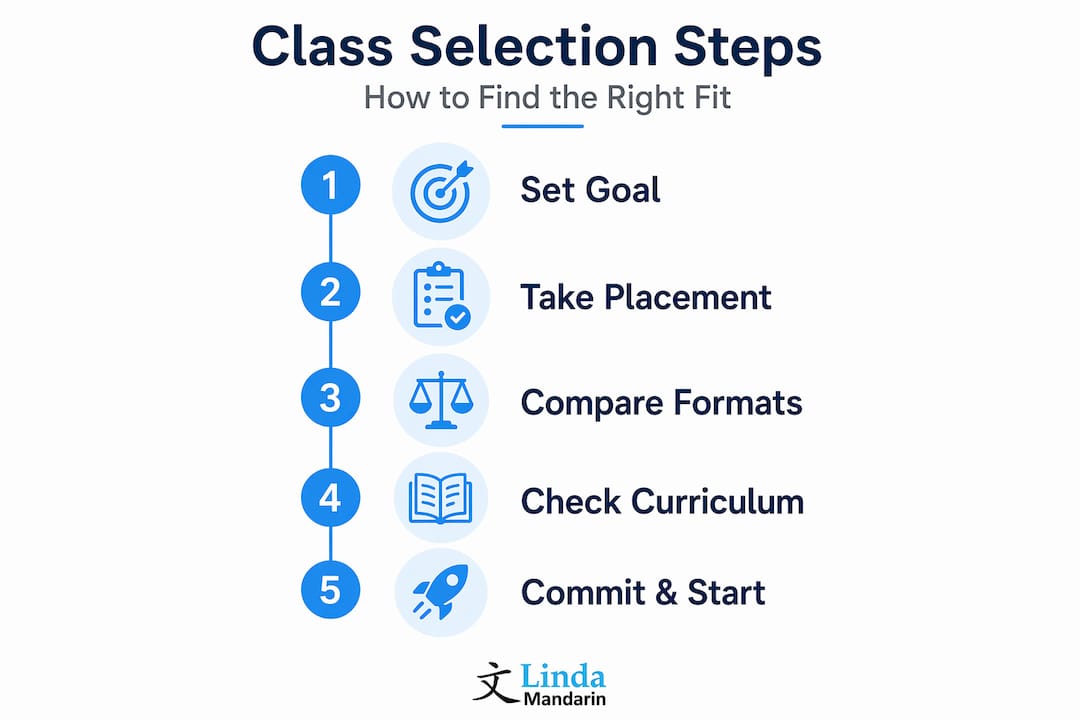
Picking the right Mandarin class sounds straightforward until you realize how many adults end up in the wrong one. They choose based on price, proximity, or a friend’s recommendation, and six weeks later they’re bored, lost, or dropping out. A proper mandarin class selection guide doesn’t just list your options. It helps you figure out what you actually need, what questions to ask, and what red flags to walk away from. This article covers the full mandarin class selection process from goal-setting to scheduling so you spend your time learning, not second-guessing.
Table of Contents
- Key Takeaways
- The Mandarin class selection guide starts here: know your goal
- Understanding course levels and placement
- Comparing course formats: private, group, and online
- Assessing curriculum and teaching quality
- Planning for consistency and long-term progress
- My honest take on choosing the right course
- Start learning with a program built for adults
- FAQ
Key Takeaways
| Point | Details |
|---|---|
| Start with your goals | Define what Mandarin success looks like for you in six months before comparing any courses. |
| Get placed accurately | Take a placement test to enter the right level and avoid wasted weeks in a class that’s too easy or too hard. |
| Match format to your life | Private, group, and online formats each serve different needs. Choose based on schedule, budget, and how you learn best. |
| Evaluate the instructor | Native fluency alone isn’t enough. Look for structured teaching, tone correction, and real feedback. |
| Commit to consistency | The best course fails if you can’t attend regularly. Prioritize a schedule you can sustain for months. |
The Mandarin class selection guide starts here: know your goal
Before you open a single course brochure, write down one sentence: what does success in Mandarin look like for you six months from now? That sentence will do more for your course search than any comparison chart.
Personal outcomes vary significantly for adult learners. Someone navigating daily life in Singapore needs very different skills than a professional presenting to a Chinese-speaking client. A casual social learner has different priorities than someone managing a Mandarin-speaking team. The mistake most people make is starting with course marketing instead of personal outcomes.
Here are four common adult learner goals and what they actually require from a course:
- Workplace communication: Focus on business vocabulary, professional phrasing, and listening comprehension in meeting contexts.
- Daily conversational Mandarin: Prioritize spoken tones, common phrases, and real-life scenarios like dining, shopping, and socializing.
- Reading and writing: Relevant if you work with Chinese documents or want to communicate in written Mandarin professionally.
- Business negotiations or presentations: Requires advanced speaking fluency, cultural context, and industry-specific vocabulary.
Most adult learners prioritize speaking and listening first. Reading and writing can come later if they’re not immediately relevant to your goals. Trying to tackle all four skills at once without a clear priority often leads to slow, unfocused progress.
Pro Tip: Write your six-month goal before browsing courses. Something like “I want to introduce myself confidently and handle basic workplace conversations” is specific enough to filter out courses that won’t serve you.
Choosing mandarin classes based on goal clarity is one of the most underrated best mandarin class tips out there. Course choice genuinely depends on personal goals, available time, budget, and your current level. There’s no shortcut around doing this work first.
Understanding course levels and placement
Once you know your goal, the next question is where you currently stand. This is where a lot of adult learners either overestimate or underestimate themselves, and both lead to frustration.
Placement tests identify your current proficiency across speaking, listening, reading, and writing so you enter a class at the right level. Skipping the test and self-selecting into a level that feels comfortable often means you’re under-challenged or overwhelmed within weeks.
The ACTFL Proficiency Guidelines are a widely used framework that defines language proficiency by what you can do in spontaneous real-world contexts across four domains. ACTFL’s FACT criteria assess Function, Accuracy, Context, and Text type. This is useful because it shifts focus away from grammar drills and toward actual communication ability, which is exactly what most adult learners need.
Here’s how proficiency bands roughly translate to practical Mandarin learning decisions:
| Proficiency Level | What you can do | Best course fit |
|---|---|---|
| Novice | Basic words and memorized phrases | Beginner group class or private lessons |
| Intermediate | Familiar topics in simple sentences | Lower-intermediate group or structured private |
| Advanced | Extended discourse on complex topics | Upper-intermediate to advanced group or one-to-one |
| Superior/Distinguished | Near-native, nuanced communication | Advanced seminar or immersive private program |
Most adult beginners starting Mandarin from zero sit comfortably at Novice. Don’t let that label discourage you. What matters is entering a class calibrated to that level so the pace feels challenging but not defeating.

Level placement works best as an ongoing process, not a one-time event. If the class feels consistently too fast or too slow after the first two or three sessions, that’s a signal worth acting on. Good language programs make it easy to shift levels early without bureaucratic friction.
Comparing course formats: private, group, and online
This is where the mandarin course comparison gets practical. Format affects your pace, your speaking practice, your budget, and your motivation. No single format works for everyone, and the right answer depends more on your lifestyle than your learning style.
Private lessons
Private instruction gives you the fastest route to specific outcomes. Your instructor adjusts pace, vocabulary, and focus entirely around your goals. If you travel frequently, work irregular hours, or have very specific business Mandarin needs, private Mandarin lessons are worth the premium. The tradeoff is cost and the absence of peer interaction, which some learners find motivating.
Group classes
Group classes work well when the class size is right. Groups of four to eight learners create enough speaking opportunities for everyone while also providing the energy of shared learning. When a group exceeds ten, speaking participation drops by roughly 40 percent, which significantly reduces conversational practice time per learner. Always ask about class size before enrolling.
The social dimension of group learning matters more than most people expect. Hearing other learners make and correct mistakes normalizes the process and keeps motivation higher over time.
Online Zoom classes
Online Mandarin learning has matured significantly. For busy professionals in Singapore or those who work from home or travel, Zoom-based classes remove commute friction without sacrificing instructor interaction. The key question is whether the online format includes real speaking feedback, structured materials, and live conversation practice. A passive video course is not the same as a live online class.
Pro Tip: If you’re unsure between group and private, try a group class first. If you find yourself consistently hesitant to speak or rushed through content, switch to private lessons for a few months and return to group later.
For a deeper look at flexible class options, the format question matters more for adults than for any other learner group. Your schedule isn’t just a logistical detail. It’s the factor most likely to determine whether you finish the course.
Assessing curriculum and teaching quality
A course can have the right level, right format, and right price, and still fail you if the content doesn’t match your real-world needs or the instructor can’t teach effectively.
Adults prioritize practical communication for daily life and work. That means a good adult Mandarin curriculum focuses on real scenarios: navigating office interactions, conducting introductions, discussing products and services, handling social situations. Theory-heavy instruction built around grammar tables and translation exercises tends to feel disconnected from why adults want to learn Mandarin in the first place.
When evaluating curriculum quality, ask yourself or the school these questions before enrolling:
- Does the course include speaking and listening practice from the first lesson, not just reading and writing?
- Are real-life scenarios used as the basis for vocabulary and phrases, or is the content primarily textbook grammar?
- How is student progress measured, and how often does the instructor provide structured feedback?
- Can the syllabus be adjusted if your specific professional needs differ from the standard curriculum?
- What happens if you miss a class? Is makeup content available?
On the instructor side, native fluency is a baseline, not a differentiator. Effective Mandarin instructors do more: they correct tones constructively, scaffold grammar in digestible steps, and adapt their teaching based on how each learner responds. Ask whether instructors are certified and trained to teach Mandarin to adult second-language learners, not just native speakers of the language.
For business Mandarin learners, curriculum relevance is especially critical. Generic conversational content won’t prepare you for a board meeting. Look for programs that address listening comprehension in professional settings, industry vocabulary, and the cultural context behind Chinese business communication.
Planning for consistency and long-term progress
Here’s the part most mandarin language program guides skip: the best curriculum in the world won’t help if your attendance is inconsistent. Sustainable scheduling is one of the strongest predictors of long-term language learning success for adult learners.
Before committing to any course, work through these steps:
- Map your real schedule for the next three months. Include travel, project deadlines, and personal commitments. Choose class times that fit your actual life, not your ideal life.
- Set a minimum attendance threshold. Two sessions per week is effective for most adult learners. One session per week is possible but requires significant self-study between classes to maintain momentum.
- Look for flexibility features. Does the school offer makeup classes, session rescheduling, or access to recorded materials? Life will interrupt your schedule. A good program accommodates that without penalizing you.
- Plan your week-three check-in. Course mismatches often surface around the third week, when the initial novelty wears off and the real pace becomes clear. If something feels consistently wrong at that point, address it directly with the school rather than pushing through.
- Set visible milestones every six to eight weeks. Progress in Mandarin can feel slow in the middle weeks. Specific milestones like ordering food confidently, completing a role-play scenario at work, or reading a short paragraph without aid give you concrete evidence of movement. Visible milestones sustain motivation better than waiting for a proficiency band jump.
Pro Tip: Treat your Mandarin class like a fixed work appointment, not an optional activity. The single biggest differentiator between adult learners who succeed and those who drop out is whether they protect that time in their calendar.
My honest take on choosing the right course
I’ve seen smart, motivated adults make the same mistake repeatedly: they research courses for weeks, then pick based on price or a polished website, and never stop to ask whether the class actually fits their life.
The truth is, there is no universally best Mandarin course. What works for a colleague who travels to Shanghai monthly is not what works for someone who needs to hold casual conversations with local suppliers. Goal alignment beats brand reputation every time.
What I’ve learned is that the learners who make the most progress are almost never the ones in the most prestigious or expensive program. They’re the ones who chose a course they could show up to consistently, with an instructor who gave them real feedback and content they could use the next day.
One thing I’d push back on: the common advice to “try a few classes first.” Trial lessons are useful, but most mismatches don’t surface until week three or four, once the novelty wears off. Early checkpoints matter, but so does honest self-assessment at that three-week mark rather than waiting until you’ve lost momentum.
Be willing to adjust. Switching levels, formats, or even schools isn’t failure. It’s exactly what active learners do.
— Paul
Start learning with a program built for adults
If you’ve worked through this guide and you’re ready to find a course that genuinely fits, Linda Mandarin offers structured Mandarin programs designed specifically for adults and professionals in Singapore. Every course is built around practical communication, from conversational Mandarin for daily life to advanced business Mandarin for professional settings.
Linda Mandarin’s adult Mandarin programs include group classes, private lessons, and live online Zoom sessions, all taught by certified native instructors fluent in English. Class sizes are kept manageable to maximize speaking time, and courses are structured around real-life scenarios rather than textbook theory. For organizations, corporate Mandarin training delivers customized workplace language programs for teams. Linda Mandarin is located above Tanjong Pagar MRT at 10 Anson Road, Level 22, International Plaza, Singapore 079903. Browse course levels and formats to find the right starting point for your goals.
FAQ
How do I start the mandarin class selection process?
Start by writing down a specific six-month goal, then take a placement test to confirm your current level. From there, compare course formats based on your schedule, budget, and whether you need private, group, or online instruction.
What group size is best for a Mandarin class?
Groups of four to eight learners offer the best balance of speaking practice and peer interaction. Groups over ten reduce individual speaking time by roughly 40 percent, which limits conversational progress for adult learners.
How long before I know if a Mandarin course is the right fit?
Most learners can make a clear judgment by week three. That’s when the pace, content, and scheduling realities become apparent. Address any mismatch directly with the school at that point rather than waiting months to act.
Is online Mandarin learning as effective as face-to-face classes?
Live online classes with real instructor interaction and speaking practice are highly effective for adults, particularly for professionals with demanding schedules. Passive video courses do not offer the same results because they lack real-time feedback.
Does course price predict course quality?
Price matters less than class size, instructor competence, and how well the course pace matches your goals. A moderately priced program with accurate placement and strong feedback will outperform an expensive course that doesn’t fit your level or schedule.