Learn Standard Mandarin. That is the version taught in classrooms from Beijing to Taipei to Singapore, and it is the one that gets you understood everywhere Mandarin is spoken. If you are starting today, the smartest first move is two-fold: begin drilling Pinyin and the four tones immediately, and book a trial lesson with a beginner course built around spoken communication rather than rote memorization.
Set your expectations correctly from day one:
- Basic conversational ability (greetings, ordering food, small talk about work and family) is realistic within a few months of consistent practice.
- Reading and writing fluency takes considerably longer, since literacy in Mandarin is a separate skill track from speaking.
- Tonal accuracy improves faster with short daily drills than with occasional long study sessions.
- A structured course with a native instructor can help you speak sooner than self-study alone, especially for pronunciation.
Key Takeaways
Adults who prioritize Pinyin, tonal drills, and spoken practice in the first weeks of study reach basic conversational Mandarin faster than those who start with character memorization.
| Point | Details |
|---|---|
| Learn Standard Mandarin first | It is the teaching standard across mainland China, Taiwan, and Singapore, giving you the widest practical reach. |
| Master Pinyin before vocabulary | Pinyin maps Mandarin sounds to the Latin alphabet and underpins accurate tone production. |
| Drill tones with minimal pairs | Practice confused tone pairs in short phrases, not isolated syllables, for faster correction. |
| Match format to your schedule | Intensive courses suit fast goals; Zoom classes suit busy professionals; private lessons suit specific needs. |
| Consider Com for a structured path | Com offers group, private, corporate, and Zoom adult courses above Tanjong Pagar MRT, with a progressive, communicative syllabus. |
Table of Contents
- What Is Standard Mandarin, and Why Does It Matter?
- Pinyin, Tones, and the Four Skills Every Beginner Needs
- Choosing the Right Format: Classroom, Private, or Zoom
- How Do You Choose a Good Adult Mandarin Course?
- Where Linda Mandarin Fits Into This Picture
- A Realistic Take on Adult Mandarin Progress
- Start Speaking Mandarin With a Course Built for Working Adults
- Sources
- FAQ
What Is Standard Mandarin, and Why Does It Matter?
Standard Mandarin goes by several names depending on where you are. In mainland China it is called Putonghua (“common speech”). In Taiwan it is Guoyu (“national language”). In Singapore and much of Southeast Asia it is often referred to as Huayu. All three point to the same standardized form of Mandarin, built largely on the pronunciation and grammar of Beijing speech.
This standard exists because China is home to hundreds of local varieties, and mutual understanding between them can be limited. Schools across mainland China, Taiwan, and Singapore all teach the same standardized variety, which is why it functions as the shared teaching target and lingua franca across the Mandarin speaking world, a reality confirmed by research on languages spoken across the region.
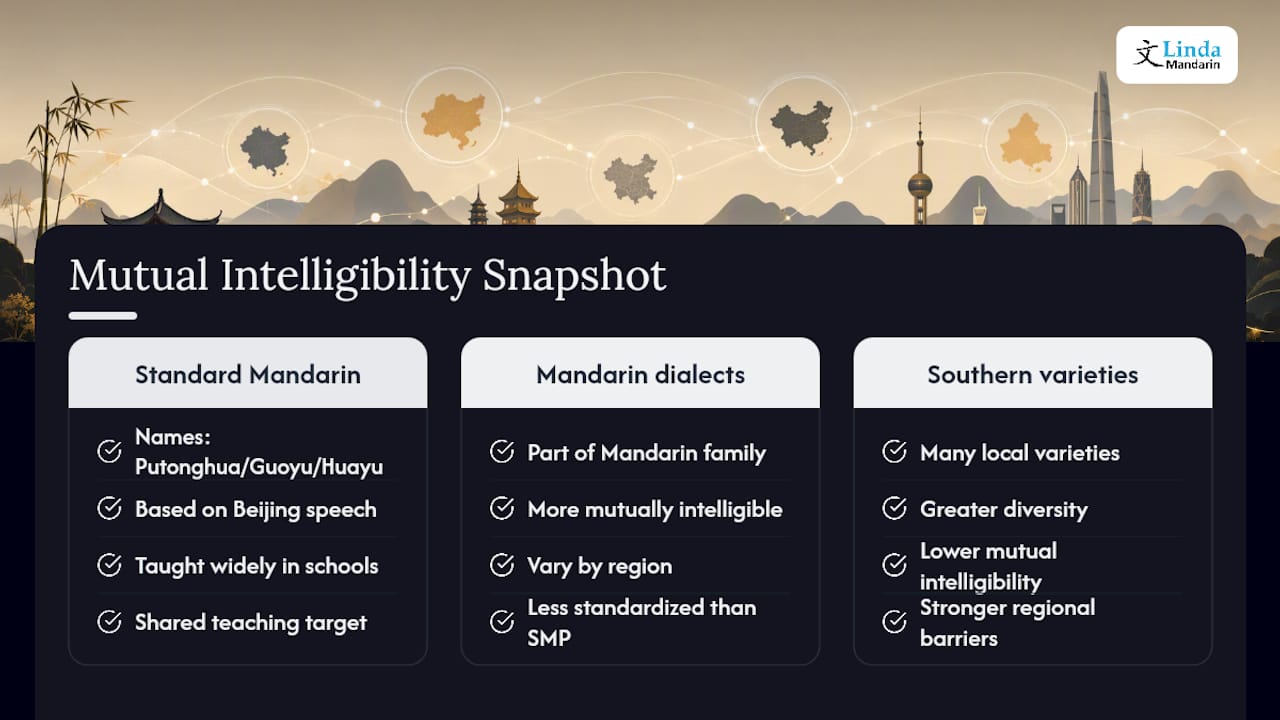
Dialect diversity within Chinese runs deep, but studies on phonetic and syntactic distance among Chinese varieties show that Mandarin dialects tend to be more mutually intelligible with each other than many southern varieties are among themselves. That is one more reason adult learners should not get distracted chasing regional dialects. Standard Mandarin gives you the widest reach for the least amount of confusion.
Pinyin, Tones, and the Four Skills Every Beginner Needs
Every adult learner faces the same starting line: an unfamiliar sound system, four tones that change meaning, and four separate skills to build almost from scratch. Get the order right, and progress feels fast. Get it wrong, and frustration sets in within the first month.
Start with Pinyin. This romanization system maps Mandarin sounds onto the Latin alphabet, and mastering it early is one of the most reliable predictors of pronunciation success, according to Carnegie Mellon’s independent learner materials. Skip Pinyin, or treat it as an afterthought, and your tones will drift for months.

Tones come next, and they are non-negotiable. Mandarin uses four distinct tones, and getting them wrong changes the meaning of a word entirely, not just the accent. The Hacking Chinese guide to Mandarin tones recommends a graded approach: identify which tone pairs you personally confuse, drill them with minimal-pair exercises, then practice them inside short phrases rather than isolated syllables. That last step matters more than most learners realize. Tones spoken alone rarely transfer to tones spoken in a sentence.
Here is a realistic roadmap for the four core skills over a few months:
- Speaking: hold a two-minute spontaneous conversation on a familiar topic (introducing yourself, ordering a meal, discussing your job).
- Listening: follow slow, simple dialogue between native speakers without subtitles.
- Reading: recognize a moderate number of Chinese characters in simple texts, a benchmark consistent with intensive university-level course outcomes.
- Writing: reproduce basic characters and short functional phrases, such as filling out a simple form.
Pro Tip: Record yourself saying the same sentence five times in a row, then play it back. Most learners cannot hear their own tone errors in real time, but they catch them instantly on playback.
The most common beginner pitfall is skipping Pinyin drills to jump straight into vocabulary lists. The fix is simple: spend the first two weeks almost entirely on sounds and tones before adding new words. Vocabulary sticks far better once the sound system is already wired in.
Choosing the Right Format: Classroom, Private, or Zoom
Format matters as much as content, because the wrong format for your schedule or learning style guarantees slow progress regardless of how good the syllabus is.
- Short intensive courses (running a few weeks, several hours a week) suit motivated adults chasing fast conversational gains before a trip or a new job, while semester-style courses spread over months deliver deeper literacy and steadier vocabulary growth.
- Private lessons accelerate progress when your schedule is irregular or your goals are specific (business negotiation vocabulary, an upcoming presentation), though the per-hour investment runs higher than group classes.
- Group classes cost less per session and add a social, conversational dynamic that many adults find motivating, but they move at the pace of the slowest learner in the room.
- Online Zoom classes solve the scheduling problem for busy professionals and remove the commute entirely, though they demand a reliable internet connection and enough self-discipline to stay engaged on screen for an hour.
- Corporate training differs from general adult courses in one key way: it is built around a company’s specific communication needs, whether that is client-facing conversation, internal meetings, or written correspondence, rather than general fluency goals.
Anyone weighing these tradeoffs should also think about how adults learn differently from children in the first place. A general guide to adult language learning covers the cognitive and scheduling realities that shape which format actually works for a working adult, not just which one sounds best on paper.
How Do You Choose a Good Adult Mandarin Course?
Not every course delivers what its brochure promises. Before you commit money and months of your schedule, run through this checklist.
Selection criteria that actually predict results:
- Instructor experience with adult learners specifically, not just general teaching credentials.
- A syllabus built around spoken, functional Mandarin, not one that front-loads character memorization before you can hold a conversation.
- Small class sizes, since tonal correction needs individual attention.
- Flexible scheduling that fits around work, including evening or online options.
- A clear, measurable progression plan (what you will be able to say and understand at week 4, week 8, week 12).
Questions worth asking before you enroll:
- Can I see a sample syllabus or lesson plan?
- What does a typical lesson structure look like, and how much of it is spoken practice versus lecture?
- What materials will I actually use, and can I preview one?
- How is progress assessed, and what happens if I am falling behind?
Red flags to walk away from:
- Vague outcome promises (“you’ll be fluent”) with no timeline or benchmark attached.
- No trial lesson offered before you commit to a full term.
- Instructor credentials that shift or feel inconsistent when you ask direct questions.
A course that cannot answer these questions clearly on a first enquiry call is unlikely to deliver a clear result twelve weeks later either.
Where Linda Mandarin Fits Into This Picture
Com has run in-person and online Zoom Mandarin programs for adults since 2003, which means the syllabus has been refined across two decades of actual classroom feedback rather than built once and left untouched.
A few specifics worth knowing before you enquire:
- The syllabus is structured for progressive, communicative learning and aligned with international standards used to benchmark Mandarin proficiency worldwide.
- Instructors are native Mandarin speakers fluent in English, so nuance in grammar or tone gets explained clearly rather than lost in translation.
- Formats include group classes, private lessons, corporate training, and online Zoom sessions, so working adults can pick whatever fits their week.
- The training center sits at 10 Anson Road, Level 22, International Plaza, Singapore 079903, directly above Tanjong Pagar MRT, making it an easy stop before or after work.
If you are comparing this against the checklist above, the practical next step is to request a trial lesson, ask for a sample syllabus, and book a placement assessment to see where you actually stand before committing to a term.
A Realistic Take on Adult Mandarin Progress
Most adults quit not because Mandarin is impossible, but because they measure progress the wrong way. Counting memorized characters feels productive but tells you little about real conversational ability. Prioritize speaking and pronunciation from the start, even if it feels slower than memorizing vocabulary.
Track yourself against real conversational tasks, not vocabulary counts, and give the process a full 12 weeks before judging whether it is working.
— Paul
Start Speaking Mandarin With a Course Built for Working Adults
Most adults trying to learn Mandarin on their own hit the same wall: no one corrects their tones, so mistakes calcify instead of fixing themselves. Com solves that directly, with native instructors who catch pronunciation errors in real time, whether you are sitting in the classroom above Tanjong Pagar MRT or joining from your laptop over Zoom.
The course structure runs on a syllabus aligned with international standards, so progress is measurable rather than vague, and formats stretch across group classes, private lessons, and corporate training built for company-specific communication needs. If your goal is business Mandarin for client meetings, the business Mandarin communication program is built around exactly that. If you want a faster start, the intensive Mandarin course compresses the early conversational gains into a shorter timeframe.
Browse the full range of adult program options and book a trial lesson to see how the syllabus fits your schedule and goals before committing to a full term.
Sources
- Languages spoken in Singapore — AsiaLocalize
- Chinese for Everyone – 12-Week Mandarin Chinese Course | University of Sheffield
- Chinese 1 for independent learners — Carnegie Mellon OLI
- The Hacking Chinese guide to Mandarin tones
- Lexico-phonetic and syntactic distances among Chinese varieties — MDPI (2025)
FAQ
What Is Standard Mandarin?
Standard Mandarin is the standardized form of Chinese based largely on Beijing pronunciation, known as Putonghua in mainland China, Guoyu in Taiwan, and Huayu in Singapore. It is the version taught in schools and used across regions for broad, mutual understanding.
How Long Does It Take an Adult to Speak Basic Mandarin?
Most adults reach basic conversational ability, such as introducing themselves and handling simple daily exchanges, within eight to twelve weeks of consistent practice, particularly when speaking and pronunciation are prioritized from the start.
Why Is Pinyin Important for Beginners?
Pinyin maps Mandarin sounds onto the Latin alphabet, which makes it easier to learn correct pronunciation and tones before tackling character reading and writing. Skipping Pinyin tends to produce shaky tonal habits later.
Should I Learn a Regional Dialect Instead of Standard Mandarin?
No. Standard Mandarin offers the widest practical reach across mainland China, Taiwan, and Singapore, and Mandarin dialects tend to be more mutually intelligible with each other than many southern varieties are among themselves.
Is Online Zoom Learning as Effective as In-Person Classes?
Zoom classes work well for busy professionals who need scheduling flexibility, and Com offers both formats with the same native instructors and syllabus, so the choice comes down to personal preference and logistics rather than a difference in teaching quality.