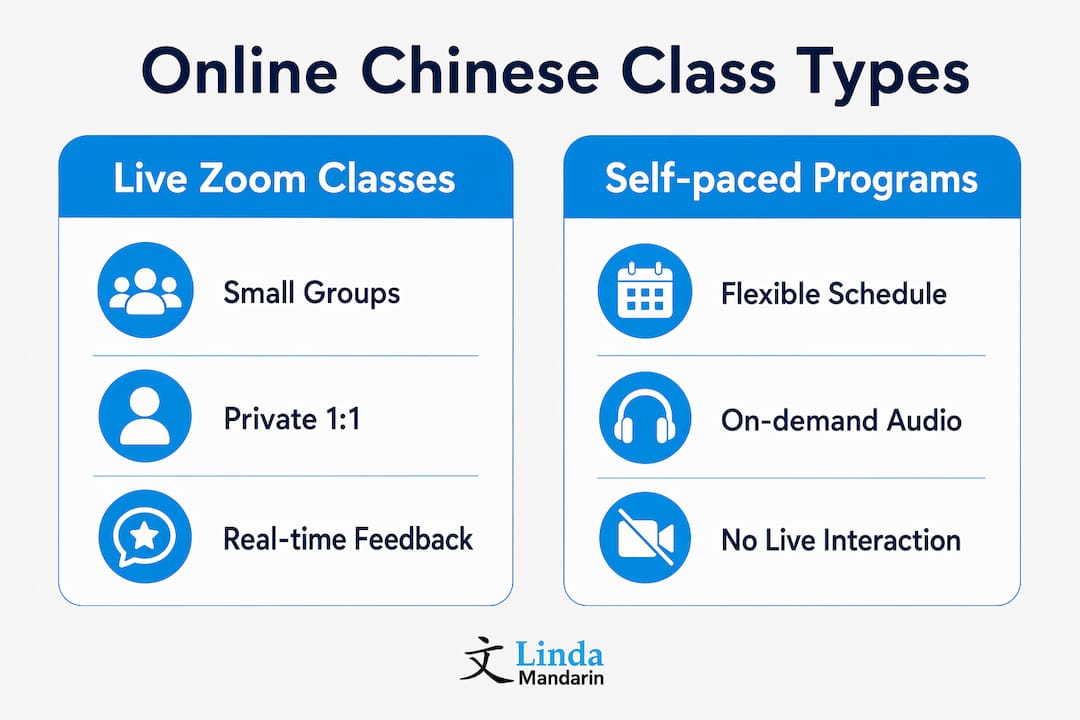
For adult beginners who want to actually speak Mandarin, live Zoom classes in a small group or private 1:1 format are the strongest starting point. They give you real-time correction, structured weekly progress, and a teacher who can adjust to how you learn. Self-paced platforms work as a supplement for vocabulary drilling between sessions, but they rarely build speaking confidence on their own.
Two practical next steps: book a trial lesson with a structured provider like Linda Mandarin to see how a live online Chinese class actually runs, or sign up for an intro session and arrive with a short self-introduction ready in English. That first session typically covers tones, basic greetings, and a placement conversation so the teacher can gauge your starting level.
If your schedule is genuinely unpredictable, a blended program combining weekly live Zoom sessions with on-demand audio and video lessons offers the best of both worlds. For fast results, intensive private lessons compress the learning curve significantly.
Table of Contents
- What types of online Chinese classes are there?
- What should you look for before enrolling?
- How much do online Chinese classes cost, and how long does it take?
- What does a typical online Mandarin lesson actually look like?
- A 4-week starter plan for absolute beginners
- How do you verify that an online Chinese course is legitimate?
- How Linda Mandarin teaches adult learners online
- Key Takeaways
- What actually works when adults learn Mandarin online
- Linda Mandarin’s online adult Mandarin classes
- Useful sources
- FAQ
What types of online Chinese classes are there?
Not every format suits every learner. Here is how the main options break down.
- Live small-group Zoom classes (4–8 students): The most cost-effective way to get real speaking practice with a teacher. Small live groups keep cost per hour lower than private lessons while still delivering structured feedback and peer interaction. Best for adult beginners who want accountability and a fixed weekly rhythm.
- Private 1:1 Zoom lessons: Maximum flexibility and personalization. The teacher adapts every session to your pace, vocabulary gaps, and goals. Higher cost, but the fastest route to conversational progress for professionals or anyone with a specific deadline.
- Blended programs (scheduled live classes + self-study library): Providers like ChineseClass101 pair weekly live sessions with thousands of short audio and video lessons, giving learners structured class time plus on-demand review. Good for learners who want variety and can self-motivate between sessions.
- Fully self-paced platforms: Apps and video libraries with no live teacher. Useful for vocabulary and listening, but weak on speaking feedback. Best as a supplement, not a primary course.
| Format | Best for | Expected outcome | Typical price band | Teacher type | Weekly time |
|---|---|---|---|---|---|
| Live small group | Budget-conscious beginners, social learners | Basic conversation in 10–16 weeks | $ (lower per hour) | Native/certified | — |
| Private 1:1 | Professionals, fast-track learners | Conversational in 6–8 weeks | $$$ | Native/certified | 1–2 hrs |
| Blended program | Flexible schedules, self-motivated learners | Solid foundation in 10–16 weeks | $$ | Native/certified | 2–3 hrs |
| Self-paced only | Supplement, travelers, casual learners | Vocabulary and listening gains | $ | Pre-recorded | Flexible |
Best-fit quick guide:
- Traveler prepping for a trip: Live small group, 8–10 weeks, conversational focus
- Professional adding Mandarin for work: Private 1:1 or corporate training track
- Busy adult with irregular hours: Blended program with recorded backup sessions
- Corporate team: Dedicated corporate Mandarin training with a customized syllabus
Pro Tip: Before you commit to any format, ask whether missed classes can be made up with a recording. A provider like Hills Learning records sessions and uses an online assignment system, which matters more than you might expect when life gets in the way.
What should you look for before enrolling?
The difference between a course that sticks and one you abandon by week three usually comes down to a few concrete factors, not marketing copy.
| Must-Have | Nice-to-Have |
|---|---|
| Speaking-first syllabus with clear level outcomes | Cultural context woven into lessons |
| Native Mandarin instructor fluent in English | Supplementary self-study library |
| Transparent curriculum with week-by-week topics | Progress tracking dashboard |
| Free or paid trial lesson before full commitment | Recorded sessions for review |
| Clear refund or satisfaction policy | Community forum or study group |
| Secure payment and responsive support | Mobile app access |
When you get on a trial call or intro session, the questions you ask tell you more than any website. Here are the ones worth asking:
“What does the first month look like, week by week?” A strong provider answers with specifics: tones in week one, basic greetings and numbers in week two, and so on. Vague answers like “we cover beginner content” are a red flag.
“How do you handle pronunciation correction during class?” Good teachers correct in real time without derailing the lesson flow. If the answer is “we focus on fluency first and fix pronunciation later,” expect bad habits to form.
“What level will I reach after completing this course, and how is that measured?” Look for a concrete answer tied to a recognized framework. Linda Mandarin publishes course-level outcomes so learners know exactly what each stage covers.
“What happens if I miss a class?” Recordings, makeup sessions, or catch-up materials are the right answer. “You just miss it” is not.
“Can I see a sample lesson or syllabus?” Any reputable provider will say yes. Hesitation here usually means the curriculum is thin or borrowed.
“What are your teachers’ qualifications?” Native speaker status matters, but so does teaching certification and experience with adult learners specifically. A native speaker who has only taught children uses very different methods.
A red flag worth naming: high-pressure sales tactics during a trial call. A provider confident in their product lets the lesson speak for itself.
How much do online Chinese classes cost, and how long does it take?
Price varies significantly by format, and so does the timeline to reach basic conversational ability.
Typical price bands (per hour, approximate):
- Live small-group classes: $15–$40 per hour
- Private 1:1 lessons: $40–$100+ per hour
- Blended programs (live + self-study access): $20–$60 per hour equivalent
- Subscription self-study platforms: $10–$30 per month
Realistic timelines to basic conversation:
Most adult beginners reach a functional conversational level (ordering food, introductions, simple directions) after 10–16 weeks of consistent live instruction per week. Private lessons can compress that to 6–8 weeks with consistent daily practice. A structured 10–16-week course with a fixed weekly meeting time and a placement test is a proven cadence for adult beginner cohorts, balancing commitment with measurable progress.
Common payment models:
- Per-class billing: pay as you go, maximum flexibility, higher per-session cost
- Package deals: 10 or 20 sessions upfront, usually 10–20% cheaper per hour
- Monthly subscription: fixed fee for a set number of classes per month
- Corporate billing: invoiced to an employer, often with a customized syllabus
On trials and refunds: Always ask about the trial policy before paying for a package. A reputable school offers either a free trial or a paid intro session at a reduced rate. For packages, ask specifically whether unused sessions are refundable if you need to stop. Some providers offer a satisfaction window of one to two weeks; others do not. Get the refund terms in writing before you pay.
What does a typical online Mandarin lesson actually look like?
Most structured live classes run on Zoom, with a learning management system (LMS) handling materials, homework, and progress tracking on the side. Here is what a standard 60-minute session looks like in practice.
The first 10 minutes are a warm-up: the teacher reviews vocabulary or phrases from the previous session, often asking students to use them in a short sentence. This is where spaced repetition kicks in without feeling like a drill. The next 20 minutes focus on new content, typically a dialogue or a grammar pattern introduced through slides and short audio clips. The teacher models pronunciation, students repeat, and the teacher corrects tones in real time.

The middle 20 minutes shift to guided practice: roleplay scenarios, question-and-answer exchanges, or pair work in breakout rooms if it is a group class. This is the most valuable part of the session for speaking confidence. The final 10 minutes cover a quick review, homework assignment, and a preview of next week’s topic.
For the tech side, you need a stable internet connection, a headset with a microphone (earbuds work, but a dedicated headset reduces echo), and a camera. Breakout rooms in Zoom require no extra setup from the student. Shared slides appear directly in the Zoom window, and most providers send PDF materials before class.
Homework in structured adult programs typically involves 15–20 minutes of spaced repetition review using flashcard tools or audio recordings, plus a short writing or speaking task. The combination of live correction and daily micro-practice between sessions is what drives retention. Skipping the homework is the single most common reason adult learners plateau after the first month.
A 4-week starter plan for absolute beginners
Starting a live class with zero preparation is possible, but arriving with even a week of groundwork makes the first session dramatically more productive.
Week-by-week plan:
- Week 1: Listen to 10–15 minutes of Mandarin audio daily (podcasts, YouTube channels for beginners). Focus on recognizing the four tones. No pressure to understand words yet. Use interactive language platforms to build early listening exposure.
- Week 2: Learn pinyin (the romanized pronunciation system). Drill the initials and finals. Apps like Pleco are useful here. Practice saying your name, country, and a two-sentence self-introduction.
- Week 3: Memorize 30–50 core phrases: greetings, numbers 1–10, days of the week, “I don’t understand,” “please repeat.” Record yourself saying them and compare to a native speaker recording.
- Week 4: Find a language exchange partner or use a native-speaker practice app for one short conversation. Even five minutes of live speaking before your first paid class removes the fear factor.
Weekly hours vs. expected progress:
| Weekly hours | Expected milestone by week 8 |
|---|---|
| 1–2 hrs (class only) | Basic greetings, numbers, simple questions |
| 3–4 hrs (class + daily review) | Short self-introduction, ordering food, directions |
| 5+ hrs (class + intensive practice) | Simple conversations on familiar topics |
First-lesson checklist:
Create your Zoom account and test your audio at least 30 minutes before class. Have a headset ready. Prepare a two-sentence self-introduction in English (the teacher will help you say it in Mandarin). Write down two or three things you want to be able to say in Chinese by the end of the course.
Pro Tip: Ten minutes of Mandarin daily beats a two-hour weekend session every time. Short daily exposure keeps tones and vocabulary in working memory. Even listening to a Mandarin podcast during your commute counts.

How do you verify that an online Chinese course is legitimate?
The online language learning space has no shortage of polished websites hiding thin curricula. Here is what to check before you hand over payment.
Trust signals to look for:
- Teacher CVs or bios listing qualifications, native-speaker status, and experience with adult learners
- Student testimonials with specific outcomes (“I held a 10-minute business conversation after 3 months”) rather than generic praise
- A sample lesson or free trial you can take before committing to a package
- A published syllabus with week-by-week topics and measurable level outcomes
- Secure payment processing (HTTPS, recognized payment gateway)
- A written refund or satisfaction policy, not just a verbal promise
- Responsive customer support before you enroll (if they are slow to reply now, expect worse later)
Red flags:
- No trial option and pressure to buy a large package upfront
- Vague syllabus (“we cover all levels”) with no specific outcomes
- Teacher credentials listed only as “native speaker” with no teaching background
- Inconsistent scheduling or last-minute cancellations during the sales process
- Reviews that all sound identical or are posted within a short window
On verifying teacher credentials: ask for the teacher’s name and look them up independently. A certified Mandarin instructor should have a teaching qualification, not just fluency. Experience with adult learners specifically matters because adult language acquisition works differently from childhood immersion.
How Linda Mandarin teaches adult learners online
Linda Mandarin has been running structured Mandarin courses for adults since 2003, and the online Zoom format follows the same speaking-first philosophy as the in-person program. Lessons are taught by experienced native Mandarin instructors who are fluent in English, which matters for adult beginners who need explanations in their own language while building confidence in a new one.
The group class program runs in small cohorts with a progressive syllabus that moves from tones and basic phrases through to conversational exchanges and, for those who continue, business Mandarin. Corporate training tracks are available for teams who need a customized program aligned with their industry vocabulary. The full-time course is designed for learners who want immersive, accelerated progress.
What distinguishes the teaching approach is the emphasis on real-life communication from the first lesson. Students are not memorizing vocabulary lists in isolation. They are using language in context: introductions, workplace scenarios, everyday transactions. The syllabus is published openly, so learners know exactly what each level covers before they enroll.
What to expect in the first month at Linda Mandarin:
- Week 1: Tones, pinyin, and core greetings
- Week 2: Numbers, time, and basic questions
- Week 3: Self-introduction and simple descriptions
- Week 4: Short dialogues and first conversational roleplay
Linda Mandarin’s course-level pages lay out the full progression from beginner to advanced, including business Mandarin outcomes for professionals.
Key Takeaways
Live Zoom classes in a small group or private 1:1 format give adult beginners the fastest, most reliable path to conversational Mandarin because they combine structured teaching, real-time correction, and weekly accountability.
| Point | Details |
|---|---|
| Best format for beginners | Live small-group or private 1:1 Zoom classes outperform self-paced study for speaking progress. |
| Realistic timeline | Most adults reach basic conversation in 10–16 weeks at 2–3 hours of live instruction per week. |
| Key evaluation criteria | Check teacher qualifications, published syllabus, trial policy, and refund terms before paying. |
| Time zone compatibility | Confirm your provider offers scheduling that works for your time zone before enrolling. |
| Linda Mandarin | Offers live Zoom group classes, private lessons, and corporate training for adults, with a published syllabus and experienced native instructors. |
What actually works when adults learn Mandarin online
Most people shopping for an online Chinese class spend too much time comparing platforms and not enough time asking one question: will I actually speak in this class? A polished app or a well-designed website tells you nothing about whether you will get real pronunciation feedback, whether the teacher knows how to pace a lesson for an adult who has not been in a classroom in 20 years, or whether the syllabus will still feel relevant in month three.
The research on adult language acquisition is consistent on one point: output matters more than input. Listening to Mandarin for hours builds passive recognition. Speaking it, getting corrected, and trying again in the same session is what builds actual fluency. That is why live instruction with a qualified teacher remains the most effective format, not because it is traditional, but because it forces production.
The other thing most guides understate is the role of the teacher’s bilingual ability. A native Mandarin speaker who cannot explain grammar in English is a liability for an adult beginner, not an asset. The best instructors for this audience are native speakers who understand exactly where English-speaking learners get stuck, because they have taught hundreds of them.
Linda Mandarin’s online adult Mandarin classes
Linda Mandarin offers live Zoom Mandarin classes for adults that run from absolute beginner through to business-level communication. The program includes small-group classes, private 1:1 sessions, and corporate Mandarin training for teams, all delivered by native instructors fluent in English. Scheduling is flexible, and the school works with learners across different time zones, including U.S.-based students who need morning or evening slots outside Singapore business hours.
Payment is handled securely online, and the support team responds to scheduling and enrollment questions promptly. To see the full course structure and book your place, visit the course details page. If you are not sure which level to start at, the enrollment team will help you find the right entry point before your first session.
Useful sources
- Linda Mandarin course levels and outcomes — Full syllabus breakdown for each adult level, from beginner to advanced.
- Linda Mandarin group classes — Schedule, format, and booking details for live Zoom group sessions.
- Linda Mandarin corporate training — Customized Mandarin programs for business teams and professionals.
- Linda Mandarin intensive course — Accelerated adult program for learners who want faster conversational outcomes.
- ChineseClass101 live group classes — Example of a blended live-class structure with placement test and self-study access.
- Hills Learning online Chinese classes — Semester-style scheduling example with recorded sessions and an assignment system.
- Best language learning apps for native-speaker practice — Useful for supplementing live classes with real conversation practice.
FAQ
What is the best online program for learning Chinese?
For adult beginners focused on conversation, a live Zoom class with a qualified native instructor in a small group or private format delivers the fastest speaking progress. Linda Mandarin’s online adult program combines structured weekly lessons with experienced bilingual teachers.
Can you really learn Chinese online?
Yes, and live online classes are particularly effective for adults because real-time correction from a teacher addresses pronunciation and tone errors that self-study cannot catch. Consistent weekly sessions plus daily review between classes is the proven combination.
Can you reach conversational Mandarin in 3 months?
Most adult beginners reach basic conversational ability in 10–16 weeks at two to three hours of live instruction per week. Three months is achievable for simple conversations with intensive private lessons and daily practice outside class.
Is a self-paced app enough to learn Chinese?
Self-paced apps build vocabulary and listening skills but rarely develop speaking confidence on their own. They work best as a supplement to live classes, not a replacement, because they provide no real-time pronunciation feedback.