For busy professionals, the smartest formats are small-group classes (capped around eight students) for maximum speaking practice, private lessons when you need fast, targeted business-language results, and online Zoom sessions when your calendar simply won’t allow commuting. Each solves a different problem: groups build confidence through peer practice, private coaching compresses the timeline, and Zoom removes the excuse of a packed schedule. The fastest way to figure out which fits you is to book a trial or assessment lesson this week, so a teacher can gauge your current level and match you to the right pace and class size. Teaching Chinese Singapore programs built for adults now span all three formats, often within the same school.
Linda Mandarin runs all three formats from its center above Tanjong Pagar MRT, which makes comparing them in a single trial lesson straightforward.
Key Takeaways
Adult professionals make the fastest progress by matching course format to their actual schedule and goals, then locking in a trial lesson to confirm class size and teacher fit before paying for a full program.
| Point | Details |
|---|---|
| Match format to your goal | Choose private lessons for speed, small groups for cost-effective speaking practice, Zoom for flexibility. |
| Confirm class size in writing | Get a written cap on group size before enrolling to protect your speaking time. |
| Expect a realistic timeline | Budget 3 to 6 months for functional conversation and 6 to 12 months for workplace fluency. |
| Corporate buyers need metrics | Request pre and post assessments, role-play scoring, and attendance reports from any vendor. |
| Linda Mandarin fits professionals | Offers private, group, and Zoom Mandarin courses from its Tanjong Pagar MRT center with native, English-fluent instructors. |
Table of Contents
- What Credentials Actually Matter When Comparing Chinese Language Courses Singapore
- How Do You Choose an Adult Mandarin Course Quickly?
- Which Course Format Fits Your Timeline?
- What Should Employers Request From Corporate Mandarin Training?
- How Do You Start Learning Mandarin This Month?
- What Does an Adult Mandarin Course Cost in Singapore?
- Are There Recognized Mandarin Proficiency Levels for Adult Learners?
- What Learning Strategies Actually Work for Busy Adults?
- An Editorial Take on Choosing an Adult Mandarin Course
- Ready to Start? What Linda Mandarin Offers Professionals
- Sources
- FAQ
What Credentials Actually Matter When Comparing Chinese Language Courses Singapore
Longevity and specialization tell you more than a slick website ever will. Linda Mandarin has run adult and professional Mandarin programs since 2003, teaching conversational and business Mandarin through both in-person classes and Zoom, from a training center at 10 Anson Road, Level 22, International Plaza, directly above Tanjong Pagar MRT. Its instructors are native Mandarin speakers who teach fluently in English, working from a structured, interactive syllabus rather than an improvised one. That combination, native fluency paired with clear English instruction, matters more than it sounds. Research on language instructor effectiveness suggests both native and well-trained non-native teachers bring distinct strengths, and the strongest programs blend accurate pronunciation modeling with teaching that adult learners can actually follow.
When you’re comparing Chinese tutors in Singapore or evaluating any school, verify these points directly:
- How many years the provider has operated and whether adult courses are a core focus, not an afterthought
- Instructor experience specifically with working professionals, not just casual learners
- Whether a trial class or level assessment is offered before you commit
- A written maximum class size policy, not just a verbal promise
- A sample syllabus showing what “level 2” or “level 4” actually covers
Pro Tip: Ask any provider for a sample lesson plan or a milestone chart before enrolling. A school confident in its curriculum will show you exactly what you’ll be able to say after four weeks versus sixteen.
How Do You Choose an Adult Mandarin Course Quickly?
You don’t need weeks of research to pick a solid course. Fifteen minutes on the phone or in a trial lesson, using the checklist below, tells you almost everything.
- Confirm class size in writing. Ask exactly how many students sit in a “small group,” and get the cap in an email or contract, not just a sales pitch. Schools sometimes advertise small classes that quietly expand once enrollment picks up, so locking in the number before you pay protects your speaking time.
- Check the teacher profile. Look for native or near-native fluency, explicit experience teaching adults, and comfort explaining grammar in English rather than switching entirely to Mandarin when you’re confused.
- Match curriculum to your goal. Conversational Mandarin for travel and daily life is a different syllabus than business Mandarin for negotiations and emails. Ask what level you’ll reach and how that’s assessed.
- Verify schedule and format flexibility. Confirm evening or weekend slots exist, whether Zoom sessions are recorded for later review, and what happens if you miss a class.
- Insist on a trial or assessment lesson. Use it to test whether the teacher corrects your pronunciation in real time and gives feedback you can actually apply, not vague encouragement.
- Ask about ongoing support. Good programs provide recordings, written materials, or conversation practice outside class, not just a weekly lesson and nothing else.
Pro Tip: During your trial lesson, deliberately mispronounce a tone and see how the teacher corrects you. That single moment tells you more about teaching quality than any brochure.
Which Course Format Fits Your Timeline?
Private lessons make sense when a deadline is looming, a client visit, a transfer to a China-based office, a specific negotiation, because the entire lesson bends around your vocabulary needs and your calendar. You pay more per hour, but you’re not waiting for six other students to catch up.
Small-group classes hit the sweet spot for most working adults. A capped group of six to eight gives you real speaking rounds every session while splitting the cost, and the shared structure keeps you accountable in a way solo study rarely does. Online Zoom classes and blended formats solve the scheduling problem entirely: no commute, sessions you can review afterward, and often the option to mix in occasional in-person pronunciation workshops when tone accuracy needs hands-on correction.
Here’s what realistic progress looks like once you commit:
- Survival phrases and basic greetings: 4 to 8 weeks of regular practice
- Functional conversation for daily and light work use: roughly 3 to 6 months, a timeline consistent with beginner-to-functional course design
- Dependable workplace communication: 6 to 12 months, assuming steady weekly attendance
The pattern that actually works: two to three hours of guided class time per week, paired with 20 to 30 minutes of daily independent practice. Consistency beats occasional marathon sessions every time. If you want a fuller breakdown of what that daily practice should look like, Linda Mandarin’s guide on practical steps for adults walks through it.
What Should Employers Request From Corporate Mandarin Training?
L&D teams booking group training for staff need to ask sharper questions than “can you send a trainer.” The programs that actually change how employees perform at work share a few non-negotiable features.
- Curriculum mapped to real job tasks: meeting facilitation, negotiation phrases, client email templates, and workplace small talk, not generic textbook chapters
- Delivery options that fit operations: intensive workshops for a launch deadline, weekly cohort classes for steady skill building, or blended coaching that follows up after the main sessions
- Measurable outcomes: pre- and post-training assessments, role-play scoring, and attendance reports you can show leadership
- Scheduling that respects business hours: block sessions to limit disruption, with recorded sessions available for employees who miss a class
- Transparent pricing tied to scope: quotes should scale with class size and customization, and vendors should be willing to walk you through past corporate programs
Basic Mandarin skills go further than most HR teams expect. Even simple greetings and small talk measurably speed up relationship-building and cut down on misunderstandings in cross-border business dealings, which is exactly the kind of soft outcome that’s hard to quantify but easy to notice once staff have it. Linda Mandarin’s corporate training programs are built around this kind of task-specific mapping rather than one-size-fits-all lessons.
How Do You Start Learning Mandarin This Month?
Getting from “I should learn Mandarin” to actually sitting in a classroom takes less effort than most people assume. Follow this order and you’ll be enrolled within a week or two.
- Book a trial or assessment lesson. This is non-negotiable. It tells you your real starting level and whether the teacher’s style suits you.
- Confirm the specifics on the spot. Ask for the maximum class size, typical lesson length, and a written outline of syllabus milestones.
- Pick your format. Decide between private, small group, or corporate based on your actual time constraints and goals, not what sounds impressive.
- Build a realistic weekly plan. Slot in your class times and commit to short daily practice around them, rather than hoping motivation carries you.
- Start with a short-term package. A 4 to 8 week starter commitment lets you test real progress before signing up for a longer program.
If you’d rather skip the search and go straight to booking, Linda Mandarin’s adult program overview lists current course levels and formats, and the main site has contact details for scheduling a trial lesson directly.
What Does an Adult Mandarin Course Cost in Singapore?
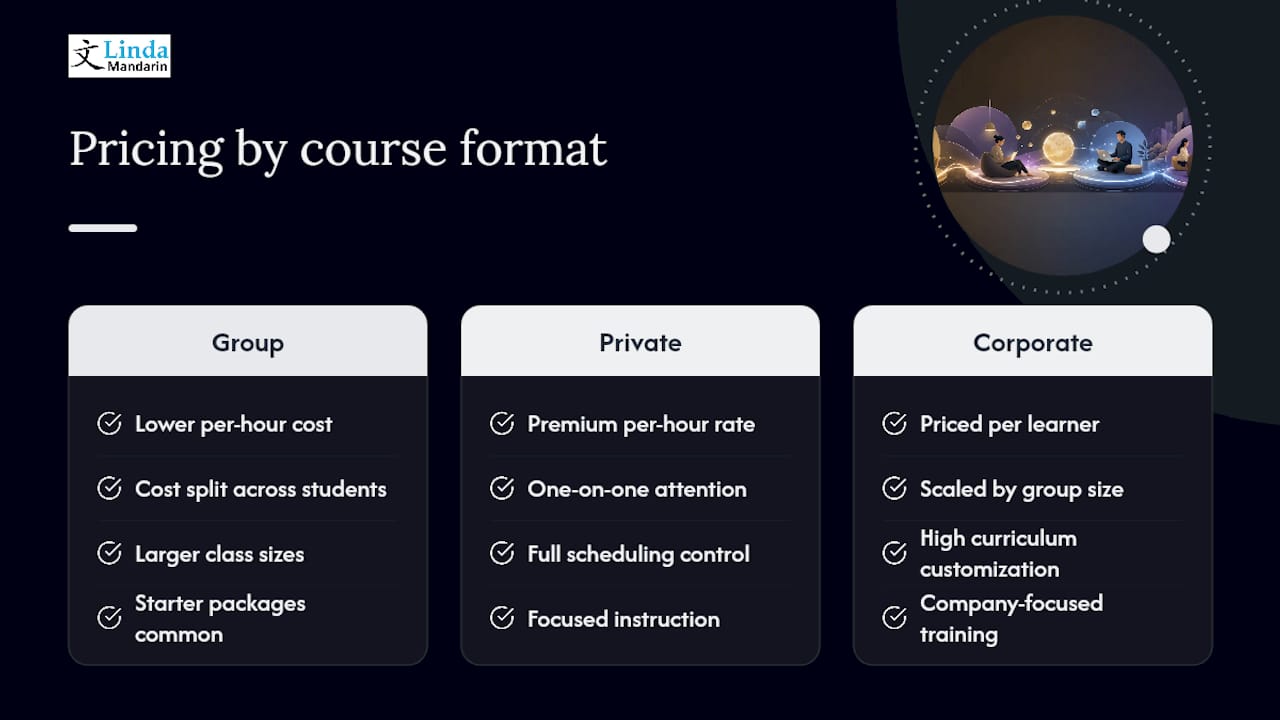
Pricing varies more by format than by school. Group classes tend to run cheaper per hour because the cost is split across students, while private lessons carry a premium for one-on-one attention and full scheduling control. Corporate training sits in its own bracket entirely, priced per learner and scaled to group size and how much customization the curriculum needs.
A few pricing patterns hold across most reputable Singapore providers. Short-term starter packages, often four to eight weeks, cost less upfront and let you test a school before committing to a full-level course. Longer-term enrollment, covering an entire proficiency level over several months, usually brings the effective hourly rate down compared to paying lesson by lesson. Zoom classes are frequently priced the same as in-person sessions since the teaching time and preparation are identical, though some schools offer a slight discount given the lower overhead of running online.
Rather than shopping purely on price, weigh cost against what you’re actually paying for: class size, teacher experience, and whether materials and after-class support are included. A cheaper course with 15 students per class and no follow-up materials often costs you more in wasted time than a slightly pricier option with a capped group and structured support. If cost is a major factor in your decision, ask providers directly for a breakdown of what’s included in the quoted rate, syllabus materials, assessments, recordings, before comparing numbers side by side.
Are There Recognized Mandarin Proficiency Levels for Adult Learners?
Mandarin proficiency for adults is typically described in practical, functional stages rather than a single universal exam score. Most Singapore course providers structure their programs around a level system, moving learners from absolute beginner through conversational fluency and into business-level communication, with clear checkpoints along the way so you know what “level 3” or “level 5” actually means in terms of real speaking ability.
For adults focused on workplace and conversational use rather than academic certification, the more useful measure is functional competence: can you handle a client meeting, follow a casual conversation with colleagues, or draft a simple business email without help. Course providers assess this through in-class evaluation, role-play scenarios, and progress checkpoints tied to the syllabus, which tends to be a more accurate reflection of usable skill than a standardized score alone.
If you’re specifically choosing a course, ask the provider how they define and measure each level internally, and request examples of what a graduate of that level can actually do. A transparent school will walk you through its level structure without hesitation, and that transparency is often a better signal of program quality than any external label.
What Learning Strategies Actually Work for Busy Adults?
Adults learning Mandarin face a different challenge than students: less free time, but sharper focus and real-world motivation. The strategies that work lean into that difference rather than fighting it.
Short, regular practice consistently beats occasional long study sessions. Pedagogical research on adult learning backs this up directly: brief daily practice paired with structured class time produces faster, more durable progress than cramming once a week. Twenty minutes of vocabulary review on your commute does more for retention than a single three-hour weekend session.
Use your environment. Singapore’s daily mix of Mandarin speakers, from hawker stalls to client meetings, gives adult learners built-in opportunities to practice outside class that learners in other countries simply don’t have. Order your next coffee in Mandarin. Attempt small talk with a Mandarin-speaking colleague. Every real exchange reinforces what you learned in class faster than another flashcard app session.
A few other habits matter more than people expect:
- Record yourself speaking and compare it to your teacher’s pronunciation weekly
- Keep a running list of workplace-specific vocabulary as it comes up, rather than relying only on textbook lists
- Review class notes within 24 hours, not days later, while the material is still fresh
- Set a specific functional goal (“handle a ten-minute client call”) rather than a vague one (“get better at Mandarin”)
An Editorial Take on Choosing an Adult Mandarin Course
The conventional advice on learning Mandarin as an adult treats every course as roughly interchangeable, as if the only real variable is price. That’s backward. The variable that actually predicts whether you’ll be conversational in six months is speaking time per person per class, and almost nobody asks about it before enrolling.
A class of twenty with a brilliant teacher gives you less usable practice than a class of six with a decent one, because language acquisition happens in the gaps between correction and repetition, not in passive listening. That’s why the written class-size cap matters more than almost anything else on a typical evaluation checklist, and why I’d weigh it above teacher credentials, price, or even curriculum design when comparing schools.
The other overlooked point: corporate buyers often measure success by attendance instead of actual competence, which lets weak programs coast on good enrollment numbers. If you’re booking training for a team, insist on role-play scoring or a pre and post assessment. Attendance tells you who showed up. It tells you nothing about who can now handle a client call in Mandarin.
Ready to Start? What Linda Mandarin Offers Professionals
If you’ve read this far, you already know what to look for: small classes, native instructors who teach clearly in English, a real syllabus, and flexible scheduling that doesn’t force you to choose between work and lessons. Linda Mandarin has run exactly that combination for adult and corporate learners since 2003, from its center right above Tanjong Pagar MRT, with the same courses available live over Zoom if getting to the office isn’t practical.
What sets it apart for busy professionals isn’t a gimmick, it’s that you can test everything on this checklist in a single trial lesson rather than taking a sales page’s word for it. Class size caps, teacher fit, and curriculum level are all things you can verify before paying for a full course. For teams, the corporate Mandarin training program maps lessons directly to workplace tasks like negotiations and client emails rather than generic textbook chapters, and for individuals focused on the office rather than casual conversation, the business communication track is built specifically around that goal.
Book a trial lesson or request a corporate quote through the course overview page to see which format and level fit your schedule.
Sources
- Why Singapore professionals gain an edge by learning Mandarin — IntelligentHQ
- Chinese course for beginners in Singapore — Acuity
FAQ
How Long Does It Take to Learn Business Mandarin?
Most adult learners can develop functional conversation and more dependable workplace communication within months of consistent weekly classes plus short daily practice.
Is Private Tutoring Better Than Group Classes for Adults?
Private lessons progress faster because content is fully tailored to your needs, while small-group classes offer more speaking practice per dollar spent, so the better choice depends on your timeline and budget.

Can I Learn Business Mandarin Entirely Over Zoom?
Yes, Zoom classes cover the same curriculum as in-person lessons and often include recordings for review, though occasional in-person sessions can help with tone and pronunciation correction.
What Should I Ask Before Enrolling in a Mandarin Course?
Ask for a written maximum class size, a sample syllabus showing level progression, and whether a trial or assessment lesson is available before you commit to a full program.
Does Linda Mandarin Offer Both In-Person and Online Classes?
Yes, Linda Mandarin runs private, group, and corporate Mandarin courses both in-person at its center above Tanjong Pagar MRT and live via Zoom.