TL;DR:
- Technology transforms Mandarin learning by integrating AI feedback, speech recognition, and digital tools to accelerate proficiency beyond traditional classroom capabilities. AI-powered platforms enhance pronunciation, vocabulary, and comprehension through personalized, multimodal practice, while addressing learner motivation and anxiety. The most effective approach combines human instruction with AI support, emphasizing digital literacy and real-world communication for optimal results.
Technology transforms Mandarin learning by combining AI-powered feedback, speech recognition, and adaptive digital tools to accelerate proficiency in ways traditional classrooms alone cannot match. The role of technology in Mandarin learning has shifted from optional supplement to core infrastructure, with platforms like SureChinese and HelloChinese delivering personalized practice at scale. Apps for learning Mandarin now address tonal accuracy, character writing, and real-time conversation, while online Mandarin learning through Zoom-based virtual classrooms removes geographic barriers entirely. This guide breaks down what the research actually shows, which tools work, and how educators and adult learners can build a smarter, more effective study system.
How do AI-powered tools enhance Mandarin learning outcomes?
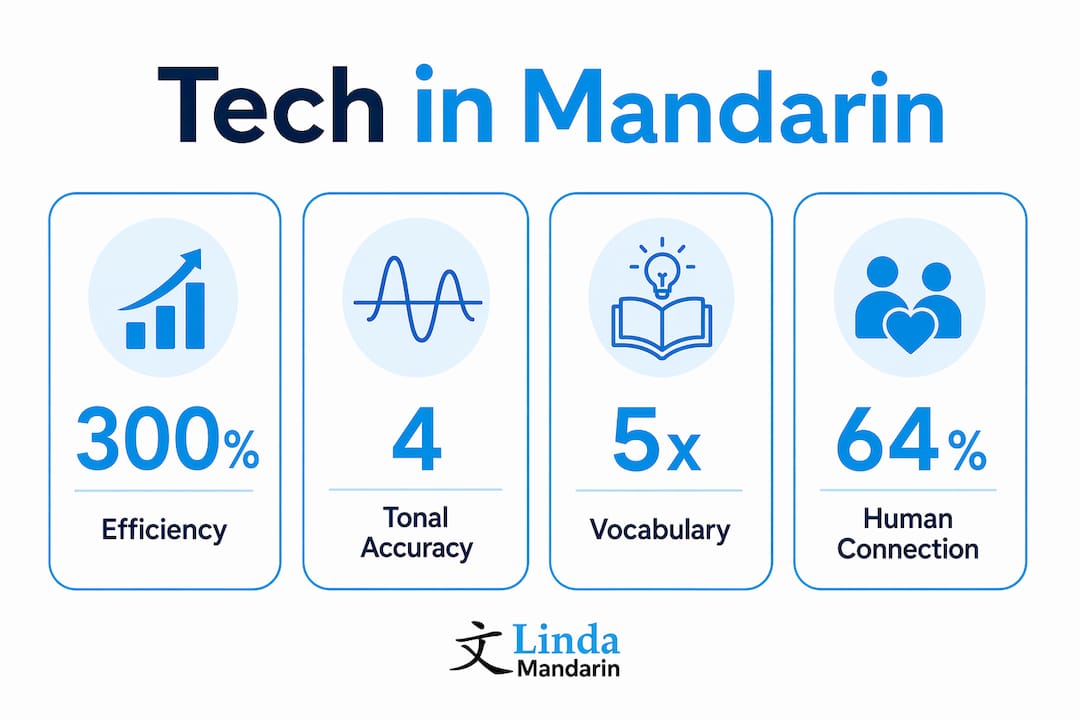
AI-driven tools produce measurable gains in Mandarin proficiency. Learning efficiency improvements of up to 300% have been reported through AI-adapted review plans, with 43.3% of students advancing at least one proficiency level per term. That figure means a learner who would normally need two terms to progress can do it in one, simply by using a smarter review schedule.
What automatic speech recognition does for tonal accuracy
Mandarin has four tones plus a neutral tone. Getting them wrong changes meaning entirely. Automatic Speech Recognition tools provide syllable-level tonal feedback, which goes far beyond a generic fluency score. Apps like Yap! and SureChinese use ASR to flag exactly which syllable is off, giving learners the kind of precision feedback that used to require a one-on-one session with a native speaker.
How multimodal input accelerates vocabulary acquisition
Vocabulary learning sticks better when it arrives through multiple channels at once. Multimodal input combining visual and textual AI explanations significantly improves vocabulary acquisition in Mandarin learners. Tools like HelloChinese and ChatGPT deliver text, audio, and visual context simultaneously, which reinforces word memory more effectively than flashcards alone.
Key AI-powered capabilities that directly improve learning outcomes include:
- Tonal feedback: ASR tools in Yap! and SureChinese flag mispronounced tones at the syllable level.
- Adaptive review: AI schedules character and vocabulary review based on individual error patterns, not a fixed calendar.
- Sentence generation: Large language models like ChatGPT produce contextual example sentences on demand, helping learners see vocabulary in realistic use.
- Character stroke guidance: Apps provide animated stroke-order correction, reducing the guesswork in written Mandarin.
- Engagement tracking: Adaptive platforms adjust difficulty in real time, keeping learners in the productive challenge zone.
Pro Tip: Use ChatGPT to generate five example sentences for every new vocabulary word you learn. Ask it to vary the formality level so you see the word in both conversational and professional contexts.
What affective factors influence technology-assisted Mandarin learning?
Motivation and anxiety matter more than most learners expect. Willingness to communicate, motivation, and speaking anxiety explain over 50% of variance in Mandarin speaking performance, outweighing even technology ease of use. That finding reframes the entire conversation about digital tools. The best app in the world cannot compensate for a learner who is too anxious to speak.
Technology addresses this directly. AI conversational agents reduce situational anxiety during structured speaking tasks by removing the social pressure of a human audience. A learner practicing tones with an AI agent does not fear judgment. That lower-stakes environment builds the confidence needed to eventually speak with native speakers.
AI literacy predicts 45% of variance in learning effectiveness and lowers writing anxiety. Learners who understand how to use AI tools well get more out of them and feel less stressed about written tasks. This is why digital literacy training is not a bonus feature. It is a prerequisite for getting full value from e-learning Mandarin courses.
“AI tools should be used as confidence builders for learners before engaging with native speakers, addressing speaking anxiety and motivation as key performance factors.” — Affective variables in Mandarin speaking performance
The practical sequence matters here. Scaffolded AI practice should come first, followed by structured human interaction, and then open conversation with native speakers. Skipping the middle step leaves learners underprepared. Explore how motivation and anxiety factors shape Mandarin progress to understand why this sequence works.
How does the human-AI synergy redefine instructor and learner roles?
The relationship between teachers and technology in Mandarin education has fundamentally changed. AI shifts teacher roles from content delivery to facilitation, mentoring, and data interpretation. Teachers now spend less time correcting stroke order and more time teaching cultural pragmatics, the kind of nuance no algorithm handles well.
Here is how the division of labor works in practice:
- AI handles repetitive correction. Tonal errors, stroke order, and vocabulary drills are logged and corrected automatically, freeing class time for higher-order communication practice.
- Teachers interpret learning data. Instructors review AI-generated performance reports to identify patterns, such as a learner consistently struggling with third-tone sandhi, and adjust instruction accordingly.
- Human-led sessions focus on cultural nuance. Pragmatic communication, register shifts between formal and informal speech, and culturally appropriate expressions require a human guide.
- Learners take greater ownership. With AI providing on-demand feedback outside class hours, learners practice more frequently and arrive at sessions with specific questions rather than basic errors.
- Digital literacy becomes a core competency. Educators who understand how to design tasks around AI tools produce better learning outcomes than those who simply assign app usage without structure.
Human teachers focus on cultural nuance and pragmatic language use while AI manages repetitive feedback and data analysis. This division is not a threat to teaching. It is an upgrade. Read more about how effective Mandarin teaching methods integrate this kind of structured approach for adult learners.
Pro Tip: If you are an educator, build one AI-assisted homework task per week where learners record themselves speaking and submit the AI feedback report alongside the audio. You get richer data and learners practice more consistently.

What are the best digital tools for Mandarin learners and educators in 2026?
The right tool depends entirely on the skill you are targeting. Technology is most effective when matched to specific micro-skills. Mismatched app use wastes time and produces frustration rather than progress.
| Tool | Primary skill | Feedback type | Adaptability | Best for |
|---|---|---|---|---|
| SureChinese | Vocabulary and reading | AI-adapted review plans | High | Self-study learners |
| Yap! | Speaking and tones | ASR tonal correction | Medium | Pronunciation practice |
| HelloChinese | Vocabulary and grammar | Gamified progression | High | Beginner to intermediate |
| ChatGPT | Writing and conversation | On-demand text feedback | Very high | Advanced learners and educators |
Tools like SureChinese, Yap!, ChatGPT, and HelloChinese each support different Mandarin skills, from vocabulary and pronunciation to communication practice tailored to learner levels. Using one tool for everything is a common mistake. A better approach pairs a pronunciation app with a vocabulary platform and a conversational AI for writing practice.
For adult learners balancing work and study, the most practical setup combines:
- A daily 10-minute session on a vocabulary app like HelloChinese for character review.
- Weekly speaking practice with an ASR tool like Yap! to maintain tonal accuracy.
- Monthly writing tasks submitted to ChatGPT for grammar and register feedback.
- Structured group or private classes, online via Zoom or in person, to practice real communication.
The blended approach works because it covers all four skills without requiring hours of daily study. For a deeper look at combining formats, the guide on blended Mandarin learning for adults covers the practical tradeoffs between online and face-to-face formats.
What challenges exist in technology-assisted Mandarin learning?
AI tools have real limits that learners and educators need to plan around. AI conversational agents are effective for structured practice but fall short for spontaneous, open-ended communication tasks like debates or negotiation. A learner who only practices with AI may develop strong drill performance but struggle in real conversations.
The most common challenges include:
- Lack of communicative authenticity. AI cannot replicate the unpredictability of a real conversation, including interruptions, cultural references, and emotional register.
- Overreliance risk. Excessive AI use risks undermining essential human interaction in language learning. Learners who skip human practice plateau faster.
- Infrastructure gaps. Reliable internet access and device quality affect the usability of interactive Mandarin learning tools, particularly for learners in lower-resource settings.
- Motivation without structure. Apps are easy to abandon. Without a structured routine or accountability, even the best digital tools go unused after the first two weeks.
Pro Tip: Set a non-negotiable weekly check-in with a teacher or study partner. AI tools work best when they feed into a human conversation, not replace it.
The fix is pedagogical design, not more technology. Educators who build AI tasks into a structured curriculum with clear human interaction milestones get far better results than those who treat apps as standalone solutions.
Key takeaways
Technology in Mandarin learning works best when AI handles repetitive skill-building and human instructors lead cultural, communicative, and motivational development.
| Point | Details |
|---|---|
| AI accelerates proficiency | Adaptive review plans improve learning efficiency by up to 300%, advancing learners faster per term. |
| Affective factors dominate outcomes | Motivation and speaking anxiety explain over 50% of performance variance, more than any app feature. |
| Match tools to micro-skills | Use ASR apps for tones, vocabulary platforms for characters, and LLMs for writing practice. |
| Teachers shift roles, not disappear | Instructors focus on cultural nuance and data interpretation while AI manages routine correction. |
| Human interaction remains non-negotiable | Over 64% of learners report concerns about lack of human connection, confirming AI as a co-pilot only. |
What I have learned from watching adults use AI for Mandarin
After observing how adult learners respond to digital tools over many years, one pattern stands out clearly. The learners who progress fastest are not the ones using the most apps. They are the ones who use one or two tools with discipline and then show up to class ready to practice what the AI flagged.
The uncomfortable truth about interactive Mandarin learning tools is that they reveal your weaknesses faster than traditional study. That is genuinely useful. But many learners respond to that feedback by switching apps rather than fixing the problem. The app becomes a comfort zone rather than a challenge.
I have also noticed that over 64% of learners express concern about losing human connection in AI-heavy programs. That concern is valid and worth taking seriously. The learners who thrive in technology-assisted environments are those who treat AI as preparation for human conversation, not a substitute for it. They practice tones with Yap!, then walk into class and use those tones in a real exchange with their instructor.
The future of Mandarin education is not AI versus teachers. It is AI plus teachers, with each doing what they do best. For educators, the priority right now is building digital literacy into your curriculum so learners know how to extract value from these tools, not just download them. For learners, the priority is simple. Use the technology, then go talk to a person.
— Paul
Take your Mandarin further with Linda Mandarin
Linda Mandarin has been delivering professional Mandarin training in Singapore since 2003, and the school’s adult programs are built around exactly the kind of human-AI balance this article describes. Experienced, certified native instructors guide learners through structured curricula that develop real speaking, listening, reading, and writing skills, whether you attend in person at 10 Anson Road, International Plaza, right above Tanjong Pagar MRT, or join via online Zoom classes.
From beginner conversational Mandarin to corporate Mandarin training for professionals, every program is designed for adult learners who need practical results. Explore the full range of adult Mandarin course levels and find the format that fits your schedule and goals.
FAQ
How does technology improve Mandarin speaking skills?
AI tools like Yap! and SureChinese use automatic speech recognition to deliver syllable-level tonal feedback, helping learners correct pronunciation errors faster than traditional classroom practice alone allows.
Can apps replace a Mandarin teacher?
Apps cannot replace a teacher. Over 64% of learners report concerns about losing human connection in AI-heavy programs, and AI agents lack the ability to teach cultural nuance, pragmatic communication, and real conversational unpredictability.
What is the most effective way to use digital tools for Mandarin?
Match each tool to a specific micro-skill: use ASR apps for tonal practice, vocabulary platforms for character learning, and large language models like ChatGPT for writing feedback. Combine these with structured human-led classes for best results.
How does online Mandarin learning compare to face-to-face classes?
Online Zoom classes offer flexibility and access to the same qualified instructors, making them effective for adult learners with busy schedules. Face-to-face classes provide richer real-time interaction, and a blended approach combining both formats tends to produce the strongest outcomes.
Why do affective factors matter in technology-assisted Mandarin learning?
Motivation and speaking anxiety explain over 50% of variance in Mandarin speaking performance, more than any technology feature. AI tools help reduce anxiety by providing low-stakes practice, but learners still need human interaction to build genuine communicative confidence.